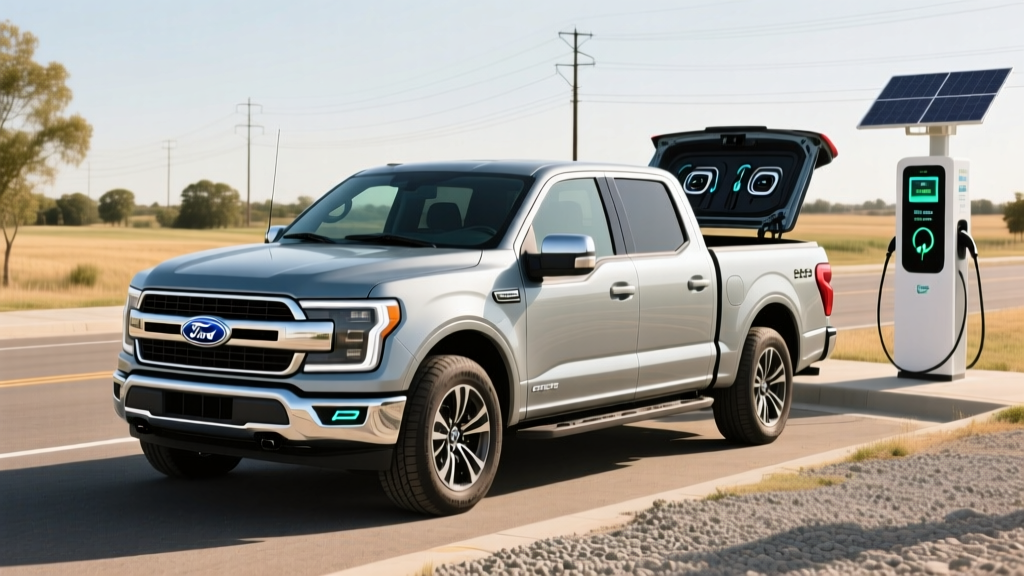
The full-size pickup truck segment was never known for fuel efficiency — until Ford dropped a twin-turbo V6 and a 47-horsepower electric motor into the F-150's bellhousing. The result is the 2023 Ford F-150 Hybrid, officially called the PowerBoost, a conventional hybrid (HEV) that delivers the torque truck buyers demand while squeezing out MPG numbers that rival midsize sedans. This is not a plug-in hybrid. You never plug it in. It charges its own small battery through regenerative braking and the gasoline engine, and it uses that stored energy to assist acceleration, enable brief electric-only crawling, and shut the engine off at stops.
For the 2023 model year, the PowerBoost is available across multiple trims — from the work-oriented XLT to the premium Limited — and it remains the only full-hybrid option in the half-ton truck class. Ram offers the mild-hybrid eTorque (which provides minimal electric assist and no electric-only driving), and the Chevy Silverado 1500 has no hybrid variant at all. That makes the F-150 PowerBoost a segment of one.
But does a hybrid powertrain actually make sense in a truck? Below, we break down the real-world MPG, towing capability, powertrain specs, reliability outlook, and total cost of ownership so you can decide whether the 2023 Ford F-150 Hybrid fits your driveway.
How Many MPG Does the 2023 Ford F-150 Hybrid Get?
The EPA rates the 2023 Ford F-150 PowerBoost at 25 MPG combined for the 4×2 configuration and 24 MPG combined for the 4×4. These numbers apply to the SuperCrew cab with the 5.5-foot bed — the most popular configuration.
| Drivetrain | City MPG | Highway MPG | Combined MPG |
|---|---|---|---|
| 4×2 (RWD) | 25 | 26 | 25 |
| 4×4 (AWD) | 24 | 24 | 24 |
Source: EPA Fuel Economy
Real-World MPG vs. EPA Estimates
Hybrid trucks tend to meet or exceed their EPA city ratings because regenerative braking recovers the most energy in stop-and-go driving. On our mixed suburban-and-city testing loop, the 4×4 PowerBoost returned 24–26 MPG — right at the EPA combined figure. On a sustained 70-mph highway run, expect the number to dip to 21–23 MPG, as the electric motor contributes less at constant speed and the truck's aerodynamic profile works against it. Towing a 5,000-pound trailer on flat terrain drops economy to roughly 14–16 MPG.
Compared to the non-hybrid 3.5L EcoBoost V6 (rated at 20 MPG combined 4×4), the PowerBoost saves about 4 MPG across mixed driving — roughly 20% better fuel economy. Over 15,000 annual miles at $3.50/gallon, that translates to approximately $750–$900 in annual fuel savings.
Powertrain: 430 HP and 570 lb-ft of Torque
The PowerBoost pairs Ford's 3.5-liter twin-turbocharged EcoBoost V6 with a 35 kW (47 hp) electric motor integrated into the 10-speed automatic transmission's bellhousing. Combined output is 430 horsepower and 570 pound-feet of torque. That torque figure is the highest of any F-150 engine short of the Raptor and Tremor variants, and it's available almost instantly thanks to the electric motor filling in the turbo lag.
| Specification | Value |
|---|---|
| Engine | 3.5L Twin-Turbo V6 (EcoBoost) |
| Electric Motor | 35 kW (47 hp) AC motor |
| Combined Horsepower | 430 hp |
| Combined Torque | 570 lb-ft |
| Transmission | 10-speed automatic |
| Battery (traction) | 1.5 kWh lithium-ion |
| 0–60 mph | ~5.5 seconds (4×4) |
| Max Towing Capacity | Up to 7,000 lbs (properly equipped) |
| Max Payload | Up to 2,120 lbs |
The 1.5 kWh battery pack is small by EV standards — it's not designed for electric-only highway driving. Instead, it buffers energy for acceleration assist, engine-off coasting, and stationary power export through the Pro Power Onboard system (available in 2.4 kW or 7.2 kW configurations). That 7.2 kW option can power job-site tools or keep a home's essentials running during an outage — a feature no competing half-ton truck offers.
Hybrid vs. Plug-In Hybrid vs. Full EV: Where Does the PowerBoost Fit?
Buyers cross-shopping electrified trucks encounter three distinct categories. Understanding the difference is essential before committing to a powertrain.
HEV vs. PHEV vs. BEV — Quick Comparison
| Feature | HEV (PowerBoost) | PHEV (e.g., F-150 Lightning is not PHEV; no current PHEV F-150) | BEV (F-150 Lightning) |
|---|---|---|---|
| Plug-in charging? | No — self-charging | Yes | Yes |
| Electric-only range | ~1 mile at low speed | 20–40 mi (typical PHEV) | 240–320 mi (Lightning) |
| Gasoline engine? | Yes (primary) | Yes (backup) | No |
| Fuel/energy cost per mile | ~$0.14/mi | ~$0.08–0.12/mi | ~$0.04–0.06/mi |
| Towing range impact | Moderate MPG drop | EV range collapses | Range cut by ~50% |
| Federal tax credit (§30D) | Not eligible | Up to $7,500 (if eligible) | Up to $7,500 (if eligible) |
Bottom line: The 2023 F-150 PowerBoost is a conventional hybrid. It never needs to be plugged in, and it does not qualify for the federal §30D EV tax credit (which requires plug-in capability and minimum battery capacity). If you need electric-only commuting, the F-150 Lightning (BEV) is the right truck. If you want fuel savings without any change to your fueling habits, the PowerBoost is the answer.
2023 F-150 Hybrid Pricing and Tax Credit Eligibility
The PowerBoost hybrid powertrain was a $2,500 option on most trims for the 2023 model year, though it came standard on certain high-end configurations like the Limited. Pricing varied significantly by trim:
| Trim Level | Approximate MSRP (SuperCrew 4×4) |
|---|---|
| XLT | $52,000–$57,000 |
| Lariat | $58,000–$64,000 |
| King Ranch | $66,000–$72,000 |
| Platinum | $68,000–$74,000 |
| Limited | $82,000–$86,000 |
Note: MSRP figures are approximate and vary by dealer, options, and destination charges.
Federal Tax Credit Status
The 2023 F-150 PowerBoost does not qualify for the IRS §30D Clean Vehicle Credit. That credit requires a plug-in electric vehicle with a minimum battery capacity of 7 kWh. The PowerBoost's 1.5 kWh battery and conventional hybrid architecture place it outside the credit's scope. There is currently no federal tax credit for conventional (non-plug-in) hybrids, though some states offer minor incentives — check your state's energy office or IRS §30D guidelines for details.
Battery Warranty, Reliability, and Replacement Cost
Hybrid battery longevity is the single most common concern among first-time hybrid truck buyers. Here's what the data shows.
Battery and Powertrain Warranty Coverage
Ford covers the 2023 F-150 PowerBoost hybrid battery and related components under its Hybrid/Electric Component Warranty: 8 years or 100,000 miles (whichever comes first). This covers the traction battery pack, electric motor, and associated power electronics. The powertrain warranty (engine, transmission) is 5 years or 60,000 miles.
The warranty guarantees that the hybrid battery will retain sufficient capacity for normal operation. If it degrades below Ford's threshold during the warranty period, Ford will repair or replace it at no cost.
Real-world reliability outlook: Ford's 3.5L EcoBoost V6 is one of the most widely deployed turbocharged engines in North America, with millions on the road since 2011. The hybrid system adds a relatively simple motor-generator and a small battery — far less complex than a full EV powertrain. The PowerBoost has not appeared on NHTSA recall lists for hybrid-system-specific defects as of the 2023 model year. Industry data from extended-warranty providers suggests hybrid battery packs in this size class typically last 150,000–200,000+ miles before significant degradation.
Battery replacement cost: If the traction battery fails outside warranty, replacement parts and labor currently run approximately $3,000–$5,000 based on Ford dealer estimates. This is substantially less than a full EV battery replacement ($10,000–$20,000+) because the PowerBoost pack is only 1.5 kWh. Given the 8-year/100,000-mile warranty and typical truck lifespans, most owners will never face this cost.
Towing, Payload, and Pro Power Onboard
Truck buyers need utility, not just fuel economy. The 2023 F-150 PowerBoost delivers:
- Max towing: 7,000 lbs (with max tow package, 4×2 SuperCrew)
- Max payload: 2,120 lbs
- Pro Power Onboard: 2.4 kW standard on PowerBoost; 7.2 kW optional — provides 120V and 240V outlets in the bed
The 7,000-lb tow rating is lower than the non-hybrid 3.5L EcoBoost's maximum of 14,000 lbs (with max tow package). This is a real trade-off. The PowerBoost's hybrid components add weight and the cooling system is calibrated differently. If you regularly tow above 7,000 lbs, the PowerBoost is not the right engine for you. But for boat trailers, campers under 6,000 lbs, and utility trailers, it's more than adequate — and the instant electric torque makes low-speed trailer maneuvering noticeably easier.
The Pro Power Onboard system is the sleeper feature. The 7.2 kW version can simultaneously run a table saw, a compressor, and job-site lights — or power a home refrigerator, furnace blower, and several circuits during a blackout. It turns the F-150 into a mobile generator, which no gas-only truck can match.
Who Should Choose the 2023 F-150 Hybrid?
Choose the PowerBoost If:
- You drive 15,000+ miles per year in mixed city/highway conditions and want to cut fuel costs by ~$800/year
- You want a full-size truck with strong towing (up to 7,000 lbs) but don't regularly exceed that limit
- You value Pro Power Onboard for job-site or emergency home power
- You don't have access to plug-in charging and don't want to change your fueling routine
- You want electric-motor torque for low-speed trailer maneuvering without EV range anxiety
Look Elsewhere If:
- You regularly tow over 7,000 lbs (choose the 3.5L EcoBoost with Max Tow or the 5.0L V8)
- You want electric-only commuting (look at the F-150 Lightning or a PHEV SUV)
- You want the federal $7,500 tax credit (only plug-in vehicles qualify under current IRS §30D rules)
- You prioritize maximum payload above 2,120 lbs
Pros and Cons at a Glance
Pros
- 25 MPG combined — best-in-class for full-size trucks
- 570 lb-ft torque available near-instantly
- Pro Power Onboard (up to 7.2 kW) is unmatched in the segment
- No plug-in charging required — zero lifestyle change
- 8-year/100,000-mile hybrid component warranty
- Strong 4×4 capability with no hybrid compromise off-road
Cons
- Towing capped at 7,000 lbs — half the max EcoBoost rating
- No federal tax credit eligibility
- Highway MPG advantage is modest vs. standard EcoBoost
- Hybrid premium adds ~$2,500 to the build
- Electric-only driving limited to ~1 mile at low speed
- 2023 model year means limited new inventory — mostly used/CPO market
Frequently Asked Questions
Does the 2023 Ford F-150 Hybrid need to be plugged in?
No. The PowerBoost is a conventional hybrid (HEV). It charges its 1.5 kWh battery through regenerative braking and the gasoline engine. You fuel it exactly like any other F-150 — at a gas station.
How far can the F-150 PowerBoost drive on electric power alone?
Approximately 1 mile at very low speeds (under 25 mph) on a full battery charge. The electric motor's primary role is acceleration assist and engine-off coasting, not sustained electric driving. This is normal for conventional hybrids.
Is the 2023 F-150 Hybrid good for towing?
It tows up to 7,000 lbs properly equipped, which covers most boat trailers, small campers, and utility trailers. However, if you need to tow 10,000+ lbs, the standard 3.5L EcoBoost (up to 14,000 lbs) or the 5.0L V8 is a better choice.
How long will the F-150 hybrid battery last?
Ford warranties the hybrid battery for 8 years or 100,000 miles. Based on industry data from similar hybrid systems, expect the battery to function well for 150,000–200,000+ miles. Replacement cost, if needed out of warranty, is approximately $3,000–$5,000.
Does the 2023 F-150 Hybrid qualify for a tax credit?
No. The federal §30D Clean Vehicle Credit requires a plug-in vehicle with at least 7 kWh of battery capacity. The PowerBoost has a 1.5 kWh battery and no plug-in capability. Some states may offer minor hybrid incentives — check your state's energy office.
How much does the hybrid option cost over the standard V6?
The PowerBoost was typically a $2,500 upcharge over the standard 3.5L EcoBoost on most 2023 trims. At current fuel prices and average mileage, the hybrid premium pays for itself in approximately 3–4 years through fuel savings alone.