Quick Verdict: The Efficiency Bargain of the Compact SUV Class
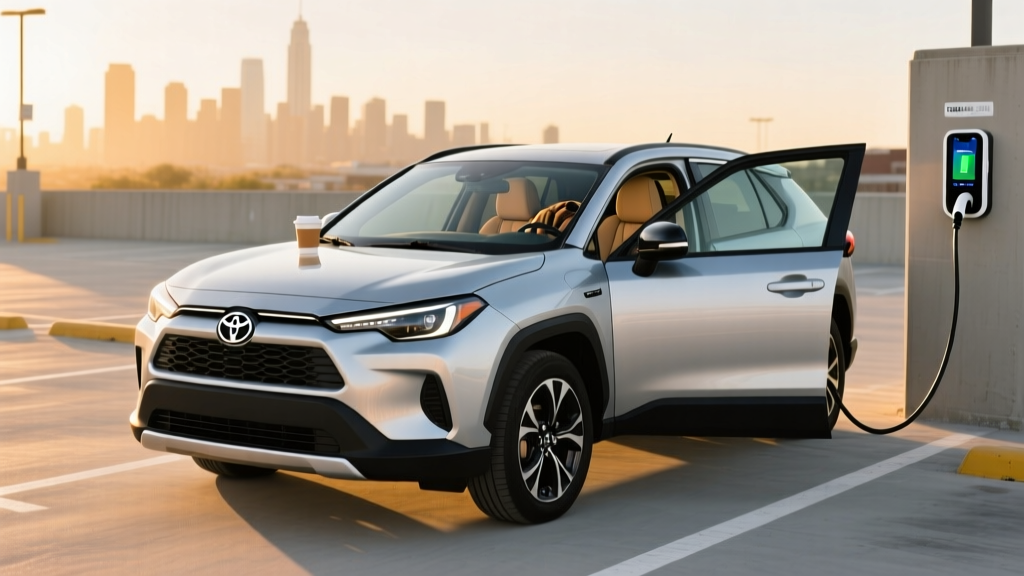
The 2023 Toyota Corolla Cross Hybrid occupies a rare sweet spot in the electrified-vehicle market: it delivers genuine hybrid fuel savings without demanding any change in driver behavior. There is no plug, no range anxiety, and no charging-app frustration. You fill it with gas, and the fifth-generation Toyota Hybrid System silently shaves your fuel bill by roughly 40% compared to the gas-only Corolla Cross.
As of 2026, the Corolla Cross Hybrid remains one of the most fuel-efficient all-wheel-drive compact crossovers available on the used market, and its proven hybrid powertrain carries one of the longest battery warranties in the industry. For buyers weighing a conventional hybrid against a plug-in hybrid (PHEV) or a full battery-electric vehicle (BEV), this model makes a compelling case for simplicity.
HEV vs PHEV: Where the Corolla Cross Hybrid Fits
Before examining specs, it is critical to understand what this vehicle is — and what it is not.
Conventional Hybrid (HEV) — 2023 Corolla Cross Hybrid
- Battery: 1.3 kWh nickel-metal hydride (NiMH), self-charging
- Plug required: No — the gasoline engine and regenerative braking recharge the battery
- Electric-only driving: Short low-speed bursts only (under ~1 mile at parking-lot speeds)
- Fuel source: Gasoline only; no external electricity needed
- Federal tax credit: Not eligible for the §30D new-vehicle credit; may qualify for the Used Clean Vehicle Credit (up to $4,000) on the secondary market
Plug-In Hybrid (PHEV) — e.g., Toyota RAV4 Prime
- Battery: 18.1 kWh lithium-ion, requires plug-in charging
- Plug required: Yes — Level 1 (120V) or Level 2 (240V) charging
- Electric-only driving: Up to 42 miles (EPA) before the gas engine engages
- Fuel source: Electricity + gasoline
- Federal tax credit: Eligible for up to $7,500 under §30D (subject to MSRP, income, and battery-sourcing rules)
The Corolla Cross Hybrid is strictly a conventional HEV. If you want plug-in electric range from Toyota in a similar footprint, the RAV4 Prime (PHEV) or the bZ4X (BEV) are the adjacent options — at significantly higher price points.
Fuel Economy: EPA Ratings and Real-World MPG
The headline number for the 2023 Corolla Cross Hybrid is its EPA-estimated combined fuel economy. Here is the full breakdown from fueleconomy.gov:
| Metric | EPA Estimate | Real-World Expectation |
|---|---|---|
| City MPG | 45 MPG | 44–48 MPG (hybrids often exceed EPA in stop-and-go) |
| Highway MPG | 38 MPG | 35–39 MPG (aerodynamic drag limits hybrid advantage at 70+ mph) |
| Combined MPG | 42 MPG | 39–44 MPG depending on driving mix |
| Fuel Tank Capacity | 10.6 gallons | — |
| Total Driving Range | ~445 miles | ~410–465 miles |
Why real-world city MPG often beats the EPA sticker: Conventional hybrids recapture kinetic energy during braking and use it for low-speed electric-only propulsion. In urban driving with frequent stops, the electric motors do a disproportionate share of the work, pushing actual city economy toward or above 45 MPG. On sustained highway runs at 75 mph, the gasoline engine carries most of the load, and efficiency drops closer to 36–38 MPG.
Cold-weather note: In sub-freezing temperatures, expect a 5–10% reduction in fuel economy. The engine runs more frequently to maintain cabin heat and battery temperature, reducing the electric-motor duty cycle. This is far less dramatic than the 20–30% range loss seen in full BEVs in winter, but it is measurable.
Powertrain: How the Fifth-Generation Hybrid System Works
| Specification | 2023 Corolla Cross Hybrid |
|---|---|
| Engine | 2.0L 4-cylinder Atkinson-cycle |
| Engine Output | 150 hp / 139 lb-ft torque |
| Electric Motors | 2 front + 1 rear (eAWD) |
| Net Combined Horsepower | 196 hp |
| Drivetrain | Electronic AWD (eAWD) — rear motor engages on demand |
| Transmission | Continuously Variable (eCVT) |
| 0–60 mph | ~7.5 seconds (est.) |
| Hybrid Battery | 1.3 kWh NiMH (bipolar) |
| Towing Capacity | Not rated for towing |
The 196 combined horsepower is a meaningful jump over the gas-only Corolla Cross's 169 hp, and it shows in everyday driving. Merging onto highways and climbing grades feel confident rather than strained. The eAWD system uses a dedicated 40 hp rear electric motor that engages automatically when front-wheel slip is detected or during hard acceleration — there is no mechanical driveshaft connecting the axles.
The 2.0L Dynamic Force engine operates on the Atkinson cycle, which sacrifices low-RPM torque for higher thermal efficiency. The electric motors fill in that torque gap instantly, which is why the hybrid feels more responsive than its gas-only sibling despite similar peak numbers.
Battery Warranty, Lifespan, and Replacement Cost
Toyota Hybrid Battery Warranty
- Coverage: 10 years / 150,000 miles (whichever comes first)
- What's covered: Hybrid battery pack, hybrid control module, and related components
- Applies to: 2020+ model year Toyota hybrids (including the 2023 Corolla Cross Hybrid)
- Transferable: Yes — warranty transfers to subsequent owners at no cost
How long do Toyota hybrid batteries actually last? Toyota's NiMH hybrid batteries have an extensive real-world track record. Data from fleet operators and long-term owners of the Prius and Camry Hybrid shows these packs routinely lasting 150,000–200,000+ miles before significant capacity loss. The 1.3 kWh pack in the Corolla Cross Hybrid is small and operates within a narrow state-of-charge window (roughly 40–80%), which is the least stressful operating range for any battery chemistry.
Replacement cost if out of warranty: A new OEM hybrid battery pack for the Corolla Cross Hybrid runs approximately $2,500–$3,500 including installation at a Toyota dealership. Independent hybrid-battery specialists can sometimes refurbish or replace individual cells for $1,200–$2,000. For context, this is dramatically less than a BEV traction battery replacement, which can exceed $10,000–$18,000.
Signs of hybrid battery degradation: Noticeable fuel-economy decline, the engine running more frequently at low speeds, or a dashboard warning light. Most owners will sell or trade the vehicle before the battery requires replacement.
Pricing, Trims, and Tax Credit Eligibility in 2026
The 2023 Corolla Cross Hybrid was offered in three trims. Original MSRP figures (before destination charges):
| Trim | Original MSRP (2023) | Typical Used Price (2026) |
|---|---|---|
| S | $28,395 | $22,000–$25,000 |
| SE | $29,695 | $23,500–$26,500 |
| XSE | $31,405 | $25,000–$28,500 |
Federal Tax Credit Rules (2026)
New-vehicle §30D credit: The Corolla Cross Hybrid does NOT qualify. The federal §30D Clean Vehicle Credit applies only to plug-in electric vehicles (BEVs and PHEVs) with a minimum battery capacity of 7 kWh. The Corolla Cross Hybrid's 1.3 kWh NiMH pack falls far short of this threshold.
Used Clean Vehicle Credit (§25E): If you purchase a 2023 Corolla Cross Hybrid from a licensed dealer in 2026, you may qualify for a credit of 30% of the sale price, up to $4,000. Requirements include:
- Sale price must be $25,000 or less
- Buyer's modified adjusted gross income must not exceed $75,000 (single) / $112,500 (head of household) / $150,000 (joint)
- The vehicle must be at least 2 model years old (a 2023 model qualifies in 2026)
- The credit can be transferred to the dealer at point of sale for an immediate price reduction
- The vehicle must be purchased from a licensed dealer (private-party sales do not qualify)
Practical example: A 2023 Corolla Cross Hybrid S trim listed at $24,000 from a dealer would yield a $4,000 used-vehicle credit (30% of $24,000 = $7,200, capped at $4,000), bringing your effective cost to $20,000 — provided you meet the income requirements. This makes the used Corolla Cross Hybrid one of the most cost-efficient electrified vehicles on the market.
Always verify current credit eligibility with a tax professional or the IRS §25E page, as rules are subject to legislative changes.
Who Should Choose the Corolla Cross Hybrid vs a PHEV or Full EV?
Choose the Corolla Cross Hybrid (HEV) if:
- You cannot install a home Level 2 charger (apartment, street parking, no garage)
- You want zero change to your fueling routine — gas station only
- Your budget is $20,000–$28,000 (used market in 2026)
- You drive a mix of city and highway and want consistent 40+ MPG
- You prioritize long-term reliability and low maintenance cost
- You want AWD for snow/rain without the fuel penalty of a conventional AWD gas SUV
Choose a PHEV (e.g., RAV4 Prime, Tucson PHEV) if:
- You can charge at home (Level 2) and want 30–42 miles of electric-only commuting
- You want to run most daily errands on electricity but keep gas for road trips
- You qualify for the full $7,500 §30D credit on a new purchase
- Your budget is $38,000–$50,000+
Choose a Full EV (e.g., Ioniq 5, Model Y, Equinox EV) if:
- You have reliable home and/or workplace charging
- You want to eliminate gasoline entirely and minimize per-mile fuel cost
- You drive under 300 miles daily and have access to DC fast charging for road trips
- You qualify for the §30D credit and your budget is $35,000–$55,000+
Pros and Cons
Pros
- 42 MPG combined is outstanding for an AWD crossover
- No plug, no charging infrastructure needed
- 196 hp with eAWD is responsive and capable in inclement weather
- 10-year / 150,000-mile hybrid battery warranty is class-leading
- Eligible for up to $4,000 used-vehicle federal credit in 2026
- Toyota Safety Sense 3.0 standard (adaptive cruise, lane-keep, AEB)
- Low cost of ownership — no plug-in equipment, minimal maintenance
Cons
- Not a PHEV — no meaningful electric-only range
- No DC fast charging capability (not applicable to HEVs, but limits electrification benefit)
- Cargo space is slightly reduced vs gas-only model due to hybrid battery placement (~25.5 cu ft behind rear seats)
- eCVT drone under hard acceleration is noticeable
- Infotainment system is functional but dated compared to competitors
- No federal tax credit available on new purchase (HEV exclusion)
- Not rated for towing
Frequently Asked Questions
How many MPG does the 2023 Corolla Cross Hybrid get?
The EPA rates it at 45 city / 38 highway / 42 combined MPG. In real-world driving, most owners report 39–44 MPG combined, with city driving often exceeding the 45 MPG sticker thanks to regenerative braking and electric-only low-speed operation.
Can the Corolla Cross Hybrid drive on electric power only?
Only for very short distances at low speeds — typically under 1 mile at parking-lot speeds (under ~25 mph). This is a conventional hybrid, not a plug-in hybrid. The electric motors assist the gas engine and enable engine-off coasting, but sustained electric-only driving is not possible.
Is the 2023 Corolla Cross Hybrid reliable?
Toyota's hybrid powertrains are among the most proven in the industry, with decades of real-world data from millions of Prius, Camry Hybrid, and RAV4 Hybrid owners. The fifth-generation system in the Corolla Cross uses a bipolar NiMH battery that is less complex and less prone to thermal issues than larger lithium-ion packs. Toyota's NHTSA safety data shows no major powertrain-related recalls for this model.
What does it cost to replace the hybrid battery?
An OEM replacement runs approximately $2,500–$3,500 installed at a Toyota dealer. Third-party refurbishment can reduce this to $1,200–$2,000. However, Toyota hybrid batteries routinely last 150,000–200,000+ miles, and the 10-year/150,000-mile warranty covers the vast majority of ownership periods.
Does the 2023 Corolla Cross Hybrid qualify for any tax credit?
Not the new-vehicle §30D credit (that requires a plug-in vehicle with 7+ kWh). However, on the used market in 2026, buyers meeting income requirements may qualify for the §25E Used Clean Vehicle Credit: 30% of the sale price up to $4,000, provided the purchase price is $25,000 or less and the buyer's income falls under IRS thresholds.
Hybrid vs PHEV vs EV — which should I choose?
It depends on your charging access and budget. If you cannot charge at home, the Corolla Cross Hybrid (HEV) is the most practical electrified option. If you can charge at home and want electric-only commuting, a PHEV like the RAV4 Prime gives you 42 miles of EV range plus gas for road trips. If you want to eliminate gas entirely and have charging access, a full EV like the Hyundai Ioniq 5 or Chevrolet Equinox EV offers the lowest per-mile cost and strongest tax incentives — but requires charging infrastructure.
How does the Corolla Cross Hybrid compare to the gas-only version?
The gas-only 2023 Corolla Cross (2.0L, FWD) is rated at 31 city / 33 highway / 32 combined MPG. The hybrid improves that by roughly 31% combined while adding 27 horsepower and standard AWD. The hybrid costs approximately $2,500–$3,000 more on the used market, but the fuel savings (roughly $400–$600/year at 15,000 miles driven) pay back the premium in 5–7 years depending on local gas prices.