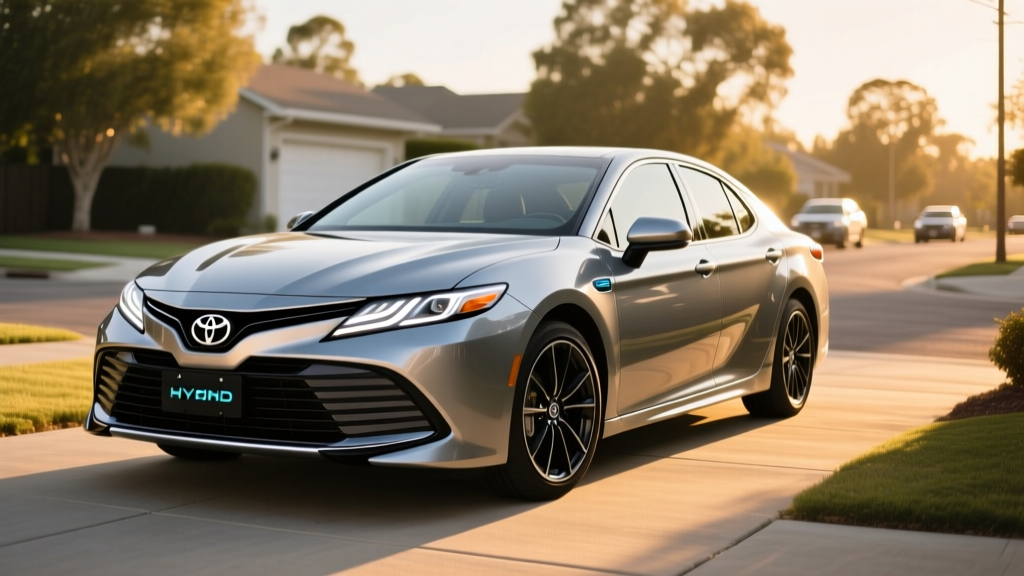
The Toyota Camry has been America's best-selling sedan for most of the last two decades, and the hybrid variant is the version that makes the most sense for the majority of buyers. The 2023 Camry Hybrid pairs a 2.5-liter four-cylinder engine with an electric motor to deliver midsize-sedan space with compact-car fuel economy — no plug required. With the 2025 model year introducing a fully redesigned, hybrid-only Camry lineup, the 2023 model represents the final iteration of Toyota's proven XV70-generation hybrid powertrain. Here's everything you need to know about its efficiency, reliability, and whether it still holds up as a smart buy in the used and certified-pre-owned market.
2023 Camry Hybrid MPG: EPA Ratings and Real-World Results
Fuel economy is the primary reason buyers choose the Camry Hybrid over the gasoline-only version, and the 2023 model delivers strong numbers across the trim range. The EPA rates the front-wheel-drive LE trim highest, while the all-wheel-drive and sportier trims sacrifice a few MPG for added capability and larger wheels.
| Trim | Drivetrain | City MPG | Highway MPG | Combined MPG |
|---|---|---|---|---|
| LE | FWD | 51 | 53 | 52 |
| SE | FWD | 44 | 47 | 46 |
| XLE | FWD | 44 | 47 | 46 |
| XSE | FWD | 44 | 47 | 46 |
| SE | AWD | 44 | 47 | 46 |
| XLE | AWD | 44 | 47 | 46 |
| XSE | AWD | 44 | 47 | 46 |
Source: fueleconomy.gov
Powertrain Specs: Engine, Motor, and Combined Output
The 2023 Camry Hybrid uses Toyota's fourth-generation Hybrid Synergy Drive system. A 2.5-liter Dynamic Force inline-four engine (A25A-FXS) operates on the Atkinson cycle for maximum thermal efficiency, paired with a permanent-magnet synchronous electric motor through an electronically controlled continuously variable transmission (eCVT).
| Specification | Value |
|---|---|
| Engine | 2.5L 4-cyl Atkinson-cycle (A25A-FXS) |
| Engine Power | 176 hp @ 5,700 rpm / 163 lb-ft @ 5,200 rpm |
| Electric Motor (FWD front) | 118 hp / 149 lb-ft |
| AWD Rear Motor | 40 hp / 89 lb-ft (AWD trims only) |
| Net Combined System Output | 208 hp (FWD) / 219 hp (AWD) |
| Transmission | eCVT (planetary gearset) |
| 0–60 mph | ~7.2 seconds (FWD), ~7.0 seconds (AWD) |
| Hybrid Battery | 1.6 kWh (245V), lithium-ion |
| Fuel Tank | 13.2 gallons |
| Total Driving Range (LE) | ~686 miles (EPA combined) |
The AWD system is worth noting: unlike a traditional mechanical AWD setup, the Camry Hybrid AWD uses a separate rear-mounted electric motor that engages automatically when slip is detected or during hard acceleration. There's no driveshaft connecting the front and rear axles. This system adds approximately 165 pounds and reduces fuel economy slightly compared to FWD, but it provides genuine all-weather traction without the efficiency penalty of a conventional AWD sedan.
This Is a Conventional Hybrid (HEV), Not a Plug-In
The 2023 Camry Hybrid is a conventional hybrid electric vehicle (HEV). It charges its small 1.6 kWh battery through regenerative braking and the gasoline engine — you never plug it in. Toyota did offer a Camry Hybrid-based plug-in variant in certain Asian markets, but the U.S.-spec 2023 Camry Hybrid has no plug, no electric-only driving mode beyond low-speed creep (~0.5 miles at under 25 mph), and no external charging port.
If you want a Toyota midsize sedan with plug-in capability and electric-only range, the closest alternative in the 2023 lineup was the RAV4 Prime (a PHEV SUV with 42 miles of electric-only range and a 18.1 kWh battery). Toyota does not currently sell a Camry PHEV in the United States.
| Factor | HEV (Camry Hybrid) | PHEV (e.g., RAV4 Prime) | BEV (e.g., Tesla Model 3) |
|---|---|---|---|
| Plug-in required? | No | Yes (for EV range) | Yes (always) |
| Electric-only range | ~0.5 mi (low-speed creep) | 25–42 mi typical | 250–360 mi typical |
| Home charging needed? | No | Recommended (Level 2) | Essential (Level 2) |
| Gasoline use | Always blended | After EV range depleted | None |
| Federal tax credit (§30D) | Not eligible | Eligible (if sourcing/income rules met) | Eligible (if sourcing/income rules met) |
| Best for | No home charging, long commutes | Short EV commutes + road trips | Home charging + under 300-mi trips |
Pricing, Trims, and Tax Credit Eligibility
When new, the 2023 Camry Hybrid started at an MSRP of approximately $28,555 (LE trim, including destination) and topped out around $36,195 for the XSE AWD with available packages. Here's the original pricing structure:
| Trim | Drivetrain | MSRP (incl. destination) |
|---|---|---|
| LE | FWD | $28,555 |
| SE | FWD | $30,090 |
| SE Nightshade | FWD | $31,090 |
| XLE | FWD | $33,090 |
| XSE | FWD | $33,690 |
| SE | AWD | $31,490 |
| XLE | AWD | $34,490 |
| XSE | AWD | $35,090 |
On the used market in 2026, certified pre-owned (CPO) 2023 Camry Hybrids typically list between $24,000 and $31,000 depending on trim, mileage, and condition. The used-EV tax credit (up to $4,000 under §25E) also does not apply, as it too requires a plug-in vehicle.
Battery Warranty, Lifespan, and Replacement Cost
Hybrid battery longevity is consistently the top concern among first-time hybrid buyers. Toyota addresses this with one of the strongest hybrid battery warranties in the industry.
- Hybrid Battery: 10 years / 150,000 miles (whichever comes first)
- Hybrid System Components: 8 years / 100,000 miles (inverter, transaxle, control module)
- Powertrain: 5 years / 60,000 miles (engine, transmission)
- Basic (bumper-to-bumper): 3 years / 36,000 miles
Toyota extended its hybrid battery warranty from 8 years/100,000 miles to 10 years/150,000 miles starting with the 2020 model year, so the 2023 Camry Hybrid carries the longer coverage.
Real-world battery lifespan: Toyota's nickel-metal-hydride and lithium-ion hybrid batteries have an exceptional track record. Data from fleet operators and long-term owners suggests that Camry Hybrid batteries routinely last 150,000–200,000+ miles before significant degradation. The Prius, which uses a similar system, has documented cases of original batteries exceeding 300,000 miles.
Replacement cost if out of warranty: A new OEM hybrid battery from Toyota currently costs approximately $2,500–$3,500 (parts only). With dealer labor, expect a total of $3,500–$5,000. Third-party reconditioned or refurbished batteries are available for $1,500–$2,500 installed. Individual cell-module replacement (only the degraded modules) can bring costs down to $800–$1,500 at a specialist hybrid shop.
Reliability, Safety, and Ownership Costs
The 2023 Camry Hybrid benefits from Toyota's reputation for long-term reliability and the inherent simplicity of its hybrid system. The eCVT has no traditional belts, clutches, or gear shifts — it's a planetary gearset that's essentially bulletproof under normal use. Brake pad life is extended significantly (often 80,000–100,000 miles) thanks to regenerative braking handling most deceleration.
Safety ratings: The 2023 Camry earned the IIHS Top Safety Pick+ designation, the highest rating from the Insurance Institute for Highway Safety. It received a "Good" rating in all crashworthiness tests. Standard Toyota Safety Sense 2.5+ includes pre-collision braking with pedestrian detection, full-speed adaptive cruise control, lane departure alert with steering assist, lane tracing assist, and automatic high beams.
5-year estimated ownership costs: Based on 15,000 miles/year at $3.40/gallon regular unleaded and the LE trim's 52 MPG combined, annual fuel cost runs approximately $980. Compare that to a non-hybrid 2023 Camry (28/39 MPG, ~32 combined) at roughly $1,595/year — a savings of about $615 annually, or $3,075 over five years. Maintenance costs are modest: oil changes every 10,000 miles, no transmission fluid service intervals under normal use, and extended brake life.
Who Should Buy the 2023 Camry Hybrid?
✓ Choose the Camry Hybrid If:
- You want 50+ MPG without changing your driving or fueling habits
- You don't have access to home or workplace charging
- You regularly drive 400+ miles between fill-ups
- You want low running costs with minimal maintenance
- You value strong resale value and proven long-term reliability
- You live in an area with extreme cold where EV range loss is a concern
✗ Look Elsewhere If:
- You want electric-only commuting (consider a PHEV like the RAV4 Prime)
- You want to eliminate gasoline entirely (consider a BEV like the Model 3 or Ioniq 6)
- You want access to HOV lanes (EV/PHEV-only in most states)
- You want the latest infotainment and driver-assist tech (the 2025+ redesign or a BEV offers more)
- You want federal tax credits for your purchase
Frequently Asked Questions
How many MPG does the 2023 Camry Hybrid get?
The EPA rates the FWD LE trim at 51 city / 53 highway / 52 combined MPG. Sportier trims (SE, XLE, XSE) and AWD models are rated at 44 city / 47 highway / 46 combined. In real-world city driving, many owners exceed the EPA estimate by 2–4 MPG, while sustained highway driving at 75+ MPH typically returns 42–48 MPG.
Does the 2023 Camry Hybrid need to be plugged in?
No. The 2023 Camry Hybrid is a conventional hybrid (HEV). Its 1.6 kWh battery charges exclusively through regenerative braking and the gasoline engine. There is no plug, no charging port, and no need for any external power source. You fuel it like a normal car at any gas station.
How far can the 2023 Camry Hybrid drive on electric power alone?
Essentially zero meaningful distance. Under very specific conditions (full battery, low speed under 25 mph, gentle throttle), the Camry Hybrid can creep roughly 0.3–0.5 miles on electric power before the engine engages. This is not a usable electric-only mode — it's a byproduct of the hybrid system's start-stop operation. If electric-only commuting is a priority, you need a PHEV or BEV.
Is the 2023 Camry Hybrid reliable?
Yes. Toyota's Hybrid Synergy Drive is one of the most thoroughly proven powertrains in the automotive industry, with over 25 years of continuous refinement since the original 1997 Prius. The eCVT has no friction bands or clutches to wear out. The hybrid battery is warranted for 10 years/150,000 miles. Long-term data from taxi fleets and high-mileage owners consistently shows these systems lasting 200,000+ miles with basic maintenance.
What does a Camry Hybrid battery replacement cost?
A new OEM Toyota hybrid battery costs approximately $3,500–$5,000 installed at a dealership. Refurbished or reconditioned batteries from third-party suppliers run $1,500–$2,500 installed. Individual cell-module replacement at a hybrid specialist can cost as little as $800–$1,500. However, given the 10-year/150,000-mile warranty and the battery's proven longevity, most owners will never need a replacement.
Does the 2023 Camry Hybrid qualify for any tax credits?
No. The federal §30D Clean Vehicle Credit and the §25E Used Clean Vehicle Credit both require a vehicle to be a plug-in electric vehicle (PHEV or BEV) with a minimum battery capacity. The Camry Hybrid's 1.6 kWh non-plug-in battery does not qualify. There is currently no federal tax incentive for conventional hybrids. Check your state's energy office for any local efficiency-based incentives, as these vary by jurisdiction.
Camry Hybrid vs. RAV4 Prime: which is better?
They serve different needs. The Camry Hybrid delivers 52 MPG combined with no plug, at a lower purchase price (~$28,500 new MSRP). The RAV4 Prime is a PHEV with 42 miles of electric-only range, 94 MPGe when charged, and qualifies for potential federal tax credits — but starts around $43,000 and requires home charging to realize its efficiency advantage. If you have home charging and a short commute, the RAV4 Prime can run months without using gas. If you lack charging access or want simplicity and lower cost, the Camry Hybrid wins.
For official EPA fuel economy data, visit fueleconomy.gov. For federal tax credit rules, consult the IRS Clean Vehicle Credits page. Safety ratings available at IIHS.org.