Quick Verdict: The 2023 Accord Hybrid Sport in 2026
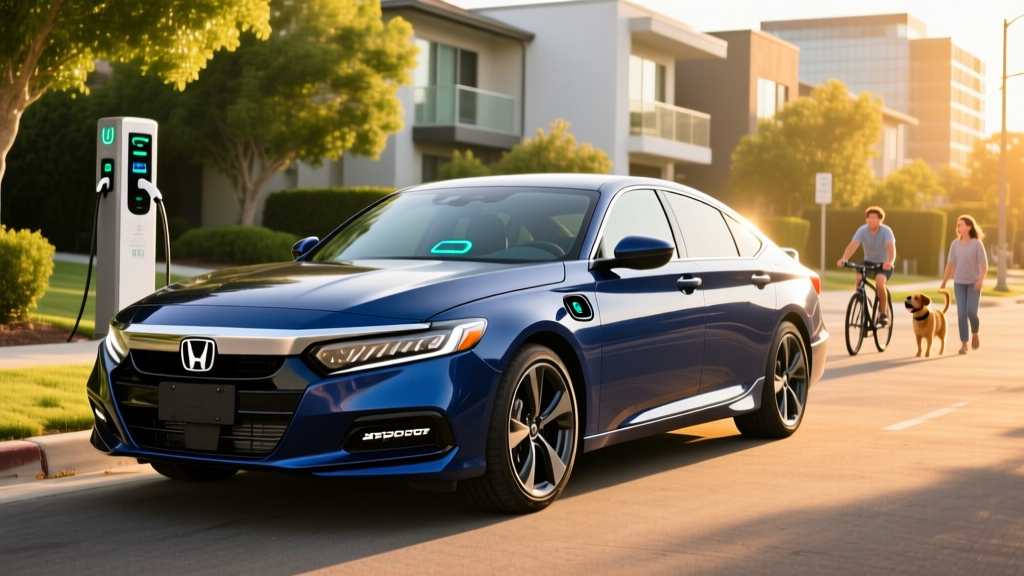
Three years after its debut, the 2023 Honda Accord Hybrid Sport remains one of the most compelling midsize hybrid sedans on the used market. With an EPA-rated 46 MPG combined, a proven two-motor hybrid powertrain producing 204 combined horsepower, and Honda's 8-year/100,000-mile hybrid battery warranty, it offers a low-risk entry into electrified driving without the charging logistics of a plug-in hybrid or full EV.
As of early 2026, used examples typically list between $23,000 and $29,000 depending on mileage and condition. The Sport trim sits mid-range in the hybrid lineup, adding sport-tuned suspension, 19-inch wheels, and paddle shifters that let you modulate regenerative braking — features that distinguish it from the more comfort-oriented EX-L and Touring hybrids.
EPA Fuel Economy vs. Real-World MPG
| Cycle | EPA Rating | Real-World Expectation |
|---|---|---|
| City | 46 MPG | 44–50 MPG (hybrids often beat EPA in stop-and-go) |
| Highway | 41 MPG | 37–42 MPG (sustained 75+ mph reduces hybrid advantage) |
| Combined | 44 MPG | 40–46 MPG depending on driving mix |
Source: EPA fueleconomy.gov
The Accord Hybrid uses Honda's fourth-generation two-motor hybrid system, which operates primarily as a series hybrid at lower speeds — the gasoline engine acts as a generator while the electric drive motor propels the wheels. At highway cruising speeds, a lock-up clutch connects the engine directly to the wheels for efficiency. This architecture explains why the city MPG matches or exceeds the highway figure: regenerative braking recovers energy in stop-and-go traffic that a conventional car wastes as heat.
In real-world driving, owners who commute primarily in urban and suburban conditions regularly report 45–50 MPG. Highway-heavy drivers should expect closer to 38–41 MPG, especially at speeds above 70 mph where aerodynamic drag dominates. Cold weather (below 40°F) typically reduces fuel economy by 5–10% due to increased engine run time for cabin heating and reduced battery efficiency.
Hybrid vs. Plug-In Hybrid vs. Full EV: Where the Accord Hybrid Fits
HEV vs. PHEV — Key Distinction
Conventional Hybrid (HEV): The 2023 Accord Hybrid is a self-charging hybrid. It has a small 1.06 kWh lithium-ion battery that charges through regenerative braking and the gasoline engine. You never plug it in. It cannot drive on electric power alone for meaningful distances.
Plug-In Hybrid (PHEV): Vehicles like the Toyota Prius Prime or Chrysler Pacifica Hybrid have larger batteries (typically 10–20 kWh) that provide 25–45 miles of electric-only range and require plug-in charging to realize their efficiency advantage. Honda does not currently offer an Accord PHEV in the US market.
| Factor | HEV (Accord Hybrid) | PHEV | Full EV (BEV) |
|---|---|---|---|
| Plug-in required? | No | Yes (to get EV range) | Yes |
| Electric-only range | ~1 mile at low speed | 25–45 miles | 200–400 miles |
| Home charging setup | Not needed | Level 2 recommended | Level 2 essential |
| Fuel cost per mile | ~$0.09 (at $3.50/gal) | $0.04–0.10 depending on mix | $0.03–0.06 (home charging) |
| Upfront cost premium | +$1,000–$2,000 vs gas | +$4,000–$8,000 vs gas | +$5,000–$15,000 vs gas |
| Tax credit eligible? | No | Yes, up to $7,500 (§30D) | Yes, up to $7,500 (§30D) |
| Best for | No home charging access; long highway trips | Short commute + occasional road trips | Home charging + mostly under 250 mi/day |
Powertrain Specifications
| Specification | Value |
|---|---|
| Engine | 2.0L Atkinson-cycle 4-cylinder |
| Engine output | 146 hp @ 6,100 rpm / 134 lb-ft torque |
| Drive motor output | 181 hp / 247 lb-ft torque |
| Combined system output | 204 hp |
| Hybrid battery | 1.06 kWh lithium-ion (NMC chemistry) |
| Transmission | Electronic CVT (e-CVT, no traditional gears) |
| Drivetrain | Front-wheel drive |
| 0–60 mph | ~7.2 seconds |
| Curb weight | ~3,477 lbs |
The 204 combined horsepower figure can confuse shoppers: Honda's system doesn't simply add engine and motor outputs together because peak outputs occur at different RPMs. The electric drive motor delivers its full 247 lb-ft of torque from 0 rpm, which gives the Accord Hybrid Sport responsive off-the-line acceleration that belies its four-cylinder engine. The Sport trim's paddle shifters adjust four levels of regenerative braking intensity, letting you capture more energy on deceleration without touching the brake pedal.
Battery Longevity, Warranty, and Replacement Cost
Hybrid Battery Warranty
Federal emissions warranty: 8 years / 100,000 miles (mandatory minimum in all 50 states).
CARB states: 10 years / 150,000 miles in California and states that follow CARB emissions standards (including NY, MA, WA, OR, CO, and others).
What's covered: If the hybrid battery pack drops below approximately 60–70% of original capacity or fails functionally, Honda replaces or reconditions it at no cost during the warranty period.
Hybrid battery degradation is a top concern for used buyers, but the data is reassuring. Honda's two-motor system uses a relatively small 1.06 kWh battery that operates in a narrow state-of-charge window (roughly 30–70%), which dramatically reduces stress on the cells compared to a full EV battery that cycles from 10–90%. Most Accord Hybrid batteries from earlier generations (2014–2022) show minimal measurable degradation even at 150,000+ miles.
If replacement is needed outside of warranty, a refurbished hybrid battery pack typically costs $2,000–$3,500 installed at an independent hybrid specialist. A new OEM pack from Honda runs approximately $3,500–$5,000 including labor at a dealership. This is far less than EV traction battery replacements, which can exceed $10,000–$20,000, because the hybrid pack stores only ~1 kWh versus 60–100 kWh in a BEV.
Pricing, Tax Credits, and Total Ownership Cost
The 2023 Accord Hybrid Sport originally carried an MSRP of $32,990 (including destination). As of early 2026, used-market pricing for examples with 20,000–50,000 miles typically falls in the $23,000–$28,000 range, making it one of the more accessible midsize hybrid sedans.
Federal Tax Credit Eligibility
The 2023 Accord Hybrid Sport does NOT qualify for the federal §30D new clean vehicle credit. Under IRS rules, conventional hybrids (HEVs) are ineligible — only plug-in hybrids (PHEVs) and battery electric vehicles (BEVs) with at least 7 kWh of battery capacity can qualify. The Accord Hybrid's 1.06 kWh battery falls far below this threshold.
If purchasing used in 2026, the used clean vehicle credit (up to $4,000 or 30% of sale price) also applies only to PHEVs and BEVs, not conventional hybrids.
Some states offer separate incentives for hybrids, but these are increasingly rare as programs shift focus to plug-in vehicles. Check your state's energy office or DMV for current programs.
| Cost Category | 2023 Accord Hybrid Sport | 2023 Accord 1.5T (Gas) |
|---|---|---|
| Purchase price (used, 2026) | $25,500 (avg) | $22,000 (avg) |
| Fuel (75,000 mi, $3.50/gal) | $5,707 (44 MPG) | $8,036 (32.5 MPG) |
| Insurance (5-yr avg) | $7,200 | $6,800 |
| Maintenance (5-yr est.) | $2,800 | $3,200 |
| Estimated depreciation | $9,000 | $8,500 |
| 5-year total | $50,207 | $48,536 |
| Fuel savings vs. gas | $2,329 over 5 years | |
The fuel savings of roughly $465/year narrow the hybrid's price premium but don't fully eliminate it over five years. The financial case strengthens significantly if gas prices rise above $4/gallon or if you drive more than 15,000 miles annually. The hybrid also benefits from reduced brake wear (regenerative braking extends pad life to 80,000+ miles in many cases) and slightly lower engine wear since the Atkinson-cycle engine runs fewer hours per mile than a conventional powertrain.
Reliability and Safety Ratings
Honda's hybrid powertrain has accumulated over a decade of real-world service across the Accord, CR-V, and Insight nameplates. The fourth-generation two-motor system in the 2023 Accord is simpler than a traditional automatic transmission — it has no multi-speed gearbox, torque converter, or clutch packs that wear out. The e-CVT is essentially two motor-generators and a planetary gearset with far fewer moving parts than an 8- or 10-speed automatic.
The 2023 Accord earned the IIHS Top Safety Pick+ rating, the organization's highest honor, with Good ratings across all crashworthiness tests. NHTSA awarded it a 5-star overall safety rating. Honda Sensing — the brand's ADAS suite including adaptive cruise control, lane-keeping assist, and automatic emergency braking — is standard on all trims. Note that Honda Sensing is an SAE Level 2 driver-assistance system: you must keep your hands on the wheel and remain fully engaged at all times.
Pros, Cons, and Who Should Choose This Hybrid
Pros
- 46 MPG combined EPA — real-world 40–50 MPG
- No plug-in charging required — works with existing routine
- Proven hybrid system with 8-yr/100k-mile battery warranty
- 204 hp with instant electric torque feels quicker than specs suggest
- IIHS Top Safety Pick+ with standard Honda Sensing ADAS
- Spacious midsize cabin with 16.7 cu-ft trunk (hybrid battery under rear seats)
Cons
- No federal or state tax credits (HEV ineligible under §30D)
- Highway MPG (41 EPA) trails city (46 EPA) — less benefit on long road trips
- Only ~1 mile electric-only — no zero-emission neighborhood driving
- Sport trim's 19-inch wheels produce a firmer ride than EX-L/Touring
- Used prices still carry a hybrid premium over gas Accord equivalents
- FWD only — no AWD option for snow-belt buyers
Decision Framework
Choose the 2023 Accord Hybrid Sport if: You lack home charging access (apartment, street parking), drive 12,000+ miles/year with significant city/suburban commuting, want a midsize sedan with strong safety ratings, and prefer to avoid the complexity of plug-in charging.
Consider a PHEV instead if: You can install a Level 2 home charger, your daily commute is under 35 miles round-trip, and you want to drive mostly on electricity while keeping a gas engine for road trips. Look at the Toyota Prius Prime (44 miles EV range) or Hyundai Tucson PHEV (33 miles EV range).
Consider a full EV instead if: You have reliable home charging, your daily driving is under 250 miles, you want to eliminate gasoline entirely, and you qualify for the $7,500 federal tax credit on a new BEV. The Hyundai Ioniq 6 (361 miles EPA) or Tesla Model 3 (341 miles EPA) are strong sedan alternatives.
Frequently Asked Questions
How many MPG does the 2023 Accord Hybrid Sport get?
The EPA rates it at 46 MPG city, 41 MPG highway, and 44 MPG combined. In real-world driving, expect 40–46 MPG combined depending on your driving mix. City-heavy commuters often see 45–50 MPG thanks to regenerative braking, while sustained highway driving at 75+ mph typically yields 37–41 MPG.
Does the Accord Hybrid need to be plugged in?
No. The 2023 Accord Hybrid is a conventional hybrid (HEV), not a plug-in hybrid. Its 1.06 kWh battery charges entirely through regenerative braking and the onboard gasoline engine. You fuel it like any other car — just with fewer fill-ups.
Is the hybrid battery reliable and what does replacement cost?
Honda's hybrid batteries have a strong reliability track record across two decades of production. The battery is covered by an 8-year/100,000-mile warranty nationwide (10 years/150,000 miles in CARB states). Out-of-warranty replacement costs $2,000–$3,500 for a refurbished pack or $3,500–$5,000 for a new OEM pack. Most batteries last well beyond 150,000 miles with minimal degradation due to the narrow state-of-charge operating window.
Does the 2023 Accord Hybrid qualify for any tax credit?
No. Under IRS §30D rules, only plug-in hybrids (PHEVs) with at least 7 kWh of battery capacity and battery electric vehicles (BEVs) qualify for the federal clean vehicle credit. The Accord Hybrid's 1.06 kWh battery disqualifies it. The used-vehicle credit (up to $4,000) also excludes conventional hybrids. Check your state energy office for any local hybrid incentives, though these are increasingly uncommon.
How does the Accord Hybrid compare to a full EV for daily commuting?
For a 20-mile round-trip commute, a full EV like the Tesla Model 3 would cost roughly $0.50–$1.00 in electricity versus $1.50–$2.00 in gasoline for the Accord Hybrid. However, the EV requires home charging infrastructure ($500–$2,000 installation), a higher upfront purchase price, and acceptance of range limitations on road trips. The Accord Hybrid offers about 525 miles of total range on a single tank with zero charging logistics — a practical advantage for apartment dwellers or frequent road trippers.