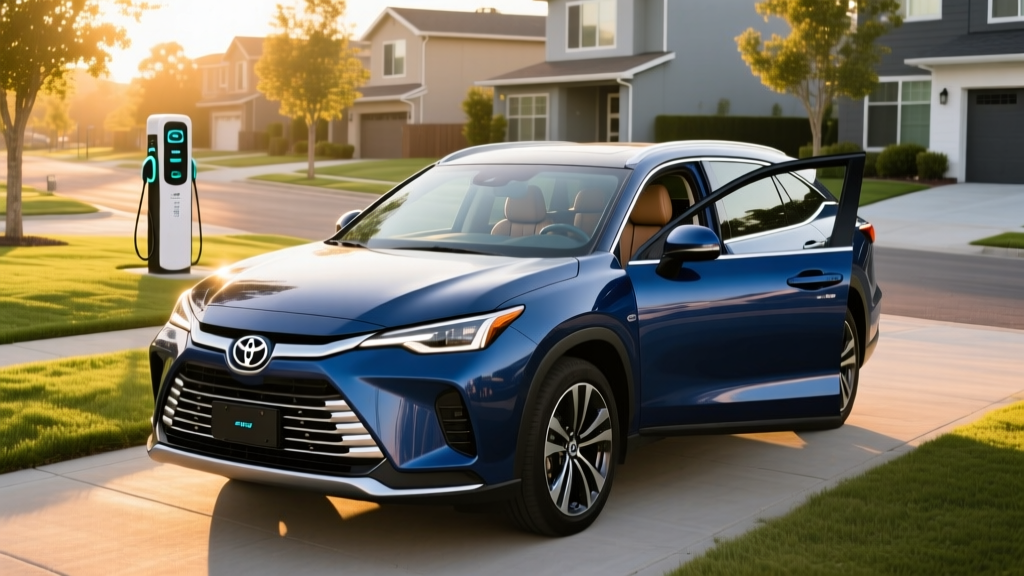
The midsize hybrid SUV segment is crowded, but the 2022 Toyota Venza hybrid carved out a specific niche: a premium-feeling, all-wheel-drive crossover that prioritizes efficiency over cargo space and outright performance. Now that this model year has settled into the used market, it's worth examining whether its 40 MPG EPA combined rating holds up in daily driving, what the hybrid battery warranty actually covers, and how it stacks up against both plug-in hybrids and full battery-electric vehicles for today's buyers.
Toyota discontinued the Venza after the 2024 model year, replacing its role in the lineup with the redesigned Crown Signia. That means if you're shopping for a 2022 Venza hybrid today, you're looking at the used and certified pre-owned market — which actually makes its value proposition more interesting, not less.
HEV vs PHEV: What the Venza Actually Is
Before diving into specs, it's critical to establish exactly what the 2022 Venza is and isn't. The Venza is a conventional hybrid electric vehicle (HEV). It does not have a plug. You cannot charge it from a wall outlet or public charger. The vehicle recovers energy through regenerative braking and its gasoline engine to keep a small traction battery charged automatically.
| Feature | HEV (Venza) | PHEV (e.g., RAV4 Prime) | BEV (e.g., bZ4X) |
|---|---|---|---|
| Plug-in charging | No | Yes | Yes |
| Electric-only range | ~1 mi (low-speed) | 42 mi (RAV4 Prime) | 222-252 mi (bZ4X) |
| Gas engine | Yes (2.5L I4) | Yes (2.5L I4) | None |
| Federal tax credit (§30D) | No | Up to $7,500* | Up to $7,500* |
| Home charging needed | No | Recommended | Essential |
| Battery size | 1.6 kWh (NiMH) | 18.1 kWh (Li-ion) | 71.4 kWh (Li-ion) |
*§30D credit eligibility depends on MSRP caps, buyer income limits, battery sourcing requirements, and point-of-sale transfer rules. See IRS guidelines for current-year details. The used Venza does not qualify for the new-vehicle credit but may qualify for the used clean vehicle credit (up to $4,000) if purchased from a dealer and meeting income/price thresholds.
This distinction matters because many shoppers confuse the Venza with the RAV4 Prime, Toyota's plug-in hybrid. The RAV4 Prime offers 42 miles of electric-only driving and qualifies for federal incentives when bought new. The Venza offers neither — but it also requires zero behavioral change from a gas-car owner. You just fill it with gas and drive.
Fuel Economy: EPA Ratings and Real-World MPG
The 2022 Toyota Venza hybrid carries a single powertrain configuration across all three trims (LE, XLE, Limited), and every one comes with electronic on-demand all-wheel drive as standard. The EPA rates it identically regardless of trim:
| Driving Cycle | EPA Rating | Real-World Expectation |
|---|---|---|
| City | 40 MPG | 38-44 MPG |
| Highway | 37 MPG | 33-37 MPG |
| Combined | 39 MPG | 36-40 MPG |
Source: fueleconomy.gov
Like most Toyota hybrids, the Venza tends to exceed its EPA city rating in stop-and-go driving, where regenerative braking recaptures the most energy. Owners who do predominantly urban commuting regularly report 41-44 MPG on the trip computer. Highway driving is where the Venza gives back some efficiency — at sustained 75-80 mph speeds, expect closer to 33-35 MPG, particularly with roof rails or in headwinds.
Cold weather impacts hybrid efficiency less dramatically than it does full EVs, but you'll still see a dip. In temperatures below 35°F, the engine runs more frequently to provide cabin heat (the Venza uses engine waste heat rather than a heat pump for heating), which can drop observed fuel economy to 34-36 MPG combined until the system reaches operating temperature. Over a full winter, most owners report a 5-8% seasonal reduction.
Powertrain and Performance Specs
| Specification | 2022 Toyota Venza Hybrid |
|---|---|
| Engine | 2.5L 4-cylinder (176 hp, 163 lb-ft) |
| Front electric motor | 88 kW (118 hp) |
| Rear electric motor | 40 kW (54 hp) |
| Net combined horsepower | 219 hp |
| Transmission | eCVT (planetary gearset) |
| Drivetrain | Electronic on-demand AWD (standard) |
| 0-60 mph | 7.6 seconds |
| Hybrid battery | 1.6 kWh, Nickel-Metal Hydride (NiMH) |
| Towing capacity | Not rated for towing |
| Curb weight | 3,900-4,100 lbs (trim dependent) |
The 219 combined horsepower figure comes from Toyota's Hybrid Synergy Drive system, which blends the gasoline engine and electric motors through a planetary gearset rather than a traditional transmission. The rear axle is driven entirely by the 40 kW electric motor — there's no mechanical driveshaft connecting the engine to the rear wheels. This "electronic AWD" engages automatically when the system detects slip, but it's designed for traction in rain and light snow, not off-road use.
The 7.6-second 0-60 time puts the Venza squarely in "adequate but not quick" territory. It's slower than the RAV4 Hybrid (7.4 sec) and notably slower than the RAV4 Prime (5.7 sec), but acceleration from a stop is responsive thanks to instant electric motor torque. Highway passing power is acceptable but requires the engine to rev noticeably — this isn't a vehicle that surges forward at 70 mph.
Battery Warranty, Lifespan, and Replacement Cost
2022 Venza Hybrid Battery Coverage
- Hybrid battery warranty: 10 years / 150,000 miles (whichever comes first) — applies in all 50 states for 2020+ model year Toyotas
- Hybrid system components: 8 years / 100,000 miles (inverter, converter, control module)
- Battery chemistry: Nickel-Metal Hydride (NiMH) — proven, durable, lower energy density than lithium-ion
- Replacement cost (out of warranty): $2,000-$3,500 for a new OEM battery pack; $800-$1,500 for a refurbished unit
Toyota's switch to a 10-year/150,000-mile hybrid battery warranty starting with the 2020 model year was a significant move, and it applies to the 2022 Venza. This is transferable to subsequent owners, which matters for used-car buyers. The NiMH chemistry Toyota uses in its conventional hybrids is less energy-dense than lithium-ion but has an exceptionally long track record — the Prius has used similar cells for over two decades with demonstrated longevity well past 200,000 miles.
Real-world hybrid battery failures in modern Toyotas are uncommon before 150,000 miles. When they do occur outside warranty, the cost is far lower than EV battery replacement. A new OEM NiMH pack for the Venza runs approximately $2,000-$3,500 installed at a dealer, while refurbished packs from independent hybrid specialists cost $800-$1,500. For context, replacing a BEV traction battery can cost $10,000-$20,000+.
The smaller 12V auxiliary battery (a standard lead-acist unit) will need replacement every 4-6 years like any conventional vehicle, at a cost of $150-$250.
Pricing, Trims, and Tax Credit Eligibility
The 2022 Venza launched with three trims, all sharing the same hybrid AWD powertrain:
| Trim | Original MSRP | Key Features |
|---|---|---|
| LE | $33,670 | Toyota Safety Sense 2.0, 8" touchscreen, LED headlights, Smart Key |
| XLE | $36,900 | SofTex seats, power liftgate, 12.3" touchscreen, wireless charging |
| Limited | $40,800 | Panoramic glass roof, ventilated seats, JBL audio, HUD, 360° camera |
In the used market as of early 2026, expect to pay roughly:
- LE (30k-50k miles): $24,000-$28,000
- XLE (30k-50k miles): $27,000-$32,000
- Limited (20k-40k miles): $30,000-$36,000
Federal tax credit note: The 2022 Venza hybrid does not qualify for the §30D new clean vehicle credit because it's a conventional HEV, not a PHEV or BEV. However, if you purchase a used Venza from a licensed dealer, you may qualify for the used clean vehicle credit — up to $4,000 or 30% of the sale price, whichever is less. This credit requires the sale price to be $25,000 or less, buyer income below $75,000 (single) / $150,000 (joint), and purchase from a licensed dealer (not private party). Always verify current rules with a tax professional, as IRS regulations evolve.
Who Should Choose the Venza Hybrid vs. a PHEV or EV?
Choose the 2022 Venza Hybrid If:
- You can't charge at home (apartment, street parking, no garage access)
- You want AWD and 39+ MPG with zero behavioral change from a gas car
- Your annual mileage is moderate (10,000-15,000 mi/year) and you want low running costs
- You value Toyota's reliability reputation and low maintenance costs
- You want a premium interior feel without luxury-brand pricing
Choose a PHEV (RAV4 Prime, etc.) Instead If:
- You have home charging and a commute under 40 miles (electric-only covers daily driving)
- You want federal tax credit eligibility on a new-vehicle purchase
- You want the option of zero-emission local driving with gas-engine range for road trips
Choose a Full EV (bZ4X, Ioniq 5, etc.) Instead If:
- You have reliable home Level 2 charging
- Your daily driving is under 200 miles and you rarely road-trip beyond charger network coverage
- You want to eliminate gasoline costs entirely and minimize moving-part maintenance
- You want maximum federal/state incentives (up to $7,500 federal + state rebates)
The Venza's fundamental appeal is simplicity. It asks nothing of its owner beyond filling up with regular unleaded. No charging cables, no range planning, no app management. For the roughly 40% of American drivers who lack access to home charging, this matters enormously.
The trade-off is the Venza's relatively small cargo area (28.8 cu ft behind the rear seats, 55.1 cu ft with seats folded) — a consequence of the sloping roofline that gives it a coupe-like profile. If cargo capacity is a priority, the RAV4 Hybrid offers 37.5 cu ft behind the rear seats with similar fuel economy (40/38/39 MPG city/highway/combined for the AWD model).
Reliability, Safety, and Long-Term Ownership
The 2022 Venza earned the IIHS Top Safety Pick rating with Good scores across all crashworthiness tests. Toyota Safety Sense 2.0 comes standard on every trim, including pre-collision braking with pedestrian detection, full-speed adaptive cruise control, lane departure alert with steering assist, and automatic high beams.
Toyota's hybrid powertrains are among the most proven in the industry. The eCVT planetary gearset has no belts, clutches, or traditional wear items — it's essentially bulletproof with normal fluid maintenance. Brake pad life is extended significantly by regenerative braking; many hybrid owners report 60,000-80,000 miles on original brake pads.
Routine maintenance costs are low: oil changes every 10,000 miles (the 2.5L runs the Atkinson cycle, which is gentle on oil), tire rotations, cabin air filter, and coolant service at 100,000 miles. Total annual maintenance typically runs $300-$500, well below the industry average for an AWD crossover.
Pros and Cons at a Glance
Pros
- 40 MPG combined with standard AWD — no compromise for efficiency
- 10-year/150,000-mile hybrid battery warranty (transferable)
- Low maintenance costs and proven hybrid reliability
- Premium interior materials, especially in Limited trim
- Standard Toyota Safety Sense 2.0 across all trims
- No charging infrastructure required
Cons
- Small cargo area (28.8 cu ft) compared to RAV4 Hybrid
- No plug-in option — misses federal new-vehicle tax credit
- Modest 219 hp; highway passing requires engine revs
- Not rated for towing
- Rear visibility limited by coupe-like roofline
- Discontinued after 2024 — limited new-vehicle availability
Frequently Asked Questions
How many MPG does the 2022 Toyota Venza hybrid get?
The EPA rates the 2022 Venza hybrid at 40 MPG city, 37 MPG highway, and 39 MPG combined. In real-world driving, city commuters often see 41-44 MPG thanks to regenerative braking, while sustained highway driving at 75+ mph typically yields 33-35 MPG. Cold weather reduces efficiency by roughly 5-8%.
Does the 2022 Venza hybrid need to be plugged in?
No. The Venza is a conventional hybrid (HEV), not a plug-in hybrid. It charges its own battery through regenerative braking and the gasoline engine. You never plug it in — you simply refuel with regular unleaded gasoline.
How far can the Venza go on electric power alone?
Essentially zero miles in practical terms. The Venza can creep at very low speeds (under 25 mph) on electric power for roughly a mile or less, but the engine engages almost immediately under any meaningful acceleration or speed. This is normal for conventional hybrids — the electric motor assists the engine rather than replacing it.
Is the hybrid battery reliable, and what does replacement cost?
Toyota's NiMH hybrid batteries have an exceptional longevity record, frequently lasting 200,000+ miles. The 2022 Venza is covered by a 10-year/150,000-mile hybrid battery warranty that transfers to subsequent owners. Out-of-warranty replacement costs approximately $2,000-$3,500 for a new OEM pack or $800-$1,500 for a refurbished unit — far less than EV battery replacement.
Does the 2022 Venza hybrid qualify for any tax credit?
The Venza does not qualify for the §30D new clean vehicle credit because it's a conventional HEV, not a PHEV or BEV. However, buyers purchasing a used Venza from a licensed dealer for $25,000 or less may qualify for the used clean vehicle credit (up to $4,000) if they meet income requirements. Consult IRS guidelines or a tax professional for eligibility.
How does the Venza compare to the RAV4 Hybrid?
Both share Toyota's 2.5L hybrid AWD powertrain and achieve nearly identical fuel economy (39 vs. 40 MPG combined). The RAV4 Hybrid offers significantly more cargo space (37.5 vs. 28.8 cu ft), a more upright driving position, and is still in production. The Venza trades practicality for a more premium interior feel, a sleeker design, and features like the available panoramic glass roof. If cargo space matters, choose the RAV4. If style and interior ambiance matter more, the Venza wins.