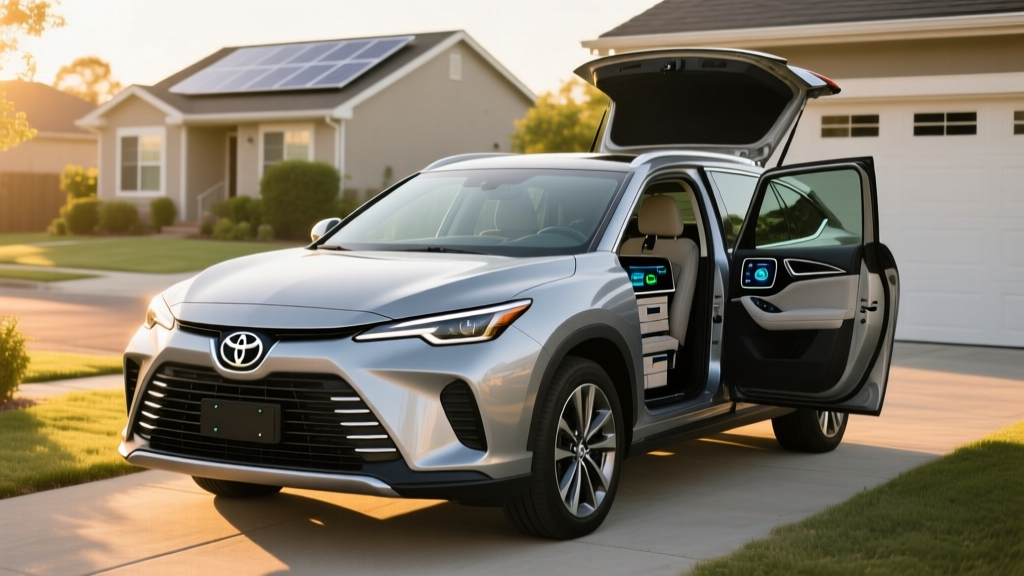
The 2022 Toyota Venza Hybrid occupies a specific niche: a midsize crossover that pairs Toyota's proven hybrid synergy drive with standard electronic all-wheel drive and a premium-leaning interior — all without ever needing to be plugged in. Now that the Venza has been discontinued after the 2024 model year (replaced by the larger Grand Highlander Hybrid in Toyota's lineup), the 2022 Venza has become a compelling used-market target for buyers who want hybrid efficiency without the complexity or cost of a plug-in hybrid or full electric vehicle.
This guide breaks down exactly what the 2022 Venza Hybrid delivers in fuel economy, powertrain capability, long-term battery reliability, and ownership economics — with the real-world numbers that matter beyond the EPA sticker.
HEV vs PHEV: Where the Venza Fits
Before examining the Venza's specs, it's essential to understand what it is — and what it isn't. The Venza is a conventional hybrid electric vehicle (HEV). It charges its own small battery through regenerative braking and the gasoline engine. You never plug it in. There is no electric-only driving range to manage, no home charger to install, and no range anxiety about finding a charging station.
| Feature | HEV (Venza Hybrid) | PHEV (e.g., RAV4 Prime) | BEV (e.g., bZ4X) |
|---|---|---|---|
| Plug-in required? | No | Yes (Level 1 or 2) | Yes (Level 2 or DC) |
| Electric-only range | ~1 mile at low speed | 35–42 miles | 220–252 miles (EPA) |
| Battery size | 1.6 kWh (NiMH) | 18.1 kWh (Li-ion) | 71.4 kWh (Li-ion) |
| Fueling | Gas station only | Gas + electric outlet | Electric only |
| Federal tax credit (§30D) | Not eligible | Not eligible (new) | Up to $7,500 (if eligible) |
| Typical starting price (MSRP new) | $33,470 (2022) | $41,515 (2022 RAV4 Prime) | $42,000 (2023 bZ4X) |
The Venza's hybrid system is designed for drivers who want lower fuel consumption and smoother stop-and-go behavior without changing their refueling habits. If you have access to home charging and a short commute, a PHEV like the RAV4 Prime may deliver more daily electric miles. If you're ready to go fully electric, a BEV eliminates gasoline entirely. But for apartment dwellers, street parkers, or anyone who simply wants to fill up at a gas station and drive, the HEV formula is the lowest-friction path to better efficiency.
Fuel Economy: EPA Numbers and Real-World MPG
The 2022 Venza Hybrid carries an EPA rating of 40 MPG city / 37 MPG highway / 39 MPG combined across all three trims (LE, XLE, Limited). That single powertrain and AWD configuration means there's no fuel-economy penalty for stepping up to the fully loaded Limited — a notable advantage over some competitors where larger wheels and added weight erode efficiency.
| Trim | City | Highway | Combined | Annual Fuel Cost* |
|---|---|---|---|---|
| LE | 40 MPG | 37 MPG | 39 MPG | $1,550 |
| XLE | 40 MPG | 37 MPG | 39 MPG | $1,550 |
| Limited | 40 MPG | 37 MPG | 39 MPG | $1,550 |
*Based on 15,000 miles/year, 55% city driving, and $3.50/gallon regular unleaded. Source: fueleconomy.gov
Real-World MPG: What Owners Actually See
Toyota's hybrid systems tend to perform close to — or even exceed — their EPA ratings in city driving, where regenerative braking recaptures energy at every stop. On owner-reported forums and fuel-tracking sites like Fuelly, the 2022 Venza averages around 37–41 MPG in mixed driving. City-heavy commuters often report 41–43 MPG, while sustained highway trips at 75+ MPH can drop to 33–35 MPG due to the Venza's aerodynamic profile and AWD system drag.
In cold weather (below 30°F), expect a 5–10% efficiency drop, bringing combined figures to roughly 35–37 MPG. The engine runs more frequently in cold conditions to provide cabin heat and maintain battery temperature, reducing the electric motor's contribution.
Powertrain and Performance Specs
The Venza uses Toyota's fourth-generation Hybrid Synergy Drive, pairing a 2.5-liter Dynamic Force four-cylinder engine with three electric motor-generators — one integrated into the transaxle for front-wheel drive, one for the rear axle (electronic AWD), and one serving as a starter/generator.
| Specification | 2022 Toyota Venza Hybrid |
|---|---|
| Engine | 2.5L inline-4 (A25A-FXS) |
| Engine output | 176 HP / 163 lb-ft torque |
| Front electric motor | 118 HP / 149 lb-ft |
| Rear electric motor (AWD) | 54 HP / 89 lb-ft |
| Net combined system horsepower | 219 HP |
| Transmission | eCVT (planetary gearset) |
| Drivetrain | Electronic AWD (standard) |
| 0–60 MPH | ~7.6 seconds |
| Battery type | Nickel-metal hydride (NiMH), 1.6 kWh |
| Fuel tank | 14.5 gallons (regular unleaded) |
| Total driving range | ~565 miles |
| Towing capacity | Not rated for towing |
The 219 combined horsepower is adequate for merging and passing, though the Venza prioritizes smoothness over sportiness. The eCVT eliminates shift shock entirely, and the electric motors provide instant torque from a stop, making the Venza feel quicker in urban driving than the 0–60 time suggests. The electronic AWD system engages the rear motor automatically during acceleration, low-traction conditions, and cornering — it's not designed for off-roading but handles rain, light snow, and gravel competently.
Battery Warranty, Lifespan, and Replacement Costs
Hybrid battery longevity is the single most common concern among first-time hybrid buyers. Toyota addresses this with one of the strongest hybrid battery warranties in the industry.
Toyota Hybrid Battery Warranty (2022 Models)
- Hybrid battery: 10 years / 150,000 miles (whichever comes first), transferable to subsequent owners
- Hybrid system components (inverter, motor-generators, ECU): 8 years / 100,000 miles
- Capacity retention guarantee: Toyota warrants the battery against defects and abnormal capacity loss — if the battery cannot hold sufficient charge to operate the hybrid system, it will be replaced under warranty
In practice, Toyota's NiMH hybrid batteries have demonstrated exceptional longevity. Data from fleet operators and long-term owners shows that Prius and Camry Hybrid batteries routinely last 150,000–200,000+ miles before significant degradation. The Venza's relatively small 1.6 kWh battery operates within a narrow state-of-charge window (roughly 40–80%), which dramatically reduces stress on the cells compared to the deep cycling a full EV battery undergoes.
If replacement is needed out of warranty, a new OEM Toyota hybrid battery for the Venza typically costs $2,000–$3,500 installed at a dealership. Third-party refurbished batteries are available for $1,000–$1,800. This is a fraction of the cost of replacing a BEV traction battery, which can exceed $10,000–$15,000.
Pricing and Tax Credit Eligibility
When new, the 2022 Venza Hybrid started at $33,470 (LE trim, including destination) and topped out around $41,000 for a fully optioned Limited. On the used market as of early 2026, expect to pay approximately $24,000–$32,000 depending on mileage, condition, and trim level.
Federal Tax Credit: Not Eligible
The 2022 Venza Hybrid does not qualify for the IRS §30D Clean Vehicle Credit. Under current federal law, only plug-in electric vehicles (BEVs and PHEVs with at least 7 kWh of battery capacity) are eligible for the new-vehicle credit of up to $7,500 or the used-vehicle credit of up to $4,000. Conventional hybrids like the Venza are excluded because they cannot be plugged in to charge.
Some states offer their own incentives for hybrid vehicles, though these are increasingly rare as state programs shift focus to zero-emission vehicles. Check your state's energy or environmental agency website for current programs. The Venza's value proposition rests on fuel savings and lower maintenance costs rather than purchase incentives.
Who Should Choose the Venza Hybrid?
Pros
- 39 MPG combined with standard AWD — no efficiency penalty for all-weather capability
- No plug-in charging required; works with existing gas-station infrastructure
- 10-year/150,000-mile hybrid battery warranty provides long-term peace of mind
- Smooth, quiet eCVT powertrain well-suited to city and suburban driving
- Premium interior materials and standard Toyota Safety Sense 2.0 ADAS suite
- Strong Toyota reliability reputation and high resale value
Cons
- No plug-in or electric-only range — still burns gasoline on every trip
- Discontinued after 2024; limited new inventory (used market only)
- Not rated for towing — unsuitable for trailer or boat hauling
- Modest 219 HP and 7.6-second 0–60 won't satisfy performance-oriented drivers
- Cargo space (28.8 cu ft behind rear seats) trails some midsize competitors
- No federal tax credit available (HEV exclusion)
Choose the Venza Hybrid If:
- You want better fuel economy without changing your refueling routine
- You live in an apartment or lack access to home/workplace charging
- You need AWD for snow or rain but don't want the efficiency penalty of a conventional AWD SUV
- You plan to own the vehicle 8–10+ years and value Toyota's hybrid warranty coverage
Look at a PHEV or BEV Instead If:
- You have home charging and a commute under 35 miles (a PHEV like the RAV4 Prime covers most trips on electricity alone)
- You want to minimize or eliminate gasoline use entirely (a BEV like the Tesla Model Y or Hyundai Ioniq 5)
- You want to take advantage of the $7,500 federal tax credit on a new EV purchase
Frequently Asked Questions
How many MPG does the 2022 Venza Hybrid get?
The EPA rates the 2022 Venza Hybrid at 40 MPG city, 37 MPG highway, and 39 MPG combined across all trims. Real-world owners typically report 37–41 MPG in mixed driving, with city-heavy routes sometimes exceeding 42 MPG thanks to regenerative braking.
Does the Venza Hybrid need to be plugged in?
No. The Venza is a conventional hybrid (HEV). Its small 1.6 kWh NiMH battery charges automatically through regenerative braking and the gasoline engine. You refuel only at gas stations, just like a traditional car.
How long will the Venza hybrid battery last?
Toyota's hybrid batteries are engineered for 150,000–200,000+ miles of service. The 2022 Venza carries a 10-year/150,000-mile hybrid battery warranty. Real-world data from Toyota's hybrid fleet shows that most batteries outlast the vehicle's useful life with proper maintenance.
What does it cost to replace the hybrid battery?
If replacement is needed out of warranty, expect $2,000–$3,500 for a new OEM battery installed at a Toyota dealer, or $1,000–$1,800 for a refurbished unit from a third-party supplier. This is significantly less than a full EV battery replacement.
Does the 2022 Venza qualify for any tax credit?
No. The federal §30D Clean Vehicle Credit applies only to plug-in vehicles (BEVs and qualifying PHEVs). As a conventional hybrid, the Venza is not eligible for the $7,500 new-vehicle credit or the $4,000 used-vehicle credit. Check your state's programs for any local hybrid incentives.
How does the Venza Hybrid compare to the RAV4 Hybrid?
The RAV4 Hybrid shares the same 2.5L hybrid powertrain and AWD system but offers more cargo space (37.6 cu ft vs. 28.8 cu ft) and a 1,500-lb towing rating. The Venza trades practicality for a more premium interior, slightly better highway fuel economy (37 vs. 35 MPG highway), and a lower starting price on the used market. If cargo and towing matter, choose the RAV4. If refinement and efficiency are priorities, the Venza is the better pick.
Is the Venza Hybrid reliable?
Toyota's hybrid powertrains are among the most reliable in the automotive industry. The Venza's A25A-FXS engine and eCVT have fewer wear components than a conventional transmission (no clutch packs, torque converter, or traditional gear sets). NHTSA gave the 2022 Venza a 5-star overall safety rating, and Toyota Safety Sense 2.0 (pre-collision, lane departure, adaptive cruise, automatic high beams) comes standard on every trim.
The 2022 Toyota Venza Hybrid makes a strong case as a used-market purchase for efficiency-minded buyers who want AWD capability, proven reliability, and zero lifestyle changes. It won't eliminate your gas station visits, but it will cut them roughly in half compared to a non-hybrid midsize SUV — and it'll do so without asking you to install a charger, plan routes around charging stations, or worry about battery replacement costs for at least a decade.