Quick Verdict: The Tundra Hybrid That Started a Generation
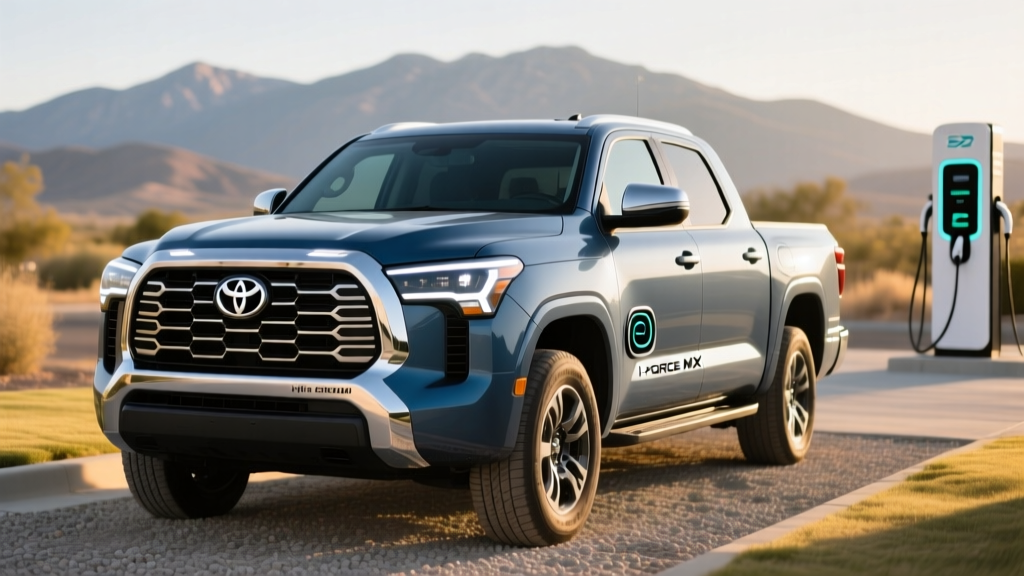
The 2022 Toyota Tundra Hybrid marked a pivotal moment for full-size pickup electrification. Toyota replaced its aging 5.7L V8 with the i-FORCE MAX twin-turbo V6 hybrid powertrain, delivering more torque than the old V8 while squeezing out meaningfully better fuel economy. Now several model years into this generation, the 2022 Tundra Hybrid remains a strong presence on the used-truck market — and a case study in how conventional hybrid (HEV) technology can serve truck buyers who aren't ready for a plug.
This is not a plug-in hybrid. You cannot charge it from a wall outlet, and it has no electric-only driving range. The i-FORCE MAX system uses a small battery and electric motor sandwiched between the engine and transmission to assist acceleration, enable regenerative braking, and allow brief low-speed electric assist. The result: a 437-horsepower, 583 lb-ft torque full-size truck that returns an EPA-estimated 20 MPG combined.
HEV (Hybrid Electric Vehicle): The Tundra i-FORCE MAX. Charges itself through regenerative braking and the engine. No plug. No electric-only range. Battery: ~1.87 kWh.
PHEV (Plug-in Hybrid): Larger battery (typically 15-25 kWh), charges from a wall outlet, offers 20-50 miles of electric-only driving before the engine engages. The Tundra is NOT a PHEV.
Powertrain and Performance: i-FORCE MAX Deep Dive
The heart of the 2022 Tundra Hybrid is the i-FORCE MAX powertrain, which pairs a 3.4L (sometimes listed as 3.5L depending on measurement convention) twin-turbocharged V6 with a 48-horsepower electric motor-generator positioned between the engine and the 10-speed automatic transmission.
| Specification | Value |
|---|---|
| Engine | 3.4L Twin-Turbo V6 |
| Electric Motor | 48 hp / 184 lb-ft motor-generator |
| Combined System Output | 437 hp @ 5,200 rpm / 583 lb-ft @ 2,400 rpm |
| Transmission | 10-speed automatic |
| Hybrid Battery | ~1.87 kWh, sealed nickel-metal hydride (NiMH) |
| Drivetrain | RWD or 4WD (part-time or full-time depending on trim) |
| 0-60 mph | ~5.7 seconds (4WD crew cab) |
| Max Towing Capacity | Up to 11,450 lbs (properly equipped, SR5 4x2) |
| Max Payload | Up to 1,760 lbs |
The 583 lb-ft of torque arrives at just 2,400 rpm — significantly lower in the rev range than the outgoing 5.7L V8's 401 lb-ft at 3,600 rpm. This translates to strong low-end pull when towing or accelerating from a stop. The electric motor fills the torque gap before the turbos fully spool, eliminating the lag typical of turbocharged engines in heavy vehicles.
One important caveat: towing at or near maximum capacity dramatically reduces fuel economy. Owners regularly report 12-14 MPG when towing heavy trailers, which is typical for any full-size truck but worth budgeting for if you tow frequently.
Fuel Economy: EPA Ratings vs Real-World MPG
The 2022 Tundra Hybrid's EPA fuel economy varies slightly by drivetrain and cab configuration. Here is the full breakdown per fueleconomy.gov:
| Configuration | City | Highway | Combined |
|---|---|---|---|
| 4x2 CrewMax | 20 MPG | 24 MPG | 22 MPG |
| 4x4 CrewMax | 19 MPG | 22 MPG | 20 MPG |
| 4x4 Double Cab (TRD Pro) | 19 MPG | 22 MPG | 20 MPG |
The Tundra Hybrid's EPA numbers are honest but conservative for city driving. Hybrid trucks shine in stop-and-go traffic where regenerative braking recaptures energy. Expect 22-24 MPG in mixed city/suburban driving without towing. On the highway at 75+ mph, aerodynamic drag dominates and the hybrid advantage shrinks — expect 18-20 MPG on flat interstate runs, and as low as 12-14 MPG when towing a 6,000+ lb trailer. Cold weather and short trips reduce MPG further, as the engine runs more often to heat the cabin and catalytic converter.
Compared to the non-hybrid 2022 Tundra with the i-FORCE 3.4L twin-turbo V6 (rated at 389 hp), the hybrid gains roughly 2-3 MPG combined. That's a 10-15% improvement — meaningful over 15,000 annual miles, especially at $3.50+ per gallon.
Pricing, Trims, and Tax Credit Eligibility
The 2022 Tundra Hybrid was offered across multiple trims, with the i-FORCE MAX powertrain available as standard on higher trims and as an option package on mid-level trims. Original MSRP ranged significantly:
| Trim | Approximate MSRP (New) | Notes |
|---|---|---|
| Limited (i-FORCE MAX option) | ~$57,000 - $60,000 | Hybrid option ~$3,575 |
| Platinum | ~$65,000 - $68,000 | Standard i-FORCE MAX |
| 1794 Edition | ~$64,000 - $67,000 | Standard i-FORCE MAX |
| TRD Pro | ~$67,000 - $70,000 | Standard i-FORCE MAX |
| Capstone | ~$74,000 - $76,000 | Standard i-FORCE MAX, top trim |
Federal tax credit status: The 2022 Tundra Hybrid does not qualify for the federal §30D clean vehicle tax credit. Under IRS rules, the §30D credit applies to plug-in electric vehicles (BEVs and PHEVs) with a minimum battery capacity of 7 kWh (post-2022 Inflation Reduction Act) or 4 kWh (pre-IRA). The Tundra Hybrid's ~1.87 kWh NiMH battery falls well below any threshold. This is a conventional hybrid — no plug, no federal EV credit.
Some states may offer minor incentives for hybrid purchases (check your state's energy office), but these are uncommon and typically small compared to BEV/PHEV incentives. On the used market, the Tundra Hybrid does not qualify for the $4,000 used clean vehicle credit either, as that also requires plug-in capability.
Battery Warranty, Reliability, and Replacement Costs
Toyota covers the 2022 Tundra Hybrid's battery under its Hybrid Battery Warranty: 10 years or 150,000 miles (whichever comes first), regardless of state. This replaced the older 8-year/100,000-mile coverage and applies to all 2020+ model-year Toyota hybrids. The powertrain (engine, transmission, motor-generators) carries a separate 5-year/60,000-mile warranty, and the basic vehicle warranty is 3 years/36,000 miles.
Toyota's hybrid systems have an exceptional reliability track record spanning two decades, starting with the original Prius. The i-FORCE MAX uses Toyota's proven hybrid synergy drive architecture adapted for heavy-duty truck use. The NiMH battery pack is relatively small (~1.87 kWh) and is never deeply discharged — the hybrid control system keeps the state of charge in a narrow band (roughly 40-80%), which dramatically extends cycle life.
Hybrid battery replacement cost: If the battery fails outside of warranty (which is rare based on Toyota's track record), replacement costs for the Tundra i-FORCE MAX hybrid battery are estimated at $3,000 to $5,000 including labor. This is significantly less than a full EV battery replacement ($8,000-$20,000+) because the pack is small. Toyota also offers refurbished hybrid battery options at reduced cost through its dealerships.
Non-hybrid components to watch: the 2022 Tundra's twin-turbo V6 was new for this generation, and some early-build models experienced turbo-related and electronic issues documented in owner forums and NHTSA complaints. Check NHTSA.gov for any open recalls on a specific VIN before purchasing used.
Hybrid vs PHEV vs Full EV: Which Truck Fits Your Needs?
The 2022 Tundra Hybrid occupies a specific niche. Here's how it compares to the alternatives for truck buyers:
| Factor | Tundra Hybrid (HEV) | PHEV Truck (e.g., F-150 PowerBoost is HEV; no PHEV trucks yet in 2022) | Full EV (e.g., F-150 Lightning, R1T) |
|---|---|---|---|
| Plug-in Required? | No | Yes | Yes |
| Electric-Only Range | None | 20-50 mi (typical) | 230-400 mi |
| Fuel Economy | 20-22 MPG combined | Varies (MPGe when charged) | 70-78 MPGe |
| Federal Tax Credit | None | Up to $7,500* | Up to $7,500* |
| Towing Range Impact | ~50% MPG reduction | Severe range loss | Range can halve |
| Refueling/Charging | 5 min at any gas station | Gas + plug | 30 min-10+ hrs |
| Best For | No home charging, frequent towing, rural | Short commute + home charging + towing needs | Home charging, daily commute, light towing |
*Federal §30D credit eligibility depends on MSRP caps, buyer income limits, battery sourcing requirements, and point-of-sale transfer rules. See IRS.gov for current rules.
Choose the Tundra Hybrid if: You don't have reliable home charging access, you tow frequently and need maximum range flexibility, you live in a rural area with sparse charging infrastructure, or you simply want better MPG without changing your fueling habits.
Choose a full EV truck (F-150 Lightning, Rivian R1T) if: You have Level 2 home charging, your daily driving is under 200 miles, you rarely tow heavy loads over long distances, and you want to eliminate fuel costs and qualify for the $7,500 federal tax credit.
Choose the gas-only Tundra (i-FORCE, non-hybrid) if: You want the lowest purchase price, you drive very few annual miles (making the hybrid premium hard to recoup), or you prefer a simpler powertrain with no hybrid battery to consider long-term.
Ownership Costs: 5-Year Tundra Hybrid Breakdown
Let's put real numbers to Tundra Hybrid ownership over five years, assuming 15,000 miles annually (75,000 miles total), $3.60/gallon regular fuel, and typical insurance rates for a full-size truck:
| Category | 5-Year Estimate | Notes |
|---|---|---|
| Fuel (75,000 mi @ 20 MPG) | ~$13,500 | 3,750 gallons @ $3.60 |
| Insurance | ~$10,000 - $14,000 | Varies widely by driver/state |
| Maintenance | ~$2,500 - $3,500 | Oil, filters, brakes (regen extends pad life) |
| Depreciation (est.) | ~$18,000 - $25,000 | Tundras hold value well |
| Total Operating Cost | ~$44,000 - $56,000 | Excludes purchase price |
Compared to the non-hybrid i-FORCE V6 Tundra 4x4 (EPA 19 MPG combined), the hybrid saves roughly $1,400-$1,800 in fuel over five years — enough to partially offset the ~$3,575 hybrid option premium that applied when new. The hybrid's regenerative braking also extends brake pad life, saving an additional $200-$400 in brake service over the same period.
Pros and Cons
Pros
- 583 lb-ft torque at just 2,400 rpm — excellent for towing
- 2-3 MPG improvement over non-hybrid V6 without any behavior change
- No plug-in required; works with existing gas station infrastructure
- 10-year/150,000-mile hybrid battery warranty
- Proven Toyota hybrid reliability pedigree
- Strong resale value — Tundras consistently rank among top trucks for retention
- Smooth, quiet low-speed operation in hybrid mode
Cons
- No federal tax credit — the $7,500 §30D credit requires plug-in capability
- Only ~2-3 MPG gain over the non-hybrid i-FORCE V6
- Fuel economy drops sharply when towing (12-14 MPG typical)
- Hybrid battery adds weight and complexity vs non-hybrid
- Some early 2022 build-quality concerns documented in NHTSA complaints
- No electric-only driving — you always burn fuel
- Higher trims push MSRP past $70,000
Frequently Asked Questions
How many MPG does the 2022 Toyota Tundra Hybrid get?
The EPA rates the 2022 Tundra Hybrid 4x4 at 19 city / 22 highway / 20 combined MPG. The 4x2 CrewMax variant achieves 20/24/22 MPG. In real-world mixed driving, owners commonly report 21-23 MPG without towing, with highway-only driving at 75+ mph yielding 18-20 MPG. City driving with frequent stops can push slightly above EPA estimates thanks to regenerative braking.
Does the Tundra Hybrid need to be plugged in?
No. The 2022 Tundra Hybrid is a conventional hybrid (HEV), not a plug-in hybrid (PHEV). The battery charges itself through regenerative braking and the gasoline engine. There is no charging port and no electric-only driving range. You fuel it exactly like a standard gasoline truck.
Is the 2022 Tundra Hybrid reliable?
Toyota's hybrid powertrains have demonstrated outstanding long-term reliability across millions of vehicles over 20+ years. The i-FORCE MAX system uses Toyota's proven hybrid synergy drive components adapted for truck duty. The 3.4L twin-turbo V6 was new for 2022 and had some early-production teething issues (documented in NHTSA complaints), but the hybrid system itself is based on mature technology. The hybrid battery carries a 10-year/150,000-mile warranty.
What does a Tundra Hybrid battery replacement cost?
Estimated at $3,000-$5,000 including labor if needed outside warranty. This is considerably less than EV battery replacement because the pack is small (~1.87 kWh). Toyota's track record suggests hybrid battery failure within the first 150,000 miles is uncommon. The 10-year/150,000-mile warranty provides extensive coverage.
Does the 2022 Tundra Hybrid qualify for any tax credit?
No. The federal §30D clean vehicle credit requires a plug-in electric vehicle (BEV or PHEV) with minimum battery capacity. The Tundra Hybrid's 1.87 kWh battery and lack of a charging port make it ineligible. It also does not qualify for the used clean vehicle credit. Check your state's energy office for any local hybrid incentives, though these are rare.
How much can the Tundra Hybrid tow?
Up to 11,450 lbs when properly equipped (SR5 4x2 CrewMax with tow package). Hybrid models with 4WD and higher trims see slightly reduced ratings — typically 10,890-11,175 lbs depending on configuration. Expect fuel economy to drop to 12-14 MPG when towing near maximum capacity, which is typical for any full-size truck.
Should I buy the Tundra Hybrid or the gas-only Tundra?
If you drive 15,000+ miles per year and value the extra low-end torque, the hybrid's 2-3 MPG improvement saves $250-$350 annually in fuel. Over 10 years, that's $2,500-$3,500 — roughly offsetting the original hybrid option premium. The hybrid also delivers noticeably stronger acceleration from stops due to instant electric torque. If you drive fewer miles or want the lowest purchase price, the non-hybrid i-FORCE V6 (389 hp) remains a strong choice.