Quick Verdict: The 2022 RAV4 Hybrid XLE Premium in 2026
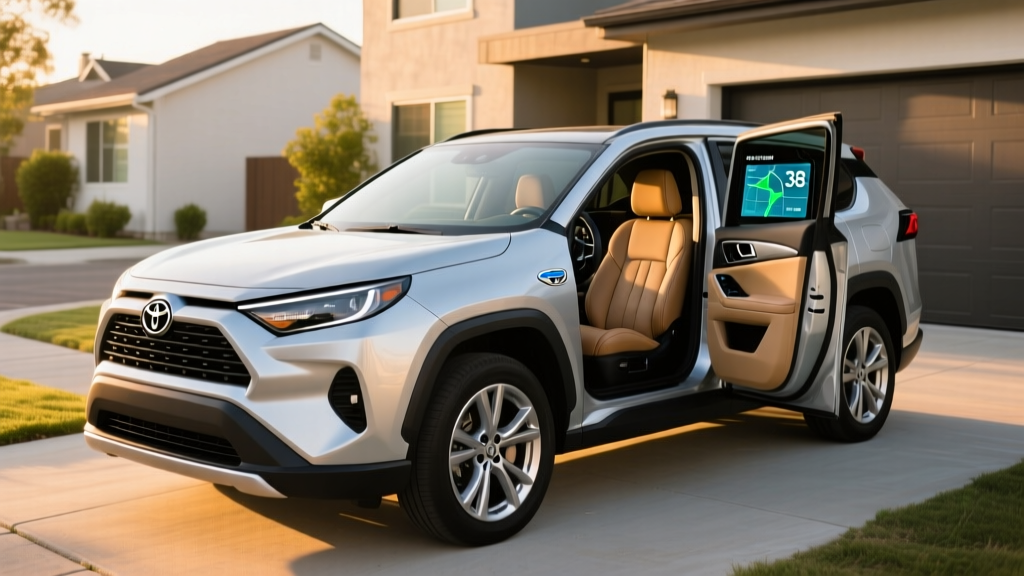
The 2022 Toyota RAV4 Hybrid XLE Premium remains one of the most compelling used hybrid SUVs on the market in 2026. With an EPA-rated 40 MPG combined, standard electronic all-wheel drive, and Toyota's proven hybrid reliability, this trim sits at the sweet spot of value and features in the RAV4 Hybrid lineup. For buyers who want SUV practicality without plugging in, it delivers real-world fuel economy that often beats its EPA sticker in city driving — and it does so without any range anxiety or charging infrastructure dependency.
| Spec | 2022 RAV4 Hybrid XLE Premium |
|---|---|
| Powertrain | 2.5L 4-cyl + 3 electric motors (AWD-i) |
| Combined Horsepower | 219 hp |
| EPA MPG (City / Hwy / Combined) | 41 / 38 / 40 |
| Fuel Tank | 14.5 gallons |
| Total Range | ~580 miles |
| 0–60 mph | 7.4 seconds |
| Cargo Volume (rear seats up / down) | 37.6 / 69.8 cu ft |
| Hybrid Battery Warranty | 10 years / 150,000 miles |
| Original MSRP (XLE Premium) | $33,645 |
| Typical 2026 Used Price | $24,000–$29,000 |
HEV vs PHEV: Where the RAV4 Hybrid Fits
Toyota sells two electrified RAV4 variants, and confusing them is a common buyer mistake. The RAV4 Hybrid (HEV) is a conventional hybrid — it charges its small battery through regenerative braking and the gasoline engine. You never plug it in. The RAV4 Prime (PHEV) is the plug-in version with an 18.1 kWh battery, 42 miles of electric-only range, and a combined 302 hp. The Prime qualifies for certain incentives but carries a significantly higher price.
| Feature | RAV4 Hybrid (HEV) | RAV4 Prime (PHEV) |
|---|---|---|
| Plug-in Required? | No | Yes (Level 1 or Level 2) |
| Electric-Only Range | None (EV mode ~1 mi at low speed) | 42 miles (EPA) |
| Battery Capacity | 1.6 kWh (NiMH) | 18.1 kWh (Li-ion) |
| Combined HP | 219 hp | 302 hp |
| EPA Combined | 40 MPG | 94 MPGe / 38 MPG (gas only) |
| DC Fast Charging | N/A | Not supported (Level 2 max) |
| Original MSRP (base trim) | ~$29,075 | ~$39,800 |
This review focuses on the 2022 RAV4 Hybrid XLE Premium — the HEV. If your commute is short and you have home charging access, the RAV4 Prime PHEV may be worth the premium. But for buyers without reliable plug-in access, the conventional hybrid is the pragmatic, lower-cost choice.
Fuel Economy: EPA Ratings vs Real-World MPG
The EPA rates the 2022 RAV4 Hybrid at 41 MPG city, 38 MPG highway, and 40 MPG combined — figures that apply across all RAV4 Hybrid trims including the XLE Premium, since they share the same powertrain and AWD-i system (fueleconomy.gov).
| Driving Scenario | EPA Rating | Real-World Expectation |
|---|---|---|
| City / Stop-and-Go | 41 MPG | 42–46 MPG (hybrids excel here) |
| Highway (70–80 mph) | 38 MPG | 34–37 MPG (aero drag, less regen benefit) |
| Combined Mixed | 40 MPG | 38–42 MPG |
| Cold Weather (below 30°F) | — | 33–37 MPG (engine runs more for cabin heat) |
The key insight with Toyota's hybrid system: city MPG often exceeds the EPA sticker. The electric motor handles low-speed acceleration, regenerative braking recaptures energy at every stoplight, and the engine shuts off during idle. On highway-dominant commutes, expect a few MPG below the combined rating because the gasoline engine does more of the work and regenerative braking opportunities are fewer.
In cold weather, fuel economy drops 10–15% because the engine must run longer to heat the cabin and bring the catalytic converter to operating temperature. This is true of all hybrids, not just Toyota. Owners in northern climates should plan for ~35 MPG in deep winter.
Powertrain and Driving Performance
The 2022 RAV4 Hybrid pairs a 2.5-liter Atkinson-cycle four-cylinder engine (176 hp, 163 lb-ft) with three electric motor-generators — two on the front axle and one on the rear axle (AWD-i). Net system output is 219 horsepower. The rear motor provides up to 1,300 Nm of torque to the rear wheels when slip is detected, though it's not a full-time AWD system like a mechanical setup.
The 0–60 mph time of 7.4 seconds puts it ahead of the gas-only RAV4 (8.0 seconds) and in line with competitors like the Honda CR-V Hybrid. The eCVT (planetary gearset, not a belt-driven CVT) delivers smooth, linear acceleration without the rubber-band feel of some competitors. Around town, the electric motor's instant torque makes the RAV4 Hybrid feel quicker than its numbers suggest.
One practical note: the hybrid battery sits under the rear seats, so cargo space is identical to the gas RAV4 — 37.6 cu ft behind the second row, 69.8 cu ft with seats folded. The XLE Premium trim adds SofTex synthetic leather seats, a power moonroof, and a 7-inch touchscreen with Apple CarPlay and Android Auto.
Battery Longevity, Warranty, and Replacement Cost
Hybrid Battery Warranty: 10 years or 150,000 miles (whichever comes first), transferable to subsequent owners. This covers the hybrid battery pack and all hybrid-system components including the inverter and motor-generators.
Toyota's hybrid battery warranty was extended from 8 years/100,000 miles to 10 years/150,000 miles starting with 2020 model-year vehicles, which means the 2022 RAV4 Hybrid is covered through at least 2032 under normal ownership. This warranty is fully transferable, which protects used buyers.
The 2022 RAV4 Hybrid uses a 1.6 kWh nickel-metal hydride (NiMH) battery pack. NiMH chemistry is less energy-dense than lithium-ion but extremely durable — Toyota's hybrid batteries routinely last 150,000–200,000+ miles before significant degradation. The Prius taxi fleet data and long-term owner reports consistently show hybrid battery failure rates well under 5% within the warranty period.
If replacement is needed out of warranty, a new OEM hybrid battery from Toyota costs approximately $2,500–$4,000 including labor. Refurbished or aftermarket options range from $1,500–$2,500. Individual module replacement (only the degraded cells) can bring the cost below $1,000 at specialized hybrid repair shops. This is dramatically less than a full EV battery replacement ($10,000–$20,000+), and the failure rate is low enough that most owners will never face it.
Pricing, Tax Credits, and Ownership Economics
The 2022 RAV4 Hybrid XLE Premium had an original MSRP of $33,645 (including destination). In the 2026 used market, well-maintained examples with 30,000–50,000 miles typically list between $24,000 and $29,000 depending on condition, mileage, and region.
Tax credit eligibility: Conventional hybrids (HEVs) like the RAV4 Hybrid do not qualify for the federal §30D clean vehicle credit — that credit applies only to plug-in electric vehicles (BEVs and PHEVs with sufficient battery capacity). The RAV4 Prime PHEV may have qualified when new, but the used §30D credit (up to $4,000 for pre-owned plug-in vehicles) has specific requirements including an MSRP cap of $25,000 for used vehicles, buyer income limits, and the vehicle must be at least two model years old (IRS §30D used vehicle rules). Since the RAV4 Hybrid is not a plug-in, it is ineligible regardless of price.
Some states offer their own hybrid or efficiency incentives, but these vary widely and change frequently. Check your state energy office or department of revenue for current programs.
The ownership economics still favor the hybrid strongly. At 40 MPG combined and $3.20/gallon gas (2026 national average), annual fuel cost for 15,000 miles is approximately $1,200. A comparable gas-only RAV4 (28 MPG combined) would cost about $1,714 — a savings of over $500/year with the hybrid, or $2,500+ over five years.
Pros
- 40 MPG combined EPA; often exceeds in city driving
- Standard AWD at no fuel-economy penalty
- 10-year/150,000-mile hybrid battery warranty (transferable)
- No plug-in dependency — works anywhere gas is sold
- Strong resale value and Toyota reliability reputation
- Cargo space identical to gas RAV4
Cons
- No federal tax credit eligibility (HEV, not PHEV)
- Highway MPG drops to ~35 in cold weather or at sustained 80 mph
- 7-inch screen feels dated vs competitors' larger displays
- AWD-i rear motor engages only on slip — not true full-time AWD
- NiMH battery (not Li-ion) — proven but older chemistry
- XLE Premium lacks navigation and premium audio (reserved for Limited)
Who Should Buy This vs a PHEV or Full EV?
Choose the RAV4 Hybrid (HEV) if:
- You lack reliable home or workplace charging access
- You want maximum simplicity — no plugs, no charging apps, no route planning
- Your budget is $24,000–$30,000 for a used SUV
- You drive a mix of city and highway and want consistent 38–42 MPG
- You plan to keep the vehicle 8–10 years (warranty covers the battery)
Choose the RAV4 Prime (PHEV) if:
- You have Level 2 home charging and a commute under 42 miles
- You want electric-only daily driving with gas backup for road trips
- You can absorb a higher purchase price ($38,000+ used in 2026)
- You want the 302 hp performance upgrade
Choose a full EV (e.g., Tesla Model Y, Hyundai Ioniq 5) if:
- You have home Level 2 charging and want zero tailpipe emissions
- Your daily driving is under 250 miles and you road-trip infrequently
- You want lower per-mile energy costs (~$0.04–0.06/mile on home electricity vs ~$0.08–0.10/mile on gas)
- You're eligible for the full §30D credit on a new EV purchase
Frequently Asked Questions
How many MPG does the 2022 RAV4 Hybrid XLE Premium actually get?
The EPA rates it at 41 city / 38 highway / 40 combined. Real-world city driving often yields 42–46 MPG thanks to regenerative braking and engine-off coasting. Highway-only driving at 75+ mph typically returns 34–37 MPG. Cold weather (below 30°F) reduces combined economy to roughly 33–37 MPG.
Does the 2022 RAV4 Hybrid need to be plugged in?
No. The RAV4 Hybrid is a conventional hybrid (HEV). Its 1.6 kWh battery charges through regenerative braking and the gasoline engine. You fuel it like any other car — there is no plug, no charging cable, and no electric-only driving range beyond about one mile at very low speeds in EV mode.
Is the hybrid battery reliable and what does replacement cost?
Toyota's hybrid batteries have an exceptional reliability record, with failure rates well under 5% within the 10-year/150,000-mile warranty period. NiMH chemistry is less energy-dense than lithium-ion but extremely long-lasting. If replacement is needed out of warranty, expect $2,500–$4,000 for a new OEM battery, or $1,500–$2,500 for refurbished options. Most owners never need a replacement.
Does the 2022 RAV4 Hybrid qualify for any tax credit?
No. The federal §30D clean vehicle credit applies only to plug-in vehicles (BEVs and PHEVs). As a conventional hybrid, the RAV4 Hybrid does not qualify for federal EV tax credits, whether purchased new or used. Some states may offer their own efficiency incentives — check your state's energy office for current programs.
What's the difference between the XLE and XLE Premium trims?
The XLE Premium adds SofTex synthetic leather upholstery, a power tilt/slide moonroof, and a leather-wrapped steering wheel over the standard XLE. Both trims share the same 219 hp hybrid powertrain, 40 MPG combined rating, and 7-inch infotainment screen. The XLE Premium was a popular mid-tier option before Toyota restructured trim naming in later model years.
How does the RAV4 Hybrid compare to the RAV4 Prime PHEV?
The Prime offers 42 miles of electric-only range, 302 hp, and 94 MPGe when charged — but costs significantly more ($38,000+ used) and requires plug-in charging to realize its benefits. The Hybrid is $10,000+ cheaper, needs no plug, and delivers consistent 40 MPG. If you can charge at home and commute under 42 miles, the Prime saves more fuel. Otherwise, the Hybrid is the better value.