Quick Verdict: The 2022 Toyota RAV4 Hybrid LE at a Glance
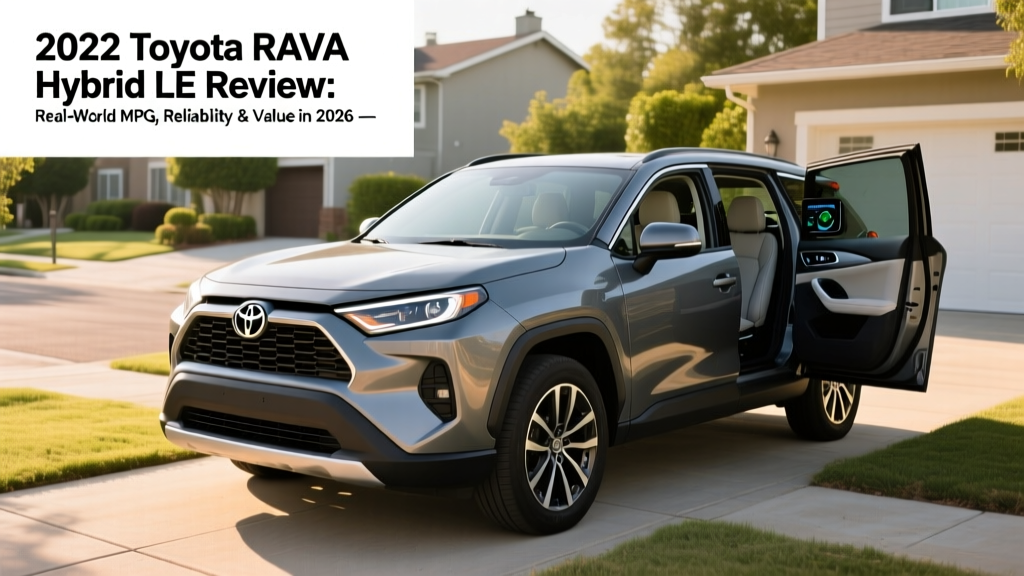
The 2022 Toyota RAV4 Hybrid LE remains one of the most pragmatic compact SUVs on the used market in 2026. It pairs a 2.5-liter four-cylinder engine with Toyota's fourth-generation hybrid system to deliver an EPA-estimated 41 city / 38 highway / 40 combined MPG — figures that hold up remarkably well in real-world driving. With no plug required, a proven hybrid battery warranty, and a 219-horsepower all-wheel-drive powertrain as standard, the LE trim serves as the value anchor for buyers who want hybrid efficiency without the complexity of a plug-in hybrid or full EV.
As a conventional hybrid electric vehicle (HEV), the RAV4 Hybrid LE generates its own electricity through regenerative braking and the gasoline engine. You never plug it in. This distinction matters because Toyota also sells the RAV4 Prime, which is a plug-in hybrid (PHEV) with 42 miles of electric-only range and eligibility for federal tax credits. We'll clarify the differences below so you can choose the right powertrain for your situation.
| Specification | Value |
|---|---|
| Powertrain | 2.5L 4-cyl + 2 electric motors (AWD) |
| Combined Horsepower | 219 hp |
| EPA MPG (City / Hwy / Combined) | 41 / 38 / 40 MPG |
| Fuel Tank Capacity | 14.5 gallons |
| Total Driving Range | ~580 miles (EPA est.) |
| 0–60 mph | 7.4 seconds |
| Drivetrain | Electronic On-Demand AWD (standard) |
| Hybrid Battery Type | Nickel-Metal Hydride (NiMH), ~1.6 kWh |
| Plug-In Required? | No — self-charging HEV |
| Original MSRP (2022 LE) | $29,075 (incl. destination) |
| Federal Tax Credit | Not eligible (§30D applies to PHEVs/BEVs only) |
| Hybrid Battery Warranty | 10 years / 150,000 miles |
Understanding HEV vs. PHEV: RAV4 Hybrid vs. RAV4 Prime
Toyota offers two electrified RAV4 variants, and confusing them is one of the most common mistakes shoppers make. Here's the fundamental difference:
RAV4 Hybrid (HEV) — This Vehicle
- No plug required. The battery recharges via regenerative braking and the gas engine.
- Small battery (~1.6 kWh NiMH) — assists the engine but cannot drive on electricity alone for meaningful distances.
- 40 MPG combined regardless of driving pattern.
- No federal tax credit — IRS §30D credits require plug-in vehicles with ≥7 kWh battery capacity.
- Lower purchase price — the LE trim originally started at ~$29,075.
RAV4 Prime (PHEV)
- Plug-in capable. Charges via Level 1 (120V) or Level 2 (240V) charging.
- Larger battery (18.1 kWh lithium-ion) — enables 42 miles of electric-only driving.
- 94 MPGe combined (electric + gas); 38 MPG combined after battery depletes.
- Previously eligible for $7,500 federal tax credit (subject to IRS §30D sourcing/income rules; credit availability varies by purchase date and vehicle eligibility).
- Higher purchase price — originally started at ~$39,800.
Bottom line: If you have access to home or workplace Level 2 charging and your daily commute is under 42 miles round-trip, the RAV4 Prime PHEV lets you drive almost entirely on electricity while retaining a gas engine for road trips. If you lack reliable charging access or want a lower upfront cost, the RAV4 Hybrid HEV gives you excellent fuel economy with zero lifestyle change.
Fuel Economy: EPA Ratings vs. Real-World MPG
The EPA rates the 2022 RAV4 Hybrid LE at 41 MPG city, 38 MPG highway, and 40 MPG combined, according to fueleconomy.gov. These numbers apply to the LE trim specifically; higher trims (XLE, XLE Premium, SE, XSE, Limited) carry slightly lower ratings of 41/38/40 or 40/36/39 depending on wheel size and equipment.
| Driving Condition | EPA Rating | Real-World Expectation |
|---|---|---|
| City | 41 MPG | 40–44 MPG (hybrids excel in stop-and-go) |
| Highway (70–80 mph) | 38 MPG | 34–37 MPG (aero drag reduces hybrid advantage) |
| Combined | 40 MPG | 37–41 MPG (varies with driving mix) |
| Cold Weather (below 30°F) | — | 33–37 MPG (engine runs more for cabin heat) |
Conventional hybrids like the RAV4 Hybrid LE often exceed their EPA city rating in real-world conditions. Regenerative braking recaptures energy during frequent stops, and the engine shuts off at idle — advantages that disappear on sustained highway runs where aerodynamic drag dominates. In warm-weather city driving with moderate traffic, owners commonly report 42–44 MPG. On a 75-mph highway cruise, expect the figure to dip to the mid-30s.
Cold weather is the biggest efficiency penalty for any hybrid. Below freezing, the gasoline engine runs more frequently to provide cabin heat and maintain battery temperature, which can drop observed fuel economy to 33–37 MPG in mixed driving. This is normal and not a sign of a problem.
Powertrain and Driving Performance
The 2022 RAV4 Hybrid LE uses Toyota's Hybrid Synergy Drive with a 2.5-liter Dynamic Force four-cylinder engine producing 176 horsepower and 163 lb-ft of torque on its own. A front-mounted electric motor adds 118 hp, while a separate rear-mounted motor (40 hp) provides electronic all-wheel drive by powering the rear axle when slip is detected. Combined system output is 219 horsepower.
The result is a 0–60 mph time of approximately 7.4 seconds — brisk for a compact SUV and noticeably quicker than the non-hybrid RAV4's 8.0-second mark. The electric motor's instant torque gives the Hybrid LE strong low-speed acceleration, making it feel responsive in city traffic and confident during highway merging.
Standard electronic on-demand AWD means the LE handles rain, light snow, and gravel roads without the fuel-economy penalty of a traditional mechanical AWD system. The rear motor only engages when needed, so there's no drivetrain parasitic loss during normal dry-road cruising.
Hybrid Battery Warranty, Lifespan, and Replacement Cost
Toyota Hybrid Battery Coverage (2022 Model Year)
Warranty: 10 years or 150,000 miles (whichever comes first), covering capacity loss and defects. This applies to all 2020+ Toyota hybrids and is transferable to subsequent owners.
Battery Type: Nickel-Metal Hydride (NiMH), approximately 1.6 kWh capacity.
Expected Lifespan: Based on fleet data from Toyota hybrids spanning two decades (Prius, Camry Hybrid, RAV4 Hybrid), NiMH packs routinely last 150,000–200,000+ miles before significant degradation. Many first-generation Prius batteries exceeded 200,000 miles.
Replacement Cost (out of warranty): A new OEM hybrid battery pack from Toyota runs approximately $3,000–$4,500 including installation at a dealership. Refurbished or aftermarket packs are available for $1,500–$2,500. Individual module replacement (if only one cell group fails) can cost $500–$1,000.
The RAV4 Hybrid's NiMH battery is one of the most battle-tested components in the automotive industry. Unlike full EV batteries, this small pack is never deeply discharged — the hybrid system keeps it in a narrow state-of-charge window (roughly 40–80%) to maximize longevity. This shallow-cycling strategy is why Toyota hybrid batteries routinely outlast their warranty periods.
For a 2022 model purchased in 2026, the factory hybrid battery warranty remains active through the 2032 model year or 150,000 miles from the original in-service date — whichever comes first. If you're buying used, confirm the in-service date and current odometer reading to verify remaining coverage.
Pricing, Used-Market Value, and Tax Credit Eligibility
The 2022 RAV4 Hybrid LE originally carried an MSRP of $29,075 including destination charges. In the 2026 used market, well-maintained examples with 30,000–50,000 miles typically sell for $24,000–$28,000 depending on condition, region, and dealer certification status.
Federal tax credit status: The conventional RAV4 Hybrid (HEV) does not qualify for the IRS §30D Clean Vehicle Credit. Per IRS guidelines, §30D applies only to plug-in electric vehicles (BEVs and PHEVs) with a battery capacity of at least 7 kWh. The RAV4 Hybrid's ~1.6 kWh NiMH pack falls far below this threshold. If you want a RAV4 that may qualify for federal incentives, the RAV4 Prime PHEV is the relevant model — though credit eligibility depends on current-year battery sourcing requirements, buyer income caps, and MSRP limits under §30D.
Some states and municipalities offer separate incentives for conventional hybrids, but these are uncommon and vary widely. Check your state energy office or the Alternative Fuels Data Center for local programs.
Reliability, Safety, and Ownership Costs
Toyota's hybrid powertrain has accumulated over two decades of field data, and the RAV4 Hybrid benefits from this maturity. The fourth-generation hybrid system used in the 2022 model year has fewer moving parts than a conventional automatic transmission (the eCVT planetary gearset has no clutches or bands to wear) and eliminates the starter motor and alternator — two common failure points in gas-only vehicles.
The 2022 RAV4 Hybrid earned the IIHS Top Safety Pick+ designation when equipped with LED projector headlights (standard on XLE and above; the LE uses reflector-type LEDs that received a lower headlight rating). Toyota Safety Sense 2.5+ is standard across all trims, including pre-collision braking with pedestrian detection, lane departure alert with steering assist, automatic high beams, and full-speed-range adaptive cruise control. Per NHTSA, the vehicle received a 5-star overall safety rating.
Ownership costs are favorable compared to non-hybrid compact SUVs. Fuel savings alone — approximately 13 MPG better than the gas-only RAV4 AWD (27 combined vs. 40 combined) — translate to roughly $500–$700 per year in fuel savings at 15,000 miles annually and $3.50/gallon regular unleaded. Insurance rates are typically in line with the gas RAV4, and Toyota's dealer network ensures affordable maintenance nationwide.
Who Should Choose the RAV4 Hybrid LE vs. a PHEV or Full EV?
Choose the 2022 RAV4 Hybrid LE (HEV) if:
- You lack reliable access to Level 2 home or workplace charging.
- Your budget is under $30,000 and you want a proven, low-risk powertrain.
- You drive a mix of city and highway miles and want consistent 38–42 MPG without behavior changes.
- You want AWD capability without the fuel penalty of a gas AWD SUV.
- You plan to keep the vehicle 8–10+ years and want minimal drivetrain risk.
Choose the RAV4 Prime (PHEV) instead if:
- You can install a Level 2 charger at home (240V, ~$500–$1,500 installation).
- Your daily commute is under 42 miles round-trip, allowing all-electric daily driving.
- You want to reduce gasoline consumption dramatically while keeping a gas engine for road trips.
Choose a full EV (e.g., Tesla Model Y, Hyundai Ioniq 5) instead if:
- You have home charging and rarely drive more than 250 miles in a single day.
- You want to eliminate gasoline entirely and minimize maintenance (no oil changes, no spark plugs).
- You qualify for the §30D federal tax credit and want to maximize financial incentives.
Pros and Cons
Pros
- 40 MPG combined EPA — and often exceeds this in city driving
- Standard AWD with no fuel-economy penalty vs. FWD competitors
- Proven 10-year/150,000-mile hybrid battery warranty
- Strong 219-hp powertrain with responsive low-speed acceleration
- No plug-in charging required — zero lifestyle adjustment
- Toyota Safety Sense 2.5+ standard on base LE trim
- High resale value and low depreciation relative to EVs
Cons
- No federal tax credit eligibility (HEV, not PHEV/BEV)
- LE trim interior is basic — cloth seats, smaller infotainment display
- Highway MPG drops to mid-30s at sustained 75+ mph speeds
- Cold-weather fuel economy penalty of 10–15%
- NiMH battery is older technology (proven but lower energy density than lithium-ion)
- Not eligible for HOV lane access in most states (unlike PHEVs/BEVs)
Frequently Asked Questions
How many MPG does the 2022 Toyota RAV4 Hybrid LE get?
The EPA rates it at 41 MPG city, 38 MPG highway, and 40 MPG combined. In real-world driving, expect 40–44 MPG in city conditions, 34–37 MPG on the highway at 75 mph, and 33–37 MPG in cold weather below 30°F.
Do I need to plug in the RAV4 Hybrid LE?
No. The 2022 RAV4 Hybrid LE is a conventional hybrid (HEV). Its small battery recharges automatically through regenerative braking and the gasoline engine. There is no charging port and no plug-in capability. Only the RAV4 Prime (PHEV) can be plugged in.
Does the 2022 RAV4 Hybrid LE qualify for any federal tax credit?
No. The IRS §30D Clean Vehicle Credit requires a plug-in vehicle with a battery capacity of at least 7 kWh. The RAV4 Hybrid's ~1.6 kWh NiMH battery does not meet this threshold. The RAV4 Prime PHEV may qualify, subject to current-year IRS rules on battery sourcing, buyer income, and MSRP caps.
How long will the hybrid battery last, and what does replacement cost?
Toyota's NiMH hybrid batteries are warrantied for 10 years or 150,000 miles. Based on two decades of Toyota hybrid fleet data, these batteries commonly last 150,000–200,000+ miles. Out-of-warranty replacement costs approximately $3,000–$4,500 for a new OEM pack, or $1,500–$2,500 for a refurbished unit.
Hybrid vs. PHEV vs. EV — which RAV4 powertrain fits me?
Choose the Hybrid (HEV) if you want great MPG with no plug and no behavior change. Choose the RAV4 Prime (PHEV) if you have home charging and a sub-42-mile commute. Choose a full EV if you want zero gas, minimal maintenance, and have reliable charging access.
Is the 2022 RAV4 Hybrid LE reliable?
Yes. Toyota's hybrid system is among the most proven in the industry, with the planetary eCVT transmission having fewer wear components than a conventional automatic. The RAV4 Hybrid carries a 10-year/150,000-mile hybrid battery warranty and a 5-year/60,000-mile powertrain warranty. Toyota Safety Sense 2.5+ and a 5-star NHTSA rating add confidence.
What's the difference between the LE and higher trims?
The LE is the base trim. It includes cloth seats, a 7-inch touchscreen with Apple CarPlay/Android Auto, Toyota Safety Sense 2.5+, and 17-inch steel wheels. Higher trims (XLE, XLE Premium, SE, XSE, Limited) add features like an 8-inch display, SofTex or leather seats, power liftgate, heated seats, and larger alloy wheels — though larger wheels can reduce fuel economy by 1–2 MPG.