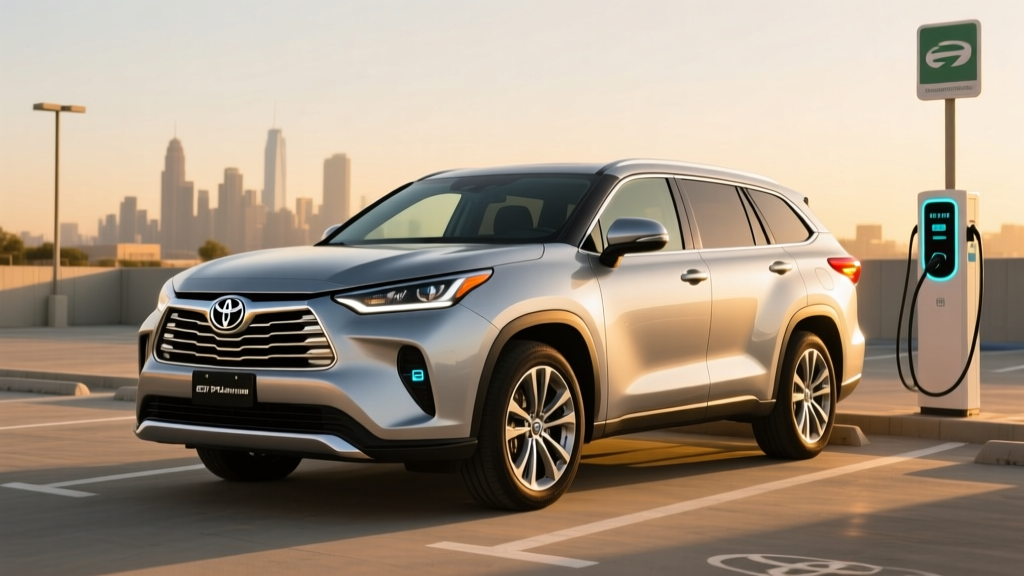
The 2022 Toyota Highlander Hybrid Platinum sits at the top of Toyota's three-row hybrid SUV lineup, pairing a 2.5-liter four-cylinder engine with two electric motors for all-wheel drive and an EPA-estimated 35 MPG combined. For families who need three rows, cargo space, and low running costs without ever plugging in, this trim remains one of the most practical choices on the used and certified-pre-owned market in 2026.
This guide breaks down the Platinum trim's real-world fuel economy, powertrain specs, battery longevity, ownership costs, and how it compares to plug-in hybrid and full-electric alternatives — so you can decide whether it's the right fit for your garage.
HEV vs. PHEV: What the Highlander Hybrid Actually Is
Before examining specs, it's critical to understand what you're buying. The 2022 Highlander Hybrid is a conventional hybrid electric vehicle (HEV), not a plug-in hybrid (PHEV). That distinction changes everything about how you use it.
| Feature | HEV (Highlander Hybrid) | PHEV (e.g., Toyota RAV4 Prime) |
|---|---|---|
| Plug-in charging required? | No — charges via regenerative braking and engine | Yes — plug in for electric-only miles |
| Electric-only range | ~1 mile at low speed | 25–42 miles typical |
| Battery size | 1.6 kWh (NiMH, small buffer) | 18.1 kWh (lithium-ion) |
| Federal tax credit (§30D) | Not eligible | Up to $7,500 if eligible |
| Best for | Drivers without home charging access | Drivers with home charging + short commutes |
The Highlander Hybrid's 1.6 kWh nickel-metal hydride battery is small by design. It captures energy from braking and deceleration, then deploys it to assist the gas engine during acceleration and low-speed crawling. You never plug it in — it operates exactly like a conventional car at the fuel pump, just with dramatically better efficiency.
Fuel Economy: EPA Ratings and Real-World MPG
The EPA rates the 2022 Highlander Hybrid (all trims including Platinum, all with standard AWD-i) at:
| Cycle | EPA Estimate | Real-World Expectation |
|---|---|---|
| City | 35 MPG | 33–38 MPG |
| Highway | 35 MPG | 30–34 MPG |
| Combined | 35 MPG | 32–36 MPG |
Source: fueleconomy.gov
Toyota's hybrid system excels in stop-and-go city driving, where the electric motor handles low-speed propulsion and the engine shuts off at stops. In real-world testing, many owners report exceeding the EPA city estimate during warm-weather urban commuting, sometimes hitting 37–38 MPG on flat terrain.
Highway driving is the opposite story. At sustained 70–80 MPH speeds, the gasoline engine does nearly all the work, and the three-row SUV's aerodynamic profile and 4,500-pound curb weight pull efficiency down to 30–34 MPG. Cold weather (below 40°F) typically drops combined economy by 2–4 MPG as the engine runs longer to heat the cabin and maintain battery temperature.
With a 17.1-gallon fuel tank, expect a real-world range of 545–615 miles per fill-up under mixed driving — comfortably more than any battery-electric SUV currently on the market.
Powertrain Specs: Horsepower, Motors, and Drivetrain
| Specification | 2022 Highlander Hybrid Platinum |
|---|---|
| Engine | 2.5L inline-4 (Atkinson cycle) |
| Engine output | 186 HP / 175 lb-ft torque |
| Front electric motor | 134 kW (180 HP) |
| Rear electric motor (AWD-i) | 40 kW (54 HP) |
| Combined net system HP | 243 HP |
| Transmission | eCVT (planetary gearset, no belts) |
| Drivetrain | Electronic on-demand AWD (AWD-i) |
| 0–60 MPH | ~7.8 seconds |
| Towing capacity | 3,500 lbs |
| Curb weight | ~4,540 lbs |
The combined 243 HP figure isn't a simple sum — Toyota's Hybrid Synergy Drive blends engine and motor output through a planetary gearset, so peak combined power is lower than adding individual peaks. The result is smooth, linear acceleration with no gear shifts to interrupt momentum. The eCVT isn't a traditional belt-driven CVT; it's a virtually maintenance-free gearset with no clutches or bands to wear out.
The AWD-i system engages the rear electric motor only when slip is detected or during hard acceleration. There's no mechanical driveshaft to the rear wheels, which saves weight and reduces drivetrain losses. In dry conditions, the Highlander Hybrid operates primarily as a front-wheel-drive vehicle.
Battery Warranty, Lifespan, and Replacement Cost
Hybrid Battery Warranty: Toyota covers the 2022 Highlander Hybrid's traction battery for 10 years / 150,000 miles (whichever comes first) in all 50 states. This applies to both the hybrid battery and all hybrid system components including the inverter and control modules.
Toyota's hybrid battery track record is among the best in the industry. The nickel-metal hydride (NiMH) pack in the 2022 Highlander Hybrid is a mature technology that has powered millions of Toyota hybrids since the original Prius. Real-world data from fleet operators and long-term owners shows these packs routinely lasting 150,000–200,000+ miles before significant degradation.
Unlike full EVs with large lithium-ion packs, the Highlander Hybrid's 1.6 kWh NiMH battery is small and operates within a narrow state-of-charge window (roughly 40–80%), which dramatically reduces stress and extends cycle life. The battery management system never allows a full charge or full discharge.
Replacement cost if the battery fails outside warranty: approximately $2,000–$3,500 for a refurbished or new OEM pack including labor at a Toyota dealer. Independent hybrid specialists often offer replacements for $1,500–$2,500. This is a fraction of EV battery replacement costs ($10,000–$20,000+), and the likelihood of needing one within 200,000 miles is low.
Platinum Trim Pricing and Tax Credit Eligibility
The 2022 Highlander Hybrid Platinum originally carried an MSRP of approximately $50,465 (including destination). As a used or certified pre-owned vehicle in 2026, expect market prices in the $34,000–$42,000 range depending on mileage, condition, and region.
Federal tax credit status: The Highlander Hybrid does not qualify for the IRS §30D Clean Vehicle Credit. That credit applies only to plug-in electric vehicles (BEVs and PHEVs) with sufficient battery capacity. Conventional hybrids like this one are excluded under current IRS rules.
Some states offer their own incentives for hybrid purchases, but these vary widely by jurisdiction and change frequently. Check your state's energy office or department of revenue for current programs.
Platinum Trim Features: What You Get at the Top
The Platinum is the highest trim in the 2022 Highlander Hybrid lineup. Key features over lower trims include:
- Panoramic glass roof with power sunshade
- 12.3-inch touchscreen with navigation and JBL premium audio (11 speakers)
- Heated and ventilated front seats, heated second-row seats
- Heated steering wheel
- 360-degree bird's-eye view camera with perimeter scan
- Head-up display (HUD)
- Premium LED headlights with adaptive front lighting
- 20-inch alloy wheels
- Toyota Safety Sense 2.5+ (pre-collision, lane tracing, adaptive cruise, road sign assist)
- Qi wireless charging pad
- Hands-free power liftgate
The Platinum trades some ride comfort for its 20-inch wheels — road imperfections are more noticeable than on the XLE's 18-inch setup. If ride quality matters more than feature content, the Limited trim (with 20-inch wheels but without the panoramic roof and HUD) or the XLE offer a softer experience at lower cost.
Highlander Hybrid vs. PHEV vs. Full EV: Which Fits You?
Choose the Highlander Hybrid (HEV) if:
- You lack access to home or workplace charging
- You regularly take road trips over 300 miles
- You need three rows and 500+ mile range between stops
- You want EV-like city efficiency with zero behavior change
- You tow occasionally (3,500-lb capacity)
Choose a PHEV (e.g., Toyota Grand Highlander Hybrid, Chrysler Pacifica PHEV) if:
- You have reliable home Level 2 charging
- Your daily commute is under 30–40 miles round trip
- You want electric-only daily driving with gas backup for trips
- You may qualify for the §30D federal tax credit (up to $7,500)
Choose a full EV (e.g., Kia EV9, Tesla Model X) if:
- You have home charging and your daily driving is under 250 miles
- You want zero tailpipe emissions and lowest per-mile energy cost
- You rarely tow and don't need 600-mile single-tank range
- You want maximum federal/state incentives and lowest maintenance costs
The Highlander Hybrid occupies a specific niche: maximum flexibility with minimum infrastructure. If you live in an apartment without charging access, drive 40+ miles daily in mixed conditions, and need three rows, it remains one of the most rational vehicles you can buy.
Reliability and Long-Term Ownership Costs
Toyota's hybrid powertrain is among the most proven in the automotive industry. The 2.5L Atkinson-cycle engine (A25A-FXS) uses a timing chain (not a belt), has no traditional starter motor or alternator to fail, and runs at lower RPMs thanks to electric motor assist — all of which reduce mechanical wear.
The eCVT transmission has no friction bands, clutches, or torque converter. Failure rates are extremely low based on long-term fleet data. Brake pad life is extended significantly (often 80,000–100,000+ miles) because regenerative braking handles most deceleration.
Estimated 5-year ownership costs (based on 15,000 miles/year, $3.50/gallon fuel, average insurance):
- Fuel: ~$5,250 (at 35 MPG combined)
- Maintenance: ~$2,000 (oil changes, filters, tire rotations — no transmission fluid changes required on schedule)
- Insurance: varies by driver, typically 5–15% higher than non-hybrid Highlander
- Depreciation: Highlander Hybrids hold value well; expect ~45–55% value retention at 5 years
Compared to the gas-only 2022 Highlander V6 (rated at 24 MPG combined), the hybrid saves approximately $1,800–$2,200 in fuel costs over 5 years at 15,000 miles/year, partially offsetting its higher purchase price.
Pros
- 35 MPG combined in a three-row SUV — class-leading efficiency
- No plug-in charging required — zero behavior change from gas cars
- 10-year/150,000-mile hybrid battery warranty
- Strong resale value and proven reliability
- Smooth, quiet eCVT powertrain with 243 HP
- Platinum trim loaded with premium features
Cons
- Highway MPG drops to ~30–34 at 75+ MPH
- 20-inch Platinum wheels firm up the ride
- No federal tax credit eligibility
- Third row is tight for adults on long trips
- Infotainment interface feels dated vs. competitors
- Towing limited to 3,500 lbs (some rivals tow 5,000+)
Frequently Asked Questions
How many MPG does the 2022 Toyota Highlander Hybrid Platinum get?
The EPA rates it at 35 MPG city, 35 MPG highway, and 35 MPG combined. Real-world results typically range from 32–38 MPG depending on driving conditions, with city driving often exceeding the EPA estimate and sustained highway driving falling to 30–34 MPG.
Does the Highlander Hybrid need to be plugged in?
No. The 2022 Highlander Hybrid is a conventional hybrid (HEV), not a plug-in hybrid. Its small battery charges through regenerative braking and the gasoline engine. You refuel only at gas stations, exactly like a conventional vehicle.
Is the hybrid battery reliable, and what does replacement cost?
Toyota's NiMH hybrid batteries are among the most durable in the industry, routinely lasting 150,000–200,000+ miles. The battery is covered by a 10-year/150,000-mile warranty. Out-of-pocket replacement costs $2,000–$3,500 at a dealer or $1,500–$2,500 at an independent hybrid specialist.
Does the 2022 Highlander Hybrid qualify for any tax credit?
No. The IRS §30D Clean Vehicle Credit applies only to plug-in electric vehicles (BEVs and PHEVs). Conventional hybrids like the Highlander Hybrid are not eligible. Some states may offer separate incentives — check your state's energy office for current programs.
How does the Platinum trim compare to the Limited and XLE?
The Platinum adds a panoramic roof, head-up display, 360-degree camera, ventilated front seats, heated second-row seats, and premium LED headlights over the Limited. The XLE offers a softer ride on 18-inch wheels and a lower price but fewer luxury features. If ride quality is a priority over features, the XLE or Limited may be preferable.
Can the Highlander Hybrid tow, and how does towing affect MPG?
Yes, the 2022 Highlander Hybrid is rated to tow up to 3,500 lbs with the proper hitch. Expect fuel economy to drop to approximately 18–22 MPG while towing a trailer near maximum capacity, depending on terrain and speed.
Hybrid vs. PHEV vs. EV — which should I choose?
Choose the Highlander Hybrid if you lack home charging or frequently drive 300+ miles. Choose a PHEV if you have home charging and a short commute. Choose a full EV if you have charging access, drive under 250 miles daily, and want the lowest per-mile cost. See the decision framework above for a detailed breakdown.
Sources: U.S. EPA fueleconomy.gov, IRS §30D Clean Vehicle Credit rules, Toyota Highlander Hybrid specifications.