Quick Verdict: The Sportiest Hybrid Sedan That Doesn't Need a Plug
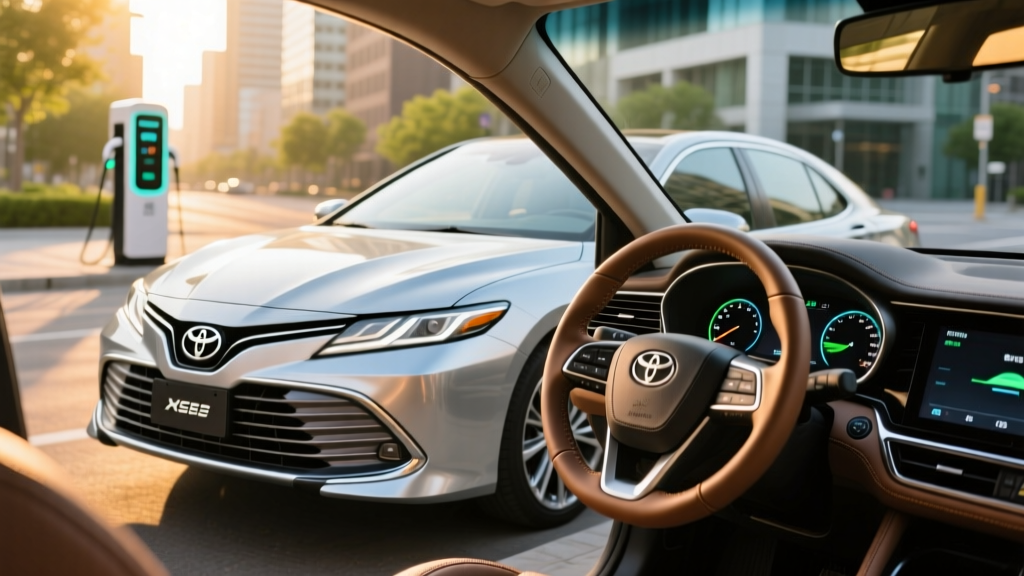
The 2022 Toyota Camry XSE Hybrid occupies a specific niche: buyers who want the fuel savings of electrification without changing their fueling habits. It's a conventional hybrid electric vehicle (HEV), meaning you never plug it in — the gasoline engine and regenerative braking handle all battery charging internally. In the XSE trim, Toyota pairs that efficiency with a sport-tuned suspension, 19-inch alloy wheels, and a 208-horsepower powertrain that makes it genuinely engaging to drive.
Now that we're well into 2026, the 2022 Camry Hybrid has accumulated significant real-world ownership data, making it one of the safest used-hybrid purchases on the market. With EPA ratings of 44 city / 47 highway / 46 combined MPG, a proven hybrid battery track record, and no dependency on charging infrastructure, it remains a compelling alternative to both plug-in hybrids and full battery-electric vehicles for drivers who prioritize simplicity.
Fuel Economy: EPA Ratings and Real-World MPG
The headline number for the 2022 Camry XSE Hybrid is its EPA-estimated fuel economy. Unlike many hybrids that sacrifice highway efficiency for city gains, the XSE Hybrid's 2.5-liter four-cylinder paired with Toyota's Hybrid Synergy Drive delivers strong numbers across the board.
| Metric | Value |
|---|---|
| City MPG | 44 MPG |
| Highway MPG | 47 MPG |
| Combined MPG | 46 MPG |
| Fuel Tank Capacity | 13.2 gallons |
| Total Range | ~607 miles |
Source: EPA Fuel Economy
Real-World MPG: What Owners Actually Report
Toyota hybrids historically perform close to — or slightly above — their EPA estimates in mixed driving, and the 2022 Camry XSE Hybrid is no exception. Owner-reported data on Fuelly and enthusiast forums clusters around 42–48 MPG in combined driving. City-heavy commuters frequently report 46–50 MPG, thanks to the hybrid system's ability to run on electric power at low speeds and recapture energy through regenerative braking. Highway-only driving at 75+ MPH tends to pull figures down to 40–43 MPG, as aerodynamic drag increases and the gas engine works harder.
In cold weather (below 35°F), expect a 5–10% fuel economy reduction during short trips, as the engine runs more frequently to provide cabin heat and reach operating temperature. This is far less severe than the 20–30% range loss a full EV experiences in the same conditions, but it's worth noting for northern-climate drivers.
Powertrain and Performance Specs
The 2022 Camry XSE Hybrid uses Toyota's fourth-generation Hybrid Synergy Drive, pairing a 2.5-liter Dynamic Force inline-four engine with an electric motor integrated into the transaxle. The result is seamless power delivery with no traditional gear shifts.
| Specification | Value |
|---|---|
| Gas Engine | 2.5L 4-cylinder Dynamic Force (176 hp, 163 lb-ft) |
| Electric Motor | 88 kW (118 hp) permanent-magnet synchronous |
| Net System Horsepower | 208 hp |
| Transmission | eCVT (electronically controlled continuously variable) |
| Drivetrain | Front-wheel drive (FWD) |
| 0–60 MPH | ~7.5 seconds |
| Hybrid Battery | ~1.6 kWh lithium-ion (sealed NiMH on some early builds) |
The 208 combined horsepower gives the XSE Hybrid respectable passing power and confident highway merging. The eCVT doesn't have the rubber-band feel of older CVTs — Toyota's planetary gearset design delivers linear, predictable acceleration. The XSE trim specifically adds a sport-tuned suspension with stiffer damping and a quicker steering ratio compared to the LE and SE Hybrid trims, making it the most engaging Camry Hybrid to drive.
Hybrid vs. PHEV vs. Full EV: Which Fits Your Driving Life?
The 2022 Camry XSE Hybrid is an HEV, not a PHEV, and Toyota never offered a plug-in Camry. Understanding where each electrified vehicle type fits helps determine if this is the right car for you — or if you should look elsewhere.
| Factor | HEV (Camry Hybrid) | PHEV (e.g., RAV4 Prime) | BEV (e.g., Tesla Model 3) |
|---|---|---|---|
| Plug-in Required? | No | Yes (for EV range) | Yes (always) |
| Electric-Only Range | ~1 mile at low speed | 25–42 miles | 250–350+ miles |
| Fuel/Charging Cost | Gas only (~$0.08–0.12/mi) | Gas + electricity | Electricity (~$0.03–0.06/mi) |
| Home Charging Install | Not needed | Level 2 recommended ($500–2,000) | Level 2 essential ($500–2,500) |
| Federal Tax Credit (§30D) | Not eligible | Up to $7,500 (if eligible) | Up to $7,500 (if eligible) |
| Best For | No home charging access; long highway commutes | Short daily commute + occasional road trips | Home charging + mostly under 250 mi/day |
- You rent or live in an apartment/condo without charging access
- Your commute is primarily highway (where PHEVs lose their EV-range advantage)
- You want zero behavior change — just fill up at any gas station
- You drive 15,000+ miles/year and want consistently low fuel costs without planning
- You have reliable Level 2 home charging and a commute under 40 miles
- You want to eliminate or drastically reduce gasoline purchases
- You qualify for the full $7,500 federal tax credit on a qualifying PHEV or BEV
Pricing, Tax Credits, and Used Market Value
When new, the 2022 Toyota Camry XSE Hybrid carried an MSRP of approximately $32,260 (before destination charges). As of early 2026, used examples typically list between $22,000 and $28,000 depending on mileage, condition, and regional demand, according to Kelley Blue Book and dealer inventory data.
Federal Tax Credit Status
The 2022 Camry XSE Hybrid does not qualify for the IRS §30D Clean Vehicle Credit. This credit applies exclusively to plug-in electric vehicles (PHEVs and BEVs) with a battery capacity of at least 7 kWh. The Camry Hybrid's ~1.6 kWh battery is far below this threshold. No federal tax credit is available for conventional hybrids purchased new or used.
Some states offer their own incentives for hybrid vehicles, though these are increasingly rare as policy has shifted toward plug-in vehicles. Check your state's department of energy or revenue website for current programs. As always, consult a tax professional for personalized guidance on credits and deductions.
Battery Reliability, Warranty, and Replacement Costs
Hybrid battery longevity is the number-one concern for used hybrid buyers. The good news: Toyota's hybrid battery track record is among the best in the industry, built on over two decades of data since the original Prius.
- Hybrid Battery: 10 years / 150,000 miles (whichever comes first) in states that adopted California's CARB standards; 8 years / 100,000 miles in other states
- Hybrid System Components: 8 years / 100,000 miles nationwide
- Basic Powertrain Warranty: 5 years / 60,000 miles
Real-World Battery Lifespan
Toyota's hybrid batteries in the Camry have demonstrated excellent longevity. Fleet data and owner reports suggest most Camry Hybrid batteries reach 150,000–200,000 miles before showing meaningful capacity degradation. Because the battery is small (~1.6 kWh) and Toyota's battery management system keeps it within a narrow state-of-charge window (roughly 40–80%), the cells experience far less stress than a full EV battery that cycles from 10–90% daily.
The hybrid system doesn't rely on the battery for long-distance propulsion — it's a buffer that smooths power delivery and captures regenerative energy. Even a degraded hybrid battery still allows the car to function; you simply lose some fuel economy benefit and electric-only low-speed creep.
Battery Replacement Cost
If the hybrid battery does eventually fail outside of warranty, replacement costs have come down significantly:
- New OEM battery from Toyota: $2,500–$4,000 (parts + labor at a dealership)
- Refurbished/remanufactured battery: $1,200–$2,200 (from authorized refurbishers like Green Bean Battery)
- Individual cell/module replacement: $500–$1,000 (if only specific modules have failed — requires a specialist shop)
For context, a conventional car's transmission replacement often costs $3,000–$5,000. The hybrid battery is a known, manageable expense — not a catastrophic failure point.
Who Should Buy the 2022 Camry XSE Hybrid in 2026?
Four years into its lifecycle, the 2022 Camry XSE Hybrid has proven itself as a low-risk, high-reward used hybrid purchase. Here's the decision framework:
✅ Pros
- 44–47 MPG EPA with real-world numbers that match or exceed
- No plug-in required — zero infrastructure dependency
- Proven Toyota hybrid reliability with 10yr/150k battery warranty in CARB states
- Sport-tuned XSE suspension adds genuine driving engagement
- 607-mile total range — fewer fill-ups on road trips
- Strong resale value; used market holds well
❌ Cons
- No federal tax credit eligibility (HEV, not PHEV/BEV)
- FWD only — no AWD option on the XSE Hybrid (AWD available on LE/SE Hybrid)
- eCVT drone under hard acceleration (common to all hybrid CVTs)
- 19-inch wheels on XSE produce more road noise than lower trims
- ~1.6 kWh battery means virtually no electric-only driving
- Infotainment feels dated compared to 2024+ Toyota systems
Buy this car if: You want maximum fuel efficiency without lifestyle changes, you lack home charging access, or you drive long highway miles where a PHEV's electric range offers no advantage. The XSE trim specifically suits drivers who find most hybrid sedans too numb — the sport suspension and paddle shifters (which simulate stepped gear ratios) add involvement.
Look elsewhere if: You have home charging and a short commute (a PHEV like the Hyundai Tucson Plug-In Hybrid or Toyota RAV4 Prime will save more fuel and may qualify for tax credits), you need all-wheel drive in the XSE trim, or you want the lowest possible per-mile energy cost that only a full BEV provides.
Frequently Asked Questions
How many MPG does the 2022 Toyota Camry XSE Hybrid get?
The EPA rates the 2022 Camry XSE Hybrid at 44 city / 47 highway / 46 combined MPG. Real-world owner reports typically cluster between 42–48 MPG combined, with city-heavy driving sometimes reaching 50 MPG and sustained high-speed highway driving dropping to 40–43 MPG.
Can the 2022 Camry XSE Hybrid be plugged in?
No. The 2022 Camry XSE Hybrid is a conventional hybrid (HEV), not a plug-in hybrid (PHEV). Its small ~1.6 kWh battery charges exclusively through the gasoline engine and regenerative braking. There is no charging port and no meaningful electric-only driving range.
Does the 2022 Camry Hybrid qualify for a federal tax credit?
No. The IRS §30D Clean Vehicle Credit requires a plug-in vehicle with at least 7 kWh of battery capacity. The Camry Hybrid's ~1.6 kWh battery does not meet this threshold. No federal tax credit is available for conventional hybrids, new or used. Some states may offer separate incentives — check your state's energy department website.
Is the 2022 Camry XSE Hybrid reliable?
Yes. Toyota's hybrid powertrain is one of the most proven in the automotive industry, with over 25 years of production data. The 2022 Camry carries a hybrid battery warranty of 10 years/150,000 miles (CARB states) or 8 years/100,000 miles (non-CARB). The 2022 Camry earned an IIHS Top Safety Pick+ rating and a 5-star overall NHTSA safety rating, reflecting strong crash-test performance. Long-term hybrid battery failures before 150,000 miles are uncommon.
What does it cost to replace the hybrid battery?
Out-of-warranty replacement costs range from approximately $1,200 for a refurbished unit to $4,000 for a new OEM battery installed at a Toyota dealership. Individual module replacement at a hybrid specialist shop can cost $500–$1,000 if the failure is localized. Given the battery's proven longevity, most owners never face this expense.
How does the Camry Hybrid compare to a full EV in cost per mile?
At 46 MPG combined and $3.20/gallon gasoline (2026 national average), the Camry Hybrid costs approximately $0.07 per mile in fuel. A comparable EV like the Tesla Model 3, charged at home at $0.13/kWh and consuming 26 kWh/100mi, costs roughly $0.034 per mile. The EV saves about $0.036 per mile, or $540 per year at 15,000 miles — but requires home charging access and a higher purchase price. The Camry Hybrid wins on simplicity and upfront cost; the EV wins on per-mile energy cost.