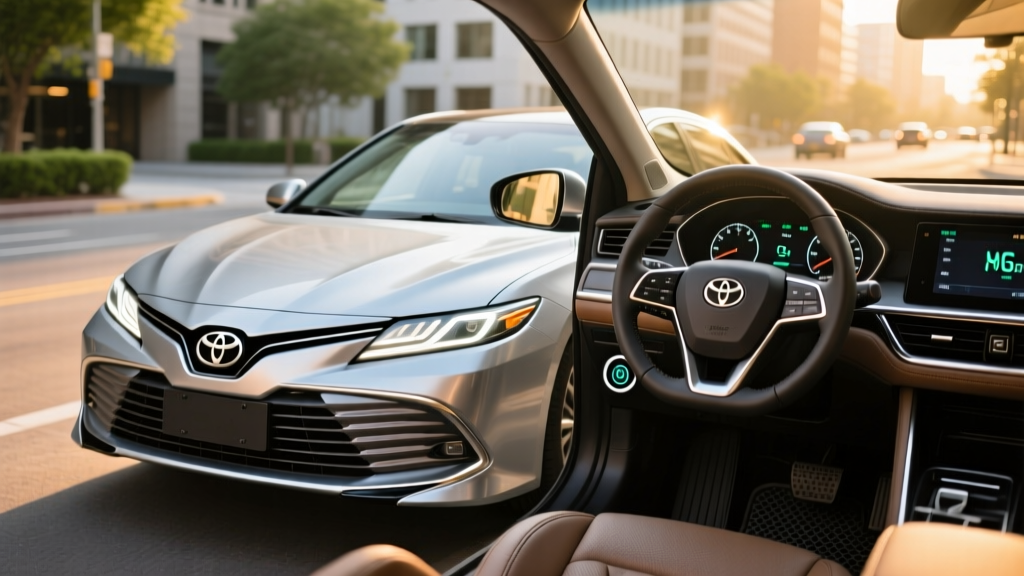
The 2022 Toyota Camry Hybrid remains one of the most fuel-efficient midsize sedans on the road, blending a proven hybrid powertrain with everyday practicality. Even as newer models have arrived, this generation continues to attract buyers who want serious MPG without plugging in, range anxiety, or a steep learning curve. In this guide, we cover the exact EPA figures, real-world fuel economy expectations, battery longevity, and how this conventional hybrid (HEV) stacks up against plug-in hybrids and full battery-electric vehicles.
HEV vs PHEV: What the 2022 Camry Hybrid Actually Is
Before diving into specs, it is critical to distinguish the two hybrid architectures Toyota offers across its lineup, because buyers frequently confuse them:
Conventional Hybrid (HEV) — 2022 Camry Hybrid
- No plug required. The battery charges via regenerative braking and the gasoline engine.
- Battery: 1.6 kWh nickel-metal hydride (NiMH) traction battery — far too small for meaningful electric-only driving.
- Electric-only range: Under 1 mile at very low speeds. Not designed for plug-in operation.
- Refueling: Gasoline only, at any station.
- Federal tax credit: Not eligible under IRS §30D (that credit requires plug-in capability and minimum battery capacity).
Plug-In Hybrid (PHEV) — e.g., Toyota RAV4 Prime
- Plugs in to charge. Larger battery (typically 18.1 kWh) enables 40+ miles of electric-only driving.
- DC fast charging: Some PHEVs support it; most Toyota PHEVs charge via Level 1 or Level 2 AC only.
- Federal tax credit: May qualify for up to $7,500 under §30D, subject to MSRP caps, income limits, and battery-sourcing requirements.
The 2022 Camry Hybrid is strictly an HEV. If you are searching for a Camry you can plug in, Toyota does not offer a Camry PHEV in the US market. The closest Toyota PHEV sedan alternative was the Prius Prime.
Fuel Economy: EPA Ratings and Real-World MPG
The 2022 Camry Hybrid comes in three trims — LE, SE, and XLE — and fuel economy varies slightly by trim due to wheel size, weight, and aerodynamic differences.
| Trim | City MPG | Highway MPG | Combined MPG |
|---|---|---|---|
| LE | 51 | 53 | 52 |
| SE | 44 | 47 | 46 |
| XLE | 44 | 47 | 46 |
Source: EPA / fueleconomy.gov
The LE trim's 52 MPG combined is exceptional for a midsize sedan. The SE and XLE trims drop to 46 combined due to larger 18- or 19-inch wheels, a sport-tuned suspension, and additional equipment weight.
Real-World MPG: What Owners Actually See
Toyota's hybrid synergy drive system excels in stop-and-go city driving, where the electric motor handles low-speed propulsion and regenerative braking recaptures energy. Many owners report exceeding the EPA city estimate in urban conditions — 53-56 MPG is achievable on the LE in warm weather with moderate acceleration.
Highway driving tells a different story. At sustained 70-80 mph speeds, the gasoline engine does most of the work, and real-world highway MPG for the LE typically falls to 46-49 MPG. Cold weather (below 40°F) reduces efficiency by roughly 5-10% as the engine runs more frequently to maintain cabin heat and battery temperature.
Real-world fuel economy summary (LE trim): Expect 48-54 MPG combined depending on driving mix. City-heavy commuters will see the high end; highway-dominant drivers should plan for the low-to-mid 40s. Cold climates knock off 2-4 MPG on average.
Powertrain Specs: Engine, Motor, and Combined Output
| Specification | 2022 Camry Hybrid |
|---|---|
| Engine | 2.5L 4-cylinder Atkinson cycle |
| Engine horsepower | 176 hp @ 5,700 rpm |
| Electric motor | Permanent magnet synchronous (front axle) |
| Motor horsepower | 118 hp |
| Net combined system output | 208 hp |
| Transmission | Electronically controlled CVT (eCVT) |
| Drivetrain | Front-wheel drive (FWD); AWD available on LE/SE |
| AWD system (when equipped) | Independent rear electric motor, 40 hp, engages up to 43 mph or on slip |
| 0-60 mph (est.) | ~7.2 seconds (FWD) |
| Traction battery | 1.6 kWh NiMH (sealed, no plug) |
The 208 combined horsepower is competitive with turbocharged 4-cylinder rivals and delivers confident highway merging. The eCVT is not a belt-and-pulley CVT — it uses a planetary gearset to blend engine and motor power, which is why Toyota hybrids avoid the "rubber band" feel of conventional CVTs.
The available electronic AWD adds a dedicated 40-hp rear motor that activates only when front-wheel slip is detected or during hard acceleration from a stop. It disengages above 43 mph to preserve fuel economy. AWD-equipped models lose roughly 1-2 MPG combined versus their FWD counterparts.
Battery Warranty, Lifespan, and Replacement Cost
Hybrid battery longevity is the single most common concern among prospective buyers. Here is what the data shows for the 2022 Camry Hybrid:
Toyota Hybrid Battery Warranty
- Hybrid battery: 10 years / 150,000 miles (whichever comes first) for 2020 and newer model years, including the 2022 Camry Hybrid.
- Hybrid system components (inverter, motor, control module): 8 years / 100,000 miles.
- Transferability: The hybrid battery warranty transfers to subsequent owners at no cost.
How Long Do Toyota Hybrid Batteries Actually Last?
Toyota's NiMH hybrid batteries have an outstanding longevity track record. Data from fleet operators, taxi services, and high-mileage owners shows that first- and second-generation Camry Hybrid batteries routinely reach 180,000-250,000 miles before needing replacement. The 2022 model's updated NiMH pack benefits from improved thermal management and shallower cycle depths, which further extends life.
The key insight: Toyota's hybrid system never fully charges or fully depletes the battery. It operates within a roughly 40-80% state-of-charge window, dramatically reducing degradation compared to full EV batteries that routinely cycle across a wider range.
Battery Replacement Cost
If the hybrid battery does eventually fail outside of warranty, here is what replacement looks like:
- New OEM Toyota battery: $2,500-$4,000 (parts) + $500-$1,000 (labor) = approximately $3,000-$5,000 total.
- Refurbished/remanufactured battery: $1,500-$2,500 total installed.
- Individual module replacement: Some independent hybrid specialists replace only the failed modules within the pack for $500-$1,500, though this is a temporary fix if multiple modules are degrading.
For context, a conventional automatic transmission replacement on a gas-only midsize sedan often costs $3,500-$5,500 — so hybrid battery replacement is in a similar range and far less likely to be needed within the first 15 years of ownership.
Pricing and Tax Credit Eligibility
| Trim | Original 2022 MSRP | Current Used Market (2026 est.) |
|---|---|---|
| LE | $27,495 | $18,000-$22,000 |
| SE | $28,995 | $19,500-$24,000 |
| XLE | $32,495 | $22,000-$27,000 |
Note: Prices vary by mileage, condition, and region. AWD adds approximately $1,400 to original MSRP.
Does the 2022 Camry Hybrid Qualify for Any Tax Credit?
No. The 2022 Camry Hybrid is a conventional HEV and does not qualify for the federal IRS §30D clean vehicle credit. That credit requires a plug-in vehicle (BEV or PHEV) with a minimum battery capacity of 7 kWh for new vehicles, or 4 kWh for used EVs under the §25E used clean vehicle credit.
Some states previously offered rebates for conventional hybrids, but most have shifted incentive programs to plug-in vehicles. Check your state energy office for any remaining local programs, but plan your purchase assuming no incentives.
If tax credits are a priority and you want a Toyota with plug-in capability, consider a used RAV4 Prime (PHEV, 42 miles electric-only) or a used Prius Prime — both may qualify for the §25E used clean vehicle credit of up to $4,000 (30% of sale price, capped at $4,000) if purchased from a dealer for under $25,000 and you meet income requirements. See IRS §25E rules for full eligibility details.
Reliability Ratings and Ownership Costs
The Camry Hybrid benefits from one of the strongest reliability reputations in the industry. Key data points:
- IIHS: The 2022 Camry earned a Top Safety Pick+ rating with good ratings across all crashworthiness tests.
- NHTSA: 5-star overall safety rating.
- Consumer Reports (historical): Toyota Camry Hybrid has consistently scored above average in predicted reliability.
- Maintenance: No oil changes more frequently than a gas car (Toyota recommends 10,000-mile intervals with synthetic oil). The regenerative braking system extends brake pad life significantly — many owners report 80,000-100,000 miles on original brake pads.
5-Year Estimated Cost of Ownership
Assuming 15,000 miles/year, $3.50/gallon regular unleaded, and the LE trim at 52 MPG combined:
- Annual fuel cost: ~$1,010 (vs. ~$1,925 for a 27 MPG gas-only midsize sedan)
- 5-year fuel savings vs. gas equivalent: ~$4,500-$5,000
- Insurance: Typically 5-10% higher than the gas Camry due to hybrid-specific repair costs
- Maintenance: Comparable to gas Camry; slightly lower brake wear offsets the hybrid system check
2022 Camry Hybrid vs. PHEV vs. Full EV: Which Should You Choose?
This is the decision that trips up many buyers. Here is a practical framework:
Choose the 2022 Camry Hybrid (HEV) if:
- You cannot charge at home (apartment, street parking, no garage).
- You drive 15,000+ miles/year and want maximum fuel savings with zero behavior change.
- You take frequent long road trips (400+ miles) and do not want to plan around charging stops.
- You want a proven, low-risk powertrain with a decade of warranty coverage.
- Your budget is under $25,000 (used market).
Choose a PHEV (e.g., Toyota Prius Prime, Hyundai Tucson PHEV) if:
- You can charge at home (Level 1 or Level 2) and have a commute under 40 miles round-trip.
- You want to drive mostly on electricity daily but need gas flexibility for road trips.
- You want to reduce gasoline consumption by 70-90% without full EV commitment.
Choose a Full EV (e.g., Tesla Model 3, Hyundai Ioniq 6) if:
- You can install a Level 2 home charger (240V).
- Your daily driving is under 250 miles and you are comfortable with public DC fast charging for road trips.
- You want the lowest per-mile energy cost (electricity at $0.13/kWh ≈ $4.50 per "gallon equivalent").
- You want to qualify for federal tax credits ($7,500 new / up to $4,000 used, subject to eligibility).
Pros
- 52 MPG combined (LE) — among the highest of any midsize sedan
- No plug-in required; zero behavior change from a gas car
- 10-year/150,000-mile hybrid battery warranty
- Top Safety Pick+ from IIHS
- Strong resale value and proven reliability record
- AWD available — rare in the hybrid sedan segment
- Brake pads last 80K-100K miles thanks to regen
Cons
- No federal or state tax credit eligibility
- SE and XLE trims drop to 46 MPG combined
- Modest 208 hp — adequate but not sporty
- Rear battery placement slightly reduces trunk pass-through
- Infotainment is dated compared to 2024+ Toyota systems
- No plug-in variant available in the US
Frequently Asked Questions
How many MPG does the 2022 Toyota Camry Hybrid get?
The LE trim achieves an EPA-estimated 51 city / 53 highway / 52 combined MPG. The SE and XLE trims are rated at 44 city / 47 highway / 46 combined. Real-world results vary: city-heavy drivers often exceed the EPA estimate by 2-4 MPG, while sustained highway driving at 75+ mph typically yields 46-49 MPG on the LE.
Does the 2022 Camry Hybrid need to be plugged in?
No. The 2022 Camry Hybrid is a conventional hybrid (HEV), not a plug-in hybrid (PHEV). The small 1.6 kWh battery charges entirely through regenerative braking and the gasoline engine. You refuel it like any gas car — with no plug, no charging cable, and no home charger installation required.
Is the 2022 Camry Hybrid reliable, and what does battery replacement cost?
Yes. Toyota's hybrid system is among the most reliable powertrains in the automotive industry, with hybrid batteries routinely lasting 180,000-250,000 miles. The battery is covered by a 10-year/150,000-mile warranty. Out-of-warranty replacement costs approximately $3,000-$5,000 for a new OEM battery, or $1,500-$2,500 for a refurbished unit.
Does the 2022 Camry Hybrid qualify for any tax credit?
No. Federal tax credits under IRS §30D (new vehicles) and §25E (used vehicles) require plug-in capability — either a full battery-electric vehicle (BEV) or a plug-in hybrid (PHEV). The Camry Hybrid is a conventional HEV with no plug, so it does not qualify for any federal EV tax credit. State incentives for conventional hybrids are extremely rare as of 2026.
How does the Camry Hybrid compare to a full EV for daily commuting?
If you can charge at home, a full EV will cost roughly 60-70% less per mile to "fuel" (about $0.04-$0.05 per mile on electricity vs. $0.07-$0.08 per mile on gasoline at 52 MPG and $3.50/gallon). However, the Camry Hybrid requires zero infrastructure investment — no Level 2 charger, no electrical panel upgrade, no charging apps — and handles any road trip without route planning. For apartment dwellers or high-mileage road-trippers, the HEV remains the more practical choice.
Is AWD worth it on the 2022 Camry Hybrid?
If you live in a region with snow or frequent rain, the electronic AWD system provides meaningful traction benefits during acceleration from stops and in low-grip conditions. The trade-off is roughly 1-2 MPG combined and about $1,400 in additional cost. For mild-climate drivers who prioritize maximum fuel economy, FWD on the LE trim is the optimal choice.