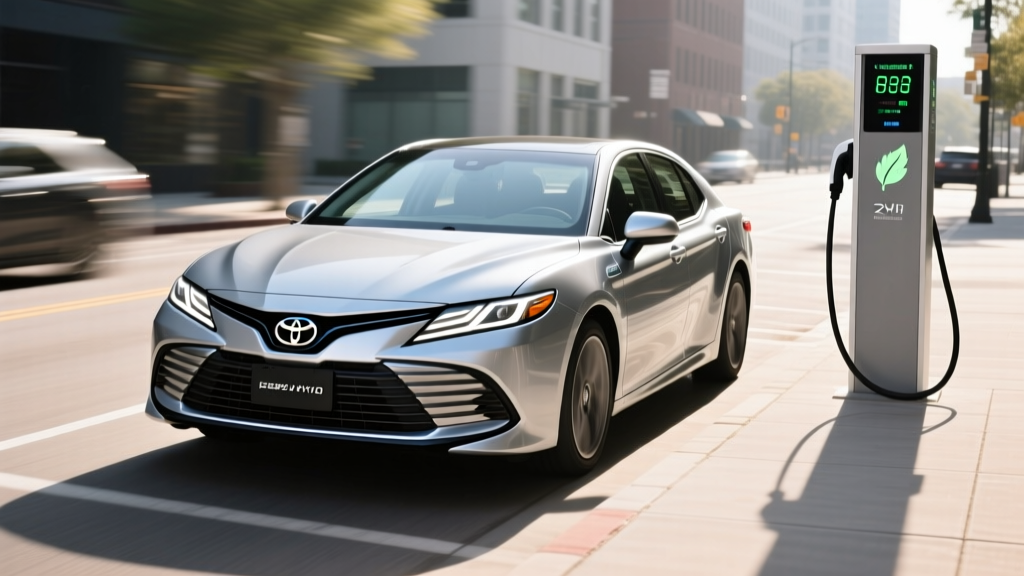
The 2022 Toyota Camry Hybrid occupies a specific niche: a midsize sedan that squeezes maximum fuel economy out of every gallon without requiring a plug, a lifestyle change, or a steep price premium. With an EPA-estimated 52 MPG combined on the LE trim, it remains one of the most efficient non-plug-in vehicles on the road. But does that sticker number hold up in real-world driving, and how does it stack up against a plug-in hybrid or a full battery-electric vehicle in 2026?
This guide breaks down the 2022 Camry Hybrid's fuel economy, powertrain, battery longevity, warranty coverage, and total ownership economics — with the exact numbers you need to make a decision.
2022 Toyota Camry Hybrid MPG: EPA Ratings and Real-World Results
The 2022 Camry Hybrid is available in three trims — LE, SE, and XLE — and fuel economy varies slightly depending on wheel size and equipment weight.
| Trim | City MPG | Highway MPG | Combined MPG | Est. Range (mi) |
|---|---|---|---|---|
| LE | 51 | 53 | 52 | ~620 |
| SE | 44 | 47 | 46 | ~550 |
| XLE | 44 | 47 | 46 | ~550 |
The LE trim achieves its higher numbers through lighter 16-inch wheels, lower rolling-resistance tires, and slightly less equipment weight. The SE and XLE trims step up to 18- or 19-inch wheels, trading roughly 6 MPG for sportier handling and more features.
Toyota's hybrid system excels in stop-and-go city driving, where the electric motor handles low-speed propulsion and regenerative braking recaptures energy. In real-world testing, Camry Hybrid LE owners frequently report city MPG in the mid-to-high 50s, exceeding the EPA city estimate. Highway cruising at 75+ MPH tends to land closer to 45–48 MPG, as the gasoline engine does the bulk of the work at sustained speeds. Expect a blended real-world average of 47–52 MPG depending on driving style, climate, and terrain. Cold weather can reduce efficiency by 5–10% due to increased engine runtime for cabin heating.
For reference, the non-hybrid 2022 Camry with the 2.5L four-cylinder earns 28 city / 39 highway / 32 combined — a 20 MPG gap that makes a meaningful difference over years of ownership.
Powertrain Specs: How the Camry Hybrid System Works
| Specification | Detail |
|---|---|
| Engine | 2.5L inline-4 Atkinson cycle |
| Engine Output | 176 hp / 163 lb-ft torque |
| Electric Motor | Permanent magnet synchronous, 88 kW (118 hp) |
| Combined Net Horsepower | 208 hp |
| Transmission | eCVT (planetary gearset, no belt) |
| Drivetrain | FWD standard; AWD available (SE/XLE) |
| Hybrid Battery | 1.6 kWh (nominal), NiMH pack |
| 0–60 MPH | ~7.2 seconds (FWD) |
The Camry Hybrid uses Toyota's fourth-generation Hybrid Synergy Drive. The Atkinson-cycle 2.5L engine prioritizes thermal efficiency over peak power, while the electric motor fills in torque at low RPM. The eCVT isn't a traditional belt-driven continuously variable transmission — it's a planetary gearset that seamlessly blends engine and motor output. This design has proven extremely durable, with no belts, clutches, or friction bands to wear out.
The AWD variant adds a rear-mounted 40 kW electric motor (no mechanical driveshaft), providing traction in slippery conditions. AWD trims carry a minor fuel economy penalty of approximately 1–2 MPG.
HEV vs. PHEV vs. EV: Which Powertrain Fits You?
The 2022 Camry Hybrid is a conventional hybrid electric vehicle (HEV). It does not plug in. It charges its small battery entirely through regenerative braking and the gasoline engine. This is fundamentally different from a plug-in hybrid (PHEV) or a battery-electric vehicle (BEV).
| Factor | HEV (Camry Hybrid) | PHEV (e.g., RAV4 Prime) | BEV (e.g., Tesla Model 3) |
|---|---|---|---|
| Plugs In? | No | Yes (Level 1/2) | Yes (Level 1/2/DC) |
| Battery Size | ~1.6 kWh | ~18 kWh | ~60–82 kWh |
| Electric-Only Range | <1 mi at low speed | 25–42 mi | 250–350+ mi |
| Gasoline Use | Always blended | After EV range depletes | None |
| Fuel/Charging Cost | Gas only | Gas + electricity | Electricity only |
| Federal Tax Credit | Not eligible (§30D) | Up to $7,500* | Up to $7,500* |
| Home Charging Needed? | No | Recommended | Essential |
| Best For | No plug access; want efficiency | Short commutes + road trips | Home charging; low running cost |
*Federal §30D tax credit eligibility for PHEVs and BEVs depends on MSRP caps ($55,000 sedans), buyer income limits, battery component and critical mineral sourcing requirements, and point-of-sale transfer rules. Always verify current-year eligibility on irs.gov and consult a tax professional.
The Camry Hybrid is not a PHEV and does not offer meaningful electric-only driving. If you want plug-in electric range from a Toyota sedan, the closest option as of the 2022 model year was the discontinued Prius Prime. For a current Toyota PHEV, the RAV4 Prime (42 mi electric range) is the primary offering. Toyota does not currently sell a Camry PHEV in the U.S. market.
Ownership Economics: What the Camry Hybrid Actually Costs
The 2022 Camry Hybrid carried an original MSRP starting around $27,480 for the LE trim, rising to approximately $33,000+ for a fully equipped XLE with AWD. On the used market in 2026, expect to pay roughly $22,000–$28,000 depending on mileage and condition.
Fuel Cost Savings vs. Gas Camry
At 15,000 miles per year and $3.50/gallon gasoline:
- Gas Camry (32 combined MPG): ~469 gallons/year = $1,641/year
- Camry Hybrid LE (52 combined MPG): ~288 gallons/year = $1,008/year
- Annual savings: ~$633/year with the hybrid
- 5-year savings: ~$3,165 in fuel alone
The hybrid premium over the gas model was typically $1,500–$2,000 at purchase, meaning the fuel savings alone pay back the hybrid upcharge in roughly 2.5–3 years — before accounting for potentially lower maintenance costs.
Tax Credit Eligibility
Conventional hybrids like the Camry Hybrid do not qualify for the federal §30D Clean Vehicle Credit, which is reserved for plug-in hybrids and battery-electric vehicles with battery capacities of at least 7 kWh. Some states may offer minor incentives for hybrid purchases, but these vary by jurisdiction and change frequently. Check your state's energy office or fueleconomy.gov for current incentives.
Battery Longevity, Warranty, and Replacement Costs
Hybrid battery reliability is consistently the top concern among first-time hybrid buyers. Here are the facts on the 2022 Camry Hybrid's battery system.
- Coverage: 10 years / 150,000 miles (whichever comes first) for 2020+ model years
- What's covered: Hybrid battery pack and hybrid system components (inverter, eCVT, control modules)
- Capacity threshold: Toyota warrants against defects and abnormal loss of capacity; there is no published minimum SoH percentage, but real-world degradation on Toyota NiMH packs is typically 10–15% over 10 years
- Transferable: Yes, the warranty transfers to subsequent owners at no cost
Toyota's hybrid battery track record is among the strongest in the industry. The NiMH chemistry used in the Camry Hybrid is less energy-dense than the lithium-ion packs in EVs, but it is extremely stable and tolerant of daily shallow charge/discharge cycles. Taxi fleets using Toyota hybrids routinely exceed 300,000 miles on the original battery pack.
Battery Replacement Cost
If the hybrid battery does fail outside of warranty, replacement costs for a 2022 Camry Hybrid are approximately:
- New OEM pack (dealer): $3,000–$4,000 installed
- Refurbished/remanufactured pack: $1,500–$2,500 installed
- Individual cell replacement (specialist shops): $800–$1,500
Given the 10-year/150,000-mile warranty and the historical durability of Toyota's NiMH packs, most owners will never face a hybrid battery replacement. According to reliability data from IIHS and long-term owner surveys, Toyota's hybrid system remains one of the lowest-risk electrified powertrains on the market.
Safety, Reliability Ratings, and Maintenance
The 2022 Camry Hybrid earned strong safety credentials:
- NHTSA Overall Rating: 5 stars — see nhtsa.gov
- IIHS Rating: Top Safety Pick+ (with specific headlight configurations)
- Toyota Safety Sense 2.5+ (standard): Pre-Collision System with Pedestrian Detection, Full-Speed Range Dynamic Radar Cruise Control, Lane Departure Alert with Steering Assist, Lane Tracing Assist, Automatic High Beams, Road Sign Assist
Note: Toyota Safety Sense features are SAE Level 2 driver-assistance. The driver must remain attentive and keep hands on the steering wheel. These systems assist with steering, braking, and acceleration but do not drive the vehicle autonomously.
Maintenance on the Camry Hybrid is straightforward. There is no conventional transmission fluid to change (the eCVT uses Toyota ATF WS fluid checked at intervals), no starter motor to replace, and regenerative braking extends brake pad life significantly — many owners report original brake pads lasting 80,000+ miles. Toyota recommends synthetic 0W-16 oil changes every 10,000 miles.
Pros and Cons of the 2022 Camry Hybrid
Pros
- Class-leading 52 MPG combined (LE trim)
- No plug-in charging required
- 10-year / 150,000-mile hybrid battery warranty
- Strong safety ratings (NHTSA 5-star, IIHS TSP+)
- Proven, durable eCVT powertrain
- Competitive pricing; fast payback vs. gas model
- Spacious trunk (15.1 cu ft) — no battery intrusion
Cons
- No electric-only driving mode for emissions-free zones
- Not eligible for federal §30D tax credit
- SE/XLE trims drop to 46 MPG combined
- NiMH battery (not Li-ion) — heavier, less energy-dense
- CVT-like engine drone under hard acceleration
- No DC fast charging capability (not applicable for HEV)
- AWD hybrid only available on SE and XLE trims
Who Should Buy the 2022 Camry Hybrid?
Choose the Camry Hybrid if:
- You don't have access to home or workplace charging
- You want maximum MPG without changing your fueling habits
- You drive 15,000+ miles/year and want to minimize fuel cost
- You want a proven, low-risk hybrid system with a long warranty
- You prefer a traditional sedan form factor over an SUV
Consider a PHEV instead if:
- You have home charging and a commute under 30 miles round-trip
- You want some electric-only driving for local errands
- You want eligibility for the federal §30D tax credit (up to $7,500)
Consider a full BEV instead if:
- You have reliable home Level 2 charging
- You want zero tailpipe emissions and minimal maintenance
- Your daily driving is under 250 miles and you can plan road-trip charging
- You want the lowest per-mile fuel cost (electricity vs. gasoline)
Frequently Asked Questions
How many MPG does the 2022 Toyota Camry Hybrid get?
The 2022 Camry Hybrid LE earns an EPA-estimated 51 city / 53 highway / 52 combined MPG. The SE and XLE trims rate at 44 city / 47 highway / 46 combined. Real-world city driving often exceeds EPA estimates, while sustained highway driving at high speeds may fall slightly below.
Does the 2022 Camry Hybrid need to be plugged in?
No. The Camry Hybrid is a conventional hybrid (HEV). It charges its battery through regenerative braking and the gasoline engine. You fuel it exactly like a regular gas car — no plug, no charging cable, no change in routine.
How long will the Camry Hybrid battery last?
Toyota covers the hybrid battery for 10 years or 150,000 miles. In practice, Toyota's NiMH hybrid packs have demonstrated exceptional longevity, with many exceeding 200,000–300,000 miles before needing replacement. Degradation is gradual and typically limited to 10–15% capacity loss over a decade.
What does it cost to replace the hybrid battery?
A new OEM replacement runs approximately $3,000–$4,000 installed at a dealer. Refurbished packs are available for $1,500–$2,500. However, given Toyota's warranty coverage and track record, most owners will never need a replacement.
Does the 2022 Camry Hybrid qualify for a tax credit?
No. The federal §30D Clean Vehicle Credit requires a plug-in vehicle with at least 7 kWh of battery capacity. The Camry Hybrid's ~1.6 kWh NiMH pack does not qualify. It is also not eligible for most state EV incentives, which target PHEVs and BEVs. Some states may offer minor hybrid-specific rebates — check your local energy office.
Is the Camry Hybrid more reliable than the gas Camry?
Historically, yes. The hybrid system has fewer wear items than a conventional powertrain: no traditional transmission, no starter motor, no alternator, and regenerative braking reduces brake wear. Toyota's hybrid components have demonstrated extremely low failure rates across millions of vehicles sold globally since 1997.
Camry Hybrid vs. a full EV — which saves more money?
A full BEV typically has lower per-mile fuel and maintenance costs, but higher upfront pricing and the requirement for home charging. If you drive 15,000 miles/year, a BEV might save $800–$1,200/year in fuel vs. the Camry Hybrid, but the purchase price gap (often $10,000+) and charging infrastructure needs may offset those savings. The Camry Hybrid is the lower-risk, lower-commitment path to better efficiency.
Sources: fueleconomy.gov — 2022 Toyota Camry Hybrid, NHTSA 2022 Camry Safety Ratings, IRS Clean Vehicle Tax Credits.