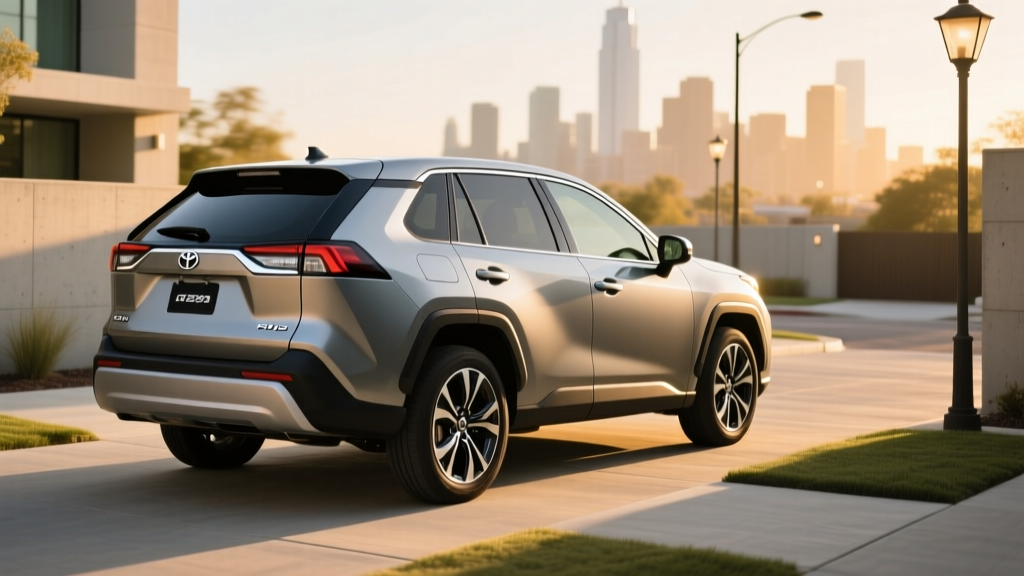
The 2022 Toyota RAV4 Hybrid remains one of the most sought-after used compact SUVs in 2026, and for good reason. With an EPA-rated 40 MPG combined, standard all-wheel drive, and Toyota's proven hybrid reliability, it bridges the gap between conventional gas vehicles and full electric ownership without requiring any change in driving habits. Whether you're shopping the used market or evaluating whether a conventional hybrid (HEV) or the plug-in RAV4 Prime (PHEV) better suits your commute, this guide covers every spec, cost, and ownership reality you need to know.
2022 RAV4 Hybrid Fuel Economy: EPA vs Real-World MPG
The 2022 RAV4 Hybrid carries identical EPA ratings across all trims (LE, XLE, XLE Premium, SE, XSE, Limited), since every trim shares the same hybrid powertrain and comes with electronic on-demand all-wheel drive as standard equipment.
| Metric | EPA Estimate | Real-World Expectation |
|---|---|---|
| City MPG | 41 MPG | 42–46 MPG (hybrids excel in stop-and-go) |
| Highway MPG | 38 MPG | 34–37 MPG (sustained 70+ mph driving) |
| Combined MPG | 40 MPG | 38–42 MPG (mixed driving) |
| Fuel Tank Capacity | 14.5 gallons | — |
| Total Range | ~580 miles | ~520–600 miles depending on conditions |
According to fueleconomy.gov, the 2022 RAV4 Hybrid's 40 MPG combined saves an estimated $2,750 in fuel costs over five years compared to the average new vehicle, based on 15,000 miles per year at $3.50/gallon. With 2026 fuel prices, savings may be even greater.
Powertrain Specs: Engine, Motors, and Horsepower
The 2022 RAV4 Hybrid uses Toyota's fourth-generation hybrid system (THS IV), pairing a 2.5-liter Dynamic Force four-cylinder engine with front and rear electric motors. The rear motor provides the AWD-i electronic all-wheel-drive system — there is no mechanical driveshaft to the rear axle.
| Component | Specification |
|---|---|
| Engine | 2.5L inline-4 (A25A-FXS), Atkinson cycle |
| Engine Output | 176 HP / 163 lb-ft torque |
| Front Electric Motor | 118 HP / 149 lb-ft (3NM permanent magnet) |
| Rear Electric Motor (AWD-i) | 54 HP / 89 lb-ft |
| Net Combined Horsepower | 219 HP |
| 0–60 MPH | 7.4 seconds (Toyota estimate) |
| Transmission | eCVT (planetary gearset, not belt-driven CVT) |
| Drivetrain | AWD (electronic on-demand rear motor) |
| Hybrid Battery (traction) | 1.6 kWh, nickel-metal hydride (NiMH) |
| Towing Capacity | 1,750 lbs |
The eCVT in the RAV4 Hybrid is not a traditional belt-and-pulley CVT like those found in some competitors. Toyota uses a planetary gearset that seamlessly blends engine and motor power with no belts, chains, or fixed gear ratios. This design is one reason the RAV4 Hybrid powertrain has earned a reputation for exceptional longevity.
HEV vs PHEV: RAV4 Hybrid vs RAV4 Prime
The 2022 model year offered two electrified RAV4 variants: the conventional RAV4 Hybrid (HEV) and the plug-in RAV4 Prime (PHEV). Understanding the distinction is critical for used buyers in 2026.
| Attribute | RAV4 Hybrid (HEV) | RAV4 Prime (PHEV) |
|---|---|---|
| Plug-in Charging | No — self-charging via regen + engine | Yes — plug in for EV range |
| Electric-Only Range | ~0.5 miles at very low speed | 42 miles (EPA) |
| Battery Chemistry | NiMH, 1.6 kWh | Lithium-ion, 18.1 kWh |
| Combined Horsepower | 219 HP | 302 HP |
| 0–60 MPH | 7.4 seconds | 5.7 seconds |
| Charge Time (Level 2, 240V) | N/A | ~2.5 hours (6.6 kW onboard charger) |
| DC Fast Charging | N/A | Not available |
| Combined MPG (hybrid mode) | 40 MPG | 38 MPG (gas) / 94 MPGe (EV+gas) |
| Total Range | ~580 miles | ~600 miles (42 EV + 558 gas) |
| Base MSRP (2022) | $29,075 (LE) | $39,800 (SE) |
| Federal Tax Credit (new) | None | $7,500 (when eligible) |
The RAV4 Hybrid (HEV) never needs to be plugged in. Its small 1.6 kWh NiMH battery charges through regenerative braking and the gas engine. You fuel it like any conventional vehicle — the hybrid system simply makes it far more efficient.
The RAV4 Prime (PHEV) has a much larger 18.1 kWh lithium-ion battery that delivers 42 miles of pure electric driving. You plug it into a standard 120V outlet (~12 hours for full charge) or a 240V Level 2 charger (~2.5 hours). Once the EV range is depleted, it operates as a conventional hybrid at 38 MPG combined. The Prime does not support DC fast charging — its 6.6 kW onboard charger is the maximum charge rate.
Who Should Buy the RAV4 Hybrid vs Prime vs Full EV?
- Choose the RAV4 Hybrid (HEV) if: You lack home charging access, want maximum simplicity, drive 30+ miles daily with mixed city/highway, and prefer the lowest purchase price. Ideal for apartment dwellers and those who don't want to think about charging.
- Choose the RAV4 Prime (PHEV) if: You can install a Level 2 home charger, your daily commute is under 42 miles round-trip, and you want electric daily driving with gas flexibility for road trips. Best for homeowners with a garage or driveway.
- Choose a full EV (e.g., Tesla Model Y, Hyundai Ioniq 5) if: You have reliable home Level 2 charging, want zero tailpipe emissions, your daily driving is under 250 miles, and you want to eliminate oil changes and gas-engine maintenance entirely.
Battery Warranty, Reliability, and Replacement Costs
Hybrid battery longevity is the top concern for used RAV4 Hybrid buyers. Toyota's track record here is among the best in the industry, but the specifics matter.
- Hybrid Battery: 10 years / 150,000 miles (whichever comes first) — applicable in all 50 states for 2022 model year
- Hybrid System Components: 8 years / 100,000 miles (inverter, transaxle, control module)
- Transferability: Full warranty transfers to subsequent owners automatically
- Capacity Threshold: Toyota covers the battery if it falls below a defined performance threshold as determined by dealer diagnostics
For a 2022 model purchased in 2026, the hybrid battery warranty remains active until 2032 or 150,000 miles — providing significant coverage for most used buyers. The NiMH battery in the HEV variant has proven remarkably durable; many Toyota hybrid owners report 200,000+ miles with original battery packs.
Battery Replacement Cost (out of warranty): If the hybrid battery does eventually need replacement, a new OEM NiMH battery pack for the RAV4 Hybrid typically costs between $2,500 and $4,000 installed at a Toyota dealer. Third-party reconditioned batteries can reduce this to $1,500–$2,500. For the RAV4 Prime's larger lithium-ion pack, replacement costs are significantly higher — typically $6,000–$9,000 due to the larger capacity and lithium chemistry.
The eCVT transmission is another reliability highlight. Unlike belt-driven CVTs that can fail around 100,000 miles, Toyota's planetary gearset eCVT has no belts or clutches to wear out. Failures are rare, and many examples exceed 300,000 miles without service. According to IIHS, the 2022 RAV4 earned a Top Safety Pick+ rating, adding confidence to its overall build quality.
2026 Used Pricing and Tax Credit Eligibility
The 2022 RAV4 Hybrid was originally priced from $29,075 (LE) to $37,075 (Limited) before destination charges. In the 2026 used market, well-maintained examples with 30,000–60,000 miles typically sell for:
- LE trim: $24,000–$27,000
- XLE trim: $26,000–$29,000
- XSE / Limited: $28,000–$33,000
The RAV4 Prime commands a significant premium on the used market, often selling for $35,000–$42,000 depending on trim and mileage.
Federal Tax Credit for Used Hybrids and PHEVs
- RAV4 Hybrid (HEV): Does not qualify for any federal tax credit — new or used. Conventional hybrids have never been eligible for the §30D new-vehicle credit or the §25E used-vehicle credit (which requires a plug-in capable vehicle).
- RAV4 Prime (PHEV) — Used: May qualify for the §25E Used Clean Vehicle Credit of up to $4,000 (30% of sale price, capped at $4,000) when purchased from a dealer. Key requirements per IRS guidelines:
- Sale price must be $25,000 or less
- Buyer income limits: $75,000 single / $112,500 head of household / $150,000 joint
- Vehicle must be at least 2 model years old (2022 qualifies in 2026)
- Must purchase from a licensed dealer (private sales excluded)
- Credit is non-refundable and applies only once per buyer per year
Practical reality: Most used RAV4 Primes sell above the $25,000 sale-price cap, making the used-EV credit difficult to claim on this model. The RAV4 Hybrid, while ineligible for credits, offers a lower entry price that may result in a comparable or better total cost of ownership.
Pros, Cons, and Final Verdict
- 40 MPG combined; often exceeds EPA in city driving
- Standard AWD on every trim — rare in the hybrid compact SUV class
- 10-year / 150,000-mile hybrid battery warranty (transfers to used owners)
- Proven eCVT reliability with no belt/pulley failure risk
- 219 HP provides confident highway merging
- No charging infrastructure needed — fuel at any gas station
- Strong resale value; low depreciation relative to competitors
- NiMH battery (not lithium) — older chemistry, slightly heavier
- No federal tax credit eligibility (HEV variant)
- 1,750-lb towing capacity — low for the compact SUV class
- Infotainment system feels dated vs 2025+ competitors (8-inch screen, no wireless CarPlay on lower trims)
- Road noise at highway speeds is above class average
- High used-market demand keeps prices elevated
Frequently Asked Questions
How many MPG does the 2022 RAV4 Hybrid actually get?
The EPA rates it at 41 city / 38 highway / 40 combined MPG. In real-world driving, city commuters often see 43–46 MPG thanks to the electric motor handling low-speed work and regenerative braking. Highway-heavy drivers should expect 34–37 MPG at sustained speeds above 70 mph.
Does the 2022 RAV4 Hybrid need to be plugged in?
No. The RAV4 Hybrid (HEV) is a conventional hybrid that charges its own battery through regenerative braking and the gasoline engine. You simply fill it with gas like any other car. Only the RAV4 Prime (PHEV) variant requires plug-in charging to access its 42-mile electric-only range.
How far can the RAV4 Prime go on electric only?
The 2022 RAV4 Prime achieves 42 miles of EPA-rated electric-only range on a full charge of its 18.1 kWh lithium-ion battery. Real-world EV range is typically 36–42 miles depending on temperature, terrain, and driving style. Highway-speed driving and cold weather reduce this to roughly 30–35 miles.
Is the 2022 RAV4 Hybrid reliable, and what does battery replacement cost?
The 2022 RAV4 Hybrid has an excellent reliability record. Toyota's hybrid system and eCVT are among the most proven in the industry. The hybrid battery is covered by a 10-year / 150,000-mile warranty that transfers to used owners. Out-of-warranty NiMH battery replacement costs $2,500–$4,000 at a dealer, though many packs last well beyond 200,000 miles.
Does the 2022 RAV4 Hybrid qualify for any tax credit?
The conventional RAV4 Hybrid (HEV) does not qualify for any federal tax credit — new or used. The RAV4 Prime (PHEV) may qualify for the §25E Used Clean Vehicle Credit of up to $4,000 when purchased from a dealer for $25,000 or less, subject to buyer income limits. However, most used RAV4 Primes sell above the $25,000 price cap, limiting practical eligibility.
How does the RAV4 Hybrid compare to a full EV for daily driving?
If you lack home charging access or regularly drive more than 250 miles in a day, the RAV4 Hybrid offers better flexibility — no range planning or charging stops needed. If you have Level 2 home charging and a commute under 250 miles, a full EV like the Tesla Model Y or Hyundai Ioniq 5 eliminates fuel costs entirely and reduces maintenance (no oil changes, fewer brake replacements due to regen). The RAV4 Hybrid is the pragmatic choice when charging access is uncertain.