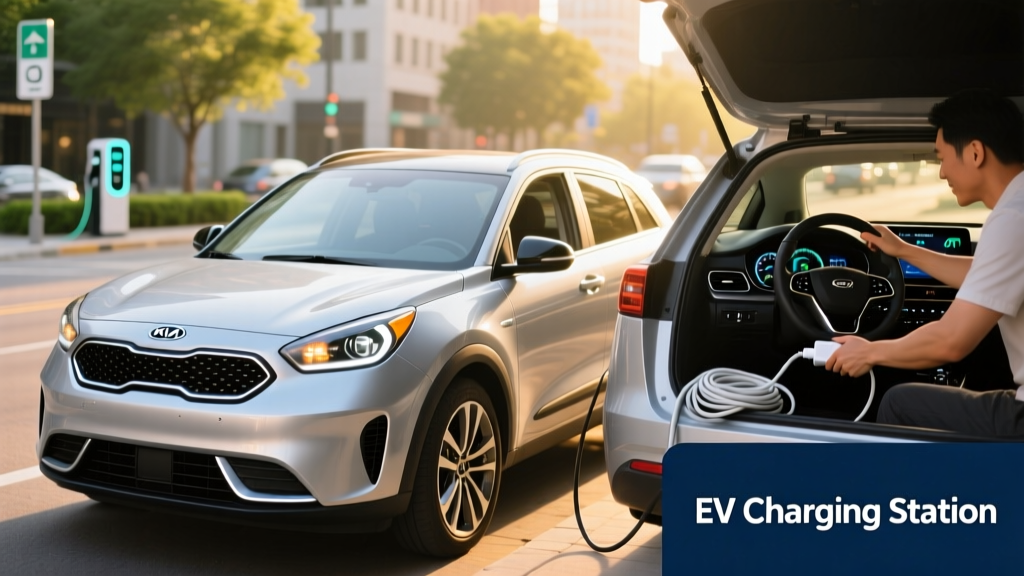
The 2022 Kia Niro Hybrid occupies a specific niche that's increasingly hard to find: a dedicated hybrid crossover that prioritizes fuel economy above all else without demanding the lifestyle changes a full EV or plug-in hybrid requires. With an EPA-estimated 50 MPG combined in its most efficient trim, the Niro HEV remains one of the most fuel-efficient non-plug-in vehicles ever sold in the United States. Now available exclusively on the used market, it presents a compelling value proposition for buyers navigating high fuel prices without home-charging access.
This guide covers every spec that matters — real-world MPG versus the EPA sticker, the hybrid powertrain's engineering, battery longevity and warranty coverage, and whether the 2022 Niro Hybrid qualifies for any federal tax incentives as a used purchase in 2026.
2022 Kia Niro Hybrid: Key Specifications at a Glance
| Specification | 2022 Kia Niro Hybrid (HEV) |
|---|---|
| Powertrain | 1.6L GDI 4-cyl + electric motor (HEV) |
| Combined Horsepower | 139 HP |
| Combined Torque | 195 lb-ft |
| Transmission | 6-speed dual-clutch automatic (DCT) |
| Hybrid Battery | 1.56 kWh lithium-ion polymer |
| EPA MPG (LX/EX trims) | 53 city / 48 highway / 50 combined |
| EPA MPG (Touring/SX Touring) | 46 city / 40 highway / 43 combined |
| Fuel Tank Capacity | 11.9 gallons |
| Total Driving Range | ~595 miles (LX/EX) / ~512 miles (Touring) |
| 0–60 MPH | ~9.8 seconds |
| Cargo Volume | 22.4 cu ft (rear seats up) / 54.5 cu ft (folded) |
| Drivetrain | Front-wheel drive |
| Original MSRP Range | $26,590 – $35,790 |
| Battery Warranty | 10 years / 100,000 miles |
HEV vs. PHEV vs. EV: Which Niro Fits Your Life?
Kia sold the 2022 Niro in three electrified variants — and confusing them is one of the most common mistakes shoppers make. Here's how they differ at a fundamental level:
| Attribute | Niro HEV (Hybrid) | Niro PHEV (Plug-In Hybrid) | Niro EV (All-Electric) |
|---|---|---|---|
| Plug-in Charging? | No — gas only | Yes — 120V or 240V | Yes — Level 2 or DC fast |
| Electric-Only Range | None (motor assists engine) | ~26 miles (EPA) | 239 miles (EPA) |
| Hybrid Battery Size | 1.56 kWh | 8.9 kWh | 64.8 kWh (traction battery) |
| DC Fast Charging | N/A | No (AC only) | Yes (CCS, up to ~77 kW) |
| Combined MPG / MPGe | 50 MPG (LX/EX) | 105 MPGe (elec) / 46 MPG (gas) | 112 MPGe |
| Best For | No home charging, max simplicity | Short commute + home charger | Full electric, home charging |
The 2022 Kia Niro Hybrid (HEV) is a conventional hybrid. It never plugs in. You fuel it like a standard gasoline car, and the onboard 1.56 kWh battery charges itself through regenerative braking and engine operation. The electric motor assists the gas engine during acceleration and enables brief low-speed electric-only creeping, but there is no meaningful all-electric driving range.
If you're looking for a Niro you can plug in and drive 26 miles on electricity before the gas engine kicks on, you want the Niro PHEV — a different vehicle with a larger 8.9 kWh battery and a charging port. If you want zero gasoline, the Niro EV is the battery-electric version. This review focuses exclusively on the conventional HEV.
Fuel Economy: EPA Ratings vs. Real-World MPG
The 2022 Niro Hybrid's fuel economy varies significantly by trim level, and understanding why is critical for setting expectations.
| Trim Level | City MPG | Highway MPG | Combined MPG |
|---|---|---|---|
| LX | 53 | 48 | 50 |
| EX | 53 | 48 | 50 |
| LXS | 51 | 46 | 49 |
| Touring | 46 | 40 | 43 |
| SX Touring | 46 | 40 | 43 |
Source: EPA Fuel Economy
The 7-MPG gap between the base LX (50 combined) and the top SX Touring (43 combined) comes down to weight and wheels. The Touring trims add larger 18-inch alloy wheels, a power sunroof, leather upholstery, a power-adjustable driver's seat, and additional sound insulation — all of which add mass and rolling resistance.
Real-World MPG: What Owners Actually Report
Hybrids tend to outperform their EPA estimates in city driving, where regenerative braking recaptures the most energy and the engine shuts off frequently at stops. The Niro Hybrid follows this pattern:
- City driving (LX/EX): Many owners report 52–56 MPG in stop-and-go traffic and suburban driving, slightly exceeding the 53 MPG EPA city estimate.
- Highway driving (LX/EX): Expect 44–48 MPG at sustained 70–75 MPH. The smaller battery provides less assist at steady highway speeds, and aerodynamic drag dominates.
- Mixed driving: Real-world combined figures of 47–51 MPG are typical for the LX and EX trims.
- Cold weather impact: In sub-freezing temperatures, expect a 5–10% fuel economy reduction (roughly 3–5 MPG). The engine runs more often to provide cabin heat, and battery efficiency drops in cold conditions.
Powertrain Deep Dive: How the Niro Hybrid Works
The 2022 Niro Hybrid pairs a 1.6-liter gasoline direct-injection (GDI) 4-cylinder engine producing 104 HP and 109 lb-ft of torque with a 32 kW (43 HP) permanent-magnet synchronous electric motor integrated into the transmission housing. Combined system output is 139 HP and 195 lb-ft of torque.
Unlike most Toyota and Honda hybrids that use a continuously variable transmission (CVT), Kia uses a 6-speed dual-clutch automatic (DCT). This is a meaningful engineering distinction:
- DCT advantage: More natural, stepped gear changes that feel like a conventional automatic. No CVT "rubber-band" drone under hard acceleration. Better driver engagement.
- DCT trade-off: Slightly less seamless than a CVT at low-speed transitions. Occasional low-speed hesitation when the system switches between electric and gas power — a characteristic noted in professional reviews and owner forums.
The 1.56 kWh lithium-ion polymer battery pack is mounted under the rear seat. It's small by design — its job is to buffer energy from regenerative braking and provide short bursts of electric assist, not to drive the vehicle independently for meaningful distances. This battery is sealed, air-cooled, and requires zero maintenance.
Performance Expectations
The Niro Hybrid is not a performance vehicle. The 0–60 MPH time of approximately 9.8 seconds is adequate for highway merging and daily commuting but won't impress anyone coming from a turbocharged crossover. The trade-off is exceptional efficiency: 139 HP moving a ~3,200 lb vehicle yields 50 MPG, which is the entire point.
Hybrid Battery Warranty, Lifespan, and Replacement Cost
Battery longevity is the number one concern for used-hybrid buyers, and the 2022 Niro addresses it with strong coverage.
| Coverage | Duration | Details |
|---|---|---|
| Hybrid Battery Warranty (original owner) | 10 years / 100,000 miles | Covers capacity loss below ~70% and defects |
| Hybrid Battery Warranty (second owner) | Varies by state; typically 8 years / 80,000 miles in CARB states | Federal baseline: 8/80,000 in non-CARB states |
| Hybrid System Components | 10 years / 100,000 miles | Inverter, motor, wiring, control modules |
| Basic Vehicle Warranty | 5 years / 60,000 miles | Bumper-to-bumper (expired for most 2022 models by 2027) |
| Powertrain Warranty | 10 years / 100,000 miles | Engine, transmission (conventional components) |
How Long Do Niro Hybrid Batteries Actually Last?
The 1.56 kWh battery in the Niro HEV operates within a narrow state-of-charge window — the hybrid system never fully charges or fully depletes it. This shallow-cycling strategy dramatically extends cell life. Based on data from Kia's hybrid lineup and comparable Hyundai/Kia hybrid platforms:
- Expected lifespan: 12–15 years or 150,000–200,000 miles before significant degradation is common.
- Degradation pattern: Most hybrid batteries lose 10–15% of original capacity over the first 100,000 miles. Because the Niro's battery is small and used only for assist (not propulsion), even a degraded battery continues to function — you simply lose some electric-assist benefit, resulting in slightly lower MPG.
- Failure vs. degradation: Complete battery failure is rare. Gradual capacity loss is the norm, and the vehicle remains drivable even with a significantly degraded pack.
Battery Replacement Cost
If the hybrid battery does require replacement out of warranty:
- New OEM battery from Kia: $2,000 – $3,500 (parts + labor at a dealership)
- Refurbished/remanufactured battery: $1,200 – $2,200
- Individual cell replacement: Some independent hybrid specialists can replace only the degraded cells for $800 – $1,500
These costs are significantly lower than full EV battery replacements because the HEV battery is small (1.56 kWh vs. 60–100 kWh in an EV). For context, a Toyota Prius hybrid battery replacement runs a similar $2,000–$3,000.
Used Pricing and Tax Credit Eligibility in 2026
The 2022 Kia Niro Hybrid is no longer sold new — Kia redesigned the Niro for the 2023 model year with updated styling and a slightly revised powertrain. As a used vehicle in 2026, pricing reflects depreciation from the original MSRP:
| Original Trim | Original MSRP | Estimated Used Price (2026) |
|---|---|---|
| LX | $26,590 | $17,000 – $20,000 |
| EX | $29,590 | $19,000 – $22,000 |
| LXS | $30,590 | $20,000 – $23,000 |
| Touring | $33,090 | $21,000 – $24,500 |
| SX Touring | $35,790 | $23,000 – $26,500 |
Used prices vary by mileage, condition, region, and market conditions. These ranges reflect typical dealer and private-party listings.
Federal Used Clean Vehicle Credit (§25E)
The 2022 Niro Hybrid may qualify for the federal Used Clean Vehicle Credit under IRS §25E — but there are strict eligibility requirements:
- Credit amount: 30% of the sale price, up to a maximum of $4,000
- Vehicle price cap: Sale price must be $25,000 or less
- Vehicle age requirement: Must be at least 2 model years old (2022 qualifies in 2026)
- Buyer income limits: Modified AGI ≤ $75,000 (single), ≤ $112,500 (head of household), ≤ $150,000 (joint)
- Dealer requirement: Must be purchased from a licensed dealer (not private party)
- Vehicle eligibility: The conventional Niro HEV qualifies as a "clean vehicle" under §25E because it meets the hybrid definition. Confirm the specific VIN with the dealer and cross-reference the IRS eligible vehicle list.
- One-time use: You can only claim the used EV credit once every 3 years
- Point-of-sale transfer: Available — the dealer can apply the credit as a reduction to your purchase price at closing
Important: The Niro HEV did not qualify for the new-vehicle §30D credit when sold new (it's a conventional hybrid, not a plug-in). The §25E used credit has different rules and does include qualified hybrids. Always verify with a tax professional and consult current IRS guidance before relying on credit eligibility.
Pros and Cons of the 2022 Kia Niro Hybrid
Pros
- 50 MPG combined (LX/EX) — among the best of any crossover
- No plug-in charging required — fuel it like any gas car
- Strong 10-year / 100,000-mile hybrid battery warranty
- Practical hatchback cargo space (54.5 cu ft with seats folded)
- Available with Apple CarPlay, Android Auto, and a full ADAS suite
- Low annual fuel cost (~$900/year at 15,000 mi and $3.00/gal)
- Used pricing well under $25K, potentially eligible for $4,000 tax credit
Cons
- Modest 139 HP — slow acceleration (9.8s to 60 MPH)
- FWD only — no all-wheel-drive option
- Touring trims drop to 43 MPG combined
- DCT can exhibit low-speed hesitation in stop-and-go traffic
- Rear-seat headroom is tight for passengers over 6 feet
- Redesigned 2023+ Niro makes the 2022 look dated
- No DC fast charging capability (HEV — irrelevant, but PHEV also lacks it)
Who Should Buy the 2022 Kia Niro Hybrid?
Choose the Niro HEV If:
- You want maximum fuel economy without plugging in anything
- You live in an apartment or lack access to home/workplace charging
- Your daily driving is a mix of city and highway with no long EV-range demands
- You want a crossover ride height with car-like fuel costs
- You're buying used and want a sub-$25K vehicle that may qualify for the $4,000 used clean vehicle credit
Consider a PHEV (Niro PHEV or RAV4 Prime) If:
- You have home charging (even a standard 120V outlet) and a commute under 25 miles
- You want electric-only daily driving with gas-engine backup for road trips
- You want to reduce gasoline consumption to near-zero on weekdays
Consider a Full EV (Niro EV, Bolt EUV, ID.4) If:
- You have reliable Level 2 home charging
- Your daily driving is under 200 miles and you rarely road-trip beyond charging-network coverage
- You want zero tailpipe emissions and minimal maintenance (no oil changes, no gas engine)
Skip the Niro HEV If:
- You need all-wheel drive (consider the Toyota RAV4 Hybrid or Subaru Crosstrek Hybrid)
- You want strong acceleration (the Niro HEV's 9.8s 0–60 won't satisfy)
- You regularly carry four adults (the rear seat is compact)
Frequently Asked Questions
How many MPG does the 2022 Kia Niro Hybrid actually get?
The EPA rates the LX and EX trims at 53 city / 48 highway / 50 combined MPG. The Touring and SX Touring trims are rated at 46 city / 40 highway / 43 combined. In real-world driving, city MPG often slightly exceeds the EPA estimate thanks to aggressive regenerative braking, while highway driving at 75+ MPH may return 2–4 MPG below the sticker.
Does the 2022 Kia Niro Hybrid need to be plugged in?
No. The Niro HEV is a conventional hybrid — it has no charging port and no plug. The small 1.56 kWh battery charges itself through regenerative braking and the gasoline engine. You simply fill it with regular unleaded gasoline.
Is the 2022 Niro Hybrid reliable, and what does battery replacement cost?
Kia's hybrid powertrain has proven reliable across the Niro and Hyundai Ioniq platforms. The hybrid battery is warrantied for 10 years / 100,000 miles and typically lasts 12–15 years with shallow-cycle use. If replacement is needed out of warranty, expect $2,000–$3,500 for a new OEM battery, or $1,200–$2,200 for a refurbished unit.
Does the 2022 Kia Niro Hybrid qualify for any tax credit?
As a used vehicle purchased from a dealer in 2026, the Niro HEV may qualify for the IRS §25E Used Clean Vehicle Credit — up to $4,000 (30% of sale price). The vehicle must sell for $25,000 or less, and the buyer must meet income caps ($75K single / $150K joint). It did not qualify for the new-vehicle §30D credit. Verify eligibility at IRS.gov and consult a tax professional.
How does the Niro Hybrid compare to the Toyota Prius?
The 2022 Prius (pre-redesign) achieves 54 city / 50 highway / 52 combined MPG in its Eco trim — 2 MPG better than the Niro. However, the Niro offers crossover ride height, more cargo space (54.5 vs. 50.7 cu ft), and a more conventional driving feel via its DCT. If you prioritize maximum MPG above all else, the Prius wins. If you want crossover practicality with near-Prius efficiency, the Niro is the stronger pick.
Can the 2022 Niro Hybrid run on electric power alone?
Only at very low speeds (typically under 25 MPH) for brief distances — such as creeping through a parking lot or in heavy stop-and-go traffic. The 1.56 kWh battery doesn't store enough energy for sustained electric-only driving. The system is designed for engine assist, not electric propulsion.
What maintenance does the Niro Hybrid require?
Standard gasoline-engine maintenance: oil changes every 7,500–10,000 miles, air filter replacement, brake fluid, and tire rotation. The hybrid system adds no routine maintenance items. Regenerative braking reduces wear on the friction brakes — many hybrid owners report original brake pads lasting 80,000+ miles.
Sources: EPA Fuel Economy (fueleconomy.gov), IRS Used Clean Vehicle Credit, Kia Motors America specifications.