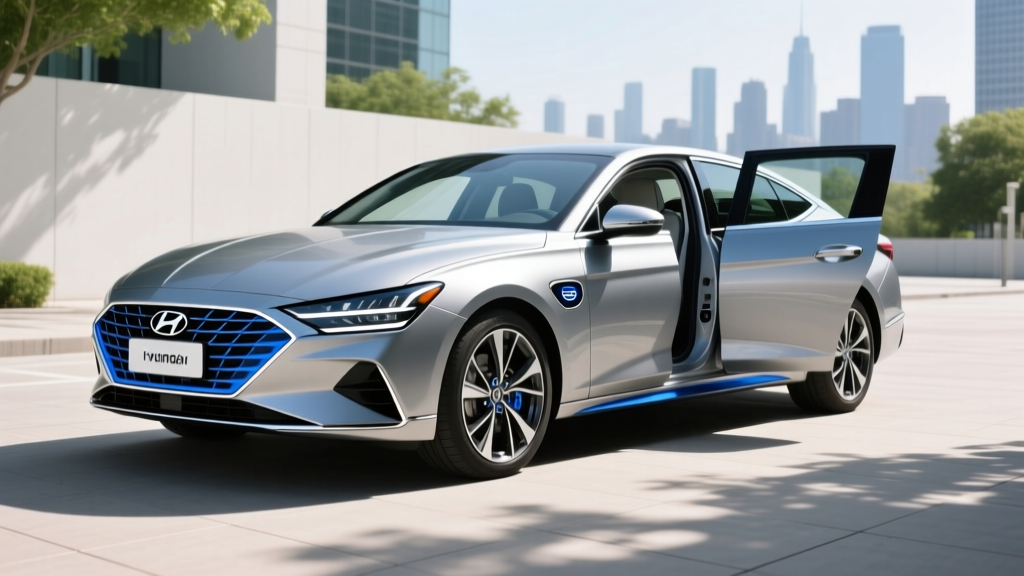
The 2022 Hyundai Sonata Hybrid Limited sits at the top of Hyundai's midsize hybrid sedan lineup, pairing a 2.0-liter four-cylinder engine with an electric motor for a combined 202 horsepower and an EPA-estimated 47 MPG combined. For buyers who want premium features without the plug-in requirement or range anxiety of a full EV, this conventional hybrid (HEV) remains a compelling option on the used market in 2026.
Before we dig into the numbers, let's establish what this car is—and what it isn't. The Sonata Hybrid is a conventional hybrid (HEV), not a plug-in hybrid. It charges its own battery through regenerative braking and the gasoline engine. You never plug it in. Hyundai did not offer a PHEV variant of the Sonata in the US market for 2022, so if you're looking for electric-only driving range, you'll need to look at competitors like the Toyota Prius Prime or Kia Niro PHEV.
How Many MPG Does the 2022 Sonata Hybrid Limited Get?
The EPA rates the 2022 Hyundai Sonata Hybrid Limited at 45 MPG city / 51 MPG highway / 47 MPG combined. These figures apply specifically to the Limited trim, which rides on 17-inch alloy wheels. The Blue and SEL trims, equipped with slightly different aero tuning and a solar roof panel on the Limited, achieve marginally different figures.
| Trim | City MPG | Highway MPG | Combined MPG |
|---|---|---|---|
| Blue | 50 | 54 | 52 |
| SEL | 45 | 51 | 47 |
| Limited | 45 | 51 | 47 |
Source: fueleconomy.gov
In mixed driving, owners and testers consistently report that the Sonata Hybrid meets or slightly exceeds its EPA city rating—often hitting 48-52 MPG in stop-and-go traffic where regenerative braking shines. Highway cruising at 70-75 MPH tends to yield 44-48 MPG, slightly below the sticker figure. In cold weather (below 35°F), expect a 5-10% drop as the engine runs more frequently to provide cabin heat and the battery operates less efficiently. Over a 300-mile mixed route, a realistic expectation for the Limited trim is 44-49 MPG combined, depending on driving style and conditions.
Powertrain Specs: Engine, Motor, and Combined Output
The 2022 Sonata Hybrid uses Hyundai's Smartstream G2.0 HEV powertrain. Here's the breakdown:
| Component | Specification |
|---|---|
| Engine | 2.0L Smartstream GDi 4-cylinder |
| Engine Output | 150 hp @ 6,000 rpm / 139 lb-ft torque |
| Electric Motor | Permanent-magnet synchronous (38 kW / 51 hp) |
| Combined System Output | 202 hp / 271 lb-ft torque |
| Transmission | 6-speed automatic (no CVT) |
| Hybrid Battery | 1.62 kWh lithium-ion (non-plug-in) |
| 0-60 MPH | ~7.5 seconds (est.) |
| Drivetrain | Front-wheel drive |
A key differentiator: Hyundai uses a traditional 6-speed automatic transmission rather than the CVT or e-CVT found in most competitors (including the Toyota Camry Hybrid). The result is more natural-feeling acceleration without the "rubber-band" drone common to CVT-equipped hybrids. The trade-off is marginally lower efficiency at steady-state cruising, though the EPA numbers show Hyundai has minimized this penalty.
The 1.62 kWh battery pack is small by EV standards—because it's not designed for plug-in use. It serves as an energy buffer, capturing regenerative braking energy and deploying it for electric-assisted acceleration and low-speed electric-only creeping (typically under 1 mile at speeds below 20 MPH).
HEV vs. PHEV vs. EV: Which Powertrain Fits You?
The Sonata Hybrid is an HEV. Understanding where it falls on the electrification spectrum helps clarify whether it's the right fit.
| Feature | HEV (Sonata Hybrid) | PHEV (e.g., Prius Prime) | BEV (e.g., Tesla Model 3) |
|---|---|---|---|
| Plug-in charging? | No — self-charging | Yes — Level 1/2 | Yes — Level 1/2/DC |
| Electric-only range | <1 mi at low speed | 25-44 mi typical | 250-350+ mi |
| Gas engine? | Yes (primary) | Yes (backup) | No |
| Tailpipe emissions | Yes | Yes (when engine runs) | None |
| Federal tax credit | None | Up to $7,500* | Up to $7,500* |
| Home charging needed? | No | Recommended | Essential |
| Best for | No garage/outlet access | Short commute + home charging | Home charging + daily driving |
*Federal §30D tax credit eligibility depends on MSRP caps, buyer income limits, and battery sourcing requirements. See IRS guidelines for current rules.
Choose the Sonata Hybrid (HEV) if: You don't have access to a garage or outlet for charging, you want maximum simplicity, and your driving involves a mix of city and highway miles where the hybrid system excels.
Choose a PHEV if: You have home charging, your commute is under 30 miles, and you want to drive mostly electric on weekdays while keeping a gas engine for road trips.
Choose a full EV if: You have reliable home Level 2 charging, want to eliminate gas entirely, and your typical trips fall within the vehicle's range (or you're willing to plan DC fast-charging stops).
Pricing and Tax Credit Eligibility
The 2022 Hyundai Sonata Hybrid Limited originally carried an MSRP of approximately $35,350 (including destination charge). As a used vehicle in 2026, expect market prices between $22,000 and $28,000 depending on mileage, condition, and regional demand.
Regarding tax incentives:
- Federal new-vehicle credit (§30D): Not applicable — the Sonata Hybrid is a conventional HEV and does not qualify for the federal clean vehicle credit, which requires a minimum battery capacity of 7 kWh and plug-in capability. The Sonata Hybrid's 1.62 kWh battery falls well below this threshold.
- Federal used-EV credit (§25E): Also not applicable — this credit applies only to qualified plug-in electric vehicles and fuel cell vehicles purchased used, not conventional hybrids.
- State incentives: A handful of states have offered rebates for conventional hybrids in the past, but most current programs (as of 2026) focus exclusively on PHEVs and BEVs. Check your state's energy office for any active programs.
The bottom line: you're buying this car for its fuel savings and ownership experience, not for tax incentives. At 47 MPG combined versus a comparable gas-only midsize sedan at ~30 MPG, the Sonata Hybrid saves roughly $500-$700 per year in fuel costs for a driver covering 15,000 miles annually (assuming $3.50/gallon regular unleaded).
Battery Warranty, Reliability, and Replacement Costs
Hyundai covers the 2022 Sonata Hybrid's lithium-ion battery pack under its hybrid/EV components warranty for 10 years or 100,000 miles (whichever comes first) for the original owner. For subsequent owners, coverage transfers at 10 years / 100,000 miles from the original in-service date—a significant advantage over some competitors that reduce coverage upon transfer.
The broader hybrid system (inverter, motor, control electronics) carries the same 10-year/100,000-mile coverage. The conventional powertrain warranty is 5 years / 60,000 miles.
On reliability, Hyundai's hybrid system has proven durable. The Sonata Hybrid uses a relatively simple parallel-hybrid architecture without the planetary gearset complexity of Toyota's Hybrid Synergy Drive. Consumer Reports and J.D. Power data for the 2022 model year show average to above-average predicted reliability for the Sonata Hybrid, with few systemic complaints about the hybrid battery or powertrain.
Should the hybrid battery need replacement outside warranty coverage, expect a cost of approximately $2,000-$3,500 for a refurbished or new OEM pack plus labor. This is notably less than a full EV battery replacement (which can exceed $10,000-$20,000) because the pack is small (1.62 kWh) and accessible. In practice, hybrid battery failures before 150,000 miles are uncommon—most degradation manifests as a gradual reduction in electric-assist capability rather than a sudden failure.
Limited Trim Features and Interior Technology
As the top-tier trim, the 2022 Sonata Hybrid Limited includes features that justify its premium over the Blue and SEL trims:
- 12.3-inch digital instrument cluster with hybrid-specific energy flow display
- 10.25-inch touchscreen with navigation, wireless Apple CarPlay and Android Auto (note: wireless connectivity is available on the 8-inch display; the 10.25-inch requires wired connection)
- Leather seating surfaces with heated and ventilated front seats, heated steering wheel
- Hyundai SmartSense ADAS suite: forward collision-avoidance assist with pedestrian detection, blind-spot collision-avoidance assist, rear cross-traffic collision-avoidance assist, lane keeping assist, highway driving assist, and adaptive cruise control with stop-and-go
- Panoramic sunroof
- Bose premium audio (12 speakers)
- Wireless phone charging pad
- Remote smart parking assist (on Limited only)
The Highway Driving Assist system is a SAE Level 2 driver-assistance feature—it combines adaptive cruise control and lane centering for hands-on-wheel highway driving. The driver must remain engaged and keep hands on the steering wheel at all times. This is not autonomous driving.
Pros and Cons at a Glance
- 47 MPG combined (Limited); Blue trim hits 52 MPG
- No plug-in charging required — works anywhere
- 6-speed automatic avoids CVT drone
- Industry-leading 10yr/100k-mile hybrid warranty
- Generous rear-seat legroom (46.1 inches)
- Comprehensive SmartSense ADAS suite standard
- Quiet cabin with refined ride quality
- No PHEV variant available (no electric-only range)
- No federal or state tax credit eligibility
- Limited trim commands premium used pricing
- 202 hp is adequate, not quick — 0-60 in ~7.5 sec
- 1.65 kWh battery limits electric-only creeping
- Trunk space slightly reduced vs. gas Sonata (16.0 vs 16.7 cu ft)
- Solar roof panel (Limited) adds minimal energy recapture
Frequently Asked Questions
Does the 2022 Sonata Hybrid need to be plugged in?
No. The Sonata Hybrid is a conventional hybrid (HEV). It charges its own 1.62 kWh battery through regenerative braking and the gasoline engine. You fuel it like any other car—with gasoline at any station. No plug, no home charger, no charging station required.
How far can the Sonata Hybrid drive on electric power alone?
Under 1 mile, and only at very low speeds (typically below 20 MPH in stop-and-go traffic). This is normal for conventional hybrids. The electric motor's primary role is to assist the gas engine during acceleration and capture energy during braking—not to provide meaningful electric-only range. If you need 20+ miles of electric-only driving, you need a PHEV or a full EV.
Is the 2022 Sonata Hybrid reliable?
Yes. Hyundai's hybrid powertrain has a strong track record, with few systemic issues reported for the 2020-2022 Sonata Hybrid generation. The 10-year/100,000-mile hybrid component warranty provides substantial protection. The 2.0L engine is naturally aspirated and proven, and the 6-speed automatic avoids the reliability concerns some CVTs have exhibited.
What does a Sonata Hybrid battery replacement cost?
Out of warranty, expect approximately $2,000-$3,500 for a replacement hybrid battery pack (1.62 kWh) including labor. This is relatively affordable compared to EV battery replacements because the pack is small. Most hybrid batteries last well beyond 150,000 miles with gradual capacity loss rather than sudden failure.
Does the Sonata Hybrid qualify for any tax credit?
No. Federal §30D and §25E clean vehicle credits require a vehicle to have plug-in capability and a minimum battery capacity (typically 7 kWh for new-vehicle credits). The Sonata Hybrid's 1.62 kWh non-plug-in battery does not meet these requirements. Some states have offered hybrid-specific rebates historically, but most current incentive programs target PHEVs and BEVs. Consult your state energy office or a tax professional for any local programs.
How does the Sonata Hybrid compare to the Toyota Camry Hybrid?
The 2022 Camry Hybrid LE achieves 52 MPG combined (vs. the Sonata Hybrid Blue at 52 MPG and Limited at 47 MPG). The Camry uses an e-CVT, while the Sonata uses a 6-speed automatic. The Sonata offers more rear legroom and a longer warranty (10yr/100k vs. Toyota's 10yr/150k hybrid battery but 5yr/60k powertrain). Both are strong choices; the Sonata wins on warranty transferability and tech features, while the Camry edges ahead on efficiency at the base trim level.