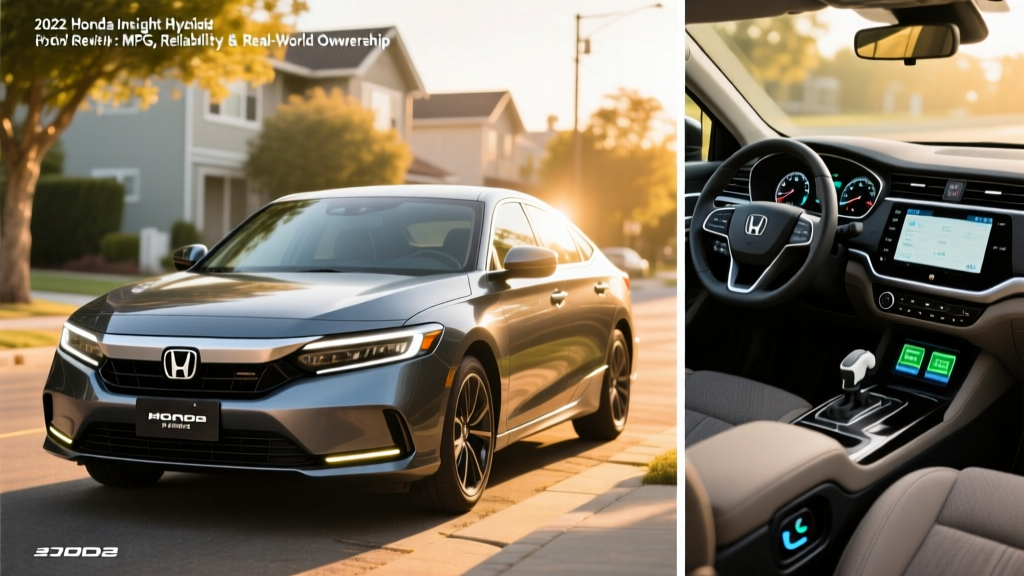
The 2022 Honda Insight hybrid occupies an unusual space in the used-car market. Discontinued after the 2022 model year and replaced by the Civic Hybrid for 2023, the Insight remains one of the most fuel-efficient sedans Honda ever produced. With EPA ratings reaching 55 MPG combined, a refined two-motor hybrid system, and Honda's reputation for long-term durability, it has become a target for buyers seeking maximum efficiency without plugging in.
This review breaks down exactly what you get with a 2022 Insight, how its real-world fuel economy compares to the EPA sticker, what the hybrid battery warranty covers, and whether this conventional hybrid (HEV) still makes sense versus a plug-in hybrid (PHEV) or full battery-electric vehicle (BEV) in 2026.
2022 Honda Insight Hybrid: Key Specifications at a Glance
| Specification | 2022 Honda Insight EX | 2022 Honda Insight Touring |
|---|---|---|
| Powertrain Type | Conventional Hybrid (HEV) | Conventional Hybrid (HEV) |
| Engine | 1.5L Atkinson-cycle 4-cyl + 2 electric motors | 1.5L Atkinson-cycle 4-cyl + 2 electric motors |
| Combined Horsepower | 151 hp | 151 hp |
| Combined Torque | 197 lb-ft (electric motor) | 197 lb-ft (electric motor) |
| EPA MPG (City / Hwy / Combined) | 55 / 49 / 52 | 51 / 45 / 48 |
| Fuel Tank Capacity | 10.6 gallons | 10.6 gallons |
| Total Driving Range (EPA est.) | ~551 miles | ~509 miles |
| 0-60 mph | ~7.7 seconds | ~7.7 seconds |
| Hybrid Battery | 1.2 kWh lithium-ion | 1.2 kWh lithium-ion |
| Drivetrain | FWD | FWD |
| Cargo Volume | 15.1 cu ft | 14.7 cu ft |
| Original MSRP | $25,760 | $29,790 |
| Hybrid Battery Warranty | 8 yr / 100,000 mi (10 yr / 150,000 mi in CARB states) | 8 yr / 100,000 mi (10 yr / 150,000 mi in CARB states) |
Sources: EPA Fuel Economy, Honda Automobiles press archives.
How Many MPG Does the 2022 Honda Insight Hybrid Actually Get?
The EPA rates the 2022 Insight EX at 55 city / 49 highway / 52 combined MPG. The heavier Touring trim drops slightly to 51 city / 45 highway / 48 combined. These numbers place the Insight among the most efficient non-plug-in vehicles ever sold in the U.S., trailing only the Toyota Prius Eco and Hyundai Ioniq Hybrid Blue in certain model years.
| Trim | City MPG | Highway MPG | Combined MPG | Est. Annual Fuel Cost* |
|---|---|---|---|---|
| Insight EX | 55 | 49 | 52 | ~$1,000 |
| Insight Touring | 51 | 45 | 48 | ~$1,100 |
*Based on 15,000 miles/year, 55% city driving, and $3.45/gallon regular unleaded (DOE/AAA average, early 2026). Your costs will vary with local fuel prices and driving patterns.
Real-World MPG vs. the EPA Sticker
Conventional hybrids like the Insight tend to exceed their EPA city rating in stop-and-go traffic, where regenerative braking recaptures energy that a gas-only car wastes as heat. In real-world mixed driving, many Insight owners report 50-54 MPG combined — very close to the EPA estimate.
However, two scenarios will reduce your numbers:
- Sustained highway driving above 70 mph: Aerodynamic drag dominates at highway speeds, and the Insight's 1.5L engine must work harder. Expect 43-47 MPG on flat interstate runs at 75 mph.
- Cold-weather operation: Below 30°F, the engine runs more frequently to maintain cabin heat and battery temperature. Expect a 5-10% MPG reduction in winter, or roughly 44-48 MPG combined for the EX trim.
The Insight's advantage over conventional gas cars is most pronounced in city driving. A comparable 2022 Honda Civic (gas) achieves 33 city / 42 highway — the Insight delivers nearly 67% better city fuel economy.
HEV vs. PHEV vs. EV: Where Does the Insight Fit?
The 2022 Insight is a conventional hybrid electric vehicle (HEV). This means it generates all its own electricity through the gasoline engine and regenerative braking. You never plug it in. There is no electric-only driving range to speak of — the small 1.2 kWh battery assists the engine during acceleration and enables brief low-speed electric-only movement (typically under 1 mile at very low speeds).
| Factor | HEV (e.g., 2022 Insight) | PHEV (e.g., Toyota Prius Prime) | BEV (e.g., Tesla Model 3) |
|---|---|---|---|
| Plug-in Required? | No | Yes (for EV range) | Yes |
| Electric-Only Range | Negligible | 25-44 miles (typical) | 250-360+ miles |
| Total Range | 500+ miles | 400-600+ miles | 250-360+ miles |
| Home Charging Needed? | No | Recommended (Level 2) | Yes (Level 2 strongly recommended) |
| Federal Tax Credit (§30D) | Not eligible | Up to $7,500 (if eligible) | Up to $7,500 (if eligible) |
| Best For | No home charging access; high-mileage commuters | Short commutes + road trips; home charging available | Home charging access; daily commutes under 300 mi |
Who Should Choose the Insight Over a PHEV or EV?
The 2022 Insight makes the most sense for drivers who:
- Cannot charge at home — apartment dwellers, street parkers, or those without garage access.
- Drive high annual mileage (15,000+ miles/year) where the MPG advantage compounds into significant fuel savings.
- Want zero behavior change — no route planning around chargers, no preconditioning, no charging apps.
- Prioritize lower upfront cost — used 2022 Insights now trade well below comparable PHEVs and BEVs.
If you have Level 2 home charging and a commute under 40 miles round-trip, a PHEV like the current Toyota Prius Prime (44 miles electric-only) or a BEV like the Hyundai Ioniq 6 (361 miles EPA) will deliver lower per-mile energy costs. But if charging infrastructure isn't an option, the Insight's 52 MPG combined is hard to beat without a plug.
Powertrain Deep Dive: Honda's Two-Motor Hybrid System
The Insight uses Honda's third-generation two-motor hybrid system, which operates differently from Toyota's planetary-gear Hybrid Synergy Drive. Here's how it works:
- 1.5L Atkinson-cycle engine (107 hp, 97 lb-ft): Primarily acts as a generator to produce electricity for the drive motor. At highway cruising speeds, a lock-up clutch connects the engine directly to the front wheels for efficiency.
- Propulsion motor (129 hp, 197 lb-ft): Drives the front wheels most of the time. This motor provides the instant torque that makes the Insight feel responsive off the line.
- Generator motor: Converts engine output to electricity and handles regenerative braking.
- 1.2 kWh lithium-ion battery pack: Located beneath the rear seats, preserving trunk space. Stores energy from regen and the generator motor.
The combined system output is 151 horsepower, with the electric motor's 197 lb-ft of torque available from near-zero RPM. The result is a 0-60 mph time of approximately 7.7 seconds — adequate for merging and passing, though not sporty. The transition between electric and engine power is one of the smoothest in the hybrid segment; most drivers won't notice when the engine engages.
Unlike some competitors, the Insight does not offer all-wheel drive. If you need AWD in a hybrid, the Toyota Prius AWD-e or a PHEV SUV like the Toyota RAV4 Prime are better options.
Hybrid Battery Warranty, Lifespan, and Replacement Cost
2022 Insight Hybrid Battery Warranty
- Standard coverage: 8 years / 100,000 miles (whichever comes first)
- CARB-state coverage: 10 years / 150,000 miles (California, New York, Massachusetts, and other states adopting California emissions standards)
- Coverage threshold: Honda warrants the hybrid battery against defects and abnormal capacity loss. If the battery fails to hold sufficient charge to maintain hybrid system function, Honda replaces it at no cost.
- Transferable: Yes — the hybrid battery warranty transfers to subsequent owners, which supports used-car resale value.
How Long Will the Insight's Hybrid Battery Last?
Honda's hybrid battery packs have a strong longevity track record. The 1.2 kWh lithium-ion pack in the Insight is small and conservatively managed — it never fully charges or fully depletes, operating in a narrow state-of-charge window (roughly 40-80% SoC). This shallow cycling dramatically reduces degradation compared to a BEV battery that regularly cycles from 10% to 90%.
Based on data from earlier Honda hybrid models (Civic Hybrid, Accord Hybrid, first-generation Insight), hybrid battery packs routinely last 150,000-200,000+ miles before requiring replacement. Many exceed the vehicle's useful life. Failures within the warranty period are uncommon but not unheard of — typically manifesting as reduced MPG and a dashboard warning rather than a sudden shutdown.
Hybrid Battery Replacement Cost
If you do need a replacement outside of warranty:
- New OEM battery (Honda dealer): $2,000-$3,500 including labor
- Refurbished/remanufactured battery: $1,000-$2,000 from aftermarket suppliers
- Individual cell replacement: Some independent hybrid specialists can replace failed cells for $500-$1,000, though this is less common for the third-gen Insight system.
For context, a full BEV battery replacement (e.g., Tesla Model 3, Chevrolet Bolt) typically costs $8,000-$16,000. The Insight's small hybrid battery is far less expensive to replace — and far less likely to need it.
Pricing, Tax Credits, and Used-Car Value in 2026
The 2022 Honda Insight was originally priced at $25,760 (EX) and $29,790 (Touring), including destination. Because the Insight is a conventional HEV — not a plug-in hybrid or battery-electric vehicle — it does not qualify for the federal §30D new clean vehicle tax credit, which applies only to PHEVs and BEVs meeting battery sourcing, MSRP, and buyer income requirements.
As a used vehicle in 2026, the Insight may qualify for the Used Clean Vehicle Credit (§25E) — but only if purchased from a licensed dealer and only if the specific vehicle is classified as a qualifying plug-in electric or fuel cell vehicle. Conventional hybrids (HEVs) like the Insight are excluded from §25E. The used-EV credit applies to PHEVs and BEVs only.
Current used-market pricing (early 2026 estimates):
- 2022 Insight EX: $18,000-$22,000 depending on mileage and condition
- 2022 Insight Touring: $21,000-$26,000
These prices represent strong value relative to a new Civic Hybrid (starting around $29,000) or a new Toyota Prius ($28,000-$35,000), especially considering the Insight's comparable efficiency and Honda's build quality.
State and Local Incentives
Some states offer rebates or HOV lane access for hybrid vehicles, but these programs vary widely and change frequently. California's Clean Vehicle Rebate Project (CVRP), for example, has historically focused on PHEVs and BEVs rather than conventional hybrids. Check your state's energy or environmental agency website for current programs. Note: Always consult the IRS §30D guidelines and a tax professional for credit eligibility.
Reliability, Safety, and Long-Term Ownership
Honda's hybrid systems have demonstrated strong reliability across multiple generations. The two-motor architecture in the 2022 Insight has fewer mechanical wear points than a conventional automatic transmission — there is no traditional gearbox, no torque converter, and no clutch packs to wear out. The e-CVT operation is handled entirely through the motor-generator set and the lock-up clutch.
Key reliability and safety notes:
- NHTSA Overall Rating: 5 stars (2022 model year)
- IIHS Rating: Top Safety Pick+ (when equipped with specific headlights on Touring trim)
- Honda Sensing suite: Standard on all trims — includes adaptive cruise control, lane-keeping assist, collision mitigation braking, and road departure mitigation. This is an SAE Level 2 driver-assistance system, meaning the driver must remain fully engaged at all times. It is not autonomous driving.
- Common maintenance items: Standard oil changes (every 7,500-10,000 miles), brake pads last significantly longer than gas-only vehicles thanks to regenerative braking (often 80,000-100,000+ miles), tire rotations, and cabin/engine air filters.
Pros
- Class-leading 52-55 MPG combined (EX trim)
- Smooth, quiet hybrid powertrain with responsive electric torque
- Strong safety ratings (NHTSA 5-star, IIHS TSP+)
- No plug-in required — zero infrastructure dependency
- Honda Sensing standard on all trims
- Conservative battery management supports long battery life
- Competitive used pricing vs. new hybrids
Cons
- Discontinued — no new examples available; limited future dealer support for body/trim parts
- No AWD option
- Touring trim loses 4 MPG vs. EX due to weight and larger wheels
- Modest 151 hp — adequate but not quick
- Small 1.2 kWh battery limits electric-only assist to very low speeds
- No federal tax credit eligibility (HEV exclusion)
- Infotainment system (2022-era Honda) lacks wireless Apple CarPlay on EX trim
Frequently Asked Questions
How many MPG does the 2022 Honda Insight hybrid get?
The EPA rates the 2022 Insight EX at 55 city / 49 highway / 52 combined MPG. The Touring trim is rated at 51 city / 45 highway / 48 combined. In real-world mixed driving, most owners see 50-54 MPG combined. Highway-only driving at 75 mph may drop to 43-47 MPG, and cold weather (below 30°F) can reduce combined figures by 5-10%.
Does the 2022 Honda Insight need to be plugged in?
No. The Insight is a conventional hybrid (HEV), not a plug-in hybrid (PHEV). It charges its own small battery through regenerative braking and the gasoline engine. You simply refuel at a gas station like any other car.
How far can the Insight drive on electric power alone?
The Insight's electric-only capability is negligible — typically less than 1 mile at very low speeds (under 25 mph) in ideal conditions. It is not designed for meaningful electric-only driving. If electric-only commuting is your goal, a PHEV like the Toyota Prius Prime (44 miles EV range) or a BEV is the correct choice.
Is the 2022 Honda Insight hybrid reliable?
Yes. Honda's hybrid systems have a strong reliability record. The two-motor hybrid architecture eliminates the conventional transmission, reducing mechanical wear points. The hybrid battery is conservatively managed with a shallow charge cycle, and Honda's track record with hybrid batteries from the Civic Hybrid and Accord Hybrid lineages shows typical lifespans of 150,000-200,000+ miles. The NHTSA gave it a 5-star overall safety rating.
What does it cost to replace the Insight's hybrid battery?
Outside of warranty, a new OEM hybrid battery replacement costs approximately $2,000-$3,500 including labor at a Honda dealer. Refurbished options are available for $1,000-$2,000. For comparison, a full BEV battery replacement typically costs $8,000-$16,000. Most Insight hybrid batteries last the life of the vehicle.
Does the 2022 Honda Insight qualify for any tax credit?
No. The Insight is a conventional hybrid (HEV), which is excluded from both the federal §30D new clean vehicle credit and the §25E used clean vehicle credit. These credits apply only to plug-in hybrid electric vehicles (PHEVs) and battery-electric vehicles (BEVs) that meet battery sourcing, MSRP caps, and buyer income requirements. Some states may offer separate incentives for high-efficiency vehicles — check your state's energy agency for current programs. Always consult IRS guidelines and a tax professional.
Should I buy a used 2022 Insight or a new Civic Hybrid?
If budget is your priority, a used 2022 Insight at $18,000-$26,000 offers comparable MPG to the new Civic Hybrid at a significantly lower price. If you want the latest infotainment, full factory warranty, and the newest Honda Sensing features, the new Civic Hybrid (starting ~$29,000, 49 MPG combined) is the better pick. Both use similar two-motor hybrid systems, so the efficiency gap is minimal.
How does the Insight compare to the Toyota Prius?
The 2022 Insight EX (52 combined MPG) is competitive with the 2022 Prius Eco (56 combined MPG). The Insight offers a more conventional sedan design, slightly more rear-seat room, and a more refined driving feel. The Prius wins on peak MPG and offers an available AWD-e powertrain. The redesigned 2023+ Prius improved performance significantly (194 hp) while maintaining strong efficiency, making newer Prius models a tougher comparison.
The Bottom Line: Who Should Buy a 2022 Honda Insight in 2026?
Choose the 2022 Honda Insight if: You cannot charge at home, you drive 15,000+ miles per year, you want 50+ MPG with zero behavior change, and you prefer a used car at $18,000-$26,000 over a new hybrid at $29,000+.
Look at a PHEV instead if: You have home Level 2 charging, your daily commute is under 40 miles round-trip, and you want to drive mostly on electricity while keeping gas for road trips.
Look at a BEV instead if: You have reliable home charging, your daily driving is under 250 miles, you want the lowest per-mile energy cost, and you want eligibility for federal tax credits (up to $7,500 for qualifying new EVs under §30D rules).
The 2022 Honda Insight hybrid is a proven, efficient, and well-built sedan that Honda discontinued too soon. As a used purchase in 2026, it remains one of the smartest ways to achieve 50+ MPG without any charging infrastructure — provided you accept that it's a dead model line with no direct successor wearing the Insight badge. The Civic Hybrid carries the torch, but for value-oriented buyers, the Insight's combination of real-world efficiency, Honda reliability, and favorable used pricing makes it a compelling choice.