Quick Verdict: The F-150 PowerBoost Hybrid in 2026
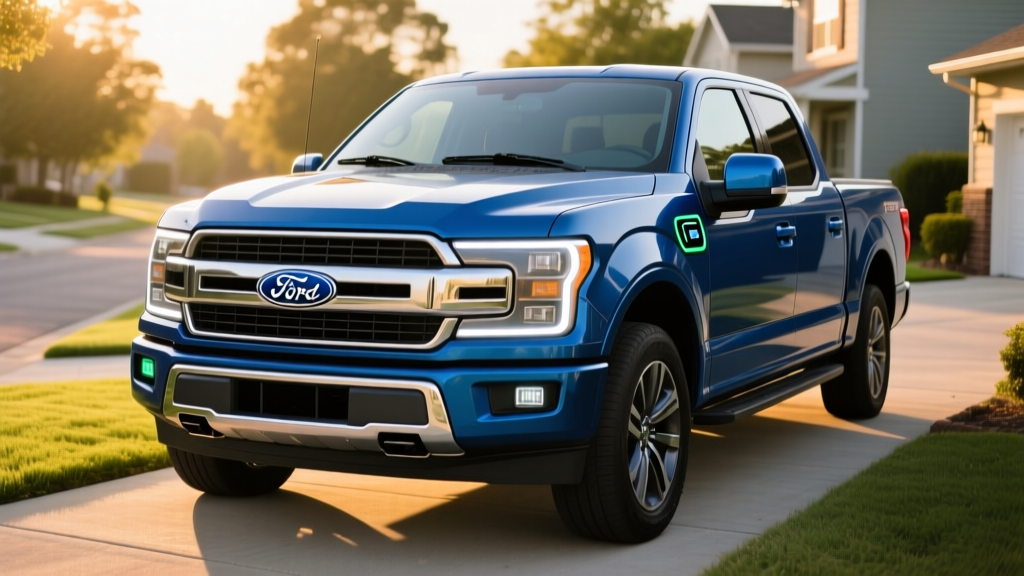
The 2022 Ford F-150 Hybrid — officially the PowerBoost — remains one of the most compelling full-size pickup choices on the used market. It pairs a 3.5-liter twin-turbo V6 with a 47-hp electric motor integrated into the 10-speed automatic transmission, delivering 430 horsepower and 570 lb-ft of torque while returning an EPA-estimated 24 MPG combined. For buyers who need serious towing capability, onboard power generation via Pro Power Onboard, and fuel economy that undercuts the standard EcoBoost by a meaningful margin, the PowerBoost still holds up well four years after its debut.
This is a conventional hybrid (HEV), not a plug-in. You never plug it in. The 1.5 kWh lithium-ion battery recharges through regenerative braking and engine operation. If you're looking for electric-only driving, this isn't it — but if you want a truck that sips fuel in stop-and-go traffic while still towing 12,700 pounds, the PowerBoost occupies a unique lane.
HEV vs PHEV vs EV: Where the PowerBoost Fits
Before diving into specs, it's critical to understand what the F-150 PowerBoost is — and isn't.
| Category | F-150 PowerBoost (HEV) | PHEV Example (e.g., F-150 Lightning is BEV, not PHEV) | F-150 Lightning (BEV) |
|---|---|---|---|
| Plugs in? | No | Yes (charges battery from grid) | Yes (charges battery from grid) |
| Electric-only range | None (motor assists engine) | Typically 20-40 mi on PHEVs | 240-320 mi EPA |
| Refuel/recharge | Gas station only | Gas + plug-in | Plug-in only |
| Federal tax credit (§30D) | Not eligible | Up to $7,500 if eligible | No longer eligible (as of 2025) |
| Towing capacity | Up to 12,700 lbs | Varies | Up to 10,000 lbs |
The PowerBoost is a self-charging hybrid. Its small 1.5 kWh battery captures energy during braking and deceleration, then deploys it to assist the gasoline engine during acceleration and low-speed driving. The electric motor can propel the truck at very low speeds (parking lots, stop-and-go traffic) for brief stretches, but it cannot sustain highway speeds on electric power alone. Think of it as a fuel-efficiency multiplier, not an electric vehicle.
Fuel Economy: EPA Ratings and Real-World MPG
| Drivetrain | City | Highway | Combined |
|---|---|---|---|
| PowerBoost 4x2 | 25 MPG | 26 MPG | 25 MPG |
| PowerBoost 4x4 | 23 MPG | 24 MPG | 24 MPG |
| 3.5L EcoBoost V6 (4x4, non-hybrid) | 17 MPG | 23 MPG | 19 MPG |
| 5.0L V8 (4x4) | 16 MPG | 22 MPG | 18 MPG |
Source: fueleconomy.gov
The 4x4 PowerBoost's 24 MPG combined represents a 26% improvement over the standard 3.5L EcoBoost and a 33% improvement over the 5.0L V8. In real-world ownership, hybrid trucks tend to outperform their EPA city ratings because regenerative braking recovers more energy in stop-and-go driving. Many F-150 PowerBoost owners report 25-27 MPG in mixed suburban driving, though highway-heavy commutes at 75+ mph tend to drop to 21-23 MPG as the aerodynamic drag of a full-size pickup overwhelms the hybrid system's advantages.
- City/suburban (stop-and-go): 25-28 MPG — hybrids shine here
- Mixed driving: 23-26 MPG
- Highway (70-80 mph): 20-23 MPG — aero drag dominates
- Towing a 6,000-lb trailer: 12-15 MPG — expect roughly half
- Cold weather (below 30°F): Subtract 1-2 MPG from all figures
With the PowerBoost's standard 30.6-gallon fuel tank, that translates to roughly 650-730 miles of real-world range on a tank in mixed driving — a genuine road-trip advantage over the F-150 Lightning's 240-320 miles before needing a 30-45 minute DC fast charge.
Powertrain Deep Dive: 430 HP and the 10-Speed Hybrid Transmission
| Specification | F-150 PowerBoost (2022) |
|---|---|
| Engine | 3.5L Twin-Turbo V6 |
| Electric Motor | 47 hp / 221 lb-ft (integrated in transmission) |
| Combined Output | 430 hp @ 5,750 rpm / 570 lb-ft @ 3,000 rpm |
| Transmission | 10-speed automatic (modular hybrid) |
| Battery | 1.5 kWh lithium-ion (under floor, behind rear seats) |
| 0-60 mph | ~5.5 seconds (MotorTrend tested) |
| Max Towing | 12,700 lbs (properly equipped, 4x2) |
| Max Payload | 2,120 lbs |
| Pro Power Onboard | 2.0 kW standard, 7.2 kW available |
The PowerBoost's genius is packaging. Ford placed the electric motor between the engine and the 10-speed transmission's torque converter, creating a modular hybrid system that doesn't sacrifice cargo space, ground clearance, or towing hardware. The 1.5 kWh battery sits beneath the rear floor, out of the way of the bed and cabin.
The 570 lb-ft of combined torque arrives low in the rev range, giving the PowerBoost a strong, immediate shove off the line that the standard EcoBoost can't match without downshifting. The electric motor fills in torque during the turbocharger's spool-up phase, effectively eliminating turbo lag. This makes the PowerBoost feel more responsive than its EPA ratings suggest — it's a genuinely quick truck that also happens to be efficient.
The available 7.2 kW Pro Power Onboard system transforms the F-150 into a mobile generator, capable of running power tools at a job site, appliances during an outage, or even a welder. This feature alone has convinced many commercial buyers to choose the PowerBoost over the standard EcoBoost.
Pricing on the Used Market and Tax Credit Reality
The 2022 F-150 PowerBoost was available across multiple trims, with original MSRP ranging significantly:
- XLT (base hybrid trim): ~$52,000-$56,000 MSRP (when new)
- Lariat: ~$58,000-$65,000 MSRP
- Platinum: ~$68,000-$74,000 MSRP
- Limited: ~$78,000-$84,000 MSRP
As of 2026, used 2022 PowerBoost models typically list between $35,000 and $58,000 depending on mileage, trim, and condition.
For buyers comparing against the F-150 Lightning (BEV), note that the Lightning also lost its federal tax credit eligibility in late 2025 due to policy changes. This levels the playing field somewhat — neither truck currently offers the §30D credit at point of sale.
Reliability, Battery Warranty, and Long-Term Costs
Ford covers the PowerBoost hybrid battery and hybrid-specific components for 8 years or 100,000 miles (whichever comes first). In states that follow California Air Resources Board (CARB) emissions warranty rules — including California, New York, Massachusetts, and several others — hybrid battery coverage extends to 10 years or 150,000 miles.
The 1.5 kWh battery in the PowerBoost is small by EV standards, and that's actually an advantage for longevity. Small batteries experience shallower charge-discharge cycles, which reduces stress on the cells. Toyota's hybrid systems — which use similarly sized batteries — have demonstrated 200,000+ mile lifespans routinely, and Ford's hybrid architecture follows similar engineering principles.
That said, the F-150 PowerBoost is newer to the market than Toyota's hybrid trucks, so long-term data is still accumulating. Early reliability surveys from Consumer Reports and J.D. Power placed the 2022 F-150 hybrid at average to slightly above average for the full-size truck segment. The most common complaints involve the 10-speed transmission's shift calibration (occasionally hunting for gears under light load) and minor software glitches in the SYNC 4 infotainment system — neither of which is hybrid-specific.
If the hybrid battery does need replacement outside of warranty, expect a cost in the range of $2,500-$4,000 for the battery pack itself, plus labor. This is significantly less than an EV battery replacement because the pack is small (1.5 kWh vs. 100+ kWh in a BEV). However, given Ford's 8-year/100,000-mile warranty and the shallow cycling of the pack, most original owners will never face this expense.
Who Should Choose the F-150 PowerBoost — And Who Shouldn't
- You tow or haul regularly and need 12,000+ lb capacity
- You want better fuel economy than a gas truck without range or charging concerns
- You need Pro Power Onboard for job-site or emergency power
- You drive in mixed city/highway conditions where hybrid efficiency pays off
- You don't have access to home charging (apartment, street parking)
- You regularly take long road trips where charging infrastructure is sparse
- You have reliable home Level 2 charging
- Your daily driving is under 200 miles round-trip
- You want the lowest per-mile "fuel" cost (electricity vs. gasoline)
- You value instant torque, a front trunk (frunk), and near-silent operation
- You rarely tow more than 8,000 lbs
- You primarily drive highway miles where the hybrid advantage is smallest
- You want the lowest upfront purchase price
- You prefer a proven, simpler powertrain with no hybrid components
Pros and Cons at a Glance
- 24 MPG combined — best in the full-size truck class (HEV)
- 430 hp / 570 lb-ft with no turbo lag
- 12,700-lb towing — matches or beats non-hybrid V6
- 7.2 kW Pro Power Onboard is a standout feature
- No plug-in needed — works with existing gas infrastructure
- Strong real-world city MPG (often exceeds EPA)
- No federal tax credit (HEV, not PHEV/BEV)
- Highway MPG advantage is modest vs. EcoBoost
- Hybrid premium adds ~$3,000-$4,000 over equivalent EcoBoost
- 1.5 kWh battery too small for meaningful electric-only driving
- Used market pricing still elevated vs. gas-only F-150s
- Transmission can hunt for gears under light throttle
Frequently Asked Questions
How many MPG does the 2022 Ford F-150 Hybrid get?
The EPA rates the 2022 F-150 PowerBoost 4x4 at 23 city / 24 highway / 24 combined MPG. The 4x2 variant is rated at 25/26/25 MPG. In real-world suburban driving, many owners see 25-27 MPG thanks to regenerative braking in stop-and-go traffic. Highway-heavy driving at 75+ mph typically drops to 21-23 MPG.
Is the F-150 PowerBoost a plug-in hybrid?
No. The F-150 PowerBoost is a conventional hybrid (HEV). It does not plug in and has no meaningful electric-only range. The 1.5 kWh battery charges exclusively through regenerative braking and engine power. If you want a plug-in F-150, the only option is the all-electric F-150 Lightning (BEV) — Ford has not offered an F-150 PHEV in the US market.
How far can the F-150 Hybrid go on a tank of gas?
With the standard 30.6-gallon fuel tank and the 4x4's 24 MPG combined rating, you can expect roughly 730 miles per tank under EPA conditions. In real-world mixed driving, 650-700 miles is typical before the low-fuel warning. That's significantly farther than the F-150 Lightning's 240-320 miles of electric range.
Is the F-150 PowerBoost hybrid reliable?
Early reliability data is average to slightly above average for the full-size truck segment. The hybrid components (battery, electric motor) are covered by Ford's 8-year/100,000-mile warranty (10 years/150,000 miles in CARB states). The small 1.5 kWh battery experiences gentle cycling, which bodes well for longevity. Most common complaints relate to transmission shift calibration and infotainment software — not the hybrid system itself.
What does it cost to replace the F-150 hybrid battery?
Out-of-warranty replacement of the 1.5 kWh hybrid battery pack is estimated at $2,500-$4,000 including labor. This is far less than an EV traction battery replacement because the pack is small. Given the 8-year/100,000-mile warranty and the battery's shallow charge cycles, most owners are unlikely to need a replacement during typical ownership.
Does the 2022 F-150 Hybrid qualify for any tax credit?
No. The IRS §30D federal clean vehicle tax credit applies only to plug-in electric vehicles (battery-electric and plug-in hybrids) meeting specific battery capacity, critical-mineral sourcing, and MSRP/income requirements. The F-150 PowerBoost is a conventional hybrid with a 1.5 kWh battery and no plug-in capability, so it does not qualify. Check your state's energy office for any local hybrid incentives, which are typically modest ($250-$1,000 where available).
How does the PowerBoost compare to the F-150 Lightning?
They serve different use cases. The PowerBoost offers 24 MPG combined, 12,700-lb towing, 650+ mile range, and no charging infrastructure requirement — ideal for towing, rural areas, and long road trips. The Lightning offers 240-320 miles of electric range, lower per-mile fuel cost, a frunk, instant torque, and near-silent operation — ideal for daily commuting with home charging. Neither currently qualifies for the federal tax credit.
Sources consulted: EPA Fuel Economy, Ford F-150 Specifications, AFDC State Incentives.