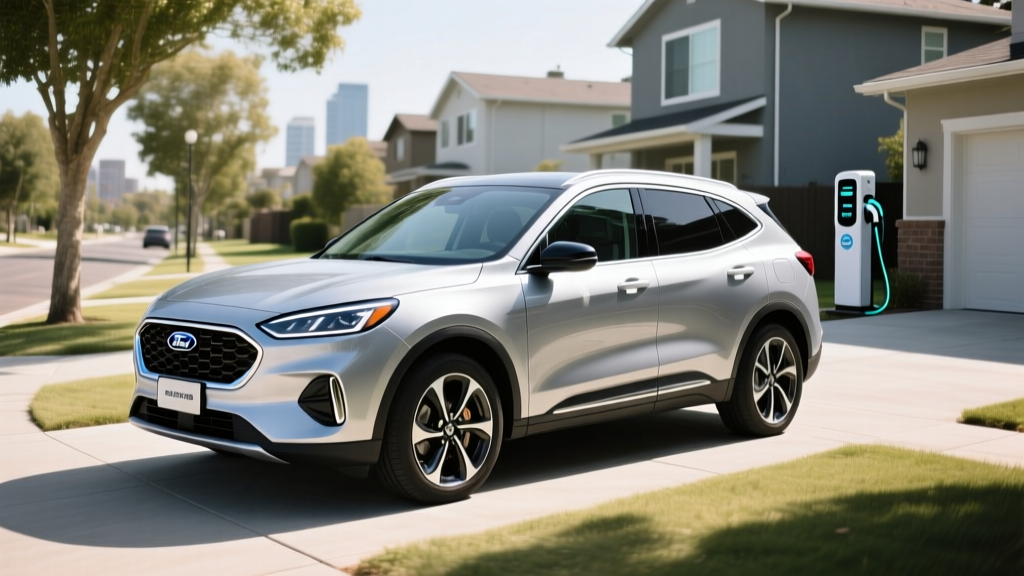
The 2022 Ford Escape SE Hybrid occupies a specific niche: a compact crossover that sips fuel without requiring a plug, a charging routine, or any change to your daily habits. For buyers who want electrified efficiency but lack home charging access or the budget for a full battery-electric vehicle, this conventional hybrid (HEV) remains one of the most practical options on the used market. Here's what you actually need to know about its fuel economy, powertrain, long-term reliability, and whether it still makes sense in 2026.
Quick Verdict: Who the 2022 Escape SE Hybrid Is For
Choose this hybrid if: You want 40+ MPG without plugging in, you primarily drive in city and suburban traffic where regenerative braking maximizes efficiency, and you want a proven, no-compromise compact SUV.
Look at a PHEV instead if: You have reliable home or workplace Level 2 charging and your daily commute is under 37 miles round-trip (the Escape PHEV's electric-only range).
Consider a full EV if: You can charge at home, your daily driving is under 250 miles, and you want to eliminate gasoline entirely while potentially qualifying for the federal §30D tax credit on a new purchase.
2022 Ford Escape SE Hybrid: Core Specifications
| Specification | 2022 Escape SE Hybrid (FWD) | 2022 Escape SE Hybrid (AWD) |
|---|---|---|
| Powertrain Type | Conventional Hybrid (HEV) | Conventional Hybrid (HEV) |
| Engine | 2.5L Atkinson-cycle 4-cylinder | 2.5L Atkinson-cycle 4-cylinder |
| Combined Horsepower | 200 hp (engine + electric motor) | 200 hp (engine + electric motor) |
| Transmission | eCVT (planetary gearset) | eCVT (planetary gearset) |
| Hybrid Battery | 1.1 kWh lithium-ion (sealed) | 1.1 kWh lithium-ion (sealed) |
| EPA City MPG | 44 MPG | 42 MPG |
| EPA Highway MPG | 37 MPG | 36 MPG |
| EPA Combined MPG | 41 MPG | 39 MPG |
| Fuel Tank | 14.2 gallons | 14.2 gallons |
| Total Range (est.) | ~582 miles | ~554 miles |
| 0–60 mph | ~7.7 seconds | ~8.1 seconds |
| Cargo Volume (behind 2nd row) | 34.4 cu ft | 34.4 cu ft |
| Original MSRP (SE Hybrid) | ~$30,090 | ~$31,590 |
The 2022 Escape SE Hybrid uses Ford's fourth-generation hybrid system, pairing a 2.5-liter Atkinson-cycle four-cylinder engine with a permanent-magnet electric motor integrated into an electronically controlled continuously variable transmission (eCVT). This is not a belt-driven CVT like those in some competitors — Ford uses a planetary gearset that seamlessly blends engine and motor power. The combined system output is 200 horsepower, which is competitive for the compact crossover segment.
Importantly, this is a conventional hybrid (HEV), not a plug-in hybrid. The 1.1 kWh battery charges exclusively through regenerative braking and the gasoline engine. You never plug it in. The small battery enables electric-only driving at very low speeds (parking lots, stop-and-go traffic under ~25 mph) but cannot sustain highway speeds on electric power alone.
Fuel Economy: EPA Ratings vs. Real-World MPG
| Driving Scenario | FWD EPA Rating | Real-World Expectation |
|---|---|---|
| City / Stop-and-Go | 44 MPG | 42–48 MPG (hybrids often exceed EPA in city) |
| Highway (70+ mph) | 37 MPG | 33–37 MPG (aero drag reduces hybrid advantage) |
| Combined (mixed) | 41 MPG | 38–43 MPG (depends on driving mix) |
| Cold Weather (below 32°F) | — | 34–38 MPG (engine runs more for cabin heat) |
According to EPA data on fueleconomy.gov, the front-wheel-drive 2022 Escape SE Hybrid achieves 44 city / 37 highway / 41 combined MPG. These are strong numbers, and real-world experience with Ford's hybrid system shows that city driving often yields results at or slightly above the EPA city rating. This is because regenerative braking recaptures energy during deceleration — the more you stop, the more the system recharges.
Highway driving tells a different story. At sustained speeds above 70 mph, aerodynamic drag dominates and the hybrid system's advantage narrows. Expect 33–37 MPG on long highway trips, which is still excellent for a compact SUV but noticeably lower than the city figure. Cold weather further reduces efficiency because the gasoline engine must run more frequently to provide cabin heating and maintain battery temperature.
Real-World Range Reality: With a 14.2-gallon tank and mixed driving, most owners report 500–560 miles between fill-ups. If your driving is predominantly city, you may stretch past 580 miles. Highway-heavy commutes will land closer to 470–500 miles per tank.
Hybrid vs. Plug-In Hybrid vs. Full EV: Which Fits You?
Ford offered the 2022 Escape in three powertrain variants: a conventional gas model, the SE Hybrid (HEV) covered here, and the Escape PHEV (plug-in hybrid). Understanding the differences is critical before buying, especially on the used market where listings may not clearly distinguish them.
| Feature | 2022 Escape Hybrid (HEV) | 2022 Escape PHEV | Full EV (e.g., Mustang Mach-E) |
|---|---|---|---|
| Plug Required? | No — gas only | Yes — Level 1 or Level 2 | Yes — Level 2 home + DC fast |
| Electric-Only Range | ~1 mile at low speed | 37 miles (EPA) | 230–314 miles (EPA) |
| Combined Efficiency | 41 MPG | 105 MPGe (elec) / 40 MPG (gas) | 101 MPGe |
| Total Range | ~582 miles | ~520 miles (elec + gas) | 230–314 miles |
| Battery Size | 1.1 kWh | 14.4 kWh (usable) | 70–91 kWh (usable) |
| Federal Tax Credit (new) | None | Up to $7,500 (§30D, if eligible) | Up to $7,500 (§30D, if eligible) |
| Home Charging Needed? | No | Strongly recommended | Essential |
The Escape PHEV (available only in FWD, in SEL and Titanium trims for 2022) carries a larger 14.4 kWh battery and can travel 37 miles on electric power alone before the gas engine engages. It qualifies for the full federal §30D clean vehicle tax credit when purchased new — up to $7,500, subject to MSRP caps, buyer income limits, and battery-sourcing requirements. However, on the used market, the PHEV may qualify for the used clean vehicle credit (up to $4,000) if purchased from a dealer and meeting income thresholds.
The SE Hybrid (HEV) does not qualify for any federal tax credit, new or used, because it lacks sufficient battery capacity and plug-in capability under IRS rules. This is a key cost consideration: the PHEV's effective price drops significantly after incentives, potentially making it cheaper than the HEV despite a higher sticker price.
Hybrid Battery Warranty, Lifespan, and Replacement Cost
Ford Hybrid Battery Warranty: 8 years or 100,000 miles (whichever comes first), covering defects and capacity loss below a specified threshold. In California and states that follow CARB emissions standards, the warranty extends to 10 years or 150,000 miles.
Battery longevity is the top concern for used hybrid buyers, and it's worth addressing directly. Ford's hybrid battery in the 2022 Escape is a sealed 1.1 kWh lithium-ion pack that operates within a conservative state-of-charge window — typically between 40% and 80%. This shallow cycling dramatically reduces degradation compared to full EV batteries that regularly charge to 100% and discharge deeply.
Based on data from Ford's earlier hybrid models (Fusion Hybrid, C-Max Hybrid) using similar battery architecture, most hybrid batteries retain sufficient capacity well beyond the warranty period. Failures before 150,000 miles are uncommon. When replacement is eventually needed, a refurbished or new hybrid battery pack for the Escape typically costs between $2,000 and $3,500 including labor at an independent hybrid specialist, or $3,500–$5,000 at a Ford dealer. Given the vehicle's efficiency and the battery's conservative management, most owners will never face this expense during typical ownership.
The eCVT transmission is similarly robust — it uses a planetary gearset with no belts, chains, or traditional clutch packs to wear out. Toyota's eCVT designs (which Ford's system closely resembles) routinely exceed 200,000 miles without major service.
Reliability Ratings and Known Issues
The 2022 Ford Escape overall received mixed reliability scores. The conventional hybrid powertrain, however, has proven to be one of the most reliable components in Ford's lineup. The 2.5L Atkinson-cycle engine is naturally aspirated and mechanically simple — no turbocharger, no direct injection complexity (it uses port injection), and no high-stress forced induction. The electric motor has no wearable friction components.
According to NHTSA records, the 2022 Escape Hybrid has had minimal safety recalls specific to the hybrid system. Most complaints for the 2022 Escape line relate to infotainment software, build quality, and non-hybrid powertrain issues — not the hybrid drivetrain itself.
The IIHS rated the 2022 Escape as a Top Safety Pick when equipped with specific headlights, reflecting strong crash-test performance. Standard Ford Co-Pilot360 includes automatic emergency braking, lane-keeping assist, and blind-spot monitoring.
Pricing and Value on the Used Market (2026)
As of early 2026, the 2022 Ford Escape SE Hybrid typically lists between $21,000 and $27,000 on the used market depending on mileage, condition, and region. The original MSRP was approximately $30,090 for FWD and $31,590 for AWD (before destination). Depreciation has been moderate — hybrids tend to hold value better than gas-only equivalents as fuel prices fluctuate and buyer interest in efficiency grows.
For comparison, a similarly equipped 2022 Escape PHEV commands $24,000–$30,000 used. If you qualify for the federal used clean vehicle credit (up to $4,000, income-dependent, dealer-purchased), the PHEV's effective cost can approach or undercut the HEV's price while offering 37 miles of electric-only driving and substantially lower per-mile fuel costs on short commutes.
Pros and Cons: 2022 Escape SE Hybrid
Pros
- 41 MPG combined EPA — among the best in the compact SUV segment
- No plug-in required — zero change to fueling habits
- Strong city MPG (44) where most daily driving occurs
- 200 hp combined is adequate for merging and passing
- Proven, conservative hybrid battery management for longevity
- Generous 8yr/100k-mi battery warranty (10yr/150k in CARB states)
- Spacious 34.4 cu ft cargo area, competitive for the class
Cons
- No federal tax credit eligibility (new or used)
- Highway MPG drops to 33–37 at sustained high speeds
- Cold weather reduces efficiency noticeably (34–38 MPG)
- AWD availability adds cost and slightly reduces MPG
- Infotainment system (SYNC 3) feels dated vs. 2025+ competitors
- Interior materials in SE trim are functional but not premium
- PHEV variant may offer better total value after incentives
Frequently Asked Questions
How many MPG does the 2022 Ford Escape SE Hybrid get?
The EPA rates the FWD model at 44 city / 37 highway / 41 combined MPG. The AWD model is rated at 42 city / 36 highway / 39 combined. In real-world driving, city-heavy commuters often see 42–48 MPG, while highway-dominant driving yields 33–37 MPG. Cold weather typically reduces combined figures to 34–38 MPG.
Does the 2022 Escape SE Hybrid need to be plugged in?
No. This is a conventional hybrid (HEV), not a plug-in hybrid (PHEV). The battery recharges through regenerative braking and the gasoline engine. You fuel it exactly like a standard gas car — at a gas station, with no plug, no charger, and no charging app required.
Does the 2022 Escape Hybrid qualify for any tax credit?
No. Conventional hybrids (HEVs) do not qualify for the federal §30D clean vehicle tax credit, which requires plug-in capability and a minimum battery capacity. The Escape PHEV (plug-in hybrid) does qualify when purchased new (up to $7,500, subject to income, MSRP, and sourcing rules) or potentially the used clean vehicle credit (up to $4,000) when purchased from a dealer. Always verify current eligibility on irs.gov or consult a tax professional.
How reliable is the 2022 Escape Hybrid, and what does battery replacement cost?
The hybrid powertrain is one of Ford's most reliable systems. The 2.5L Atkinson-cycle engine and eCVT are mechanically simple with few wear items. The 1.1 kWh hybrid battery is warrantied for 8 years/100,000 miles (10 years/150,000 in CARB states) and typically lasts well beyond the warranty period due to conservative charge management. If replacement is eventually needed, expect $2,000–$3,500 at an independent specialist or $3,500–$5,000 at a Ford dealer.
Should I get the Escape Hybrid, Escape PHEV, or a full EV?
If you cannot charge at home and want maximum simplicity, the HEV is the right choice — 41 MPG with zero lifestyle changes. If you have home Level 2 charging and a short commute (under 37 miles), the PHEV offers near-EV daily driving with a gas backup for road trips and may cost less after tax credits. If you have home charging, drive under 250 miles daily, and want zero tailpipe emissions plus the lowest per-mile fuel cost, a full EV like the Mustang Mach-E or Hyundai Ioniq 5 is the long-term play — but requires upfront investment in a Level 2 home charger ($500–$1,500 installed).
How does the Escape Hybrid compare to the Toyota RAV4 Hybrid?
The 2022 RAV4 Hybrid achieves 41 MPG combined (40 city / 38 highway) with standard AWD and 219 hp. The Escape Hybrid matches it on combined MPG (FWD) but trades slightly more highway efficiency and standard AWD for a lower starting price and a more car-like driving position. Both are excellent choices; the RAV4 holds a slight edge in cargo space and resale value, while the Escape offers a smoother ride and more intuitive infotainment in comparable trims.