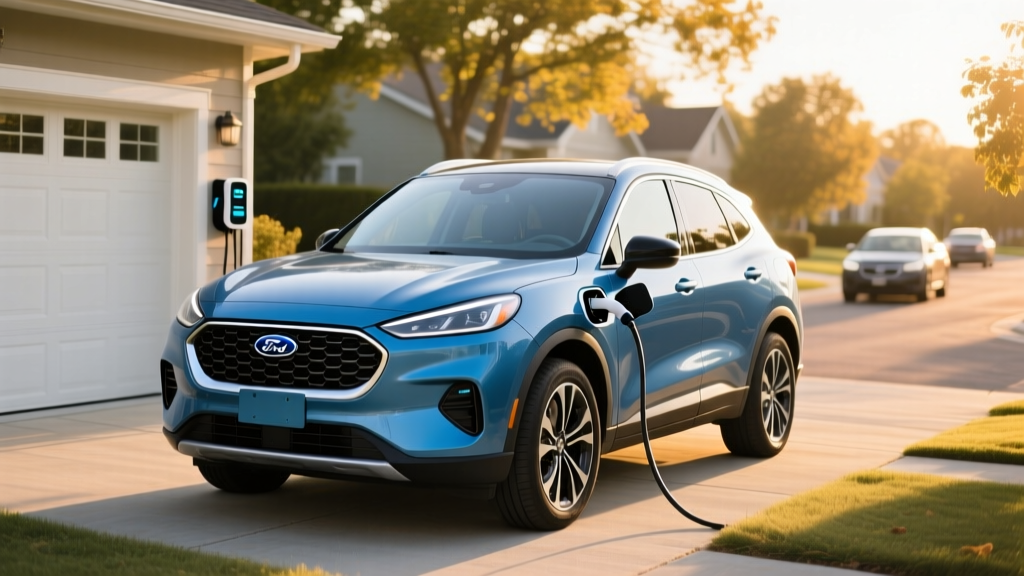
The 2022 Ford Escape Plug-In Hybrid occupies a specific niche: a compact crossover that handles most daily commutes on electricity alone while eliminating range anxiety for longer trips. Now available exclusively on the used market, it remains one of the more practical PHEV options for buyers who want electric driving without committing to a full battery-electric vehicle. Here's everything you need to know about its real-world efficiency, charging behavior, and ownership economics.
HEV vs PHEV: What the Escape Plug-In Hybrid Actually Is
Before diving into specs, it's worth clarifying the distinction between the two Escape hybrid variants Ford offered in 2022:
| Feature | Escape Hybrid (HEV) | Escape Plug-In Hybrid (PHEV) |
|---|---|---|
| Battery Size | 1.1 kWh (self-charging) | 14.4 kWh (plug-in capable) |
| Electric-Only Range | ~1 mile at low speed | 37 miles (EPA) |
| Needs to Plug In? | No — regenerates via braking/engine | Yes — for full electric benefit |
| Combined MPG (gas) | 41 MPG | 40 MPG (after battery depleted) |
| MPGe (electric+gas) | N/A | 105 MPGe |
| Drivetrain | AWD available | FWD only |
| DC Fast Charging | N/A | No — Level 2 AC only |
The conventional HEV is a gas car that uses a small battery to assist the engine and capture regenerative braking energy. You never plug it in. The PHEV, by contrast, carries a much larger 14.4 kWh lithium-ion battery that you charge from a wall outlet or Level 2 charger, enabling genuine electric-only driving before the gasoline engine kicks in as a range extender.
Electric-Only Range, MPG, and Total Range
The EPA rates the 2022 Escape PHEV at 37 miles of electric-only range and 105 MPGe when operating in blended electric-gas mode. Once the battery is depleted, it functions as a conventional hybrid rated at 40 MPG combined (42 city / 37 highway), according to fueleconomy.gov.
| Metric | EPA Rating | Real-World Expectation |
|---|---|---|
| Electric-Only Range | 37 miles | 30–35 mi (highway/cold); up to 40 mi (city, mild weather) |
| MPGe (EV+gas blended) | 105 MPGe | 85–100 MPGe depending on charge frequency |
| Combined MPG (gas only) | 40 MPG | 36–42 MPG (city driving favors higher numbers) |
| City MPG (gas only) | 42 MPG | 40–45 MPG (hybrids excel in stop-and-go) |
| Highway MPG (gas only) | 37 MPG | 33–37 MPG |
| Total Range (EV + gas tank) | ~520 miles | 460–520 miles |
A few real-world caveats apply. The 37-mile electric range assumes moderate temperatures and mixed driving. In winter conditions below 40°F, expect that range to drop to roughly 28–32 miles due to cabin heating demands and reduced battery efficiency. Conversely, city driving in mild weather with frequent regenerative braking can push electric range to 40 miles or slightly beyond. The gasoline-only MPG tends to beat the EPA estimate in city traffic — a hallmark of the series-parallel hybrid system — but falls slightly short on sustained highway driving at 70+ mph.
Battery, Charging, and Powertrain Specs
| Specification | Detail |
|---|---|
| Battery Capacity | 14.4 kWh (lithium-ion) |
| Electric-Only Range | 37 miles (EPA) |
| Onboard Charger | 3.3 kW (Level 2 AC) |
| Level 1 Charge Time (120V) | ~10–11 hours (0–100%) |
| Level 2 Charge Time (240V) | ~3.5 hours (0–100%) |
| DC Fast Charging | Not supported |
| Charge Port | J1772 (standard AC connector) |
| Engine | 2.5L Atkinson-cycle 4-cylinder |
| Electric Motor | 88 kW (118 hp) permanent-magnet |
| Combined System Output | 210 hp |
| Transmission | eCVT (power-split device) |
| Drivetrain | Front-wheel drive only |
| 0–60 mph | ~8.5 seconds (estimated) |
| Fuel Tank | 11.1 gallons |
| Cargo Volume | 34.4 cu ft (rear seats up) / 60.8 cu ft (folded) |
The 2022 Escape PHEV uses a 14.4 kWh battery paired with a 2.5-liter Atkinson-cycle four-cylinder engine and an 88 kW electric motor through Ford's eCVT power-split transmission. Combined output is 210 horsepower — adequate for merging and passing, though not sporty.
Charging is limited to AC only. The onboard charger maxes out at 3.3 kW, meaning a full recharge from empty takes about 3.5 hours on a 240V Level 2 circuit or roughly 10–11 hours on a standard 120V household outlet. There is no DC fast-charging capability, which is typical for PHEVs in this class — the battery is small enough that Level 2 charging is sufficient for overnight or workplace replenishment. If your commute falls within the 37-mile electric envelope and you charge nightly, you may go weeks without visiting a gas station.
Pricing, Tax Credits, and Used Market Value
When new, the 2022 Escape PHEV started at approximately $33,075 for the SE trim, with the SEL at ~$36,625 and the Titanium at ~$40,325 (all including destination). Ford discontinued the Escape PHEV after the 2022 model year, so all examples are now purchased used or certified pre-owned.
On the used market as of early 2026, expect to pay roughly $22,000–$30,000 depending on mileage, condition, and trim. This positions it competitively against used Toyota RAV4 Prime examples, which tend to command higher resale premiums.
Regarding tax credits: the 2022 Escape PHEV originally qualified for a federal tax credit of up to $6,843 under the pre-IRA rules. Under current IRS §30D regulations (as updated through the Inflation Reduction Act), the federal credit for new PHEVs requires meeting battery sourcing, critical minerals, MSRP caps ($80,000 for SUVs), and buyer income limits. Since this vehicle is only available used now, the relevant credit is the Used Clean Vehicle Credit (§25E), which offers up to $4,000 (or 30% of the sale price, whichever is lower) for qualified used EVs and PHEVs. Eligibility requires:
- Sale price of $25,000 or less
- Buyer income below $75,000 (single) / $150,000 (joint)
- Vehicle at least 2 model years old (2022 qualifies in 2026)
- Purchased from a licensed dealer
- Battery capacity of at least 7 kWh (14.4 kWh qualifies)
Always verify current eligibility on IRS.gov and consult a tax professional, as rules and qualifying vehicle lists are updated periodically.
Reliability, Battery Warranty, and Replacement Cost
Factory Battery Warranty (when new): 8 years / 100,000 miles for hybrid/PHEV battery components, covering defects and capacity loss below a defined threshold. Powertrain coverage: 5 years / 60,000 miles.
For a 2022 model in 2026: Original battery warranty remains active through the 2030 model year or 100,000 miles — whichever comes first — and transfers to subsequent owners.
Ford's hybrid and PHEV powertrains have demonstrated solid reliability in the Escape lineage. The eCVT power-split device has no traditional gear shifts or clutch packs to wear, and the Atkinson-cycle engine operates under relatively low stress. The high-voltage battery is liquid-cooled, which helps manage thermal degradation over time.
For context on battery longevity: most PHEV batteries in this size class retain 85–95% of original capacity after 5 years of typical use. Because the Escape PHEV's 14.4 kWh pack is relatively small and the vehicle's software maintains a buffer (you never use 100% of the cells), degradation tends to be gradual rather than cliff-like. A full high-voltage battery replacement, if ever needed out of warranty, typically runs $4,000–$7,000 including labor at a Ford dealer — though this is uncommon within the first decade of ownership.
For safety and crash-test context, the 2022 Escape earned strong marks from NHTSA and was an IIHS Top Safety Pick when equipped with specific headlights.
Who Should Choose the Escape PHEV Over a Full EV or Gas Car?
Choose the 2022 Escape PHEV if:
- Your daily round-trip commute is under 35 miles and you can charge at home overnight
- You take regular road trips where charging infrastructure is sparse or unreliable
- You want electric-like city driving without the upfront cost of a full EV
- You need a compact crossover with reasonable cargo space (34.4 cu ft)
- You want AWD... wait — this is FWD only. If you need AWD, consider the RAV4 Prime or the conventional Escape Hybrid
Choose a full BEV instead if:
- You have reliable home charging and rarely drive more than 250 miles between charges
- You want zero tailpipe emissions and lower per-mile energy cost
- You want access to DC fast charging for road trips
Choose the conventional Escape HEV (or a gas car) if:
- You cannot install a home charger and lack workplace charging
- Your daily driving exceeds 50+ miles, making the PHEV's electric range less impactful
- You need all-wheel drive (available on the HEV, not the PHEV)
The Escape PHEV's sweet spot is the commuter who charges nightly, drives 20–35 miles daily, and takes a handful of longer road trips per year. In that scenario, you'll burn very little gasoline month-to-month while never worrying about charging-desert anxiety on holiday drives.
Pros and Cons at a Glance
Pros
- 37-mile electric range covers most daily commutes
- 40 MPG combined after battery depletion — excellent for a crossover
- Charges fully overnight on a standard 120V outlet
- Strong city MPG that often exceeds EPA estimates
- Federal used-EV credit of up to $4,000 may apply
- Remaining factory battery warranty through 2030 / 100K miles
- Comfortable ride quality and intuitive infotainment (SYNC 3)
Cons
- Front-wheel drive only — no AWD option
- No DC fast charging (not unusual for PHEVs, but limits public charging utility)
- 3.3 kW onboard charger is slow compared to newer PHEVs (some offer 6.6–7.2 kW)
- Discontinued after 2022 — limited new inventory and uncertain parts support long-term
- Cargo space slightly reduced vs. gas Escape due to battery placement
- Electric-only range drops significantly in cold weather (28–32 mi)
- Used-market pricing can approach newer competing PHEVs
Frequently Asked Questions
How many MPG does the 2022 Ford Escape Plug-In Hybrid get?
The EPA rates it at 40 MPG combined (42 city / 37 highway) when running on gasoline after the battery is depleted. In real-world city driving with frequent stops, many owners report 42–45 MPG. Highway cruising at 70+ mph tends to yield 33–37 MPG. When factoring in electric-only driving, the combined rating is 105 MPGe.
How far can the 2022 Escape PHEV go on electric power alone?
The EPA electric-only range is 37 miles. In practice, expect 30–35 miles in mixed driving and cold weather, and up to 40 miles in mild-weather city driving with regenerative braking. The gasoline engine will seamlessly engage once the battery is depleted — there's no range-anxiety scenario.
Does the 2022 Escape PHEV qualify for a tax credit?
As a used vehicle in 2026, it may qualify for the IRS §25E Used Clean Vehicle Credit of up to $4,000, provided the sale price is $25,000 or less, the buyer meets income limits ($75K single / $150K joint), and the vehicle is purchased from a licensed dealer. The original new-vehicle credit is no longer available. Always check current rules at IRS.gov.
Is the Escape PHEV reliable, and what does battery replacement cost?
Ford's hybrid powertrain has a solid reliability track record. The high-voltage battery is covered by an 8-year/100,000-mile warranty (still active for 2022 models through 2030). PHEV batteries in this class typically retain 85–95% capacity after 5 years. Out-of-warranty replacement, if needed, runs approximately $4,000–$7,000 — though most owners never require it within the first decade.
Should I get the Escape PHEV or a full electric vehicle?
If you can charge at home, drive under 35 miles daily, and take road trips where charging infrastructure is uncertain, the PHEV is an excellent bridge. If you have reliable home charging, rarely exceed 250 miles between stops, and want the lowest per-mile energy cost with DC fast-charging capability, a full BEV like the Hyundai Ioniq 5 or Tesla Model Y may serve you better long-term.
Can the Escape PHEV charge at public DC fast chargers?
No. The 2022 Escape PHEV supports only AC charging via a J1772 connector — Level 1 (120V, ~10 hours) or Level 2 (240V at 3.3 kW, ~3.5 hours). This is typical for PHEVs, whose smaller batteries make overnight Level 2 charging sufficient for daily needs.
Is the 2022 Escape PHEV available with all-wheel drive?
No. The plug-in hybrid variant is front-wheel drive only. If AWD is a priority, the conventional Escape Hybrid (HEV) offers an AWD option, as does the Toyota RAV4 Prime PHEV.