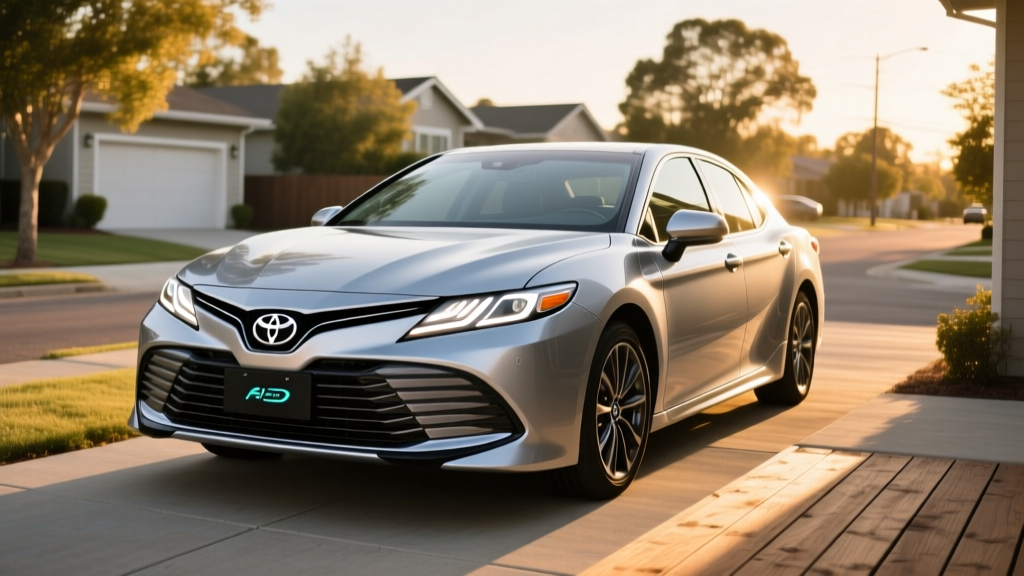
The 2022 Toyota Camry Hybrid remains one of the most practical midsize sedans on the used market in 2026, especially for buyers who want electric-like efficiency without plugging in. With EPA ratings reaching 52 MPG combined and a proven hybrid powertrain shared across millions of Toyota vehicles, it's a rational choice for commuters, road-trippers, and anyone wary of charging infrastructure gaps.
But how does the 2022 Camry Hybrid stack up against a plug-in hybrid like the RAV4 Prime, or a full battery-electric vehicle like the Tesla Model 3? And what should you expect from a three-to-four-year-old hybrid battery in 2026? This guide covers every spec, real-world data point, and ownership cost you need before buying.
HEV vs PHEV vs EV: Where Does the Camry Hybrid Fit?
Before diving into specs, it's critical to understand what the 2022 Camry Hybrid is — and what it is not. The Camry Hybrid is a conventional hybrid electric vehicle (HEV). It pairs a gasoline engine with one or more electric motors and a small battery pack that recharges through regenerative braking and engine power. You never plug it in.
This differs fundamentally from a plug-in hybrid (PHEV) like the Toyota RAV4 Prime or Chrysler Pacifica Hybrid, which carries a larger battery (typically 15–20 kWh) that can be charged from a wall outlet and delivers 25–42 miles of electric-only driving before the gas engine kicks in. And it's entirely different from a battery-electric vehicle (BEV) like the Hyundai Ioniq 6 or Tesla Model 3, which runs solely on electricity.
| Feature | HEV (Camry Hybrid) | PHEV (e.g., RAV4 Prime) | BEV (e.g., Model 3) |
|---|---|---|---|
| Plug-in Required? | No | Yes (optional but recommended) | Yes (mandatory) |
| Electric-Only Range | ~1 mile at low speed | 25–42 miles | 250–360+ miles |
| Gasoline Engine | Yes | Yes | No |
| Fuel/Energy | Gasoline only | Gasoline + electricity | Electricity only |
| Federal Tax Credit (§30D) | Not eligible | Up to $7,500 (if eligible) | Up to $7,500 (if eligible) |
| Home Charging Needed | No | Recommended (Level 2) | Required (Level 2) |
| Typical Price (New, 2022) | $27,480–$35,495 | $39,800–$46,000 | $44,990–$62,990 |
Bottom line: The Camry Hybrid is the right pick if you want maximum fuel savings with zero lifestyle change — no charger installation, no route planning, no range anxiety. If you have home charging access and a short commute, a PHEV or BEV may save more on fuel. But for apartment dwellers, frequent road-trippers, or those in areas with sparse charging networks, the HEV's simplicity is a major advantage.
2022 Camry Hybrid Fuel Economy: EPA Ratings vs Real-World MPG
The 2022 Camry Hybrid was offered in three trims — LE, SE, and XLE — and fuel economy varies slightly by trim due to wheel size and weight differences. Here are the official EPA figures from fueleconomy.gov:
| Trim | City MPG | Highway MPG | Combined MPG | Annual Fuel Cost* |
|---|---|---|---|---|
| LE | 51 | 53 | 52 | ~$1,050 |
| SE | 44 | 47 | 46 | ~$1,200 |
| XLE | 44 | 47 | 46 | ~$1,200 |
*Based on 15,000 miles/year, 55% city driving, and $3.40/gallon regular unleaded (2026 national average estimate).
Real-World MPG: What Owners Actually See
Toyota's hybrid system excels in city driving, where regenerative braking and electric-motor assist do the heavy lifting. In real-world driving reported on Fuelly and in long-term tests, the Camry Hybrid LE commonly achieves 48–54 MPG in mixed driving, with some hypermilers exceeding the EPA city figure in stop-and-go traffic.
Highway driving is where hybrids lose their advantage. At sustained 70–80 mph speeds, expect 42–47 MPG — below the EPA highway sticker. The SE and XLE trims, equipped with 18- or 19-inch wheels and sport-tuned suspensions, typically deliver 2–4 MPG less than the LE across all conditions.
In cold weather (below 30°F), hybrid fuel economy drops 10–15% because the gasoline engine runs more frequently to heat the cabin and warm the battery. Expect 38–44 MPG combined in winter conditions for the LE trim.
Powertrain Specs: Engine, Motor, and Combined Horsepower
| Specification | Detail |
|---|---|
| Engine | 2.5L 4-cylinder Dynamic Force (A25A-FXS) |
| Engine Power | 176 hp @ 5,700 rpm / 163 lb-ft @ 5,200 rpm |
| Electric Motor | Permanent-magnet synchronous (front); AWD models add rear motor |
| Motor Power | 118 hp / 149 lb-ft (front) |
| Combined Net Horsepower | 208 hp |
| Transmission | Electronic continuously variable (eCVT) |
| Drivetrain | FWD standard; electronic AWD available (SE, XLE) |
| 0–60 mph | ~7.2 seconds (FWD) |
| Hybrid Battery | 1.6 kWh lithium-ion (sealed NiMH on some early builds) |
| Towing Capacity | Not rated for towing |
The 208-hp combined output puts the Camry Hybrid ahead of most competitors in the midsize hybrid sedan segment. The eCVT delivers smooth, linear acceleration without the rubber-band effect common in older CVTs. The available electronic AWD system uses a separate 40-hp rear motor to provide traction when the front wheels slip — it's not a performance AWD system, but it adds confidence in rain and light snow.
Battery Life, Warranty, and Replacement Cost
Hybrid battery longevity is the number-one concern for used-hybrid buyers. Toyota's track record here is among the best in the industry.
2022 Camry Hybrid Battery Warranty
- Hybrid Battery Warranty: 10 years / 150,000 miles (whichever comes first) in all 50 states, effective for 2020 and newer model years
- Hybrid System Components: 8 years / 100,000 miles (inverter, control module, etc.)
- Transferability: Fully transferable to subsequent owners at no cost
Source: Toyota Warranty Guide
Real-World Hybrid Battery Longevity
Toyota has sold millions of vehicles using its Hybrid Synergy Drive system, and data from taxis, fleet vehicles, and high-mileage owners consistently shows hybrid batteries lasting 150,000–250,000 miles before significant degradation. Some Camry and Prius taxis have surpassed 300,000 miles on the original battery pack.
For a 2022 model in 2026, the vehicle is roughly 4 years old. Assuming average mileage of 12,000–15,000 miles per year, most examples will have 48,000–60,000 miles — well within the 10-year/150,000-mile warranty window. This means the hybrid battery should remain fully covered through approximately 2032 or 150,000 miles, whichever comes first.
Battery Replacement Cost (Out of Warranty)
If you keep the vehicle past the warranty period and the hybrid battery eventually fails, replacement costs in 2026 are approximately:
- New OEM battery (Toyota dealer): $3,000–$4,500 including labor
- Refurbished/remanufactured battery: $1,500–$2,500 including labor
- Individual module replacement: $500–$1,200 (if only a few cells are degraded)
The Camry Hybrid's lithium-ion pack is smaller and less expensive to replace than the larger batteries found in PHEVs and BEVs. Complete failures before 150,000 miles are rare; most degradation manifests as a slight reduction in electric-only assist at low speeds, not a total loss of function.
2022 Camry Hybrid Pricing and Tax Credit Eligibility
Original MSRP (2022 Model Year)
| Trim | MSRP (FWD) | AWD Option |
|---|---|---|
| LE Hybrid | $27,480 | +$1,400 |
| SE Hybrid | $29,990 | +$1,400 |
| XLE Hybrid | $32,990 | +$1,400 |
Used Pricing in 2026
As of early 2026, used 2022 Camry Hybrid listings typically range from $22,000–$29,000 depending on trim, mileage, and condition. The LE trim holds value well due to its superior fuel economy, while the XLE commands a premium for its leather-trimmed interior and upgraded infotainment.
Federal Tax Credit: Does the Camry Hybrid Qualify?
No. The 2022 Camry Hybrid is a conventional HEV and does not qualify for the federal §30D Clean Vehicle Credit (up to $7,500 for new EVs/PHEVs). The §30D credit, as defined by the IRS, requires a vehicle to have a battery capacity of at least 7 kWh and the ability to be recharged from an external source. The Camry Hybrid's 1.6 kWh battery and lack of a charging port disqualify it entirely.
There is also no federal tax credit for used conventional hybrids. The used clean vehicle credit (up to $4,000 under §25E) applies only to used BEVs and PHEVs — not HEVs.
Some states may offer minor incentives for hybrid purchases (reduced registration fees, HOV lane access in certain states), but these vary widely. Check your state's DMV or energy office for current programs.
Who Should Buy the 2022 Camry Hybrid — and Who Shouldn't
Choose the Camry Hybrid If:
- You want 45+ MPG without installing a home charger or changing your routine
- You live in an apartment or lack access to Level 2 charging
- You take frequent long road trips and don't want to plan around DC fast-charging stops
- You want a proven, low-risk powertrain with a 10-year/150,000-mile battery warranty
- You drive primarily in city or suburban conditions where the hybrid system excels
- You want a midsize sedan with strong resale value and low maintenance costs
Consider a PHEV or BEV Instead If:
- You have home Level 2 charging and a commute under 35 miles (a PHEV like the RAV4 Prime covers most trips on electricity alone)
- You want to eliminate gasoline entirely and have reliable charging access (consider a Model 3, Ioniq 6, or Chevy Equinox EV)
- You want to claim the federal §30D tax credit (up to $7,500 for qualifying new EVs/PHEVs, or up to $4,000 for qualifying used EVs/PHEVs)
- You want one-pedal driving and instant torque (BEVs deliver a fundamentally different driving experience)
- You drive fewer than 8,000 miles per year (fuel savings may not offset the higher purchase price of a hybrid vs. a gas Camry)
Quick Decision Framework
- No home charging + high annual miles → Camry Hybrid (HEV) is ideal
- Home charging + short commute + road trips → PHEV (RAV4 Prime, Prius Prime)
- Home charging + mostly local driving + tax credit priority → BEV (Model 3, Ioniq 6)
- Low annual miles + budget priority → Gas Camry or used non-hybrid sedan
Reliability, Safety, and Long-Term Ownership Costs
Reliability Track Record
The 2022 Camry Hybrid benefits from Toyota's decades-long refinement of the Hybrid Synergy Drive system. Consumer Reports rates the 2022 Camry Hybrid at above-average predicted reliability, and the model consistently appears on best-reliability lists. The eCVT transmission, which has no traditional gears or belts, is one of the most durable transmissions in the industry.
Common maintenance items are minimal compared to gas-only vehicles: there's no timing belt to replace (the A25A engine uses a timing chain), brake pads last significantly longer thanks to regenerative braking (often 80,000–100,000 miles), and the hybrid system requires no regular service beyond standard coolant checks.
Safety Ratings
The 2022 Camry earned a 5-Star Overall Safety Rating from NHTSA and was an IIHS Top Safety Pick+ when equipped with specific headlights. Toyota Safety Sense 2.5+ comes standard on all trims, including:
- Pre-Collision System with Pedestrian Detection
- Full-Speed Range Dynamic Radar Cruise Control
- Lane Departure Alert with Steering Assist
- Lane Tracing Assist
- Automatic High Beams
- Road Sign Assist
Note: Toyota Safety Sense is a Level 2 driver-assistance system per SAE classification. The driver must remain fully engaged and attentive at all times. This is not autonomous driving.
Estimated 5-Year Ownership Costs
| Category | Estimated Cost |
|---|---|
| Fuel (gasoline at ~$3.40/gal) | $5,250 |
| Insurance (national avg) | $8,500–$10,500 |
| Maintenance (oil, tires, brakes) | $2,800–$3,500 |
| Depreciation (purchase ~$25K used) | $8,000–$10,000 |
| Repairs (out-of-pocket, under warranty) | $200–$500 |
| Total Estimated (5 years) | $24,750–$29,750 |
Compared to a 2022 gas-only Camry (30 MPG combined), the Hybrid saves approximately $3,500–$4,500 in fuel over five years at 15,000 miles per year. The hybrid's higher upfront cost (roughly $2,000–$3,000 more than a comparable gas LE on the used market) is typically recouped within 3–4 years of average driving.
Frequently Asked Questions
How many MPG does the 2022 Camry Hybrid get?
The EPA rates the 2022 Camry Hybrid LE at 51 city / 53 highway / 52 combined MPG. The SE and XLE trims are rated at 44 city / 47 highway / 46 combined. In real-world driving, owners commonly report 48–54 MPG mixed for the LE, with highway driving yielding 42–47 MPG.
Does the 2022 Camry Hybrid need to be plugged in?
No. The Camry Hybrid is a conventional HEV — its battery charges through regenerative braking and the gasoline engine. There is no plug, no charging port, and no electric-only range beyond brief low-speed maneuvering. If you want plug-in capability, consider the Toyota Prius Prime or RAV4 Prime.
How long will the hybrid battery last?
Toyota's hybrid batteries in the Camry routinely last 150,000–250,000 miles based on fleet and owner data. The 2022 model is covered by a 10-year/150,000-mile hybrid battery warranty that transfers to subsequent owners. In 2026, most examples remain well within warranty coverage.
What does it cost to replace the Camry Hybrid battery?
A new OEM hybrid battery replacement costs approximately $3,000–$4,500 including labor at a Toyota dealer. Refurbished batteries are available for $1,500–$2,500. Individual module repairs can cost as little as $500–$1,200. Complete battery failures before 150,000 miles are uncommon.
Does the 2022 Camry Hybrid qualify for a federal tax credit?
No. The §30D Clean Vehicle Credit requires a battery of at least 7 kWh with external charging capability. The Camry Hybrid's 1.6 kWh battery and lack of a plug disqualify it from all federal EV/PHEV tax credits. The used vehicle credit (§25E) also does not apply to conventional hybrids.
Is the Camry Hybrid AWD system worth it?
The electronic AWD system adds a 40-hp rear electric motor that engages automatically when front-wheel slip is detected. It's effective for rain, light snow, and hill starts, but it's not designed for off-road use or performance driving. It costs roughly $1,400 extra and reduces fuel economy by about 1–2 MPG. If you live in a region with mild winters, FWD is sufficient. For frequent snow or ice, the AWD option provides meaningful peace of mind.
Camry Hybrid vs Prius: which is better in 2026?
The redesigned 2023+ Prius (fifth generation) now offers up to 57 MPG combined and a more engaging driving experience, narrowing the gap with the Camry Hybrid. However, the 2022 Camry Hybrid provides a larger trunk (15.1 cu ft vs 23.8 cu ft in the Prius hatchback, though the Prius hatch is more versatile), a smoother ride, and a more spacious rear seat. On the used market, the 2022 Camry Hybrid is often priced similarly to a 2022 Prius, so the choice comes down to sedan vs hatchback preference and whether you prioritize maximum MPG (Prius) or comfort and space (Camry).