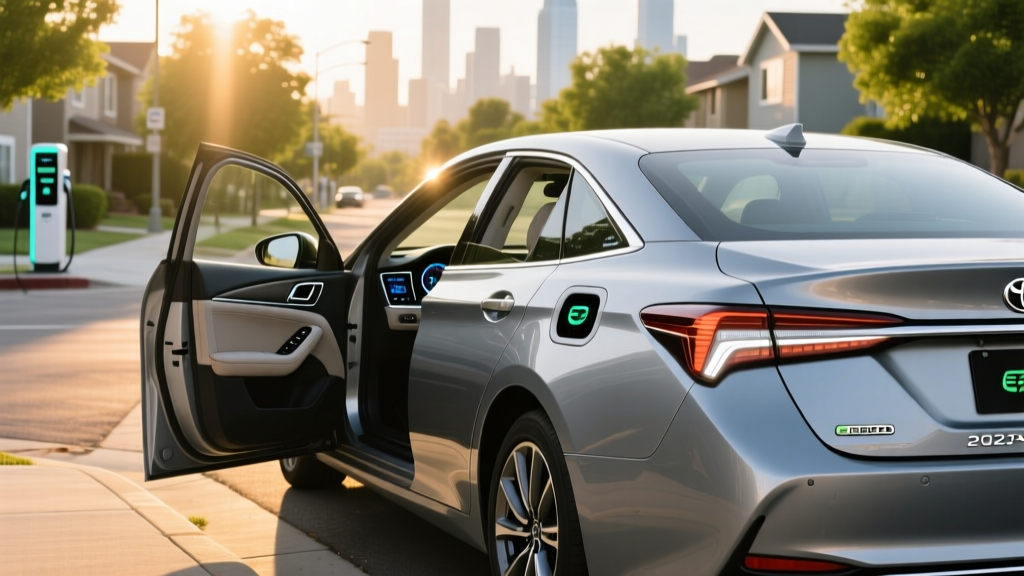
The Toyota Avalon Hybrid was discontinued after the 2022 model year, closing the book on one of the most fuel-efficient full-size sedans ever sold in the United States. For used-car shoppers in 2026, that discontinuation is actually good news: supply is finite, depreciation has already absorbed the initial hit, and Toyota's hybrid powertrain has proven itself over hundreds of thousands of real-world miles. If you want a spacious, comfortable sedan that sips fuel without requiring a plug, the 2022 Avalon Hybrid remains a compelling choice on the pre-owned market.
This guide covers everything a 2026 buyer needs to know — EPA fuel economy versus real-world results, the hybrid powertrain, battery longevity and warranty, pricing, and whether this conventional hybrid (HEV) is the right fit compared to a plug-in hybrid or full battery-electric vehicle.
HEV vs. PHEV: What the 2022 Avalon Hybrid Actually Is
Before diving into specs, it is critical to understand that the 2022 Avalon Hybrid is a conventional hybrid electric vehicle (HEV), not a plug-in hybrid (PHEV). This distinction shapes everything about ownership.
HEV vs. PHEV — Key Differences
| Feature | HEV (2022 Avalon Hybrid) | PHEV (e.g., Toyota RAV4 Prime) |
|---|---|---|
| Plugs in to charge? | No — charges via engine and regen | Yes — Level 1/Level 2 |
| Electric-only range | ~1 mile at low speed | 25–42 miles typical |
| Battery size | 1.6 kWh (NiMH) | 13–18 kWh (lithium-ion) |
| Federal tax credit (§30D) | Not eligible | Up to $7,500 if eligible |
| Gasoline required? | Yes, always | Yes, for longer trips |
The Avalon Hybrid recovers energy through regenerative braking and the gasoline engine. You never plug it in. You simply fill up at the pump and drive — the hybrid system handles the rest.
Fuel Economy: EPA Ratings and Real-World MPG
The 2022 Avalon Hybrid's headline number is its fuel efficiency, especially for a sedan with this much interior room. Here is the EPA fuel economy data broken down by trim:
| Trim | City | Highway | Combined |
|---|---|---|---|
| XLE | 43 | 44 | 44 |
| XSE | 43 | 43 | 43 |
| Limited | 43 | 43 | 43 |
| Nightshade | 43 | 43 | 43 |
Real-World MPG: What Owners Actually See
EPA numbers are a solid baseline, but Toyota's hybrid system tends to overperform in city driving. The Avalon Hybrid's engine shuts off frequently at low speeds, relying on the electric motor for stop-and-go traffic. Owner-reported data on Fuelly shows many drivers averaging 42–47 MPG combined in mixed driving, with city-dominant commutes sometimes pushing above 46 MPG.
Highway-heavy driving at 75+ mph tends to drop the figure to roughly 38–41 MPG — the aerodynamic penalty of a large sedan and the engine running more continuously at speed reduce the hybrid advantage. In cold weather (below 30°F), expect a 5–10% reduction as the engine runs more often to maintain cabin heat and battery temperature.
- City-dominant: 44–47 MPG
- Mixed driving: 42–45 MPG
- Highway (70–80 mph): 38–41 MPG
- Cold weather (sub-30°F): subtract 5–10%
Powertrain: Engine, Motor, and Combined Output
The 2022 Avalon Hybrid pairs a 2.5-liter inline-four Atkinson-cycle gasoline engine with an electric motor through Toyota's fourth-generation Hybrid Synergy Drive (e-CVT). Here is the full powertrain breakdown:
| Component | Specification |
|---|---|
| Gas engine | 2.5L I4 Atkinson-cycle, 176 hp / 163 lb-ft |
| Electric motor | Permanent-magnet synchronous, 118 hp / 149 lb-ft |
| Net combined output | 215 hp |
| Transmission | e-CVT (planetary gearset, not a belt CVT) |
| Drivetrain | Front-wheel drive (FWD) |
| Hybrid battery | 1.6 kWh Nickel-Metal Hydride (NiMH) |
| 0–60 mph | ~7.9 seconds |
| Fuel tank | 13.2 gallons (regular 87 octane) |
The 215 hp combined output provides adequate acceleration for a 3,600-pound sedan. The e-CVT uses a planetary gearset rather than a traditional belt-and-pulley CVT, which means there is no rubber-band effect — power delivery is smooth and linear. At low speeds, the Avalon Hybrid can operate in EV mode for roughly one mile, using battery power alone in parking lots or crawl-speed traffic.
Battery Warranty, Lifespan, and Replacement Cost
Hybrid battery longevity is the number-one concern for used hybrid buyers. Here is what you need to know about the 2022 Avalon Hybrid's battery:
Toyota Hybrid Battery Warranty
Coverage: 10 years / 150,000 miles (whichever comes first) for the hybrid battery and hybrid system components.
Applies to: 2020 and newer Toyota hybrids, including the 2022 Avalon Hybrid.
Transferable: Yes — the warranty transfers to subsequent owners automatically.
How Long Do Toyota Hybrid Batteries Last?
Toyota's NiMH hybrid batteries have an exceptionally strong track record. Data from fleet operators, taxi services, and long-term owners of the Prius and Camry Hybrid (which share the same Hybrid Synergy Drive architecture) consistently shows these batteries lasting 150,000–250,000 miles before significant degradation. Many exceed 200,000 miles with minimal capacity loss.
The NiMH chemistry in the Avalon Hybrid is less energy-dense than lithium-ion but is extremely durable and tolerant of the shallow charge-discharge cycles that hybrid systems use. The battery management system keeps the state of charge between roughly 40% and 80%, which dramatically extends cycle life.
Battery Replacement Cost
If the hybrid battery does eventually need replacement:
- New OEM battery (Toyota dealer): $3,000–$4,500 installed
- Refurbished/remanufactured battery: $1,500–$2,500 installed
- Individual cell replacement (specialist shops): $500–$1,200
Given the 10-year/150,000-mile warranty and the proven durability of Toyota's hybrid system, battery replacement is a low-probability event for most owners. A 2022 model will remain under factory hybrid warranty until at least 2032 or 150,000 miles.
Used Pricing and Tax Credit Eligibility in 2026
When new, the 2022 Avalon Hybrid started at approximately $37,350 (XLE) and climbed to around $43,550 (Limited), including destination. As of early 2026, used examples are trading in these ranges:
| Trim | Original MSRP | Used Range (2026) |
|---|---|---|
| XLE | $37,350 | $24,000–$28,000 |
| XSE | $38,750 | $25,500–$30,000 |
| Limited | $43,550 | $29,000–$35,000 |
| Nightshade | $40,150 | $27,000–$32,000 |
Does the 2022 Avalon Hybrid Qualify for a Tax Credit?
No. The 2022 Avalon Hybrid is a conventional HEV and does not qualify for the federal §30D Clean Vehicle Credit. That credit applies only to plug-in electric vehicles (BEVs and PHEVs) that meet battery sourcing, MSRP, and buyer income requirements.
However, buyers purchasing a used Avalon Hybrid may benefit from the Used Clean Vehicle Credit (§25E) — but only if the vehicle is a qualifying plug-in model. Since the Avalon Hybrid is an HEV, it is also ineligible for this credit. The trade-off is straightforward: no tax credit, but no plug-in infrastructure cost, no range anxiety, and a significantly lower purchase price than a comparable used BEV.
Who Should Buy the 2022 Avalon Hybrid?
The Avalon Hybrid occupies a specific niche. Here is a decision framework to determine if it fits your needs:
Choose the 2022 Avalon Hybrid If:
- You drive 15,000+ miles per year and want to minimize fuel costs without plugging in
- You need a full-size sedan with a large trunk (16.1 cu ft) and generous rear legroom
- You lack access to home or workplace charging (apartment, street parking)
- You prioritize proven reliability and low maintenance costs
- You want a smooth, quiet ride for commuting and road trips
Choose a PHEV Instead If:
- You have home Level 2 charging and a commute under 30 miles round-trip
- You want to drive mostly on electricity but need gas flexibility for road trips
- You want to claim a federal tax credit (up to $7,500 for qualifying new PHEVs)
Choose a Full EV (BEV) Instead If:
- You have reliable home charging and want to eliminate gasoline entirely
- Your daily driving is under 250 miles and you rarely tow
- You want the lowest per-mile energy cost (electricity at $0.13/kWh ≈ $0.04/mile vs. gas at $3.20/gal ≈ $0.07/mile at 44 MPG)
Pros, Cons, and Ownership Realities
Pros
- 43–44 MPG combined EPA — among the best for any full-size sedan
- 10-year / 150,000-mile hybrid battery warranty (transferable)
- No plug-in charging required — works with existing gas infrastructure
- Smooth, quiet powertrain with seamless engine/motor transitions
- Spacious cabin: 106.7 cu ft passenger volume, 16.1 cu ft trunk
- Standard Toyota Safety Sense 2.5+ (adaptive cruise, lane-keep, AEB)
- Proven reliability track record for Toyota's hybrid system
- Runs on regular 87-octane gasoline
Cons
- Discontinued after 2022 — no new models, limited future dealer support for body parts
- FWD only — no AWD option for snow-belt buyers
- 215 hp is adequate but not quick for a 3,600-lb sedan (7.9s 0–60)
- No federal tax credit eligibility (HEV, not PHEV or BEV)
- Infotainment system feels dated compared to 2024+ competitors
- NiMH battery (older chemistry, though more durable than early Li-ion)
- Highway MPG drops noticeably above 75 mph
Total Cost of Ownership: 5-Year Estimate
Here is how the 2022 Avalon Hybrid stacks up on operating costs over five years, assuming 15,000 miles per year and $3.20/gallon regular gasoline:
| Vehicle | Fuel Cost | Est. Maintenance | Total Energy + Maint. |
|---|---|---|---|
| 2022 Avalon Hybrid (44 MPG) | $5,455 | $2,200 | $7,655 |
| 2022 Avalon V6 (25 MPG, gas-only) | $9,600 | $2,500 | $12,100 |
| Comparable midsize BEV (3.5 mi/kWh) | $3,570* | $1,500 | $5,070 |
*BEV fuel cost assumes $0.13/kWh average electricity rate. Actual rates vary by utility and state.
The Avalon Hybrid saves roughly $4,400 in fuel costs over five years compared to the gas-only V6 Avalon. It costs about $2,500 more to fuel than a comparable BEV, but without the higher upfront purchase price or charging-infrastructure investment that a BEV requires.
Frequently Asked Questions
How many MPG does the 2022 Avalon Hybrid get?
The EPA rates the 2022 Avalon Hybrid XLE at 43 city / 44 highway / 44 combined MPG. The XSE, Limited, and Nightshade trims are rated at 43/43/43 MPG. Real-world owners typically see 42–47 MPG combined, with city-dominant driving yielding the best results.
Does the 2022 Avalon Hybrid need to be plugged in?
No. The Avalon Hybrid is a conventional HEV. Its 1.6 kWh NiMH battery charges exclusively through regenerative braking and the gasoline engine. There is no plug, no charging cable, and no need for any charging infrastructure.
Is the 2022 Avalon Hybrid reliable?
Toyota's Hybrid Synergy Drive is one of the most proven powertrains in the automotive industry, with millions of units on the road globally. The IIHS gave the 2022 Avalon strong safety ratings, and Toyota's hybrid system has consistently ranked at the top of reliability surveys. The e-CVT planetary gearset has no belts, clutches, or torque converter to wear out, reducing long-term maintenance risk.
What is the hybrid battery replacement cost?
A new OEM replacement battery from a Toyota dealer runs approximately $3,000–$4,500 installed. Refurbished options are available for $1,500–$2,500. However, the 10-year/150,000-mile factory warranty (transferable to used buyers) and the proven 150,000–250,000-mile lifespan of Toyota's NiMH packs make replacement unlikely during typical ownership.
Does the 2022 Avalon Hybrid qualify for any tax credit?
No. As a conventional HEV, the Avalon Hybrid does not qualify for the federal §30D Clean Vehicle Credit or the §25E Used Clean Vehicle Credit. Those credits apply only to plug-in vehicles (BEVs and PHEVs). Some states may offer minimal incentives for hybrid purchases, but these are uncommon and vary by jurisdiction — check your state's energy office for current programs.
How does the Avalon Hybrid compare to the Camry Hybrid?
The 2022 Camry Hybrid uses a nearly identical powertrain (2.5L I4 + electric motor, 208 hp combined) and achieves 46–52 MPG combined depending on trim. The Avalon Hybrid gives up 5–8 MPG but provides significantly more rear-seat legroom, a larger trunk, and a quieter, more refined ride. If you need full-size sedan space, the Avalon Hybrid is the better choice; if maximum MPG is the priority, the Camry Hybrid wins.
Is the Avalon Hybrid good for road trips?
Yes. With a 13.2-gallon fuel tank and 44 MPG combined, the Avalon Hybrid delivers roughly 580 miles of total range — more than most BEVs and comparable to diesel sedans. The adaptive cruise control and lane-centering (Toyota Safety Sense 2.5+) reduce highway fatigue. The main limitation is that highway fuel economy drops to about 38–41 MPG at speeds above 75 mph, which reduces range to approximately 500–540 miles on fast interstate runs.
Sources: EPA Fuel Economy (fueleconomy.gov), Toyota Motor Corporation specifications, IRS Clean Vehicle Credits (irs.gov), IIHS safety ratings. Used pricing reflects 2026 market estimates and varies by mileage, condition, and region.