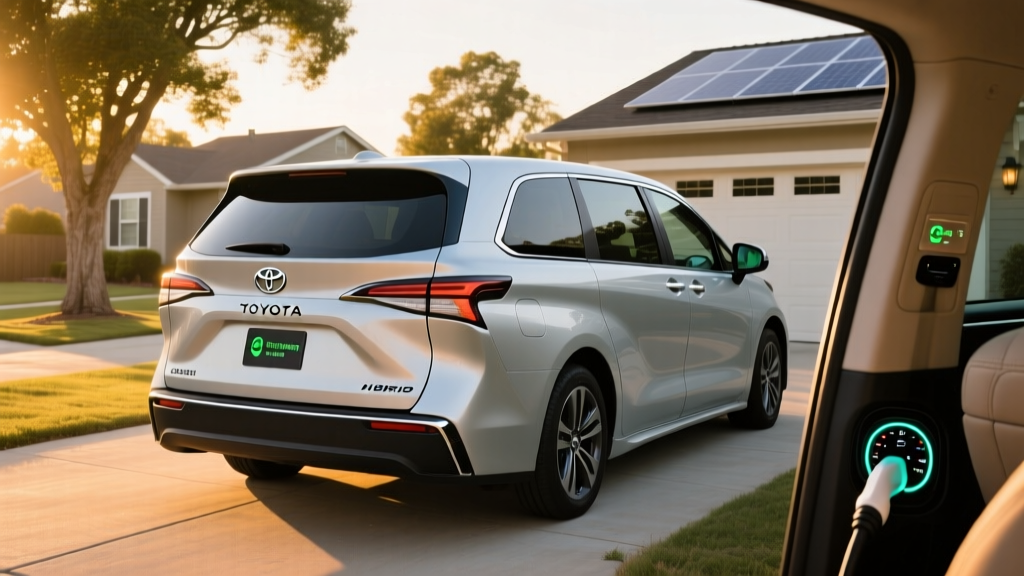
The 2021 Toyota Sienna Hybrid at a Glance
When Toyota redesigned the Sienna for the 2021 model year, it made a bold move: every Sienna became a hybrid. No gas-only variant, no plug-in option — just a single fourth-generation hybrid electric vehicle (HEV) powertrain across all trims. Five years later, that decision looks prescient. The 2021 Toyota Sienna hybrid remains one of the most fuel-efficient three-row vehicles on the used market, and its hybrid battery has largely proven durable in real-world ownership.
If you're shopping for a 2021 Sienna today — whether from a dealer lot, a private seller, or a certified pre-owned program — here's every number that matters: fuel economy, powertrain output, battery warranty, real-world MPG, and how it stacks up against plug-in hybrids and full EVs for family hauling.
| Spec | Value |
|---|---|
| Powertrain | 2.5L 4-cyl + 2 electric motors (FWD) / 3 motors (AWD) |
| Combined Horsepower | 245 hp (net system) |
| Transmission | eCVT (electronically controlled CVT) |
| EPA MPG (FWD) | 36 city / 36 highway / 36 combined |
| EPA MPG (AWD) | 35 city / 36 highway / 35 combined |
| Fuel Tank | 14.5 gallons |
| Total Range | ~522 miles (FWD) |
| Hybrid Battery | ~1.6 kWh nickel-metal hydride (NiMH), sealed |
| Drivetrain | FWD standard; electronic AWD optional |
| 0–60 mph | ~7.1 seconds (FWD) |
| Towing Capacity | 3,500 lbs (when properly equipped) |
| Seating | 7 or 8 passengers (trim-dependent) |
| Cargo (behind 3rd row) | 33.5 cu ft |
| Original MSRP (base LE FWD) | $34,460 |
| Original MSRP (Platinum AWD) | $50,460 |
How Many MPG Does the 2021 Toyota Sienna Hybrid Get?
The EPA rates the front-wheel-drive 2021 Sienna hybrid at 36 MPG city, 36 highway, and 36 combined. The all-wheel-drive variant drops slightly to 35 city / 36 highway / 35 combined. These are remarkable numbers for a 4,600-pound minivan with seating for up to eight.
| Drivetrain | City MPG | Highway MPG | Combined MPG | Est. Total Range |
|---|---|---|---|---|
| FWD | 36 | 36 | 36 | 522 mi |
| AWD | 35 | 36 | 35 | 508 mi |
Real-World MPG vs. EPA Sticker
Toyota's hybrid system excels in stop-and-go driving where regenerative braking recovers energy and the electric motors handle low-speed propulsion. In real-world ownership, many Sienna hybrid drivers report exceeding the EPA city estimate, with 38–40 MPG achievable in urban and suburban driving. Highway fuel economy tends to track closer to the EPA figure, though sustained 75+ mph cruising on flat interstates can dip to 31–33 MPG — a function of the minivan's aerodynamic profile and weight.
Cold weather impacts the Sienna hybrid less severely than a full EV. The gasoline engine runs more frequently in winter to provide cabin heat and maintain catalyst temperature, which can reduce observed MPG to the low 30s during short-trip winter commuting. Once the powertrain is warm, the hybrid system resumes normal efficiency. According to fueleconomy.gov, the 2021 Sienna FWD hybrid achieves an annual fuel cost estimate of approximately $1,650 based on 15,000 miles per year and $3.70/gallon regular unleaded.
HEV vs. PHEV vs. EV: Where Does the Sienna Fit?
The 2021 Sienna is a conventional hybrid (HEV), not a plug-in hybrid. This distinction matters for buyers cross-shopping electrified family vehicles. Here's how the three electrified categories compare:
| Factor | HEV (Sienna Hybrid) | PHEV (e.g., Chrysler Pacifica Hybrid) | BEV (e.g., Kia EV9) |
|---|---|---|---|
| Plug-in required? | No — self-charging via regen + engine | Yes — Level 2 recommended | Yes — Level 2 essential, DC fast charging |
| Electric-only range | ~1 mile at low speed | 32 miles (Pacifica Hybrid) | 230–300+ miles (model-dependent) |
| Total range | ~522 miles | ~430 miles (electric + gas) | 230–300+ miles (battery only) |
| Combined efficiency | 36 MPG | 30 MPG / 82 MPGe | 85–97 MPGe |
| Home charging install | Not needed | $500–$2,000 (Level 2) | $800–$2,500+ (Level 2, 240V) |
| Federal tax credit (§30D) | Not eligible | Not eligible (new); used credit possible | Up to $7,500 (if eligible, new) |
| Three-row seating | Yes (7–8 passengers) | Yes (7 passengers) | Yes (6–7 passengers) |
The Chrysler Pacifica Hybrid is the closest PHEV competitor. It offers 32 miles of electric-only range, which is excellent for school runs and errands, but its combined gas-only MPG (30) trails the Sienna hybrid significantly once the battery is depleted. The Kia EV9, a three-row BEV, eliminates gasoline entirely but requires home charging infrastructure and delivers 230–300 miles of range depending on trim — adequate for most families, but a constraint on long road trips without DC fast-charging planning.
Who Should Choose the Sienna Hybrid?
The 2021 Sienna hybrid is the right call if:
- You want maximum fuel efficiency without changing your fueling habits (gas stations only, no plug-in)
- You live in an apartment or lack access to home or workplace charging
- You regularly take road trips exceeding 300 miles and don't want to plan charging stops
- You need 7–8 seats, sliding doors, and minivan cargo practicality
- You want proven hybrid reliability with low maintenance costs
Consider a PHEV or BEV instead if you have home charging access, want to drive partially or fully on electricity, and are willing to manage charging logistics for the benefit of lower per-mile energy costs.
Powertrain Deep Dive: 245 HP Hybrid System
The 2021 Sienna uses Toyota's fourth-generation hybrid system, built around a 2.5-liter Atkinson-cycle four-cylinder engine producing 189 horsepower and 176 lb-ft of torque on its own. Two front-mounted electric motor-generators (MG1 and MG2) supplement the engine, with MG2 providing primary electric drive torque. The combined net system output is 245 horsepower.
AWD models add a third electric motor on the rear axle — a separate 54-hp unit that engages automatically when front-wheel slip is detected or during hard acceleration. Unlike mechanical AWD systems, there's no driveshaft connecting the front and rear axles. The rear motor activates from 0–43 mph and during acceleration, then disengages at cruising speed to minimize drag losses.
The hybrid battery pack is a ~1.6 kWh nickel-metal hydride (NiMH) unit located under the front seats. Toyota chose NiMH over lithium-ion for this application due to its proven long-term durability, wide operating temperature range, and lower cost. The small capacity is intentional: HEVs don't store significant energy. The battery acts as a buffer, capturing energy from regenerative braking and the engine, then deploying it in short bursts for electric assist and low-speed creep.
Battery Warranty, Lifespan, and Replacement Cost
Hybrid battery longevity is the single most common concern among used hybrid buyers. Toyota's warranty coverage is strong:
Toyota Hybrid Battery Warranty (2021 Sienna)
- Hybrid battery: 10 years / 150,000 miles (whichever comes first)
- Hybrid system components: 8 years / 100,000 miles
- Transferability: Fully transferable to subsequent owners
- Applies in: All 50 states (California PZEV states may have extended coverage)
For a 2021 model purchased in 2026, the hybrid battery remains under factory warranty until 2031 or 150,000 miles — whichever comes first. This is a significant advantage over buying a used EV where battery State of Health (SoH) may be uncertain and replacement costs are far higher.
Real-World Battery Degradation
Toyota's NiMH hybrid batteries have an exceptional track record. Data from fleet operators and long-term owners of Toyota hybrids (including the Prius, Camry Hybrid, and Highlander Hybrid sharing similar architecture) shows that hybrid battery packs routinely last 150,000–200,000+ miles before meaningful degradation occurs. Unlike EV batteries, which cycle deeply (0–100% State of Charge), the Sienna's hybrid battery operates in a narrow state-of-charge window — typically between 40% and 80% SoC — which dramatically reduces cell stress.
If the hybrid battery does eventually fail out of warranty, replacement costs for a Toyota Sienna hybrid battery range from $2,500 to $4,500 depending on whether you choose a new OEM pack, a refurbished unit, or an aftermarket option. Independent hybrid repair shops can also replace individual battery modules for $500–$1,500, extending the pack's life at a fraction of full replacement cost.
Pricing, Used Market Value, and Tax Credits
As a 2021 model year vehicle, the Sienna hybrid is now available only on the used and certified pre-owned market. Pricing varies significantly by trim, mileage, and condition:
- LE FWD (base): ~$26,000–$30,000 (60,000–80,000 miles)
- XLE FWD: ~$29,000–$34,000
- Limited AWD: ~$33,000–$38,000
- Platinum AWD (top trim): ~$36,000–$42,000
Federal Tax Credit Eligibility
The 2021 Toyota Sienna hybrid is not eligible for the federal §30D new clean vehicle tax credit (up to $7,500) because it is a conventional hybrid, not a plug-in electric vehicle. The §30D credit applies only to BEVs and PHEVs meeting battery capacity, sourcing, MSRP, and buyer income requirements per IRS guidelines.
However, if you purchase a used 2021 Sienna hybrid from a licensed dealer, you may qualify for the §25E used clean vehicle credit — but only if the vehicle qualifies as a plug-in electric vehicle or fuel cell vehicle. Since the Sienna hybrid is a conventional HEV, it does not qualify for the used EV credit either. No federal tax incentive applies to conventional hybrid purchases in 2026.
Some states offer rebates or HOV lane access for hybrid vehicles, though most incentive programs have shifted focus to plug-in vehicles. Check your state's energy office or DMV for current programs.
Driving Impressions and Practical Ownership
The 2021 Sienna hybrid drives like a competent, comfortable minivan — not like a fuel-economy science experiment. The eCVT is smooth and linear, without the rubber-band sensation of older CVTs. Off-the-line acceleration is surprisingly brisk thanks to instant electric motor torque, and merging onto highways at 245 combined horsepower is confident. The 0–60 mph time of approximately 7.1 seconds places it mid-pack among minivans, but the real-world sensation is one of adequate, relaxed power.
Ride quality is tuned for comfort, with well-damped suspension that absorbs potholes and expansion joints. Cabin noise is low at city speeds, though wind noise becomes noticeable around the A-pillars above 70 mph — a common trait in the minivan segment. The available 1,500-watt power inverter (XLE and above) is a standout feature for tailgating, camping, or job-site use.
Maintenance Costs
Hybrid ownership simplifies maintenance in several ways:
- No alternator or starter motor — MG1 handles both functions
- Regenerative braking extends brake pad life significantly (many owners report 80,000+ miles on original pads)
- No transmission fluid changes on the sealed eCVT under normal use
- Engine runs less, reducing oil contamination and wear
Routine maintenance follows Toyota's standard schedule: oil changes every 10,000 miles, cabin air filter, tire rotation. Annual maintenance costs are typically $400–$600 — well below the segment average. NHTSA awarded the 2021 Sienna a 5-star overall safety rating, and the IIHS named it a Top Safety Pick+.
Pros
- Best-in-class 36 MPG combined for a minivan
- No plug-in required — zero lifestyle change from gas vehicles
- 10-year/150,000-mile hybrid battery warranty
- Available AWD with rear electric motor
- Strong reliability record; low maintenance costs
- 3,500-lb towing capacity
- 1,500W power inverter (higher trims)
Cons
- No electric-only driving capability (unlike PHEVs)
- 245 hp feels adequate, not quick, when fully loaded
- AWD engages only at low speeds — not full-time
- No federal tax credit eligibility
- Infotainment system (2021 software) feels dated vs. 2026 competitors
- Third-row seat doesn't fold into the floor (removable only)
Sienna Hybrid vs. the 2026 Competition
Five years after its launch, the 2021 Sienna hybrid still holds up well against newer competitors. The 2026 Sienna carries forward the same powertrain with minor software refinements and updated infotainment. The Honda Odyssey remains gas-only (22 MPG combined), making the Sienna's 36 MPG a 64% improvement. The Chrysler Pacifica Hybrid offers 32 miles of EV range but drops to 30 MPG once the battery depletes — and its hybrid battery warranty is shorter at 10 years/100,000 miles.
For buyers who want three rows without gasoline, the Kia EV9 (starting around $54,900 new) offers 230–300 miles of electric range and 85–97 MPGe, but requires a home Level 2 charger and road-trip charging planning. A used 2021 Sienna hybrid at $28,000–$35,000 delivers dramatically lower acquisition cost with no charging infrastructure needed.
Frequently Asked Questions
How many MPG does the 2021 Toyota Sienna hybrid actually get in real driving?
The EPA rates it at 36 MPG combined (FWD). In real-world ownership, city and suburban drivers often see 37–40 MPG thanks to regenerative braking. Highway-only driving at 75+ mph typically yields 31–34 MPG. Cold weather and short trips reduce efficiency to the low 30s until the powertrain warms up.
Does the 2021 Sienna hybrid need to be plugged in?
No. The Sienna hybrid is a conventional HEV, not a plug-in hybrid. It charges its own small battery through regenerative braking and the gasoline engine. You fuel it exclusively at gas stations, exactly like a traditional vehicle.
How far can the Sienna hybrid drive on electric power alone?
Only about 1 mile at very low speeds (under 25 mph) in EV mode. The hybrid battery is too small (~1.6 kWh) for meaningful electric-only driving. If electric-only range is a priority, look at the Chrysler Pacifica Hybrid (32 miles EV) or a BEV like the Kia EV9 (230+ miles).
Is the 2021 Toyota Sienna hybrid reliable?
Yes. Toyota's fourth-generation hybrid system is one of the most proven electrified powertrains in the industry. The hybrid battery uses durable NiMH chemistry and operates in a narrow charge window that minimizes degradation. The hybrid battery is warranted for 10 years/150,000 miles, and real-world data from Toyota hybrid fleets shows packs lasting 150,000–200,000+ miles routinely.
What does it cost to replace the hybrid battery?
Out-of-warranty replacement runs $2,500–$4,500 for a new OEM pack. Refurbished or aftermarket packs cost less, and individual module replacement at a hybrid specialist can extend battery life for $500–$1,500. However, many Sienna hybrids reach 200,000+ miles without needing battery replacement.
Does the 2021 Sienna hybrid qualify for any tax credit?
No federal tax credit applies. The §30D new vehicle credit and §25E used vehicle credit both require a plug-in electric vehicle (BEV or PHEV). The Sienna hybrid is a conventional HEV and is not eligible. Some states may offer minor incentives — check your state energy office.
Should I buy a 2021 Sienna hybrid or wait for a newer model?
The 2021–2026 Sienna uses the same powertrain, so you're not missing meaningful mechanical improvements by choosing a 2021. Newer model years offer updated infotainment (larger touchscreen, wireless CarPlay/Android Auto on 2023+ models), but the core value proposition — 36 MPG, hybrid reliability, family practicality — is identical. A used 2021 at $28,000–$35,000 represents strong value versus a new 2026 Sienna starting at $38,000+.