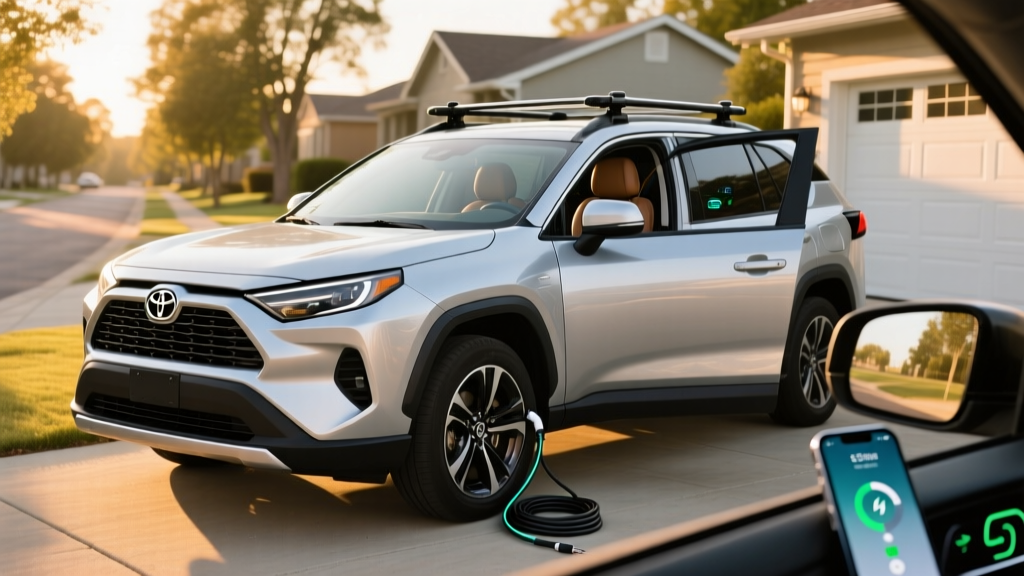
Quick Verdict: The RAV4 Hybrid Limited Still Sets the Bar
Even several years after its release, the 2021 Toyota RAV4 Hybrid Limited remains one of the most compelling used hybrid SUVs on the market. With an EPA-estimated 40 MPG combined, standard electronic all-wheel drive, and a premium-trim interior that punches above its price class, it continues to deliver where it matters most: at the pump and in long-term reliability. For buyers weighing a used hybrid against a new EV or a conventional gas crossover, the RAV4 Hybrid Limited occupies a practical sweet spot—no charging infrastructure required, no range anxiety, and a proven powertrain backed by Toyota's extensive hybrid warranty.
In this guide, we break down the exact fuel economy figures, the hybrid powertrain architecture, real-world MPG expectations, battery longevity data, and what you should expect to pay on the used market in 2026. We also clarify a common point of confusion: the difference between this conventional hybrid (HEV) and the plug-in variant (the RAV4 Prime PHEV).
HEV vs. PHEV: RAV4 Hybrid vs. RAV4 Prime
Before diving into specs, it's critical to distinguish the 2021 RAV4 Hybrid from its plug-in sibling, the 2021 RAV4 Prime. They share a nameplate but serve fundamentally different use cases.
| Attribute | 2021 RAV4 Hybrid (HEV) | 2021 RAV4 Prime (PHEV) |
|---|---|---|
| Powertrain type | Conventional hybrid (self-charging) | Plug-in hybrid (grid-chargeable) |
| Needs to be plugged in? | No — charges via engine & regen braking | Yes — for electric-only driving |
| Electric-only range | Less than 1 mile at low speed | EPA 42 miles |
| Combined horsepower | 219 hp | 302 hp |
| EPA combined MPG / MPGe | 40 MPG | 94 MPGe (electric) / 38 MPG (gas) |
| Traction battery | 1.6 kWh NiMH | 18.1 kWh lithium-ion |
| DC fast charging | N/A | No — Level 2 AC only (~2.5 hrs) |
| 2021 MSRP (Limited / XSE) | ~$38,350 (Limited) | ~$42,600 (XSE) |
| Federal tax credit (when new) | None | Up to $7,500 (§30D) |
Bottom line: If you can charge at home and want electric-only commuting, the RAV4 Prime PHEV is the stronger play. If you want simplicity—no plug, no charging setup, just excellent fuel economy—the RAV4 Hybrid (HEV) is the right choice. This review focuses on the HEV, specifically the top-tier Limited trim.
Fuel Economy: EPA Ratings and Real-World MPG
The 2021 Toyota RAV4 Hybrid Limited carries the following EPA-estimated fuel economy ratings:
| Driving Cycle | EPA Estimate |
|---|---|
| City | 41 MPG |
| Highway | 38 MPG |
| Combined | 40 MPG |
These numbers apply to all RAV4 Hybrid trims equipped with the standard electronic AWD system (AWD-i). Toyota's hybrid system excels in stop-and-go traffic, where the electric motor handles low-speed propulsion and the regenerative braking system recaptures energy that a conventional vehicle would waste as heat.
Real-World MPG: What Owners Actually Report
EPA estimates are a useful baseline, but real-world results vary by driving style, climate, and terrain. Based on aggregated owner data from FuelEconomy.gov's My MPG tracker and long-term fleet testing:
- City-dominant driving: Many owners report 42–45 MPG in urban environments, exceeding the EPA city estimate. This is typical of Toyota's Hybrid Synergy Drive, which maximizes electric-motor usage at low speeds.
- Highway-dominant driving (70–80 mph): Expect 34–37 MPG. At sustained highway speeds, the 2.5-liter four-cylinder engine does most of the work, and aerodynamic drag reduces efficiency.
- Cold weather (below 30°F): Fuel economy typically drops 10–15%, landing around 34–36 MPG combined. The engine runs more frequently to provide cabin heat and maintain battery temperature.
- Mixed real-world combined: Most owners see 38–42 MPG in day-to-day mixed driving.
With a 14.5-gallon fuel tank, that translates to a real-world total range of approximately 550–610 miles between fill-ups—comfortably more than most EVs and nearly every gas-only compact SUV.
Powertrain Specs: 219 HP with Electronic AWD
The 2021 RAV4 Hybrid pairs a 2.5-liter Dynamic Force four-cylinder engine with Toyota's fourth-generation hybrid system. Here's the complete powertrain breakdown:
| Specification | Detail |
|---|---|
| Engine | 2.5L 4-cylinder Dynamic Force (A25A-FXS) |
| Engine output | 176 hp / 163 lb-ft torque |
| Front electric motor | 118 hp / 149 lb-ft |
| Rear electric motor (AWD-i) | 54 hp / 89 lb-ft |
| Net combined system output | 219 hp |
| Transmission | Electronically controlled CVT (eCVT) |
| Drivetrain | Electronic on-demand AWD (AWD-i) |
| 0–60 mph | 7.8 seconds (Toyota est.) |
| Traction battery | 1.6 kWh Nickel-Metal Hydride (NiMH) |
| Towing capacity | 1,750 lbs |
| Fuel tank | 14.5 gallons |
| Fuel type | Regular unleaded (87 octane) |
The rear electric motor is the key to the AWD-i system. Unlike mechanical AWD with a driveshaft and center differential, the RAV4 Hybrid uses a dedicated rear motor that engages only when the system detects front-wheel slip or when additional traction is needed. This keeps weight and mechanical complexity low while providing confident all-weather capability.
Limited Trim: What You Get for the Money
The Limited was the top-of-the-line RAV4 Hybrid trim for 2021. Here's what distinguishes it from the LE, XLE, XSE, and XLE Premium trims:
- SofTex-trimmed heated and ventilated front seats with driver memory
- Heated leather-trimmed steering wheel
- 9-inch touchscreen with integrated navigation, Apple CarPlay, Android Auto, and Amazon Alexa
- JBL 11-speaker premium audio system with Clari-Fi technology
- Panoramic glass roof with power sunshade
- Wireless smartphone charging pad
- Smart Key System on all doors with push-button start
- 18-inch black alloy wheels with chrome accents
- Hands-free power liftgate
- Bird's Eye View Camera with perimeter scan
- Toyota Safety Sense 2.0 (standard on all trims): pre-collision with pedestrian detection, full-speed dynamic radar cruise control, lane departure alert with steering assist, automatic high beams, lane tracing assist, and road sign assist
On the used market in early 2026, a well-maintained 2021 RAV4 Hybrid Limited with 40,000–60,000 miles typically lists between $26,000 and $31,000, depending on condition, mileage, and regional demand. The RAV4 Hybrid has historically held its value well, often retaining 60–70% of original MSRP at the four-year mark.
Battery Warranty, Lifespan, and Replacement Cost
Hybrid battery longevity is consistently the top concern for used hybrid buyers. Here's what Toyota provides:
2021 RAV4 Hybrid Battery Warranty
- Hybrid battery warranty: 10 years / 150,000 miles (whichever comes first), applicable in all 50 states starting with 2020 model-year vehicles
- Hybrid system components warranty: 8 years / 100,000 miles (includes inverter, transaxle, and control modules)
- Transferability: The hybrid battery warranty is fully transferable to subsequent owners at no cost
For a 2021 model, that means the hybrid battery remains under warranty through 2031 or 150,000 miles—a significant advantage when buying used. Toyota's NiMH hybrid batteries have demonstrated exceptional durability in real-world service. Data from fleet operators and long-term owners of Toyota hybrids (including the Prius and Camry Hybrid) show that the vast majority of hybrid batteries outlast the 150,000-mile warranty period without significant degradation.
The 1.6 kWh NiMH battery in the RAV4 Hybrid is relatively small and operates within a conservative state-of-charge window (roughly 40–80% SoC), which minimizes stress on the cells. Toyota's battery management system never fully charges or fully depletes the pack, a design choice that prioritizes longevity over electric-only range.
Battery Replacement Cost
If the hybrid battery does fail outside of warranty, here's what to budget:
- New OEM replacement from Toyota: $3,000–$4,000 (battery pack) + $500–$1,000 labor ≈ $3,500–$5,000 total
- Refurbished/remanufactured pack: $1,500–$2,500 installed
- Individual cell module replacement: Some independent hybrid specialists can replace failed modules for $500–$1,200, though this is a shorter-term fix
Given the 10-year/150,000-mile warranty and Toyota's track record, the probability of needing a battery replacement on a 2021 RAV4 Hybrid before 2031 is statistically low. This is a meaningful advantage over early-model EVs, where out-of-warranty battery replacements can exceed $10,000–$15,000.
Tax Credits and Incentives
This is where the HEV vs. PHEV distinction matters most:
- 2021 RAV4 Hybrid (HEV): Does not qualify for the federal §30D clean vehicle tax credit. Conventional hybrids that cannot be plugged in are ineligible under current IRS rules. This was true when the vehicle was new and remains true on the used market.
- Used EV/PHEV credit (§25E): The used clean vehicle credit of up to $4,000 applies only to battery-electric vehicles and plug-in hybrids with at least 7 kWh of battery capacity. The RAV4 Hybrid's 1.6 kWh NiMH pack does not meet this threshold, so it is ineligible.
- State incentives: A handful of states offer rebates or HOV lane access for hybrids, but these programs are increasingly focused on PHEVs and BEVs. Check your state's energy office or Alternative Fuels Data Center for current local incentives.
The takeaway: If maximizing tax incentives is a priority, the RAV4 Prime PHEV or a fully electric alternative like the Toyota bZ4X or Hyundai Ioniq 5 will offer substantially more financial benefit. The RAV4 Hybrid's value proposition rests on its low running costs, reliability, and zero-infrastructure convenience—not on government incentives.
Who Should Choose the RAV4 Hybrid vs. a PHEV or Full EV?
Reasons to Choose the RAV4 Hybrid (HEV)
- No home charging setup needed — ideal for apartment dwellers or those without garage access
- 40 MPG combined with no behavioral changes required
- Proven 10-year/150,000-mile battery warranty still active through 2031
- Standard AWD for snow and rain confidence
- Limited trim offers near-luxury features at mainstream pricing
- Strong resale value and low depreciation risk
- Regular unleaded fuel — no premium required
Reasons to Consider a PHEV or EV Instead
- No electric-only driving range — always burning some gasoline
- No federal or state tax credit eligibility
- Lower total system horsepower (219 hp) vs. RAV4 Prime (302 hp)
- Does not reduce tailpipe emissions to zero for climate-motivated buyers
- Higher long-term fuel cost vs. home-charged EV if electricity rates are low
- Towing limited to 1,750 lbs
Decision Framework
Choose the 2021 RAV4 Hybrid Limited if: You lack reliable access to home or workplace charging, want maximum simplicity, prioritize long-term reliability and warranty coverage, and drive a mix of city and highway miles where 40 MPG delivers meaningful savings.
Choose the RAV4 Prime PHEV if: You can install a Level 2 charger at home, your commute is under 42 miles round-trip, you want electric-only daily driving with gas-engine backup for road trips, and you want to capture the federal tax credit (up to $7,500 for qualifying buyers on new purchases).
Choose a full EV (BEV) if: You have home charging access, want zero tailpipe emissions, are eligible for the full §30D credit, drive under 300 miles daily, and are comfortable with DC fast charging on road trips.
Ownership Costs: Fuel Savings Over 5 Years
To put the RAV4 Hybrid's fuel economy in context, here's a 5-year/75,000-mile fuel cost comparison against the gas-only 2021 RAV4 (non-hybrid, AWD, EPA 29 MPG combined):
| Vehicle | EPA Combined MPG | Gal. per 75k Miles | Fuel Cost @ $3.50/gal | 5-Year Fuel Savings vs. Gas |
|---|---|---|---|---|
| 2021 RAV4 Gas AWD | 29 MPG | 2,586 | $9,051 | — |
| 2021 RAV4 Hybrid AWD | 40 MPG | 1,875 | $6,563 | $2,488 |
| 2021 RAV4 Prime (PHEV, mixed) | 94 MPGe / 38 MPG | Varies | ~$3,500–$5,000* | $4,000–$5,500 |
*PHEV fuel cost assumes 60% of miles driven on electricity at $0.14/kWh national average. Actual costs vary significantly by utility rate and charging habits.
The hybrid saves roughly $500/year in fuel compared to the gas-only RAV4. Over a typical ownership period, that's a meaningful offset against the hybrid's modest price premium—especially as gas prices fluctuate upward.
Frequently Asked Questions
How many MPG does the 2021 Toyota RAV4 Hybrid Limited get?
The EPA rates it at 41 MPG city, 38 MPG highway, and 40 MPG combined. Real-world owners typically report 38–42 MPG in mixed driving, with city-dominant commutes sometimes exceeding 43 MPG. Highway-only driving at 75+ mph may drop to 34–37 MPG.
Does the 2021 RAV4 Hybrid need to be plugged in?
No. This is a conventional hybrid (HEV), not a plug-in hybrid (PHEV). The 1.6 kWh battery charges itself through the gasoline engine and regenerative braking. You simply fill it with regular 87-octane gasoline like any other car. The RAV4 Prime, by contrast, is the plug-in variant that requires charging for electric-only operation.
Is the 2021 RAV4 Hybrid reliable?
Toyota's hybrid powertrains are among the most reliable in the industry, with decades of data from the Prius and Camry Hybrid lineages supporting this claim. The RAV4 Hybrid earns strong reliability ratings from both Consumer Reports and J.D. Power. The hybrid battery is warranted for 10 years/150,000 miles, and out-of-warranty failures are uncommon before 200,000 miles in typical use.
What does a hybrid battery replacement cost for the RAV4?
A new OEM hybrid battery from Toyota costs approximately $3,500–$5,000 installed. Refurbished packs run $1,500–$2,500. However, the 10-year/150,000-mile warranty on 2021 models means most original and second owners will never face this expense during the warranty period.
Does the 2021 RAV4 Hybrid qualify for any tax credit?
No. Conventional hybrids (HEVs) are not eligible for the federal §30D new clean vehicle credit or the §25E used clean vehicle credit. These credits require plug-in capability and a minimum battery capacity of 7 kWh (used) or specific battery-sourcing requirements (new). The RAV4 Hybrid's 1.6 kWh pack does not qualify. Some states may offer minor incentives—check your local programs.
How does the RAV4 Hybrid compare to the RAV4 Prime?
The RAV4 Prime (PHEV) offers 42 miles of electric-only range, 302 combined horsepower, and eligibility for the $7,500 federal tax credit (when new, subject to income and sourcing rules). However, it costs significantly more on the used market ($34,000–$40,000+ for a 2021 model) and requires home charging infrastructure to realize its efficiency benefits. The Hybrid (HEV) is the more practical choice for buyers who want simplicity and lower upfront cost.
Is the 2021 RAV4 Hybrid good in snow?
Yes. The AWD-i system uses a dedicated rear electric motor that engages automatically when front-wheel slip is detected. Combined with the hybrid system's smooth torque delivery and available all-season or winter tires, the RAV4 Hybrid performs competently in moderate snow and icy conditions. It is not a dedicated off-roader, but it handles winter commuting well.