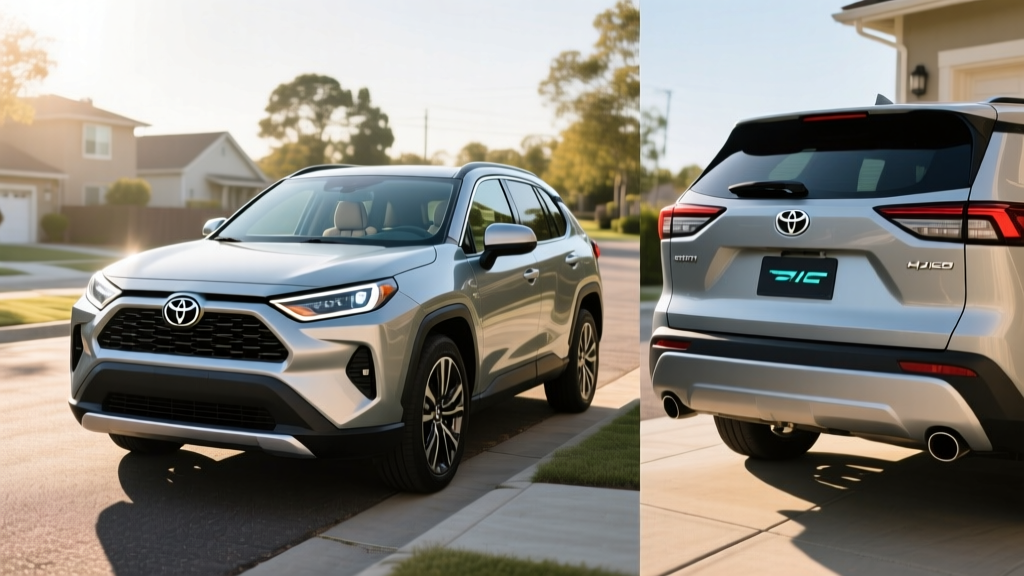
Quick Verdict: The Benchmark Compact Hybrid SUV
The 2021 Toyota RAV4 Hybrid LE remains one of the most compelling used hybrid SUVs on the market in 2026. With an EPA-rated 41 mpg city and 38 mpg highway, standard electronic all-wheel drive, and Toyota's proven hybrid synergy drive system, it offers a practical bridge for drivers who want electrified efficiency without charging infrastructure. The LE trim keeps the entry price accessible while delivering the same powertrain as higher trims.
For buyers navigating the used market today, the 2021 RAV4 Hybrid LE typically trades between $24,000 and $30,000 depending on mileage and condition — a significant discount from its original $29,470 MSRP while retaining nearly all of its hybrid battery warranty coverage.
HEV vs. PHEV: Understanding What the RAV4 Hybrid LE Is
Before examining the numbers, it's critical to distinguish what this vehicle is and is not. The 2021 RAV4 Hybrid LE is a conventional hybrid electric vehicle (HEV). It does not plug in. It has no electric-only range. It charges its own small battery through regenerative braking and the gasoline engine.
| Feature | RAV4 Hybrid (HEV) | RAV4 Prime (PHEV) | Full EV (e.g., bZ4X) |
|---|---|---|---|
| Plugs in? | No | Yes | Yes |
| Electric-only range | 0 miles | 42 miles (EPA) | 222-252 miles (EPA) |
| Battery capacity | 1.6 kWh (NiMH) | 18.1 kWh (Li-ion) | 71.4 kWh (Li-ion) |
| Combined HP | 219 hp | 302 hp | 201-214 hp |
| Gas engine | 2.5L 4-cyl | 2.5L 4-cyl | None |
| Fueling | Gas only | Gas + plug-in | Charge only |
| Federal tax credit (new) | None | Up to $7,500 (expired for new orders) | Up to $7,500 (§30D rules apply) |
The RAV4 Prime (PHEV variant) is an entirely different vehicle with a much larger battery, plug-in capability, and 42 miles of electric-only driving. If you're specifically looking at the Hybrid LE, you're looking at the self-charging HEV — no plug, no electric-only mode, just consistently strong fuel economy from a gasoline-electric system that manages itself.
Fuel Economy: EPA Ratings vs. Real-World MPG
The EPA rates the 2021 RAV4 Hybrid LE (and all RAV4 Hybrid trims, since they share the same powertrain) at:
| Driving Condition | EPA Rating | Real-World Expectation |
|---|---|---|
| City | 41 mpg | 39-44 mpg (hybrids excel in stop-and-go) |
| Highway | 38 mpg | 35-38 mpg (less regen benefit at steady speed) |
| Combined | 40 mpg | 37-41 mpg |
According to fueleconomy.gov, the 2021 RAV4 Hybrid AWD achieves its 40 mpg combined figure across all trims. The LE's slightly lighter curb weight (approximately 3,800 lbs vs. 3,900+ for loaded Limited trims) can yield marginally better real-world results, though the difference is typically within 1 mpg.
Why city MPG beats highway: Hybrid systems recover kinetic energy during braking and deceleration, converting it to battery charge. In city driving with frequent stops, this regenerative braking is constantly replenishing the battery, allowing the electric motors to assist more. On sustained highway cruising, the gasoline engine does most of the work, which is why the highway number drops to 38 mpg. This is the opposite pattern from conventional gas cars.
Cold weather impact: Expect a 5-12% fuel economy reduction in winter months (roughly 35-37 mpg combined). The engine runs more frequently to provide cabin heat and maintain battery temperature. This is less severe than EV range loss in cold weather but still measurable.
Powertrain Specifications: 219 HP with Standard AWD
| Specification | 2021 RAV4 Hybrid LE |
|---|---|
| Engine | 2.5L Dynamic Force 4-cylinder (176 hp, 163 lb-ft) |
| Front electric motor | 118 hp, 149 lb-ft |
| Rear electric motor (AWD) | 54 hp, 89 lb-ft |
| Net combined system output | 219 hp |
| Transmission | Electronically controlled CVT (eCVT) |
| Drivetrain | Electronic On-Demand AWD (standard) |
| 0-60 mph | 7.8 seconds (Motor Trend tested) |
| Towing capacity | 1,750 lbs |
| Battery type | Nickel-Metal Hydride (NiMH), 1.6 kWh |
| Fuel tank | 14.5 gallons |
| Total driving range | ~580 miles (at 40 mpg combined) |
The 2021 RAV4 Hybrid uses Toyota's fourth-generation Hybrid Synergy Drive. The rear axle has no mechanical connection to the engine — it's driven entirely by the rear electric motor, which engages automatically when the system detects slip or during hard acceleration. This electronic AWD system adds roughly 100 lbs compared to a FWD-only layout but provides genuine all-weather traction without the parasitic loss of a traditional mechanical AWD system.
The eCVT is not a belt-and-cone CVT like those in some competitors. It's a planetary gearset that seamlessly blends engine and motor power. There are no belts to wear, no rubber bands, and no slippage — which is why Toyota's hybrid transaxles have proven extraordinarily durable in long-term fleet use (taxi service, high-mileage commuting).
Battery Warranty, Lifespan, and Replacement Costs
Toyota Hybrid Battery Warranty (2021 Model Year):
- Coverage: 10 years / 150,000 miles (whichever comes first)
- Applies to: Hybrid battery pack, hybrid control module, inverter
- Transferable: Yes — fully transfers to subsequent owners
- Capacity threshold: Toyota replaces if the battery cannot hold sufficient charge to operate the hybrid system normally
For a 2021 model purchased used in 2026, you still have approximately 5 years or 100,000+ miles of factory hybrid battery warranty remaining (from the original in-service date). This is a significant advantage of buying a recent used Toyota hybrid.
Real-world battery longevity: Toyota's NiMH hybrid batteries have an exceptional track record. Data from fleet operators and long-term owners shows that RAV4 Hybrid and Prius battery packs routinely exceed 200,000 miles before needing replacement. The NiMH chemistry is less energy-dense than modern lithium-ion but is extremely tolerant of the shallow charge-discharge cycles that hybrids use (the system typically keeps the battery between 40-80% state of charge, avoiding the stress of full cycles).
Replacement cost if out of warranty: A new OEM hybrid battery pack for the RAV4 Hybrid costs approximately $3,000-$4,500 installed at a Toyota dealer as of 2026. Third-party refurbished packs are available for $1,500-$2,500 installed. Individual module replacement (only the failed cells) can run $500-$1,200 at hybrid-specialist shops. Given the 10-year/150,000-mile warranty and demonstrated longevity, most owners will sell the vehicle before facing this cost.
Pricing and Tax Credit Eligibility
The 2021 RAV4 Hybrid LE originally carried an MSRP of $29,470 (including destination). In the 2026 used market, expect to pay:
| Condition / Mileage | Typical Price Range |
|---|---|
| Low mileage (<30k), excellent | $28,000 - $31,000 |
| Average (40-70k miles), good | $24,500 - $28,000 |
| Higher mileage (80-100k+), fair | $21,000 - $24,500 |
Federal tax credit status: The 2021 RAV4 Hybrid LE does not qualify for the federal §30D new clean vehicle credit — that credit applies only to plug-in vehicles (PHEVs and BEVs) with sufficient battery capacity, and only to new purchases. Conventional hybrids like this one are excluded.
However, if you purchase this vehicle used from a dealer for $25,000 or less, it may qualify for the Used Clean Vehicle Credit (§25E) — up to $4,000 or 30% of the sale price (whichever is less). Key requirements per the IRS:
- Sale price must be $25,000 or below
- Buyer income limits: $75,000 single / $112,500 head of household / $150,000 joint
- Vehicle must be at least 2 model years old (2021 qualifies in 2026)
- Must purchase from a licensed dealer (private-party sales excluded)
- Credit is non-refundable but can be transferred to the dealer as a point-of-sale discount
- The hybrid battery must have at least 4 kWh capacity — the RAV4 Hybrid's 1.6 kWh pack does NOT meet this threshold
Unfortunately, the conventional RAV4 Hybrid's small 1.6 kWh battery disqualifies it from the used EV credit, which requires a minimum 4 kWh battery capacity. This credit effectively applies only to PHEVs and BEVs on the used market. The RAV4 Prime (PHEV) with its 18.1 kWh pack would qualify; the Hybrid LE does not.
State incentives: Some states offer their own hybrid rebates or HOV lane access for HEVs, but these vary widely and many have expired or shifted focus to plug-in vehicles. Check your state's energy office or DMV for current programs.
Reliability Record and Ownership Costs
The 2021 RAV4 Hybrid benefits from one of the strongest reliability reputations in the industry. Toyota's hybrid powertrain has been in continuous production since 1997 (Prius), and the RAV4 Hybrid specifically has been sold in the US since the 2016 model year with minimal powertrain revisions.
IIHS awarded the 2021 RAV4 Hybrid the Top Safety Pick designation when equipped with specific headlights. Standard Toyota Safety Sense 2.0 includes pre-collision braking with pedestrian detection, full-speed adaptive cruise control, lane departure alert with steering assist, and automatic high beams.
Estimated annual operating costs (2026):
| Expense | Annual Estimate (15,000 mi/yr) |
|---|---|
| Fuel (40 mpg, $3.40/gal regular) | $1,275 |
| Insurance (national avg. for RAV4 Hybrid) | $1,400 - $1,800 |
| Maintenance (oil, filters, tires, brakes) | $400 - $600 |
| Total annual operating cost | $3,075 - $3,675 |
Compared to a gas-only RAV4 (rated at 30 mpg combined AWD), the Hybrid LE saves approximately $380/year in fuel at 15,000 miles annually and $3.40/gallon. Over 5 years of ownership, that's roughly $1,900 in fuel savings. The hybrid also uses regenerative braking extensively, which significantly extends brake pad life — many owners report 80,000+ miles on original brake pads.
Who Should Choose the RAV4 Hybrid LE vs. Alternatives
Pros
- 40 mpg combined with no plug-in requirement or charging hassle
- Standard electronic AWD at no extra cost
- Remaining factory hybrid battery warranty (through ~2031)
- Proven reliability with 200k+ mile battery track record
- Strong cargo capacity: 37.6 cu ft behind rear seats, 69.8 cu ft total
- Regular unleaded fuel (87 octane) — no premium required
- Smooth, quiet operation with seamless engine/motor transitions
Cons
- No electric-only driving mode — always uses some gasoline
- LE trim lacks premium features (no power liftgate, basic 7-inch screen)
- 1,750-lb towing limit (lower than some turbocharged gas competitors)
- Road noise at highway speeds is noticeable vs. quieter rivals
- No federal tax credit eligibility (new or used)
- Acceleration adequate but not quick (7.8s 0-60)
Choose the 2021 RAV4 Hybrid LE if:
- You want 40 mpg without ever thinking about charging
- You live in an apartment or lack home charging access
- You drive 12,000-20,000+ miles per year and want to minimize fuel costs
- You need AWD for snow/rain but don't want the fuel penalty of a gas AWD SUV
- You want proven reliability and low maintenance costs over 5-10 years
Look at a PHEV (RAV4 Prime) instead if:
- You have home charging and a commute under 42 miles
- You want electric-only daily driving with gas backup for road trips
- You can find one within budget (RAV4 Primes command a significant premium)
Look at a full EV instead if:
- You have reliable home Level 2 charging
- Your daily driving is under 200 miles and you rarely road-trip beyond charger network coverage
- You want zero tailpipe emissions and minimal maintenance (no oil changes, no engine)
Frequently Asked Questions
How many MPG does the 2021 Toyota RAV4 Hybrid LE get?
The EPA rates it at 41 mpg city, 38 mpg highway, and 40 mpg combined. In real-world driving, most owners report 37-43 mpg combined depending on driving mix. City-heavy commutes tend to yield higher numbers due to regenerative braking; sustained highway driving at 75+ mph reduces efficiency to the mid-to-high 30s.
Does the RAV4 Hybrid LE plug in?
No. The 2021 RAV4 Hybrid LE is a conventional hybrid (HEV), not a plug-in hybrid (PHEV). You never plug it in. The 1.6 kWh battery charges itself through regenerative braking and the gasoline engine. If you want plug-in capability and electric-only driving, you need the RAV4 Prime (PHEV), which is a separate, more expensive model with a much larger 18.1 kWh battery.
Is the 2021 RAV4 Hybrid reliable, and what does battery replacement cost?
Yes — Toyota's hybrid system has an outstanding reliability record spanning decades. The NiMH hybrid battery is warranted for 10 years/150,000 miles, meaning a 2021 model still has warranty coverage through approximately 2031. Real-world data shows these batteries routinely lasting 200,000+ miles. If replacement is ever needed out of warranty, expect $3,000-$4,500 for a new OEM pack or $1,500-$2,500 for a refurbished unit.
Does the 2021 RAV4 Hybrid LE qualify for any tax credit?
Not for the federal new-vehicle §30D credit (that's for plug-in vehicles only). It also does not qualify for the federal used clean vehicle credit (§25E) because its 1.6 kWh battery is below the 4 kWh minimum threshold. Some states may offer minor hybrid incentives, but most have shifted focus to plug-in vehicles. Check your state energy office for current programs.
How does the RAV4 Hybrid LE compare to the gas-only RAV4?
The gas-only 2021 RAV4 AWD is rated at 28 mpg combined (30 mpg for FWD). The Hybrid LE's 40 mpg combined represents a 33-43% improvement in fuel economy. The hybrid also delivers more power (219 hp vs. 203 hp for the gas model), standard AWD, and smoother acceleration from the electric motor's instant torque. The trade-off is a higher initial purchase price (roughly $1,500-$2,000 more when new) and slightly less cargo space due to the hybrid battery placement under the rear seat.
What's the difference between the LE and higher RAV4 Hybrid trims?
The LE is the base trim. All RAV4 Hybrid trims share the identical 219 hp powertrain, AWD system, and 40 mpg combined rating. The LE comes with a 7-inch touchscreen, Toyota Safety Sense 2.0, LED headlights, and 17-inch alloy wheels. Higher trims (XLE, XSE, Limited, Platinum) add features like a larger 9-inch screen, power liftgate, heated seats, panoramic sunroof, and larger wheels — but these add weight and cost without improving fuel economy or performance.