Quick Verdict: The Efficiency Benchmark in a Midsize Sedan
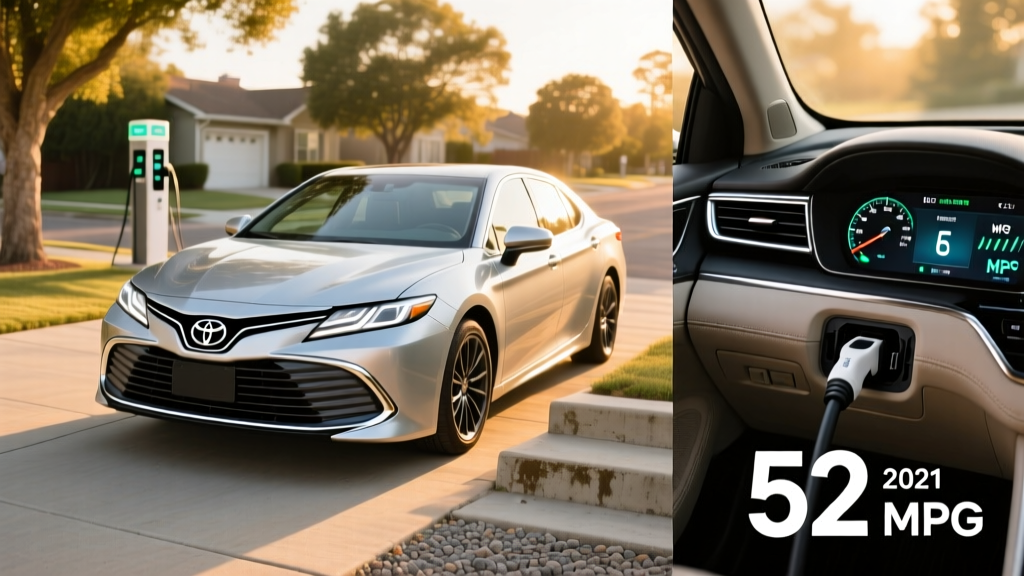
The 2021 Toyota Camry Hybrid LE remains one of the most fuel-efficient midsize sedans ever sold in the United States. With an EPA-estimated 52 MPG combined, it undercuts nearly every competitor in its class — including many vehicles half its size. For buyers who want dramatic fuel savings without plugging in, changing their driving habits, or worrying about charging infrastructure, this conventional hybrid (HEV) delivers a compelling package at a used-market price point that has become increasingly attractive as of 2026.
This is not a plug-in hybrid. The Camry Hybrid LE requires no charging cord, no home electrical upgrades, and no behavior change beyond filling up at the gas station less often. It captures energy through regenerative braking and its gasoline engine, storing it in a compact lithium-ion traction battery. The result is seamless, transparent electrification that most drivers never consciously notice.
| Spec | Value |
|---|---|
| EPA Fuel Economy (City / Highway / Combined) | 51 / 53 / 52 MPG |
| Powertrain | 2.5L 4-cyl + electric motor (HEV) |
| Combined System Horsepower | 208 hp |
| Transmission | eCVT (planetary gearset) |
| Traction Battery | ~1.6 kWh lithium-ion (sealed, not plug-in) |
| Drivetrain | Front-wheel drive |
| 0–60 mph (est.) | ~7.5 seconds |
| Fuel Tank Capacity | 13.2 gallons |
| Total Driving Range (est.) | ~686 miles |
| Original MSRP (2021) | $27,270 (before destination) |
| Hybrid Battery Warranty | 10 years / 150,000 miles |
Understanding the Camry Hybrid: HEV vs. PHEV vs. Full EV
A common source of confusion among electrified-vehicle shoppers is the distinction between a conventional hybrid (HEV), a plug-in hybrid (PHEV), and a battery-electric vehicle (BEV). The 2021 Camry Hybrid LE is an HEV — meaning it cannot be plugged in, has no electric-only driving range to speak of, and always uses its gasoline engine in combination with the electric motor.
| Feature | HEV (Camry Hybrid LE) | PHEV (e.g., RAV4 Prime) | BEV (e.g., Tesla Model 3) |
|---|---|---|---|
| Plug-in Required? | No | Yes (Level 1 or 2) | Yes (Level 2 or DC fast) |
| Electric-Only Range | None (motor assists engine) | 25–42 miles typical | 250–400+ miles |
| Gasoline Use | Always blended | After EV range depletes | None |
| Federal Tax Credit (§30D) | Not eligible | Up to $7,500 (if eligible) | Up to $7,500 (if eligible) |
| Home Charging Needed? | No | Recommended for EV range | Essential |
| Best For | Apartment dwellers, no charger access | Short commutes + road trips | Home-charging access, low daily miles |
The Camry Hybrid LE's role is clear: maximum fuel economy with zero lifestyle change. If you live in an apartment without charging access, drive in a region with sparse public charging, or simply don't want to think about plugging in, this HEV is the electrified vehicle that asks nothing of you except the occasional gas station stop.
Fuel Economy: EPA Ratings vs. Real-World MPG
| Driving Cycle | EPA MPG |
|---|---|
| City | 51 MPG |
| Highway | 53 MPG |
| Combined | 52 MPG |
According to fueleconomy.gov, the 2021 Camry Hybrid LE achieves 51 city / 53 highway / 52 combined MPG. These are among the highest ratings of any non-plug-in midsize sedan on record.
Real-World MPG: What Owners Actually See
Hybrid vehicles often exceed their EPA city ratings in real-world stop-and-go driving because regenerative braking recaptures energy that a conventional car wastes as heat. Many Camry Hybrid owners report 50–55 MPG in mixed suburban and city driving, with some hypermilers pushing past 60 MPG on flat routes in moderate temperatures.
However, real-world fuel economy can dip below the EPA estimate in specific conditions:
- Highway driving above 75 mph: Aerodynamic drag rises sharply; expect 44–48 MPG at sustained 80+ mph speeds.
- Cold weather (below 30°F): The gasoline engine runs more frequently to provide cabin heat and maintain catalyst temperature. Expect a 5–10 MPG drop, landing around 42–47 MPG combined in deep winter.
- Short trips in cold weather: The engine may not reach optimal operating temperature, further reducing efficiency on trips under 5 miles.
- Hilly or mountainous terrain: Sustained climbs increase fuel consumption, though downhill regenerative braking partially offsets this on return routes.
For the average driver in moderate climates with a mix of city and highway miles, 48–54 MPG is a realistic expectation — making the EPA combined rating of 52 MPG one of the most accurate stickers in the industry.
Powertrain and Driving Dynamics
The 2021 Camry Hybrid LE pairs a 2.5-liter Dynamic Force 4-cylinder Atkinson-cycle gasoline engine with a permanent-magnet electric motor, routed through Toyota's eCVT — a planetary gearset that provides seamless, shiftless power delivery. Combined system output is 208 horsepower.
The gasoline engine alone produces 176 hp and 163 lb-ft of torque, while the electric motor contributes up to 118 hp and 149 lb-ft. Because these power sources peak at different RPM ranges, the combined figure is 208 hp rather than a simple sum.
Acceleration is adequate for daily driving: 0–60 mph arrives in approximately 7.5 seconds. The eCVT eliminates shift shock entirely, and the transition between electric-only creeping at low speeds and gasoline-engine engagement is remarkably smooth. Toyota's hybrid synergy drive system has been refined over more than two decades, and it shows.
The LE trim rides on 16-inch steel wheels with low-rolling-resistance tires, which contributes to its superior fuel economy compared to the SE and XLE trims (which achieve 44–46 MPG combined due to larger wheels and stickier tires). The trade-off is slightly less grip in spirited cornering, though the Camry Hybrid LE handles competently for its efficiency-focused mission.
Battery Longevity, Warranty, and Replacement Cost
Hybrid Battery Warranty: Toyota covers the 2021 Camry Hybrid's traction battery for 10 years or 150,000 miles (whichever comes first) in all 50 states. This coverage was extended from the previous 8-year/100,000-mile standard beginning with the 2020 model year.
Hybrid System Components: The hybrid control module, inverter, and related components carry the same 10-year/150,000-mile warranty.
The Camry Hybrid LE uses a compact lithium-ion traction battery pack rated at approximately 1.6 kWh of total capacity. Unlike a full EV battery (which might be 60–100 kWh), this small pack is designed for frequent shallow cycling — capturing regenerative braking energy and discharging it for motor assist — rather than deep discharge cycles. This operating pattern is gentle on battery chemistry and contributes to exceptional longevity.
Real-World Battery Degradation
Toyota's hybrid battery packs have demonstrated remarkable durability in fleet and taxi service. Data from Prius fleets operating in extreme climates suggests capacity loss of roughly 10–15% over 200,000+ miles. Because the Camry Hybrid's battery is small and the system never fully depletes or fully charges it (operating in a roughly 40–80% state-of-charge window), degradation is minimal.
If the battery does eventually require replacement outside of warranty, costs as of 2026 typically range from $2,000 to $4,000 for a refurbished or aftermarket pack, or approximately $4,500 to $5,500 for a new OEM unit installed at a dealership. However, given the 10-year/150,000-mile warranty and the track record of Toyota hybrid batteries lasting well beyond 200,000 miles, most owners will never face this expense.
Ownership Costs and Tax Credit Eligibility
Federal Tax Credit: Not Applicable
The 2021 Camry Hybrid LE is a conventional hybrid (HEV) and does not qualify for the federal §30D Clean Vehicle Credit. Per IRS guidelines, the §30D credit applies only to plug-in electric vehicles (PHEVs and BEVs) that meet battery capacity, sourcing, MSRP, and buyer income requirements. Conventional hybrids like the Camry Hybrid LE have never been eligible for this credit.
Some states and local utilities have offered rebates for hybrid vehicles in the past, but most have shifted incentive programs toward plug-in vehicles. Check your state energy office or utility provider for any current hybrid-specific programs — but do not count on significant incentives for an HEV purchase in 2026.
Total Cost of Ownership: Where the Savings Come From
The Camry Hybrid LE's financial case rests on fuel savings, not incentives. Consider this comparison at $3.50/gallon gasoline:
| Vehicle | Combined MPG | Gallons/Year | Annual Fuel Cost |
|---|---|---|---|
| 2021 Camry Hybrid LE | 52 | 288 | $1,008 |
| 2021 Camry Gas (4-cyl) | 32 | 469 | $1,641 |
| 2021 Honda Accord (4-cyl) | 33 | 455 | $1,592 |
The Camry Hybrid LE saves approximately $583–$633 per year in fuel costs versus its gasoline-only counterpart at $3.50/gallon. Over five years and 75,000 miles, that's roughly $2,900–$3,165 in fuel savings — often enough to offset the hybrid's original price premium over the gas model.
Insurance costs for the Camry Hybrid LE are typically comparable to or slightly lower than the gasoline Camry, as hybrid owners statistically file fewer claims. Maintenance costs are reduced thanks to regenerative braking (less brake pad wear) and the absence of a traditional starter motor, alternator, or accessory belt.
Used Market Pricing in 2026
As a five-year-old vehicle in 2026, the 2021 Camry Hybrid LE trades on the used market in a range of approximately $18,000 to $24,000, depending on mileage, condition, and region. Low-mileage examples under 40,000 miles command the upper end, while high-mileage fleet vehicles may be available below $17,000.
For context, a new 2026 Camry Hybrid LE starts around $30,000 MSRP. The used 2021 model offers roughly 60–70% of the new-car experience at 60–70% of the price — with the hybrid battery warranty still potentially active for several more years given the 10-year coverage window.
When buying used, request the hybrid battery state-of-health (SoH) report from a Toyota dealer. This diagnostic check confirms the battery's remaining capacity and flags any cell imbalance issues before purchase.
Pros and Cons
Pros
- 52 MPG combined — among the highest of any midsize sedan
- No plug-in charging required; zero behavior change
- 10-year / 150,000-mile hybrid battery warranty
- Strong reliability record (Toyota hybrid system, 4th generation)
- ~686 miles of total driving range per tank
- Lower brake wear thanks to regenerative braking
- Comfortable ride, spacious rear seat, large trunk (15.1 cu ft)
- Toyota Safety Sense 2.5+ standard (AEB, lane keeping, adaptive cruise)
Cons
- No electric-only driving mode; always uses gasoline
- Not eligible for federal §30D tax credit
- 208 hp is adequate but not sporty; eCVT can drone under hard acceleration
- LE trim has cloth seats and fewer premium features vs. XLE
- 16-inch steel wheels look utilitarian
- All-wheel drive not available on LE (AWD offered on SE/XLE Hybrid)
- Infotainment system dated by 2026 standards (no wireless CarPlay on LE)
Who Should Choose the 2021 Camry Hybrid LE?
Choose the Camry Hybrid LE if:
- You want maximum MPG without plugging in or changing your routine
- You live in an apartment or lack access to home/workplace charging
- Your commute involves heavy stop-and-go traffic (where hybrids shine)
- You plan to keep the car 8+ years and want proven long-term reliability
- You want low cost-per-mile with minimal maintenance complexity
Consider a PHEV instead if:
- You have home charging and a short commute (under 30 miles) — a PHEV like the RAV4 Prime can do most trips on electricity alone
- You want to reduce gasoline consumption to near-zero on weekdays
Consider a full EV instead if:
- You have reliable home Level 2 charging
- Your daily driving is under 200 miles
- You want to eliminate gasoline costs entirely and qualify for the §30D tax credit on a new purchase
Frequently Asked Questions
How many MPG does the 2021 Toyota Camry Hybrid LE get?
The EPA rates it at 51 city / 53 highway / 52 combined MPG. In real-world driving, most owners see 48–55 MPG depending on conditions. City and suburban driving with frequent stops often yields the best results due to regenerative braking.
Does the 2021 Camry Hybrid LE need to be plugged in?
No. This is a conventional hybrid (HEV), not a plug-in hybrid. It charges its small lithium-ion battery through regenerative braking and the gasoline engine. You never plug it in — just fill up at the gas station as usual.
Is the hybrid battery reliable, and what does replacement cost?
Toyota's hybrid batteries have an excellent longevity record, frequently lasting 200,000+ miles with minimal degradation. The battery is warranted for 10 years / 150,000 miles. If replacement is eventually needed, expect $2,000–$4,000 for a refurbished pack or $4,500–$5,500 for a new OEM unit.
Does the 2021 Camry Hybrid qualify for any tax credit?
No. The federal §30D Clean Vehicle Credit applies only to plug-in vehicles (PHEVs and BEVs). Conventional hybrids like the Camry Hybrid LE are not eligible. Some state or utility programs may offer small rebates, but these are increasingly rare for HEVs.
How does the Camry Hybrid LE compare to the SE and XLE Hybrid trims?
The LE achieves the highest fuel economy (52 MPG combined) because of its lighter 16-inch steel wheels and low-rolling-resistance tires. The SE and XLE Hybrid trims, with larger alloy wheels and wider tires, are rated at 44–46 MPG combined. The LE also forgoes some premium features (leather, premium audio) to keep weight and cost down.
Is the 2021 Camry Hybrid LE a good used buy in 2026?
Yes, particularly for buyers prioritizing low operating costs and reliability. With prices in the $18,000–$24,000 range and the hybrid battery warranty potentially still active (10 years from original sale date), it represents strong value. Request a hybrid battery health check before purchase and verify service history.
Can the Camry Hybrid LE drive on electric power alone?
Only at very low speeds (typically under 25 mph) for short distances, such as creeping through a parking lot. The gasoline engine engages automatically and seamlessly when more power is needed. There is no dedicated EV mode with meaningful range — unlike a PHEV or BEV.