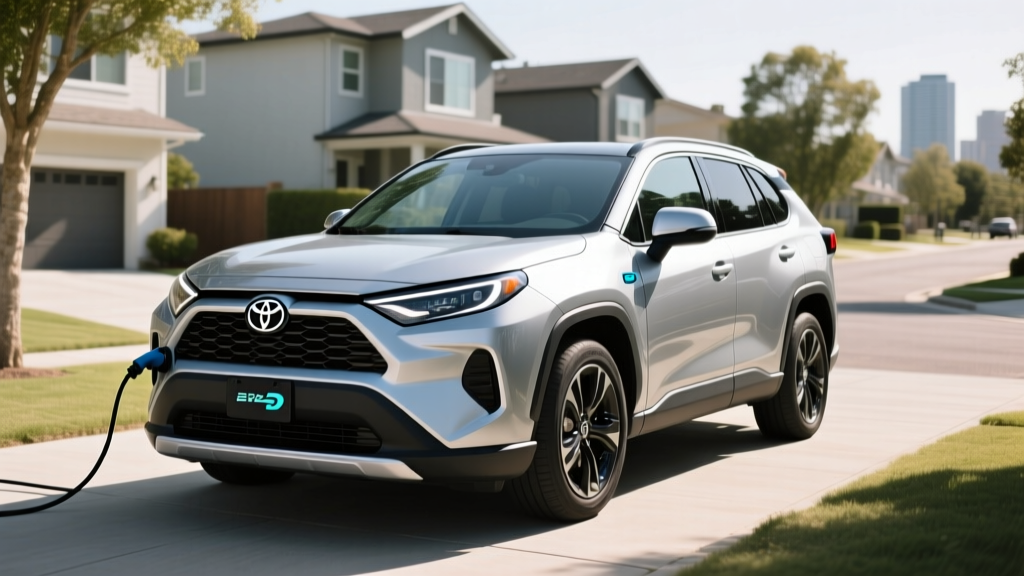
If you are shopping the used compact SUV market in 2026, the 2021 Toyota RAV4 Hybrid remains one of the most rational purchases you can make. It delivers standard all-wheel drive, a proven hybrid powertrain, and fuel economy that routinely beats its EPA sticker in city driving — all without ever needing a plug. This guide covers every number that matters: real-world MPG, powertrain specs, battery longevity, warranty coverage, and how this five-year-old hybrid stacks up against newer PHEVs, full EVs, and gas-only alternatives.
2021 RAV4 Hybrid Powertrain and Performance Specs
The 2021 RAV4 Hybrid pairs a 2.5-liter inline-four Atkinson-cycle gasoline engine with three electric motors — one driving the front axle, one integrated into the transmission, and a dedicated rear-axle motor for electronic on-demand AWD. The result is a net system output of 219 horsepower, a meaningful bump over the 203 hp of the gas-only RAV4.
| Specification | Value |
|---|---|
| Engine | 2.5L 4-cyl Atkinson-cycle (176 hp / 163 lb-ft) |
| Front Electric Motor | 118 hp / 149 lb-ft |
| Rear Electric Motor (AWD) | 54 hp / 89 lb-ft |
| Net System Horsepower | 219 hp |
| Transmission | eCVT (electronically controlled) |
| Drivetrain | Electronic On-Demand AWD (standard) |
| Hybrid Battery | 1.6 kWh nickel-metal hydride (NiMH) |
| 0–60 mph | 7.4 seconds |
| Towing Capacity | 1,750 lbs |
| Cargo Volume (rear seats up) | 37.6 cu ft |
| Cargo Volume (rear seats folded) | 69.8 cu ft |
The 1.6 kWh NiMH battery is small by electrified-vehicle standards, but that is by design. A conventional hybrid (HEV) uses its battery as a buffer for regenerative braking energy and brief electric-only assist — not as a primary energy source. You never plug it in; the gasoline engine and regen braking keep it charged.
EPA Fuel Economy and Real-World MPG
The EPA rates the 2021 RAV4 Hybrid at 41 mpg city / 38 mpg highway / 40 mpg combined across all trims (LE, XLE, XLE Premium, SE, XSE, Limited). That uniformity is because every trim shares the same powertrain and AWD system — there is no FWD-only variant that sips slightly less fuel, unlike the gas RAV4.
| Vehicle | City MPG | Highway MPG | Combined MPG |
|---|---|---|---|
| 2021 Toyota RAV4 Hybrid AWD | 41 | 38 | 40 |
| 2021 Honda CR-V Hybrid AWD | 40 | 35 | 38 |
| 2021 Ford Escape Hybrid FWD | 44 | 37 | 41 |
| 2021 Toyota RAV4 (gas) AWD | 27 | 34 | 30 |
Source: fueleconomy.gov
HEV vs PHEV: Understanding the RAV4 Hybrid Lineup
Toyota sold two electrified RAV4 variants for 2021: the RAV4 Hybrid (conventional HEV) and the RAV4 Prime (plug-in hybrid, or PHEV). The distinction matters enormously for your wallet, your commute, and your charging setup.
RAV4 Hybrid (HEV)
- No plug required — refuels at any gas station
- 1.6 kWh NiMH battery (self-charging via engine + regen)
- 40 mpg combined
- ~100 miles of range per fill-up at low speeds on electric assist only (not sustained EV mode)
- No federal tax credit for new purchases
- Used pricing (2026): ~$24,000–$32,000 depending on trim/mileage
RAV4 Prime (PHEV)
- Plugs in — Level 1 (120V) or Level 2 (240V) charging
- 18.1 kWh lithium-ion battery
- 42 miles EPA electric-only range
- 94 MPGe (electric + gas combined)
- 38 mpg combined after battery depletes
- 302 net hp (significantly quicker — 5.7 sec 0–60)
- Qualified for up to $7,500 federal tax credit when purchased new
- Used pricing (2026): ~$35,000–$45,000
The RAV4 Prime can DC fast charge? No. The 2021 RAV4 Prime accepts only Level 1 (1.4 kW, ~12 hours for a full charge) and Level 2 (up to 6.6 kW with the optional onboard charger upgrade, ~2.5 hours; base 3.3 kW charger takes ~4.5 hours). There is no DC fast-charge port. For most PHEV owners who charge overnight at home, this is perfectly adequate — the 42-mile electric range covers most daily commutes without the battery ever needing rapid replenishment.
Hybrid vs PHEV vs Full EV: Which Is Right for You?
Choosing between the RAV4 Hybrid, RAV4 Prime, and a full battery-electric vehicle (BEV) depends on three variables: your daily mileage, your home charging access, and your willingness to engage with charging infrastructure.
Decision Framework
Choose the RAV4 Hybrid (HEV) if:
- You cannot charge at home (apartment, street parking, no garage)
- You want maximum simplicity — just add gas and drive
- Your daily driving is 30–80 miles and you want 40 mpg without behavioral changes
- You're buying used on a budget under $30,000
Choose the RAV4 Prime (PHEV) if:
- You can install a Level 2 charger at home and your commute is under 40 miles round-trip
- You want to drive mostly on electricity but need gas-engine flexibility for road trips
- You value the 302 hp performance upgrade
- You found a used example with remaining battery warranty
Choose a full BEV (e.g., Tesla Model Y, Hyundai Ioniq 5) if:
- You have reliable home Level 2 charging
- Your daily driving is under 250 miles and you road-trip infrequently
- You want to eliminate gasoline expenses entirely and minimize maintenance
- You qualify for the current §30D federal tax credit on a new purchase (up to $7,500, subject to MSRP caps, income limits, and battery-sourcing requirements)
Battery Longevity, Warranty, and Replacement Cost
Battery anxiety is the single biggest concern for used-hybrid buyers. Here are the facts for the 2021 RAV4 Hybrid.
Toyota's hybrid synergy drive system has an outstanding longevity track record. The NiMH battery in the 2021 RAV4 Hybrid is far less stressed than a large lithium-ion BEV pack: it operates in a narrow state-of-charge window (roughly 40–80%), never fully depletes, and never fully charges. This shallow cycling dramatically extends cell life.
Real-world degradation data: Based on fleet data and owner reports from high-mileage Toyota hybrids (including the Prius and prior-gen RAV4 Hybrid), NiMH packs routinely exceed 200,000 miles before significant capacity loss. Failure before 150,000 miles is uncommon and would be covered under warranty.
Out-of-warranty replacement cost (2026 estimate):
- New OEM NiMH battery from Toyota: $3,000–$4,500 (part + labor at dealer)
- Refurbished/remanufactured pack: $1,500–$2,500
- Individual module replacement (if only a few cells fail): $500–$1,200 at a hybrid specialist shop
For context, the RAV4 Prime's 18.1 kWh lithium-ion PHEV battery carries the same 10-year/150,000-mile warranty but would cost significantly more to replace out of pocket — estimated at $8,000–$12,000 given the larger capacity and Li-ion chemistry.
Used Pricing and Tax Credit Eligibility in 2026
The 2021 RAV4 Hybrid was originally priced from $28,500 (LE) to $37,400 (Limited) MSRP. In the 2026 used market, expect the following approximate ranges depending on mileage, condition, and region:
| Trim | Original MSRP | Used Range (40k–70k mi) |
|---|---|---|
| LE | $28,500 | $23,000–$26,000 |
| XLE | $30,090 | $25,000–$28,500 |
| XLE Premium | $32,900 | $27,000–$31,000 |
| SE | $32,410 | $26,500–$30,000 |
| XSE | $34,410 | $28,000–$32,000 |
| Limited | $37,400 | $30,000–$35,000 |
Federal tax credit: The 2021 RAV4 Hybrid (HEV) has never qualified for the federal §30D new clean vehicle tax credit — that credit applies only to plug-in vehicles (PHEVs and BEVs) with sufficient battery capacity. The RAV4 Prime (PHEV) did qualify for up to $7,500 when purchased new, but that benefit does not transfer to the used buyer.
However, if you purchase a used RAV4 Prime (not the standard Hybrid) from a dealer in 2026, you may qualify for the Used Clean Vehicle Credit under IRC §25E: up to $4,000 (30% of sale price, capped at $4,000) if the sale price is $25,000 or less, your income falls below the threshold ($75,000 single / $150,000 joint), and you buy from a licensed dealer. Given current used RAV4 Prime pricing, hitting the $25,000 price cap is challenging but possible on higher-mileage examples. Consult a tax professional and verify eligibility on IRS.gov before relying on this credit.
Reliability, Safety, and Ownership Costs
Toyota's hybrid systems are among the most proven in the industry, with over 25 years of continuous refinement since the original Prius. The 2021 RAV4 Hybrid carries an excellent reliability reputation backed by data:
- IIHS rating: Top Safety Pick (with specific headlight trims). Good ratings in all crashworthiness tests. (IIHS)
- NHTSA: 5-Star Overall Safety Rating
- Toyota Safety Sense 2.0 is standard on every trim: pre-collision system with pedestrian detection, full-speed-range dynamic radar cruise control, lane departure alert with steering assist, lane tracing assist, and automatic high beams
- Maintenance savings: The hybrid system eliminates the traditional starter motor and alternator (the motor-generators handle those functions), and regenerative braking extends brake pad life significantly — many owners report 60,000+ miles on original pads
Estimated 5-year ownership cost advantage vs. the gas-only 2021 RAV4 AWD (at 15,000 miles/year, $3.40/gal gas):
- Fuel savings: ~$1,300–$1,600 over 5 years (40 mpg vs. 30 mpg combined)
- Brake maintenance savings: ~$300–$500 (fewer pad replacements)
- Insurance: comparable to gas RAV4 (hybrid surcharge is minimal for Toyota)
- Total estimated 5-year savings: $1,600–$2,100 in operating costs, partially offset by a slightly higher purchase price
Pros, Cons, and the Final Verdict
✓ Pros
- 40 mpg combined EPA; often 42–45 mpg in city driving
- Standard AWD on every trim (no FWD penalty model)
- 10-year/150,000-mile hybrid battery warranty (still partially active in 2026)
- Strong reliability record and low maintenance costs
- Practical cargo space (37.6 cu ft) with no battery intrusion
- No charging infrastructure required
✗ Cons
- Highway MPG drops to ~35–37 real-world at 75+ mph
- CVT drone under hard acceleration (common to Toyota hybrids)
- No DC fast charging (irrelevant for HEV, but Prime also lacks it)
- Infotainment feels dated vs. 2024+ competitors (no wireless CarPlay in 2021)
- 1,750-lb towing capacity is low for the segment
- No federal tax credit available on the HEV
The 2021 RAV4 Hybrid occupies a sweet spot in the 2026 used market: it is modern enough to include Toyota Safety Sense 2.0, Apple CarPlay, and the improved 10-year battery warranty, yet depreciated enough to offer strong value. For buyers who cannot charge at home but want meaningful fuel savings and standard AWD, it remains one of the best compact SUVs available — electrified or otherwise.
Frequently Asked Questions
How many MPG does the 2021 RAV4 Hybrid actually get?
The EPA rates it at 41 city / 38 highway / 40 combined. In real-world driving, most owners see 42–45 mpg in city and suburban conditions and 35–37 mpg on the highway. Your combined average will likely fall between 38 and 42 mpg depending on your driving mix.
Does the 2021 RAV4 Hybrid need to be plugged in?
No. The RAV4 Hybrid is a conventional hybrid (HEV). Its small 1.6 kWh battery charges itself through regenerative braking and the gasoline engine. You fuel it at any gas station like a regular car. Only the RAV4 Prime (PHEV) requires plugging in.
How far can the RAV4 Prime go on electric only?
The 2021 RAV4 Prime is EPA-rated for 42 miles of electric-only range on a full charge of its 18.1 kWh lithium-ion battery. Total combined range (electric + gas) is approximately 600 miles. Note: the standard RAV4 Hybrid (HEV) does not have a meaningful electric-only range — it uses its electric motor as an assist, not for sustained standalone propulsion.
Is the hybrid battery reliable, and what does replacement cost?
Toyota's NiMH hybrid batteries have an excellent longevity record, commonly lasting 200,000+ miles. The 2021 model carries a 10-year/150,000-mile hybrid battery warranty, meaning coverage extends through at least 2031. Out-of-warranty replacement costs $3,000–$4,500 for a new OEM pack, or $1,500–$2,500 for a refurbished unit.
Does the 2021 RAV4 Hybrid qualify for any tax credit?
The standard RAV4 Hybrid (HEV) does not qualify for any federal tax credit — the §30D credit applies only to plug-in vehicles. The RAV4 Prime (PHEV) originally qualified for up to $7,500 when new. If you buy a used RAV4 Prime in 2026 for $25,000 or less from a dealer, you may qualify for the Used Clean Vehicle Credit (up to $4,000) subject to income limits. Verify current rules at IRS.gov.
How does the RAV4 Hybrid compare to a full EV like the Tesla Model Y?
A 2026 Tesla Model Y Long Range delivers ~310 miles of range, ~$600/year in electricity costs (vs. ~$1,600/year in gas for the RAV4 Hybrid at 15k miles), and near-zero drivetrain maintenance. However, the Model Y requires home charging access, costs significantly more upfront (even after tax credits), and demands planning for road trips. The RAV4 Hybrid eliminates range anxiety and charging logistics entirely — you trade some fuel-cost savings for total convenience.