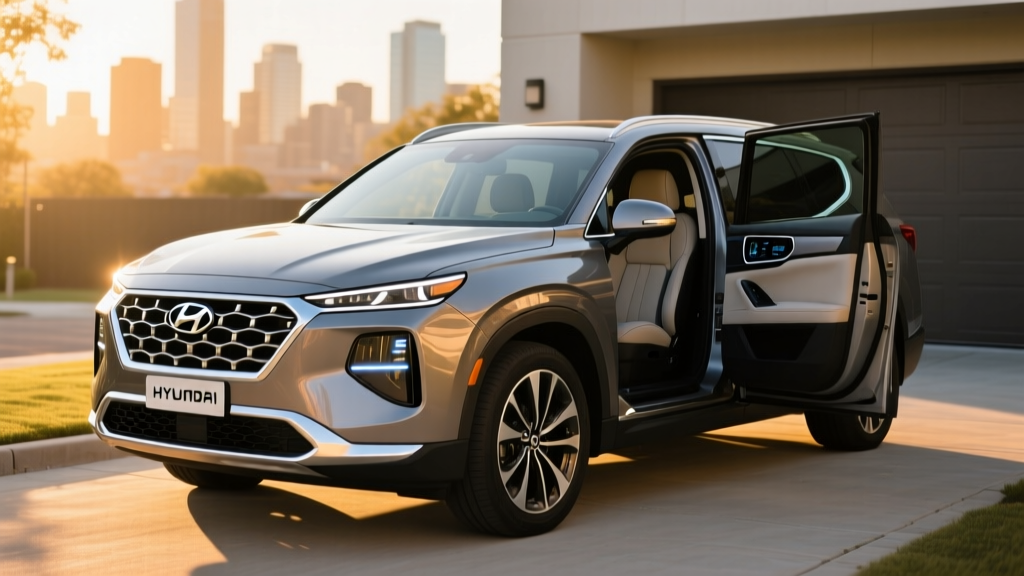
The 2021 Hyundai Santa Fe Hybrid arrived as a redesigned midsize SUV with a turbocharged hybrid powertrain that prioritizes real-world drivability over peak efficiency numbers. In a segment dominated by the Toyota RAV4 Hybrid and Honda CR-V Hybrid, the Santa Fe Hybrid carves its niche with upscale interior materials, generous standard safety tech, and a combined 226 horsepower — more than most rivals offer. Now several years into its lifecycle on the used market, it represents a compelling entry point for buyers who want hybrid fuel economy without plugging in.
This guide covers the 2021 Santa Fe Hybrid's EPA fuel economy, real-world MPG expectations, powertrain details, battery warranty, and how it stacks up against the Santa Fe Plug-in Hybrid variant and full EVs. If you're cross-shopping this SUV, the numbers below will help you decide.
EPA Fuel Economy and Real-World MPG
The 2021 Hyundai Santa Fe Hybrid carries an EPA rating of 33 MPG combined, broken down as 33 MPG city and 32 MPG highway, according to fueleconomy.gov. These figures apply to the Blue and SEL Premium trims equipped with the 1.6-liter turbocharged hybrid powertrain and all-wheel drive.
| Trim | City MPG | Highway MPG | Combined MPG |
|---|---|---|---|
| Blue | 33 | 32 | 33 |
| SEL Premium | 33 | 32 | 33 |
| Limited | 33 | 32 | 33 |
Real-world expectation: Hybrid SUVs tend to meet or slightly exceed their EPA city ratings in stop-and-go traffic, where regenerative braking recaptures energy most effectively. In mixed suburban driving, owners commonly report 31–35 MPG. Highway-dominant commutes at 75+ MPH may dip to 28–30 MPG, as aerodynamic drag and the turbo engine working harder under load reduce efficiency. Cold weather (below 32°F) typically knocks 2–4 MPG off combined figures due to cabin heating demands and reduced battery efficiency.
Compared to the non-hybrid 2021 Santa Fe with the 2.5-liter turbo (22 MPG combined), the hybrid version delivers roughly 50% better fuel economy — a substantial gap that adds up over 15,000 annual miles.
HEV vs PHEV: Understanding the 2021 Santa Fe Options
Hyundai offered the 2021 Santa Fe in two electrified variants: the conventional Hybrid (HEV) and the Plug-in Hybrid (PHEV). These are fundamentally different systems, and confusing them is a common buyer mistake.
Conventional Hybrid (HEV) — The Santa Fe Hybrid
- No plug required. The 1.49 kWh battery charges via regenerative braking and the gasoline engine.
- 33 MPG combined in all driving conditions.
- No electric-only driving range to speak of — the motor assists the engine but cannot propel the SUV alone for meaningful distances.
- No federal tax credit under current IRS §30D rules, which apply only to plug-in vehicles.
Plug-in Hybrid (PHEV) — The Santa Fe Plug-in Hybrid
- Plug-in charging required to access electric-only mode. Uses a 12.4 kWh battery pack.
- 30 miles of EPA electric-only range, then operates as a conventional hybrid at 33 MPG combined.
- Total range: approximately 430 miles (30 electric + ~400 gas-hybrid).
- Level 2 charging: ~2 hours from empty on a 240V / 32A home charger. No DC fast charging capability.
- Federal tax credit eligible — qualified buyers may receive up to $7,500 under §30D, subject to income caps, MSRP limits, and battery sourcing requirements. Check current rules at irs.gov.
The HEV is the simpler choice: you fuel it like any gas car and it delivers consistent hybrid efficiency. The PHEV rewards owners who can charge at home or work daily, turning short commutes into zero-gas trips while retaining gas-engine flexibility for road trips.
Powertrain: 226 HP Turbo Hybrid System
The 2021 Santa Fe Hybrid pairs a 1.6-liter turbocharged four-cylinder engine (178 hp, 195 lb-ft) with a 44.2 kW (59 hp) electric motor integrated into the transmission housing. Combined system output is 226 horsepower and 258 lb-ft of torque, routed through a 6-speed automatic transmission to standard HTRAC all-wheel drive.
| Specification | Value |
|---|---|
| Engine | 1.6L turbocharged I4 |
| Engine Output | 178 hp / 195 lb-ft |
| Electric Motor | 44.2 kW (59 hp) / 195 lb-ft |
| Combined System Output | 226 hp / 258 lb-ft |
| Transmission | 6-speed automatic |
| Drivetrain | HTRAC AWD (standard) |
| Battery Capacity (HEV) | 1.49 kWh (lithium-ion polymer) |
| 0–60 MPH | ~7.4 seconds (est.) |
| Towing Capacity | 2,000 lbs |
The turbo-hybrid setup gives the Santa Fe an advantage in passing power and highway merging confidence over naturally aspirated hybrid rivals. The electric motor fills in torque at low RPM before the turbo spools, resulting in responsive off-the-line acceleration. The 6-speed automatic is a deliberate choice over a CVT — shifts are perceptible but engagement feels more natural than the drone of a continuously variable transmission under hard acceleration.
Battery Warranty, Lifespan, and Replacement Cost
Hyundai Hybrid Battery Warranty: 10 years / 100,000 miles (whichever comes first) for the original owner. For subsequent owners on used 2021 models, the warranty transfers but is typically reduced to 5 years / 60,000 miles from the original in-service date, depending on state and transfer terms. Verify with a Hyundai dealer using the VIN.
The 1.49 kWh battery in the HEV variant is small and operates within a narrow state-of-charge window — Hyundai's hybrid system rarely depletes it below ~40% or charges above ~80%. This buffer strategy significantly reduces degradation stress. Most Hyundai hybrid batteries outlast the warranty period without meaningful capacity loss.
Replacement cost: If the hybrid battery does fail outside warranty, replacement runs approximately $2,000–$3,500 including parts and labor at a dealership. Independent hybrid specialists may offer refurbished units for $1,200–$2,000. For context, the PHEV's larger 12.4 kWh battery would cost significantly more to replace ($5,000–$8,000), but carries its own 10-year/100,000-mile warranty.
The hybrid system's other components — the electric motor, inverter, and transmission — are covered under Hyundai's 5-year/60,000-mile powertrain warranty (original owner) and have proven reliable across Hyundai's hybrid lineup since the 2011 Sonata Hybrid.
Pricing, Trims, and Tax Credit Eligibility
When new, the 2021 Santa Fe Hybrid started at $32,050 MSRP for the Blue trim and topped out around $40,660 for the Limited. On the used market in 2026, expect to pay roughly $20,000–$28,000 depending on mileage, condition, and trim.
| Trim | Original MSRP | Key Features |
|---|---|---|
| Blue | $32,050 | 18" wheels, 8" touchscreen, SmartSense safety suite, cloth seats |
| SEL Premium | $35,860 | Leather seats, panoramic sunroof, 10.25" nav, Harman Kardon audio |
| Limited | $40,660 | Quilted Nappa leather, head-up display, surround-view camera, highway drive assist |
Federal tax credit (HEV): The conventional Santa Fe Hybrid does not qualify for the federal §30D Clean Vehicle Credit. That credit applies exclusively to plug-in electric vehicles (BEVs and PHEVs) meeting battery sourcing, MSRP, and buyer income requirements.
Federal tax credit (PHEV variant): The 2021 Santa Fe Plug-in Hybrid may qualify for up to $7,500 under §30D, but eligibility depends on current-year battery critical-mineral and component sourcing rules, buyer income caps ($150K single / $300K joint), and the $80,000 MSRP cap for SUVs. Because the 2021 model predates the 2023 IRA sourcing requirements, its credit eligibility in 2026 is limited — check the latest IRS guidance and confirm with a tax professional before purchasing.
Who Should Choose the Santa Fe Hybrid vs a PHEV or Full EV?
Pros
- 33 MPG combined without any charging infrastructure needed
- 226 hp with turbo torque — confident highway passing
- Standard AWD across all trims
- Upscale interior (especially SEL Premium and Limited)
- Comprehensive SmartSense safety suite standard
- 10-year hybrid battery warranty (original owner)
Cons
- Highway MPG trails city MPG (unusual for hybrids — turbo works harder at speed)
- No federal tax credit for the HEV variant
- Third row unavailable (two-row SUV only)
- Cargo space slightly reduced vs gas model due to battery placement
- Used PHEV variant's tax credit eligibility is uncertain under current rules
Choose the Santa Fe Hybrid (HEV) if:
- You lack access to home or workplace charging and want hybrid efficiency with zero behavioral change.
- Your driving is a mix of city and highway, and 33 MPG combined meaningfully reduces your fuel budget.
- You want AWD, a premium interior, and strong safety ratings without paying PHEV or EV premiums.
Choose the Santa Fe Plug-in Hybrid (PHEV) if:
- You can install a Level 2 charger at home and your daily commute is under 30 miles round-trip.
- You want to drive mostly on electricity for daily errands but need gas-engine range for weekend trips.
- You can confirm §30D tax credit eligibility for the specific vehicle and your income bracket.
Choose a Full EV (e.g., Hyundai Ioniq 5, Tesla Model Y) if:
- You have reliable home charging and want to eliminate gasoline entirely.
- Your daily driving is under 250 miles and you're comfortable with public DC fast charging for road trips.
- You want to maximize fuel cost savings (~$0.04–$0.06/mile on home electricity vs ~$0.12–$0.15/mile on gas for the hybrid).
Frequently Asked Questions
How many MPG does the 2021 Hyundai Santa Fe Hybrid get?
The EPA rates it at 33 MPG city, 32 MPG highway, and 33 MPG combined. Real-world results typically fall between 31–35 MPG in mixed driving, with highway-heavy commutes potentially dropping to 28–30 MPG.
Does the Santa Fe Hybrid need to be plugged in?
No. The conventional Hybrid (HEV) charges its small 1.49 kWh battery through regenerative braking and the gasoline engine. You fuel it at any gas station. Only the Plug-in Hybrid (PHEV) variant requires plugging in to access its 30-mile electric-only range.
How far can the Santa Fe PHEV go on electric only?
The 2021 Santa Fe Plug-in Hybrid delivers an EPA-rated 30 miles of electric-only range from its 12.4 kWh battery. After that, it operates as a conventional hybrid. Total combined range is approximately 430 miles.
Is the 2021 Santa Fe Hybrid reliable?
Hyundai's turbo-hybrid powertrain has proven durable since its introduction. The hybrid battery carries a 10-year/100,000-mile warranty for original owners. Independent reliability data from sources like IIHS show the 2021 Santa Fe earned Top Safety Pick+ status, reflecting strong crashworthiness. Long-term powertrain reliability has been favorable, though early-production 2021 models had some transmission shift-quality software updates addressed under warranty.
What does a hybrid battery replacement cost?
For the HEV's 1.49 kWh battery, expect $2,000–$3,500 at a dealer or $1,200–$2,000 for a refurbished unit from an independent hybrid shop. The battery is designed to last the vehicle's lifetime under normal use, and Hyundai's buffer management strategy (keeping SoC between ~40–80%) minimizes degradation.
Does the 2021 Santa Fe Hybrid qualify for a tax credit?
The conventional HEV does not qualify for any federal tax credit. The PHEV variant may qualify for up to $7,500 under IRS §30D, but eligibility for a 2021 model purchased used in 2026 depends on current battery sourcing rules, your income, and the vehicle's MSRP. Consult a tax professional and verify on irs.gov before relying on credit assumptions.
Hybrid vs PHEV vs EV — which is right for me?
If you can't charge at home, the HEV is your best option — it requires no infrastructure and delivers consistent 33 MPG. If you can charge at home and commute under 30 miles, the PHEV lets you skip gas most weekdays. If you have home charging, drive under 250 miles daily, and want maximum savings, a full EV eliminates gas entirely but requires planning for longer road trips.