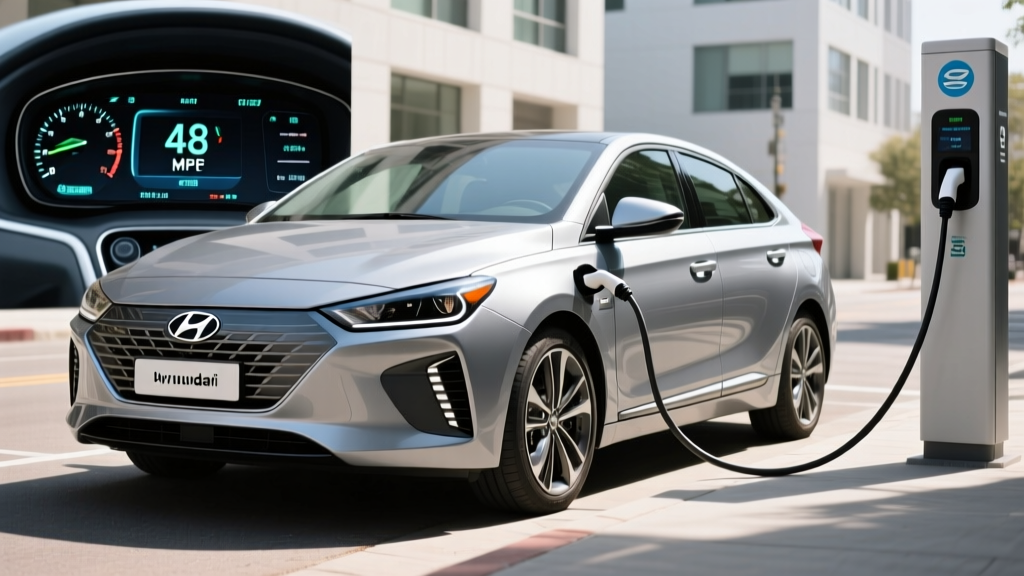
The 2021 Hyundai Ioniq Hybrid occupies a narrow but valuable lane in the used-car market: it is one of the most fuel-efficient conventional hybrids ever sold in the United States, and by 2026, it has become an affordable entry point for buyers who want electrified efficiency without plugging in. Hyundai discontinued the Ioniq nameplate after the 2022 model year (replacing it with the Elantra Hybrid and the all-electric Ioniq 5), but the 2021 model remains a compelling used purchase for commuters, rideshare drivers, and anyone tired of volatile gas prices.
This guide covers exactly what you need to know before buying a used 2021 Hyundai Ioniq Hybrid in 2026: real-world MPG versus EPA estimates, the difference between the HEV and PHEV variants that Hyundai sold that year, battery longevity and warranty coverage, and whether any tax incentives still apply to a used purchase.
HEV vs PHEV: Which 2021 Ioniq Are You Looking At?
Hyundai sold two electrified Ioniq variants for the 2021 model year, and confusing them is the most common mistake shoppers make. The conventional hybrid (HEV) is the volume seller and the subject of this review. The plug-in hybrid (PHEV) is a different vehicle with different capabilities.
| Feature | 2021 Ioniq Hybrid (HEV) | 2021 Ioniq Plug-In Hybrid (PHEV) |
|---|---|---|
| Powertrain Type | Conventional hybrid — no plug | Plug-in hybrid — charges via outlet |
| Electric-Only Range | N/A (motor assists engine) | 29 miles (EPA) |
| Battery Capacity | 1.56 kWh (lithium-ion polymer) | 8.9 kWh (lithium-ion polymer) |
| Combined Horsepower | 139 hp | 164 hp |
| EPA Combined MPG / MPGe | 58 MPG (Blue trim) | 119 MPGe (elec+gas) / 52 MPG (gas only) |
| Plug-In Charging | No — regenerative braking only | Yes — Level 1 (120V) ~5 hrs; Level 2 (240V) ~2.5 hrs |
| DC Fast Charging | No | No |
If you see a listing that simply says "2021 Hyundai Ioniq" without specifying Hybrid or Plug-In Hybrid, check the charge port. The PHEV has a charge door on the driver's front fender; the HEV does not have any external charging port. The PHEV also wears a "Plug-in Hybrid" badge on the rear.
Fuel Economy: EPA Ratings and Real-World MPG
The 2021 Hyundai Ioniq Hybrid comes in three trims — Blue, SEL, and Limited — and the trim level directly affects fuel economy because of wheel size and weight differences.
| Trim | City MPG | Highway MPG | Combined MPG |
|---|---|---|---|
| Blue | 58 | 60 | 59 |
| SEL | 54 | 57 | 55 |
| Limited | 54 | 57 | 55 |
Source: EPA Fuel Economy
The Blue trim's 59 MPG combined is extraordinary — it was the highest EPA-rated non-plug-in vehicle in America for its model year. The difference between Blue and higher trims comes down to 15-inch aero wheels with low-rolling-resistance tires versus 17-inch alloys on the SEL and Limited, plus slightly heavier equipment loads.
Real-World MPG: What Owners Actually See
Hybrids tend to perform close to or even above their EPA estimates in city driving, because stop-and-go traffic maximizes regenerative braking and electric-motor assist. The Ioniq Hybrid is no exception.
In mixed suburban and city driving, many owners report 55–62 MPG in warm weather. On the highway at sustained 70–75 mph, expect a slight dip to roughly 50–55 MPG because the gasoline engine carries more of the load and aerodynamic drag increases. In cold weather (below 35°F), the engine runs more frequently to maintain cabin heat and battery temperature, dropping real-world economy to approximately 45–50 MPG.
Real-World Range Estimate: With an 11.9-gallon fuel tank and real-world combined economy of ~54 MPG (across trims and conditions), expect a practical range of 580–650 miles per tank in mild weather. Cold-weather or sustained-highway driving may reduce this to ~500 miles.
Powertrain and Driving Experience
The 2021 Ioniq Hybrid pairs a 1.6-liter Atkinson-cycle four-cylinder gasoline engine (104 hp, 109 lb-ft torque) with a 32-kW electric motor (43 hp, 125 lb-ft torque) integrated into a 6-speed dual-clutch automatic transmission. Combined system output is 139 horsepower.
This is not a quick car. The 0–60 mph time sits around 9.5 seconds, which is adequate for merging and city driving but noticeably slower than competitors like the Toyota Corolla Hybrid (~9.0 seconds) or the Honda Insight (~9.3 seconds, now also discontinued). Where the Ioniq Hybrid distinguishes itself is the dual-clutch transmission: unlike the continuously variable transmissions (CVTs) in most rivals, the 6-speed DCT provides distinct gear shifts that feel more natural to drivers accustomed to conventional automatics.
The electric motor provides smooth, quiet launch from a stop, and the transition between electric and gasoline power is well-managed. Regenerative braking is moderate — it slows the car noticeably when you lift off the accelerator but does not provide true one-pedal driving. Paddle shifters behind the steering wheel let you adjust regen intensity across three levels.
Battery Longevity, Warranty, and Replacement Cost
The 2021 Ioniq Hybrid uses a 1.56 kWh lithium-ion polymer battery pack mounted behind the rear seats. This is a small battery by design — it buffers energy from regenerative braking and assists the gasoline engine during acceleration, then recharges continuously. It is not designed to be depleted or charged from an external source.
| Coverage | Term |
|---|---|
| Hybrid Battery Warranty (original owner) | 10 years / 100,000 miles |
| Hybrid Battery Warranty (subsequent owner) | 10 years / 100,000 miles (Hyundai transfers hybrid battery coverage in most states; verify with dealer) |
| Hybrid System Components | 10 years / 100,000 miles |
| Basic Vehicle Warranty | 5 years / 60,000 miles (likely expired on a 2021 model by 2026) |
| Powertrain Warranty | 10 years / 100,000 miles |
Hyundai's hybrid battery warranty is among the best in the industry. Because the 1.56 kWh battery is small and the system never fully depletes or fully charges it (the car maintains a state-of-charge buffer between roughly 30% and 80%), degradation is minimal. Most Hyundai hybrid owners report no meaningful battery capacity loss over 100,000+ miles.
Battery Replacement Cost
If the hybrid battery does fail outside warranty, replacement cost for the 2021 Ioniq Hybrid battery pack typically ranges from $2,000 to $3,500 including labor at a dealership. Independent hybrid-specialty shops may offer refurbished packs for $1,200–$2,000. Given the small battery size and conservative charge management, outright failure is rare — most hybrid batteries outlast the vehicle itself.
2026 Used Pricing and Tax Credit Eligibility
The 2021 Hyundai Ioniq Hybrid originally started at an MSRP of approximately $23,400 (Blue trim) and topped out around $29,000 (Limited with options). In the 2026 used market, expect pricing in these ranges:
- Blue trim (40,000–60,000 miles): $15,000–$18,000
- SEL trim (30,000–50,000 miles): $16,500–$19,500
- Limited trim (25,000–45,000 miles): $18,000–$22,000
Does It Qualify for a Tax Credit?
The 2021 Ioniq Hybrid does not qualify for the federal §30D new clean vehicle credit — it is a conventional hybrid, not a plug-in vehicle with sufficient battery capacity. When new, the Ioniq PHEV qualified for up to $4,543 in federal credit, but that credit is no longer available for new purchases since the model is discontinued.
However, if you purchase a used 2021 Ioniq PHEV (not the HEV covered here) from a dealer in 2026, it may qualify for the Used Clean Vehicle Credit under IRC §25E: up to $4,000 or 30% of the sale price (whichever is less), subject to income caps ($75,000 single / $150,000 married filing jointly) and a sale price cap of $25,000. The conventional HEV does not qualify for any federal credit. Always verify current rules at IRS.gov and consult a tax professional.
Some states offer their own incentives for used hybrid purchases — check your state energy office or department of revenue for current programs.
Reliability and Safety Record
The 2021 Ioniq Hybrid benefits from a mature, well-tested hybrid system. Hyundai's 1.6L Atkinson-cycle engine and dual-clutch hybrid powertrain have been in production since 2017 with minimal revisions, and major reliability aggregators rate it well. The car has few complex failure points compared to a conventional gasoline vehicle — no alternator, no starter motor, no traditional friction brakes wearing quickly (regen handles most deceleration).
The NHTSA awarded the 2021 Ioniq a 5-star overall safety rating. The IIHS named it a Top Safety Pick when equipped with specific headlights. Standard safety equipment includes forward collision-avoidance assist, lane-keeping assist, driver attention warning, and adaptive cruise control with stop-and-go capability — a robust ADAS suite for a car in this price bracket.
Common owner-reported concerns are minor: some wind noise at highway speeds (a tradeoff of lightweight construction), the rear seat being tighter than a Toyota Prius, and the infotainment system feeling dated compared to 2026 vehicles. None of these are mechanical reliability issues.
2021 Hyundai Ioniq Hybrid: Pros and Cons
Pros
- Best-in-class EPA fuel economy (59 MPG combined, Blue trim)
- Real-world MPG often matches or exceeds EPA in city driving
- 10-year/100,000-mile hybrid battery warranty (transfers to second owner)
- 6-speed dual-clutch transmission feels more natural than a CVT
- Strong standard ADAS suite (adaptive cruise, lane-keeping, AEB)
- Low used-market pricing in 2026 ($15K–$22K)
- 600+ mile real-world range per tank
Cons
- Modest 139 hp — slow acceleration (0–60 in ~9.5 seconds)
- Cramped rear seat compared to Prius or Elantra Hybrid
- Discontinued model — no new units available
- No EV mode or electric-only driving capability
- Dated 8-inch infotainment screen; no wireless CarPlay on Limited trim
- Higher trims (SEL/Limited) sacrifice 4 MPG for larger wheels
- No federal tax credit for the HEV variant
Who Should Buy the 2021 Ioniq Hybrid — and Who Shouldn't?
Choose the 2021 Ioniq Hybrid (HEV) if:
- You commute 30–80 miles daily in mixed city/suburban traffic and want to minimize fuel cost without changing your habits
- You cannot charge at home (apartment, street parking, no garage) and a plug-in vehicle isn't practical
- You want a reliable, low-cost used car with a strong warranty safety net
- You drive for rideshare or delivery and high MPG directly impacts your income
- You want a simple ownership experience — no charging apps, no plug-in logistics
Choose the 2021 Ioniq PHEV instead if:
- You can charge at home (even a standard 120V outlet works overnight)
- Your daily driving is under 29 miles round-trip — you could run almost entirely on electricity
- You want the used-vehicle federal tax credit (up to $4,000, income-limited)
Choose a full EV (like a used Ioniq 5 or Chevrolet Bolt) if:
- You have reliable Level 2 home charging access
- Your daily driving is under 200 miles and you rarely take road trips over 250 miles
- You want to eliminate gasoline entirely and reduce maintenance (no oil changes, no engine)
Choose a conventional gas car if:
- You drive mostly highway miles at high speed (the hybrid advantage shrinks)
- Upfront purchase price is the sole priority and you drive under 8,000 miles/year (fuel savings won't offset a price premium)
Spec Summary: 2021 Hyundai Ioniq Hybrid at a Glance
| Specification | 2021 Ioniq Hybrid Blue | 2021 Ioniq Hybrid SEL / Limited |
|---|---|---|
| EPA Combined MPG | 59 | 55 |
| City / Highway MPG | 58 / 60 | 54 / 57 |
| Engine | 1.6L Atkinson-cycle I-4 (104 hp) | |
| Electric Motor | 32 kW / 43 hp permanent-magnet synchronous | |
| Combined System HP | 139 hp | |
| Transmission | 6-speed dual-clutch automatic (DCT) | |
| Battery | 1.56 kWh lithium-ion polymer | |
| 0–60 mph | ~9.5 seconds | |
| Fuel Tank | 11.9 gallons | |
| Real-World Range | ~640 miles | ~600 miles |
| Cargo Volume | 23.0 cu ft (rear seats up) | |
| Curb Weight | ~3,042 lbs | ~3,135 lbs |
| Original MSRP | ~$23,400 | ~$25,700 / ~$28,300 |
| 2026 Used Price Range | $15,000–$18,000 | $16,500–$22,000 |
| Hybrid Battery Warranty | 10 years / 100,000 miles | |
| Federal Tax Credit (used HEV) | Not eligible | |
Frequently Asked Questions
How many MPG does the 2021 Hyundai Ioniq Hybrid actually get?
The EPA rates the Blue trim at 58 city / 60 highway / 59 combined MPG, and the SEL and Limited trims at 54 city / 57 highway / 55 combined. In real-world city and suburban driving, owners regularly match or exceed these numbers — 55–62 MPG is typical in warm weather. Highway-only driving at 75 mph and cold-weather operation will reduce economy to roughly 45–52 MPG.
Does the 2021 Ioniq Hybrid need to be plugged in?
No. The conventional Ioniq Hybrid (HEV) has no plug and no external charging capability. It recharges its small 1.56 kWh battery entirely through regenerative braking and the gasoline engine. If you want a plug-in version, look specifically for the Ioniq Plug-In Hybrid (PHEV), which is a separate model with a charge port and 29 miles of electric-only range.
Is the 2021 Ioniq Hybrid reliable, and what does a battery replacement cost?
The Ioniq Hybrid has a strong reliability record. The hybrid system is mature (in production since 2017), and the small battery is managed conservatively with a charge buffer that prevents deep cycling. Hyundai's 10-year/100,000-mile hybrid battery warranty provides substantial protection and transfers to subsequent owners. Out-of-warranty battery replacement, while rare, costs approximately $2,000–$3,500 at a dealer or $1,200–$2,000 for a refurbished pack at an independent shop.
Does the 2021 Ioniq Hybrid qualify for any tax credit in 2026?
The conventional hybrid (HEV) does not qualify for any federal tax credit — it lacks the battery capacity and plug-in capability required under §30D or §25E. The plug-in hybrid (PHEV) variant may qualify for the Used Clean Vehicle Credit (up to $4,000) if purchased from a dealer for under $25,000 and the buyer meets income requirements. Verify current eligibility at IRS.gov.
Hybrid vs PHEV vs EV — which is right for me?
Choose the HEV (this car) if you cannot charge at home and want maximum simplicity. Choose the PHEV if you can charge at home and your daily trips are under 30 miles — you'll drive mostly on electricity with a gas backup for longer trips. Choose a full EV if you have Level 2 home charging, drive under 200 miles daily, and want zero gasoline use and minimal maintenance.
How does the 2021 Ioniq Hybrid compare to a used Toyota Prius?
The 2021 Prius achieves 52–56 MPG combined depending on trim (per EPA data), slightly less than the Ioniq Blue's 59 MPG. The Prius offers more rear-seat room, all-wheel-drive availability, and a stronger dealer network, but typically costs $1,000–$3,000 more on the used market. If cargo space and rear-seat comfort matter, the Prius wins. If pure MPG and value matter, the Ioniq Hybrid has the edge.
What maintenance does the Ioniq Hybrid need?
Standard maintenance includes oil changes every 7,500–10,000 miles (it still has a gasoline engine), cabin air filter replacement, tire rotation, and brake inspection. Brake pads last significantly longer than on conventional cars because regenerative braking handles most deceleration — many owners report original brake pads at 80,000+ miles. There is no hybrid-specific maintenance required beyond standard fluid checks.