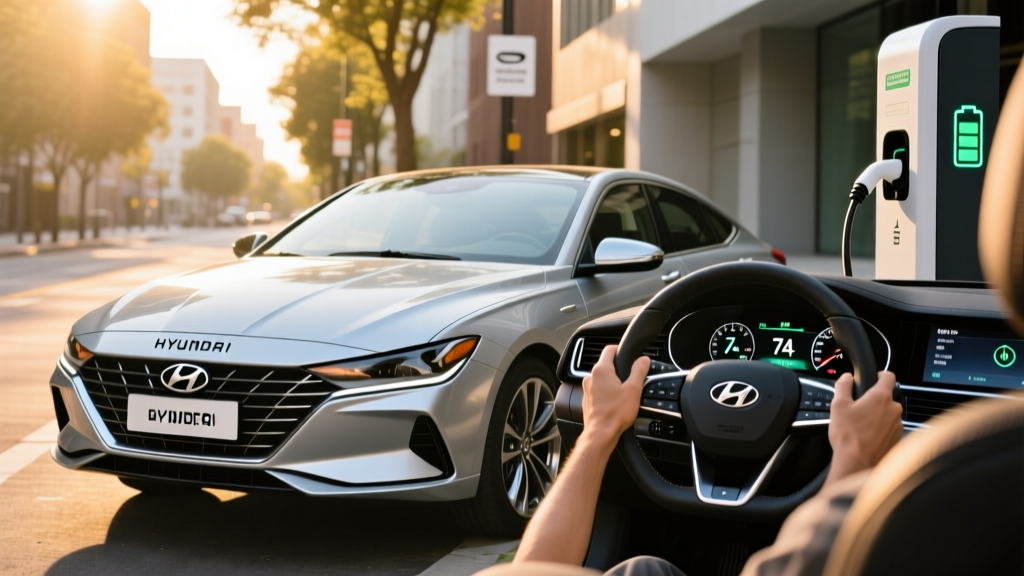
The 2021 Hyundai Elantra Hybrid arrived with a bold redesign and a fuel-economy number that still turns heads: 54 MPG combined on the Blue trim. For 2026 used-car shoppers weighing a fuel-sipping sedan against pricier plug-in hybrids and full EVs, this conventional hybrid (HEV) remains a compelling, low-commitment option. No plug required, no range anxiety, and a proven powertrain that sips fuel in city traffic where it matters most.
Below, we break down the exact EPA numbers, the real-world MPG you can expect, the hybrid battery warranty, and whether the 2021 Elantra Hybrid still makes financial sense on the used market today.
2021 Hyundai Elantra Hybrid: Key Specifications at a Glance
| Specification | Blue Trim | Limited Trim |
|---|---|---|
| Powertrain | 1.6L GDI 4-cyl + electric motor | 1.6L GDI 4-cyl + electric motor |
| Combined Horsepower | 139 hp | 139 hp |
| Combined Torque | 195 lb-ft | 195 lb-ft |
| Transmission | 6-speed dual-clutch (DCT) | 6-speed dual-clutch (DCT) |
| Hybrid Battery | 1.32 kWh lithium-ion polymer | 1.32 kWh lithium-ion polymer |
| EPA City MPG | 54 | 51 |
| EPA Highway MPG | 57 | 58 |
| EPA Combined MPG | 54 | 54 |
| Fuel Tank Capacity | 10.6 gal | 10.6 gal |
| Total Driving Range | ~572 mi | ~572 mi |
| 0–60 mph (est.) | ~8.5 sec | ~8.5 sec |
| Original MSRP | $24,100 | $28,500 |
| Battery Warranty | 10 yr / 100,000 mi | 10 yr / 100,000 mi |
HEV vs. PHEV vs. EV: Which Powertrain Fits You?
The 2021 Elantra Hybrid is a conventional hybrid (HEV), not a plug-in hybrid. This is a critical distinction that trips up many shoppers.
Conventional Hybrid (HEV) — like the Elantra Hybrid
- You never plug it in. The battery recharges through regenerative braking and the gasoline engine.
- Small battery (1.32 kWh) assists the engine for better fuel economy.
- No electric-only driving range to speak of — the motor assists at low speeds and during acceleration.
- Best for: Drivers who want maximum MPG without changing their fueling habits.
Plug-in Hybrid (PHEV) — e.g., Hyundai Tucson PHEV
- You plug it in to charge a larger battery (typically 10–20 kWh).
- Offers 25–40 miles of electric-only driving before the gas engine kicks in.
- Requires home charging access to realize full value.
- Best for: Drivers with short commutes who can charge at home but want gas flexibility for road trips.
Battery Electric Vehicle (BEV) — e.g., Hyundai Ioniq 6
- No gasoline engine. Larger battery (58–77+ kWh) charged by plug.
- 250–360+ miles of range per charge.
- Eligible for up to $7,500 federal tax credit (§30D) if new and qualifying.
- Best for: Drivers with reliable charging access who want zero tailpipe emissions and lower per-mile fuel costs.
Fuel Economy: EPA Ratings vs. Real-World MPG
| Trim | City (EPA) | Highway (EPA) | Combined (EPA) | Real-World Expectation |
|---|---|---|---|---|
| Blue | 54 MPG | 57 MPG | 54 MPG | 50–56 MPG combined |
| Limited | 51 MPG | 58 MPG | 54 MPG | 48–55 MPG combined |
Hybrids tend to outperform their EPA ratings in stop-and-go city driving, where regenerative braking recaptures the most energy. The Elantra Hybrid's 54 MPG city figure on the Blue trim is no exception — many owners report 55–60 MPG in urban commuting, particularly in mild weather.
Highway driving is a different story. At sustained 75–80 mph speeds, the electric motor provides less assistance, and aerodynamic drag dominates. Expect highway MPG to settle around 48–52 MPG on long road trips, which is still excellent for a gasoline-powered sedan.
Cold-weather impact: In temperatures below 30°F, expect a 5–10% reduction in fuel economy. The engine runs more frequently to generate cabin heat, and battery efficiency drops. This is modest compared to the 20–30% range loss EVs experience in cold weather, making hybrids more predictable in winter climates.
According to EPA data on fueleconomy.gov, the Blue trim's 54 MPG combined places it among the most efficient non-plug-in vehicles sold in the United States for the 2021 model year.
Powertrain Deep Dive: How the Hybrid System Works
The 2021 Elantra Hybrid pairs a 104-hp 1.6-liter GDI four-cylinder engine with a 43-hp (32 kW) permanent-magnet synchronous electric motor embedded in the transmission. Combined system output is 139 horsepower and 195 lb-ft of torque.
Unlike the Toyota Prius, which uses a continuously variable transmission (CVT), Hyundai opted for a 6-speed dual-clutch automatic (DCT). This choice gives the Elantra Hybrid a more conventional, engaging driving feel with distinct gear shifts — a welcome trade for enthusiasts who find CVTs monotonous. The trade-off is slightly less seamless low-speed behavior; some drivers notice minor shuddering during parking-lot maneuvers.
The 1.32 kWh lithium-ion polymer battery pack is mounted under the rear seats. It's small by PHEV or EV standards — it stores roughly enough energy to move the car about one mile on electricity alone — but its role is assistive. It smooths acceleration, enables engine-off coasting, and powers the electric motor during regenerative braking cycles.
Battery Warranty, Lifespan, and Replacement Cost
Hyundai Hybrid Battery Warranty
Coverage: 10 years or 100,000 miles (whichever comes first) for the original owner. For subsequent owners in most states, coverage transfers at 5 years / 60,000 miles. California-emissions states may offer extended transferable coverage.
What's covered: Defects and capacity loss below a defined threshold (typically around 70% state of health).
How long do Hyundai hybrid batteries actually last? Real-world data suggests Hyundai's lithium-ion polymer packs hold up well. Most hybrid batteries are designed to last 150,000–200,000 miles before significant degradation. Because the Elantra Hybrid's battery is small and never deeply cycled (the system keeps it in a narrow state-of-charge window, roughly 40–80%), stress on the cells is minimal.
Replacement cost if out of warranty: A new OEM hybrid battery pack for the Elantra Hybrid runs approximately $2,000–$3,500 including labor at a dealership. Third-party refurbished packs may be available for $1,200–$2,000. This is significantly cheaper than EV battery replacement ($8,000–$20,000+) because the hybrid pack is far smaller.
For a 2021 model purchased used in 2026, the original 10-year/100,000-mile warranty may still apply if the vehicle has fewer than 100,000 miles and you are the original owner. As a second owner, verify the remaining transferable warranty with a Hyundai dealer using the VIN.
Pricing, Used Market Value, and Tax Credit Eligibility
The 2021 Elantra Hybrid originally started at $24,100 (Blue) and $28,500 (Limited), including destination charges.
2026 used-market pricing: Expect to pay approximately $16,000–$21,000 for a 2021 Elantra Hybrid depending on mileage, condition, and trim. Blue trims command a slight premium due to the higher MPG rating.
Federal Tax Credit Status
New (in 2021): The Elantra Hybrid did not qualify for the federal §30D plug-in vehicle tax credit because it is a conventional hybrid, not a plug-in vehicle. Only BEVs and PHEVs with sufficient battery capacity are eligible under IRS rules.
Used in 2026: The IRS §25E used clean vehicle credit (up to $4,000 or 30% of sale price, whichever is less) applies only to used BEVs and PHEVs — conventional hybrids like the Elantra Hybrid are not eligible.
Some states offer rebates or HOV lane access for hybrids, but these vary widely by jurisdiction. Check your state's energy office or DMV for current programs.
Driving Impressions and Daily Ownership
The 2021 Elantra Hybrid drives like a competent compact sedan that happens to be extremely efficient. The 139-hp output isn't thrilling — 0–60 mph in roughly 8.5 seconds is adequate for merging but won't win any stoplight races. Where the powertrain shines is in low-to-mid-speed responsiveness; the electric motor fills in the torque gap before the engine reaches its power band.
Ride quality is composed and quiet, a step up from the previous-generation Elantra. The cabin is well-insulated from road noise, and the hybrid system transitions between electric and gas power almost imperceptibly.
Tech and features (Limited trim): 10.25-inch touchscreen with navigation, wireless Apple CarPlay and Android Auto (on the standard 8-inch display), Bose premium audio, SmartSense safety suite (forward collision-avoidance assist, lane-keeping assist, blind-spot monitoring, rear cross-traffic alert), and adaptive cruise control with stop-and-go.
Cargo space: 14.2 cubic feet of trunk volume — competitive with the segment and unimpacted by the under-seat battery placement.
Pros and Cons
Pros
- 54 MPG combined (Blue) — among the highest of any non-plug-in vehicle
- No plug-in required — fuel it like a regular gas car
- Strong 10-year/100,000-mile hybrid battery warranty
- Composed ride and quiet cabin
- Comprehensive SmartSense safety suite standard
- Affordable used pricing ($16K–$21K in 2026)
- Low cost of ownership — no charging infrastructure needed
Cons
- No electric-only driving capability
- No federal tax credit eligibility (new or used)
- Modest 139 hp — acceleration is adequate, not quick
- DCT can feel slightly hesitant at very low speeds
- Limited trim loses 3 MPG city vs. Blue
- Small fuel tank (10.6 gal) means more fill-ups despite great MPG
Who Should Choose the 2021 Elantra Hybrid?
Choose the 2021 Elantra Hybrid if:
- You want maximum fuel economy without installing a home charger or changing your fueling routine.
- Your commute is mostly city or suburban stop-and-go, where hybrids excel.
- You're buying used and want a low-risk, low-maintenance vehicle with a strong warranty.
- You drive 15,000+ miles per year and want to minimize fuel spending without the upfront cost of an EV.
Look at a PHEV or EV instead if:
- You have home charging access and a commute under 30 miles — a PHEV could eliminate most gasoline use.
- You want federal tax credit eligibility (up to $7,500 for qualifying new BEVs/PHEVs under §30D, or up to $4,000 for qualifying used BEVs/PHEVs under §25E).
- You want electric-only, zero-emission driving for environmental or HOV-lane reasons.
- You want stronger acceleration — most EVs in this price range offer 200+ hp and instant torque.
Frequently Asked Questions
How many MPG does the 2021 Hyundai Elantra Hybrid get?
The EPA rates the Blue trim at 54 city / 57 highway / 54 combined MPG. The Limited trim is rated at 51 city / 58 highway / 54 combined. In real-world city driving, many owners exceed the EPA city rating, reaching 55–60 MPG in stop-and-go traffic. Highway driving typically yields 48–52 MPG at sustained speeds above 70 mph.
Does the 2021 Elantra Hybrid need to be plugged in?
No. The 2021 Elantra Hybrid is a conventional hybrid (HEV). It charges its own small battery through regenerative braking and the gasoline engine. You simply fill it with gasoline like any other car. If you want a Hyundai that plugs in, look at the Tucson PHEV or Ioniq PHEV.
How far can it go on electric power alone?
Essentially zero miles in sustained electric-only driving. The 1.32 kWh battery assists the engine during acceleration and enables brief engine-off coasting, but it cannot propel the car on electricity alone for any meaningful distance. For electric-only capability, you need a PHEV or BEV.
Is the 2021 Elantra Hybrid reliable?
Hyundai's hybrid system has a solid reliability track record. The 1.6L GDI engine and 6-speed DCT are proven components, and the lithium-ion polymer battery is conservatively managed (never fully charged or fully depleted), which extends lifespan. The 10-year/100,000-mile hybrid battery warranty provides additional peace of mind. The vehicle earned a Top Safety Pick rating from IIHS when equipped with specific headlights.
What does it cost to replace the hybrid battery?
Out-of-warranty replacement runs approximately $2,000–$3,500 at a Hyundai dealership, including labor. Refurbished or aftermarket packs may be available for $1,200–$2,000. Given the battery's conservative management and 10-year warranty, most owners will never need a replacement.
Does the 2021 Elantra Hybrid qualify for any tax credit?
No. As a conventional hybrid (HEV), it is ineligible for the federal §30D new vehicle credit, the §25E used vehicle credit, or most state EV rebates. These programs require plug-in capability and a minimum battery capacity. Some states may offer minor incentives for hybrids — check your state energy office for details. See IRS clean vehicle credit guidelines for current eligibility rules.
How does the Elantra Hybrid compare to the Toyota Prius?
The 2021 Prius achieves 54/50/52 MPG (city/highway/combined) on the Eco trim, making the Elantra Hybrid Blue slightly more efficient overall. The Elantra offers a more conventional driving feel with its DCT, a quieter cabin, and a longer powertrain warranty (10yr/100K vs. Toyota's 8yr/100K hybrid battery coverage). The Prius offers available all-wheel drive (AWD-e), which the Elantra Hybrid does not.
Is the 2021 Elantra Hybrid still a good buy in 2026?
Yes, for the right buyer. At $16,000–$21,000 on the used market, it offers exceptional fuel economy, low running costs, and remaining factory warranty coverage. If you don't need plug-in capability and want a proven, no-surprises commuter, it remains one of the best values in the hybrid segment.