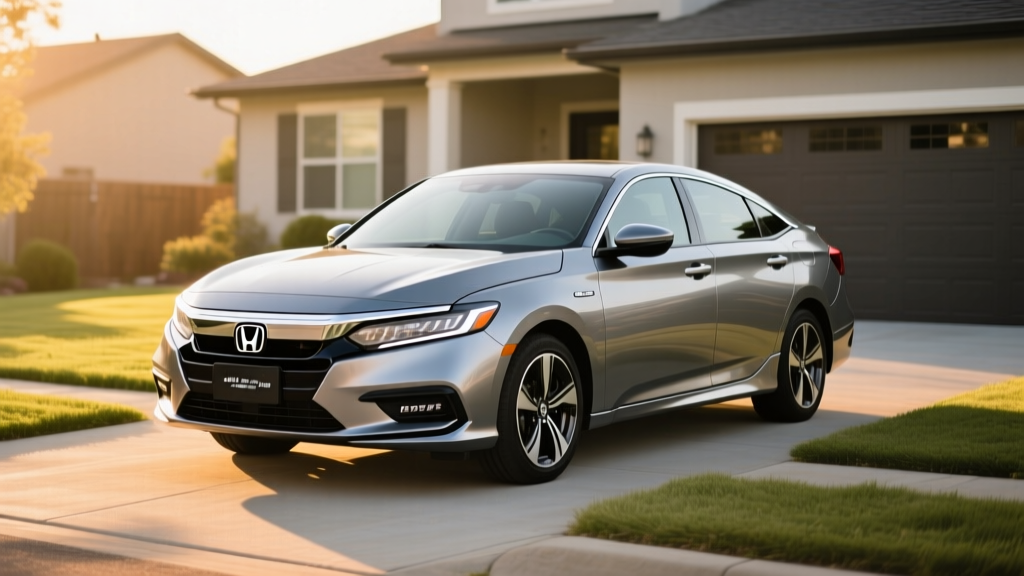
The 2021 Honda Insight hybrid occupies a specific niche: a compact sedan that delivers Prius-rivaling fuel economy without looking like a science experiment. Honda discontinued the Insight after the 2022 model year, replacing it with the Civic Hybrid, but the 2021 Insight remains a compelling used hybrid purchase in 2026 — especially for buyers who want proven efficiency without plugging in.
This guide breaks down everything you need to know before buying a used 2021 Insight: real-world MPG versus EPA estimates, the hybrid powertrain's reliability record, battery replacement costs, and whether this conventional hybrid (HEV) still makes sense versus a newer PHEV or full EV.
HEV vs PHEV: What the 2021 Insight Actually Is
The 2021 Honda Insight is a conventional hybrid (HEV). It does not plug in. It has no electric-only driving range to speak of. The small lithium-ion battery recharges exclusively through regenerative braking and the gasoline engine. You fuel it like any other car — just far less often.
This is fundamentally different from a plug-in hybrid (PHEV) like the Toyota Prius Prime or Hyundai Tucson PHEV, which offers 25–45 miles of electric-only range from a larger battery you charge at home or a public station. The Insight trades that EV-mode capability for simplicity: no charging cable, no home electrical upgrades, no range-anxiety about depleting an electric buffer on long trips.
| Feature | HEV (2021 Insight) | PHEV (e.g., Prius Prime) | BEV (e.g., Tesla Model 3) |
|---|---|---|---|
| Plugs in? | No | Yes | Yes |
| Electric-only range | ~1 mile (low speed) | 25–45 miles | 250–360+ miles |
| Home charging needed | No | Recommended (Level 2) | Required |
| Fuel/energy cost per mile | ~$0.08 | ~$0.04 (electric) / $0.08 (gas) | ~$0.04 |
| Federal tax credit (§30D) | Not eligible | Up to $7,500 (if eligible) | Up to $7,500 (if eligible) |
| Best for | No home charging access | Short commute + road trips | Home charging + mostly daily driving |
Fuel Economy: EPA Ratings and Real-World MPG
The 2021 Honda Insight comes in two trim levels — EX and Touring — and the EPA ratings differ slightly due to wheel size and weight.
| Trim | City MPG | Highway MPG | Combined MPG |
|---|---|---|---|
| EX | 55 | 49 | 52 |
| Touring | 51 | 45 | 48 |
Source: EPA Fuel Economy
Real-World MPG: What Owners Actually Report
Honda's hybrid system excels in city driving, where the electric motor handles low-speed propulsion and regenerative braking recaptures energy at every stoplight. In real-world ownership, the Insight frequently exceeds its EPA city rating. Owners on Fuelly and Honda forums regularly report 53–58 MPG in mixed suburban driving during warm months.
Highway driving tells a different story. At sustained 70–80 mph speeds, the gasoline engine does most of the work, and real-world highway MPG tends to land between 42–46 MPG for the EX trim — slightly below the EPA estimate. Cold weather (below 40°F) reduces efficiency by roughly 5–8 MPG as the engine runs more frequently to maintain cabin heat and battery temperature.
Real-World Fuel Economy Expectation: EX trim owners should expect 48–54 MPG combined in moderate climates, dropping to 43–48 MPG in cold-weather regions. The Touring trim runs about 3–4 MPG lower across the board due to 17-inch wheels and additional equipment weight.
Powertrain Specs: How the Insight Hybrid System Works
The 2021 Insight uses Honda's third-generation two-motor hybrid system, which operates differently from Toyota's planetary-gear setup. Here, a 1.5-liter Atkinson-cycle four-cylinder engine primarily acts as a generator, producing electricity that feeds a propulsion motor driving the front wheels. At highway cruising speeds, a lock-up clutch connects the engine directly to the wheels for efficiency.
| Engine | 1.5L Atkinson-cycle I-4 |
| Engine horsepower | 107 hp @ 6,000 rpm |
| Propulsion motor output | 129 hp / 195 lb-ft torque |
| Combined system output | 151 hp |
| Hybrid battery | 1.2 kWh lithium-ion (nominal) |
| Transmission | Single-speed direct drive (e-CVT) |
| 0–60 mph | ~7.7 seconds |
| Drivetrain | Front-wheel drive |
| Curb weight | 3,078–3,137 lbs |
| Fuel tank | 10.6 gallons |
| Total range | ~550 miles (EX) |
The 1.2 kWh battery is small by PHEV or EV standards — it's not designed for stored electric range. Instead, it buffers energy from regenerative braking and provides short bursts of electric assist during acceleration. This small battery is also a longevity advantage: shallow charge cycles produce far less degradation stress than the deep cycles in a full EV.
Pricing in 2026: Used Market and Tax Credit Reality
The 2021 Insight launched with an MSRP of $23,910 (EX) and $29,790 (Touring), including destination. As of early 2026, used 2021 Insights typically sell for $16,000–$22,000 depending on mileage, condition, and trim.
Federal Tax Credit Eligibility
The 2021 Honda Insight does NOT qualify for the federal §30D clean vehicle tax credit. Here's why:
- The §30D credit applies only to plug-in electric vehicles (PHEVs and BEVs) with a battery capacity of at least 7 kWh
- The Insight's 1.2 kWh hybrid battery falls far below this threshold
- Conventional hybrids (HEVs) have not qualified for federal purchase credits since the original Toyota Prius credit phase-out
- Some states offer modest hybrid incentives — check your state's energy office for current programs
For full §30D eligibility rules on plug-in vehicles, see the IRS Clean Vehicle Credit guidelines.
Reliability Record and Hybrid Battery Longevity
The third-generation Insight shares its hybrid powertrain with the Honda Accord Hybrid and CR-V Hybrid, giving it a broad reliability track record. The two-motor system has fewer mechanical wear points than a conventional automatic transmission — there are no gear shifts, no torque converter, and no traditional starter motor to fail.
Honda's hybrid battery warranty covers 8 years or 100,000 miles (10 years/150,000 miles in California and states that follow CARB emissions standards). This warranty guarantees the battery will maintain sufficient capacity for normal hybrid operation. For a 2021 model, that factory coverage extends through 2029 or the mileage limit — meaning most used buyers still have remaining warranty protection in 2026.
Hybrid Battery Replacement Cost: If the Insight's lithium-ion hybrid battery fails outside warranty, replacement costs approximately $2,000–$3,500 including parts and labor at a Honda dealer. Independent hybrid specialists can often refurbish or replace individual cells for $800–$1,500. Given the shallow cycling of this small battery, failures before 150,000 miles are uncommon based on Accord Hybrid fleet data.
Beyond the hybrid battery, the Insight's maintenance profile is straightforward: oil changes every 7,500–10,000 miles, brake pads that last 60,000+ miles thanks to regenerative braking, and no transmission fluid changes on the e-CVT. The 12-volt auxiliary battery (a standard AGM unit) typically needs replacement every 4–5 years, as it does in any vehicle.
Who Should Buy the 2021 Insight Hybrid in 2026?
Reasons to Choose the Insight
- 52 MPG combined (EX) without plugging in — ideal for apartment dwellers or anyone without home charging access
- Proven Honda hybrid reliability with warranty coverage still active on most 2021 models
- Refined ride quality — quieter and more composed than the contemporaneous Prius
- Strong city MPG that often exceeds EPA estimates in stop-and-go traffic
- Used pricing ($16K–$22K) undercuts new hybrids and EVs significantly
- Honda Sensing suite (adaptive cruise, lane-keeping, automatic emergency braking) standard on all trims
Reasons to Look Elsewhere
- No electric-only driving range — every mile burns some gasoline
- No federal tax credit eligibility, unlike PHEVs and EVs
- Discontinued after 2022 — parts availability is fine now but long-term model support may thin
- Cargo space (15.1 cu ft) is adequate but smaller than the Civic Hybrid it was replaced by
- Highway MPG drops below EPA estimates at sustained 75+ mph speeds
- Apple CarPlay/Android Auto only on Touring trim (EX lacks smartphone integration)
The Decision Framework
Choose the 2021 Insight if: You lack reliable access to home or workplace charging, your commute involves significant city/stop-and-go driving, and you want maximum fuel savings with zero behavioral change. It's also the right pick if you regularly take long road trips and don't want to plan around charging stations.
Choose a PHEV instead if: You have access to Level 2 charging at home or work, your daily commute is under 40 miles round-trip, and you want to drive mostly on electricity while keeping a gas engine for road trips. A used Toyota RAV4 Prime or new Hyundai Tucson PHEV can eliminate most of your gasoline use.
Choose a full EV instead if: You have home charging, your daily driving is under 250 miles, and you want the lowest per-mile energy cost and zero tailpipe emissions. Used Tesla Model 3s and Chevrolet Bolts in the $18K–$25K range compete directly with the Insight's used price.
Frequently Asked Questions
How many MPG does the 2021 Honda Insight hybrid get?
The EX trim is EPA-rated at 55 city / 49 highway / 52 combined MPG. The Touring trim rates at 51/45/48 MPG. In real-world driving, city MPG often exceeds EPA estimates while highway MPG at speeds above 70 mph tends to fall 3–5 MPG short.
Does the 2021 Insight need to be plugged in?
No. The Insight is a conventional hybrid (HEV). Its small battery charges entirely through regenerative braking and the gasoline engine. There is no plug, no charging cable, and no electric-only driving mode of any practical distance.
How far can the Insight drive on electric power alone?
Effectively zero miles in normal driving. At very low speeds (under 25 mph) with a fully charged hybrid battery, the Insight can creep short distances on electric power — perhaps a quarter mile in a parking lot. This is not usable electric range and should not be compared to a PHEV's 25–45 mile EV mode.
Is the 2021 Insight hybrid reliable?
Yes. Honda's two-motor hybrid system has proven durable across the Accord Hybrid, CR-V Hybrid, and Insight platforms. The e-CVT has no traditional transmission wear components, and the small hybrid battery undergoes shallow charge cycles that minimize degradation. Most 2021 models still carry factory hybrid warranty coverage through 2029.
What does it cost to replace the Insight's hybrid battery?
Dealer replacement runs approximately $2,000–$3,500. Independent hybrid battery specialists can often repair or replace individual modules for $800–$1,500. Premature hybrid battery failure is rare on this generation based on fleet data from the mechanically similar Accord Hybrid.
Does the 2021 Honda Insight qualify for any tax credits?
Not at the federal level. The IRS §30D clean vehicle credit requires a plug-in vehicle with at least 7 kWh of battery capacity. The Insight's 1.2 kWh battery does not qualify. Some state or local utility programs offer small rebates for hybrid purchases — check your state energy office or utility provider.
How does the Insight compare to the Civic Hybrid that replaced it?
The 2023+ Civic Hybrid uses an updated version of the same two-motor system with a larger 2.0L engine and 200 combined horsepower — a meaningful performance upgrade. It also offers more cargo room and standard Apple CarPlay/Android Auto. However, used Civic Hybrids command $25,000+ in 2026, making the Insight a significantly more affordable entry into Honda hybrid ownership.
Is the 2021 Insight a good used hybrid buy in 2026?
For the right buyer, yes. At $16,000–$22,000, it offers 50+ MPG efficiency, remaining hybrid warranty coverage, Honda's reputation for longevity, and low operating costs. Its main limitation — no electric-only range — is irrelevant if you can't charge at home. Buyers who can install a Level 2 charger should also consider used PHEVs for greater daily electric driving.