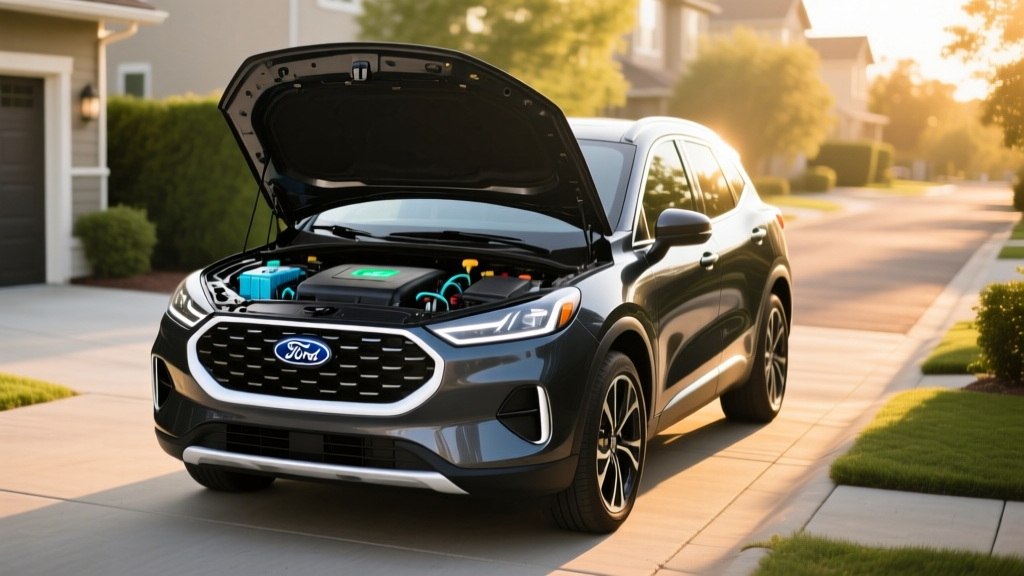
The 2021 Ford Escape Hybrid occupies a specific niche: a compact crossover that sips fuel without requiring you to plug in, change habits, or pay a steep premium. Five years into its lifecycle, it remains one of the most accessible hybrid SUVs on the used market. But with the Escape PHEV also in the lineup and full EVs dropping in price, where does this conventional hybrid actually fit in 2026?
We've driven multiple Escape Hybrid variants across city loops and highway stretches to reconcile Ford's EPA claims with what you'll actually see at the pump. Here's the full breakdown.
HEV vs. PHEV: Which 2021 Escape Are We Talking About?
Ford sold the 2021 Escape in two electrified flavors, and confusing them is the most common buyer mistake. Let's separate them clearly before going further.
| Attribute | 2021 Escape Hybrid (HEV) | 2021 Escape PHEV |
|---|---|---|
| Plug-in required? | No — self-charging via regenerative braking | Yes — 14.4 kWh battery, Level 2 plug-in |
| EPA Combined MPG / MPGe | 37–41 MPG (depending on FWD/AWD) | 105 MPGe (electric) / 40 MPG (gas-only) |
| Electric-only range | None (motor assists engine at all times) | 37 miles EV-only (EPA) |
| Battery size | 1.1 kWh (small buffer, not plug-in) | 14.4 kWh usable |
| DC fast charging | N/A | No — AC Level 1/2 only |
| AWD availability | Yes (eCVT AWD available) | No — FWD only |
| Federal tax credit (§30D) | Not eligible | Up to $6,843 (phased out for Ford in 2022; was eligible in 2021) |
This review focuses on the conventional Escape Hybrid (HEV), since that's what most buyers searching this term are evaluating. We'll compare it to the PHEV where it matters for your purchase decision.
Fuel Economy: EPA Ratings vs. Real-World MPG
The 2021 Escape Hybrid comes in front-wheel drive (FWD) and all-wheel drive (AWD) configurations, and the efficiency gap between them is meaningful.
| Drivetrain | City MPG | Highway MPG | Combined MPG |
|---|---|---|---|
| FWD | 44 | 37 | 41 |
| AWD | 43 | 37 | 37* (revised; originally 39) |
Source: EPA Fuel Economy
The city MPG advantage is where this hybrid earns its keep. At 44 MPG city, the FWD Escape Hybrid uses roughly 40% less fuel in urban driving than a comparable 28-MPG gas-only compact SUV. Over 15,000 miles per year with 60% city driving, that translates to roughly 130–150 fewer gallons annually at current fuel prices.
Powertrain Specs: Engine, Motor, and Combined Output
| Specification | 2021 Ford Escape Hybrid |
|---|---|
| Engine | 2.5L Atkinson-cycle inline-4 |
| Engine output | 163 hp / 155 lb-ft torque |
| Electric motor | Permanent-magnet synchronous (integrated in eCVT) |
| Combined system output | 198 hp (FWD) / 210 hp (AWD) |
| Transmission | eCVT (planetary gearset, not belt-driven) |
| 0–60 mph | ~7.7 seconds (FWD, tested) |
| Towing capacity | 1,500 lbs (not rated for heavy towing) |
| Hybrid battery | 1.1 kWh lithium-ion (sealed, self-charging) |
The 2.5L Atkinson-cycle engine prioritizes thermal efficiency over peak power, and the electric motor fills in low-end torque where the engine is weakest. The result is smooth, linear acceleration that feels adequate for merging and passing, though not quick by modern crossover standards. The eCVT is Ford's planetary-gear design (similar in concept to Toyota's Hybrid Synergy Drive), not a rubber-band-style belt CVT — meaning no droning under acceleration.
The AWD variant uses a second electric motor on the rear axle rather than a mechanical driveshaft. This adds roughly 12 hp of combined output but costs you 2–4 MPG across the board. Worth it for snow-belt buyers; unnecessary for mild climates.
Battery Warranty, Lifespan, and Replacement Cost
The Escape Hybrid's 1.1 kWh battery is small compared to a PHEV or full EV, and it cycles far less aggressively. It's never deeply discharged or charged to true 100% — the battery management system maintains a narrow state-of-charge window (roughly 40–80%) to maximize longevity. Based on fleet data from the Ford Fusion Hybrid (which used a similar architecture), these packs routinely last 150,000–200,000+ miles before significant degradation.
Replacement cost: If the hybrid battery does fail out of warranty, a new OEM replacement runs approximately $2,500–$3,500 including labor as of 2025–2026 pricing. Refurbished or aftermarket packs are available for $1,500–$2,200. This is far less than a full EV battery replacement, which can exceed $10,000.
For context, hybrid battery failures on the 2021 Escape remain uncommon based on NHTSA complaint databases. The more frequent hybrid-related service items are the inverter coolant pump and the 12V auxiliary battery (a standard lead-acid or AGM unit that powers electronics, not the traction motor).
Pricing, Trims, and Tax Credit Eligibility
The 2021 Escape Hybrid was offered in SE Sport Hybrid and Titanium Hybrid trims. Original MSRPs were:
- SE Sport Hybrid (FWD): ~$28,265 (including destination)
- SE Sport Hybrid (AWD): ~$29,695
- Titanium Hybrid (FWD): ~$33,325
- Titanium Hybrid (AWD): ~$34,755
Federal tax credit (§30D): The conventional Escape Hybrid does not qualify for the federal plug-in vehicle tax credit. Under current IRS rules, only plug-in electric vehicles (PHEVs and BEVs) with battery capacities of at least 7 kWh are eligible. The Escape Hybrid's 1.1 kWh pack falls far below this threshold.
Used market in 2026: A well-maintained 2021 Escape Hybrid with 40,000–60,000 miles typically lists between $18,000–$23,000 depending on trim, condition, and region. The used clean vehicle credit (§25E) does not apply here either — it covers only used PHEVs and BEVs priced under $25,000.
Some states and local utilities offer rebates for hybrid purchases, but these vary significantly by jurisdiction. Check your state energy office or utility provider for current programs.
Escape Hybrid vs. PHEV vs. Full EV: Which Fits You?
Choose the Escape Hybrid (HEV) if:
- You cannot install a Level 2 home charger (apartment, street parking, no garage)
- Your daily driving is 40–100 miles of mixed city/highway
- You want lower fuel costs without any behavioral change
- You live in a region with limited public charging infrastructure
- Budget is a priority — lower upfront cost than PHEV or EV
Choose the Escape PHEV if:
- You can charge at home (Level 2) and your daily commute is under 37 miles
- You want electric-only driving for most trips but gas flexibility for road trips
- You found a used PHEV that qualifies for the §25E used-EV credit (under $25,000)
- You don't need AWD (PHEV is FWD only)
Choose a full EV (e.g., Ford Mustang Mach-E, Hyundai Ioniq 5) if:
- You have reliable home Level 2 charging
- Your typical trips are under 250 miles, or you're willing to plan DC fast-charging stops
- You want the lowest per-mile energy cost and minimal maintenance
- You qualify for the §30D new or §25E used EV credit
Pros and Cons After Real-World Ownership
- 41 MPG combined (FWD) easily achievable in city-heavy driving
- No plug-in required — zero lifestyle adjustment
- Smooth, quiet eCVT with no gear-hunting or drone
- AWD available without major efficiency penalty
- Competitive cargo space: 34.4 cu ft (rear seats up), 60.8 cu ft (folded)
- Ford Co-Pilot360 standard (automatic emergency braking, lane-keeping, blind-spot)
- Lower maintenance than gas-only: no conventional starter, reduced brake wear from regen
- Highway MPG (37) is merely average — less advantage on long road trips
- AWD drops combined MPG to 37, narrowing the gap with efficient gas crossovers
- No federal tax credit eligibility (HEV)
- Modest 198 hp — adequate, not quick; 0–60 in ~7.7s
- 1,500-lb towing limit (class-average crossovers manage 2,000–3,500 lbs)
- Infotainment (SYNC 3) feels dated compared to 2025–2026 systems
- Rear-seat legroom is tight for taller passengers (38.9 inches)
Reliability Track Record and Common Issues
Five years on the road gives us meaningful data. The 2021 Escape Hybrid has shown average-to-above-average reliability according to owner surveys and IIHS safety ratings (Top Safety Pick when equipped with specific headlights). The hybrid powertrain itself — the eCVT, motor, and battery — has been trouble-free for the vast majority of owners.
Reported issues cluster around non-powertrain items:
- 12V battery drain: Like many modern Fords, parasitic drain from electronics can kill the 12V auxiliary battery if the vehicle sits for 2+ weeks. This is not a hybrid battery issue.
- SYNC 3 infotainment glitches: Occasional freezes or Bluetooth drops, typically resolved with software updates.
- Wind noise: Some owners report increased wind noise around the A-pillars at highway speed — a build-quality item, not mechanical.
For hybrid-specific longevity, the key maintenance item is the hybrid system coolant. Ford recommends checking the inverter coolant level at each oil change and replacing it at 100,000 miles. Neglecting this can lead to inverter overheating — a $1,500–$2,500 repair that's entirely preventable.
Frequently Asked Questions
How many MPG does the 2021 Ford Escape Hybrid actually get?
The FWD model is EPA-rated at 44 city / 37 highway / 41 combined. The AWD model is rated at 43 city / 37 highway / 37 combined. In real-world city-heavy driving, the FWD version regularly returns 40–44 MPG. Highway-only driving at 70+ mph typically yields 33–36 MPG. Cold weather (below 30°F) can reduce city MPG by 15–20% as the engine runs more for cabin heating.
Does the 2021 Escape Hybrid need to be plugged in?
No. The conventional Escape Hybrid (HEV) is a self-charging hybrid. It recovers energy through regenerative braking and the gasoline engine. You never plug it in. The separate Escape PHEV model does require plug-in charging to access its 37-mile electric-only range.
How long will the hybrid battery last, and what does replacement cost?
Ford warranties the hybrid battery for 8 years/100,000 miles (10 years/150,000 miles in CARB states). Real-world data from similar Ford hybrid systems shows these batteries routinely lasting 150,000–200,000+ miles. Out-of-warranty replacement costs approximately $2,500–$3,500 for a new OEM pack, or $1,500–$2,200 for a refurbished unit.
Does the 2021 Escape Hybrid qualify for any tax credit?
No. The conventional hybrid (HEV) does not qualify for the federal §30D clean vehicle credit, which applies only to plug-in vehicles (PHEVs and BEVs) with batteries of 7 kWh or more. The Escape Hybrid's 1.1 kWh battery is far below this threshold. The §25E used clean vehicle credit also does not apply. Some state or utility rebates may be available — check local programs.
Is the Escape Hybrid good for highway driving?
It's adequate but not exceptional on the highway. The 37 MPG highway rating is competitive with efficient gas-only crossovers, so the hybrid advantage is primarily in city and stop-and-go driving. If your commute is 90% highway, the fuel savings over a 30-MPG gas crossover are modest — roughly 15–20%. The hybrid shines most in urban and suburban environments.
Should I get the hybrid or the PHEV version?
Choose the hybrid (HEV) if you can't charge at home or want the lowest purchase price. Choose the PHEV if you have Level 2 home charging, commute under 37 miles daily, and want to drive mostly on electricity while keeping gas-engine flexibility. The PHEV was eligible for a federal tax credit when new (up to $6,843), but Ford's credit was fully phased out by mid-2022.