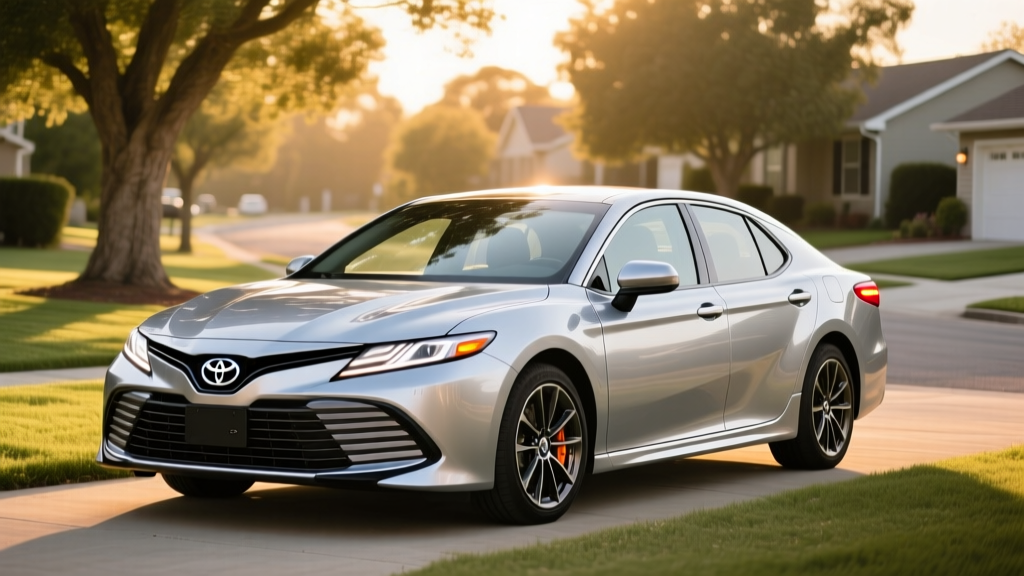
The 2021 Toyota Camry Hybrid occupies a specific niche that full EVs still struggle to fill: a midsize sedan that delivers exceptional fuel economy without requiring any change to your driving or fueling habits. Five years after its release, this generation of the Camry Hybrid remains a benchmark for conventional hybrid efficiency, and on the used market, it has become one of the most cost-effective ways to cut fuel spending without range anxiety or charging infrastructure concerns.
This guide covers the 2021 Camry Hybrid's real-world fuel economy, powertrain specifications, long-term battery reliability, and how it compares to plug-in hybrids and full battery-electric vehicles for today's buyers.
2021 Camry Hybrid Fuel Economy: EPA Numbers vs. Real-World Results
The 2021 Camry Hybrid comes in three trims — LE, SE, and XLE — and fuel economy varies slightly by trim due to wheel size, weight, and aerodynamic differences. The LE trim is the efficiency champion of the lineup.
| Trim | City MPG | Highway MPG | Combined MPG |
|---|---|---|---|
| LE | 51 | 53 | 52 |
| SE | 44 | 47 | 46 |
| XLE | 44 | 47 | 46 |
Source: EPA / fueleconomy.gov
The Camry Hybrid LE's 52 MPG combined EPA rating is one of the few cases where real-world driving often exceeds the sticker in city conditions. Hybrids recapture energy through regenerative braking, so stop-and-go traffic actually boosts efficiency. Owners consistently report 50–56 MPG in mixed city driving. Highway-only trips at 75+ mph typically yield 42–48 MPG for the LE, and 38–43 MPG for SE/XLE trims. In cold weather (below 30°F), expect a 5–10% drop as the engine runs more frequently to provide cabin heat.
Powertrain Specs: Engine, Motor, and Combined Output
The 2021 Camry Hybrid pairs a 2.5-liter four-cylinder Atkinson-cycle gasoline engine with an electric motor integrated into the transaxle. Toyota's Hybrid Synergy Drive system seamlessly blends power from both sources. All-wheel drive (AWD) was available for the first time on the Camry Hybrid starting with the 2020 model year, adding a second, independent rear electric motor.
| Gasoline Engine | 2.5L 4-cyl Atkinson-cycle |
| Engine Power | 176 hp / 163 lb-ft torque |
| Electric Motor (front) | 118 hp / 149 lb-ft |
| Combined Net Horsepower | 208 hp (FWD) / 219 hp (AWD-e) |
| Transmission | eCVT (planetary gearset) |
| Drivetrain | FWD standard; AWD-e available |
| 0–60 mph | ~7.5 seconds |
| Hybrid Battery | 1.6 kWh (259V) lithium-ion |
The 208 hp combined output provides confident highway merging and passing. The AWD-e variant adds a 40 kW (54 hp) rear motor that engages automatically during acceleration and low-traction conditions, bringing total system output to 219 hp. Unlike mechanical AWD systems, there is no driveshaft — the rear motor is entirely independent and only draws power when needed, minimizing efficiency loss.
HEV vs. PHEV vs. EV: Which Powertrain Fits Your Driving Pattern?
The 2021 Camry Hybrid is a conventional hybrid (HEV) — it does not plug in. The small 1.6 kWh battery charges entirely through regenerative braking and the gasoline engine. This is fundamentally different from a plug-in hybrid (PHEV) or a battery-electric vehicle (BEV).
| Factor | HEV (Camry Hybrid) | PHEV (e.g., Prius Prime) | BEV (e.g., Tesla Model 3) |
|---|---|---|---|
| Plugs in? | No | Yes (Level 1/2) | Yes (Level 1/2/DC) |
| Electric-only range | ~0.5 mi at low speed | 25–44 mi typical | 250–360 mi typical |
| Fuel/energy source | Gasoline only | Gasoline + electricity | Electricity only |
| Home charging needed? | No | Recommended | Essential |
| Best for | No charging access; high mileage | Short commutes + road trips | Home charging + daily driving |
| Federal tax credit | Not eligible | Up to $7,500 (§30D) | Up to $7,500 (§30D) |
- Choose the Camry Hybrid (HEV) if: You lack home charging access, drive 15,000+ miles/year, want maximum simplicity, or live in an apartment without charging options.
- Choose a PHEV if: You have home Level 2 charging, your daily commute is under 40 miles, and you still want gas-engine range for road trips without planning.
- Choose a BEV if: You have reliable home charging, want zero tailpipe emissions, and your typical trips fall within 250 miles or you're willing to use DC fast charging on road trips.
Is the 2021 Camry Hybrid Reliable? Battery Lifespan and Warranty
Toyota's hybrid systems have an extensive track record dating back to the 1997 Prius, and the Camry Hybrid benefits from two decades of iterative refinement. The 2.5L Dynamic Force engine and eCVT transmission are among the most durable powertrains Toyota produces — the eCVT uses a planetary gearset with no belts, clutches, or traditional friction components to wear out.
For the 2021 model year, Toyota covers the hybrid battery and all hybrid system components under a 10-year / 150,000-mile warranty (whichever comes first) in all 50 states. This was extended from the previous 8-year/100,000-mile coverage starting with 2020 model-year vehicles. The warranty covers battery capacity loss below a defined threshold, inverter failures, and hybrid control module defects.
Based on long-term data from Toyota's hybrid fleet, the 1.6 kWh lithium-ion traction battery in the Camry Hybrid is designed for the life of the vehicle. Toyota uses conservative state-of-charge windows — the battery never fully charges or fully discharges during normal operation, which significantly reduces degradation. Real-world reports of Camry Hybrid battery failures before 200,000 miles are rare.
If replacement is needed out of warranty, a new OEM hybrid battery for the Camry Hybrid costs approximately $2,000–$4,000 including labor. Refurbished or reconditioned units are available for $1,000–$2,000. This is a fraction of the cost of a full EV battery replacement, largely because the Camry's hybrid battery is small (1.6 kWh vs. 60–100 kWh in a BEV).
2021 Camry Hybrid Pricing and Tax Credit Eligibility
The 2021 Camry Hybrid is no longer available new, but it holds strong resale value on the used market. Here's what original pricing looked like and what you can expect to pay today:
| Trim | Original MSRP | Est. Used Price (2026) |
|---|---|---|
| LE | $27,270 | $18,000–$22,000 |
| SE | $28,770 | $19,500–$24,000 |
| XLE | $32,720 | $22,000–$27,000 |
| AWD-e (SE/XLE) | + $1,400 | + $1,000–$1,500 premium |
Federal and State Tax Credits
The 2021 Camry Hybrid as a conventional HEV does not qualify for the federal §30D clean vehicle tax credit. That credit applies only to plug-in electric vehicles (BEVs and PHEVs) that meet battery sourcing, MSRP caps, and buyer income requirements as defined by the IRS.
However, some states and municipalities offer rebates or HOV lane access for hybrid vehicles. Check your state energy office or Alternative Fuels Data Center for current local incentives. A few states still offer modest hybrid purchase rebates or reduced registration fees, though most incentive programs have shifted toward plug-in vehicles.
For used buyers: the federal used clean vehicle credit (up to $4,000 or 30% of sale price) also applies only to qualifying used BEVs and PHEVs — not conventional hybrids.
Ownership Cost: 5-Year Fuel Savings vs. Gas-Only Camry
The financial case for the Camry Hybrid centers on fuel savings over time. Here's a comparison against the gas-only 2021 Camry (2.5L 4-cylinder, EPA-rated 28 city / 39 highway / 32 combined MPG):
| Vehicle | Combined MPG | Annual Fuel Cost* | 5-Year Fuel Cost |
|---|---|---|---|
| Camry Hybrid LE | 52 | $980 | $4,900 |
| Camry Gas (2.5L) | 32 | $1,595 | $7,975 |
| 5-Year Savings (Hybrid vs. Gas) | ~$3,075 | ||
*Based on $3.40/gallon regular unleaded, 15,000 miles/year, 55% city / 45% highway driving split. Actual costs vary by region and driving pattern.
At these rates, the Hybrid LE's typical used-market price premium of $1,500–$3,000 over a comparable gas Camry pays back within 2–4 years through fuel savings alone. For high-mileage drivers (20,000+ miles/year), the payback period shortens further. The hybrid also benefits from reduced brake wear — regenerative braking handles much of the deceleration, extending brake pad life to 80,000–100,000+ miles in many cases.
2021 Camry Hybrid Pros and Cons
- Class-leading 52 MPG combined (LE trim) with real-world city MPG often exceeding EPA
- No charging infrastructure required — fill up at any gas station
- 10-year/150,000-mile hybrid battery warranty (strongest in the segment)
- Proven reliability with decades of Toyota hybrid data
- AWD-e available for snow-belt buyers without major efficiency penalty
- Spacious trunk (15.1 cu ft) — battery packaging doesn't compromise cargo
- Smooth, quiet operation with seamless engine/motor transitions
- No federal tax credit eligibility (HEV, not PHEV/BEV)
- SE and XLE trims drop to 46 MPG combined — still good, but noticeably less than LE
- Modest 208 hp — adequate but not sporty; competitors like the Accord Hybrid feel more responsive
- Infotainment system (2021-era Toyota Entune) feels dated vs. newer interfaces
- No plug-in variant — if you want electric-only commuting, you'll need to look at a PHEV or BEV
- Road noise on coarse pavement at highway speeds
Frequently Asked Questions
How many MPG does the 2021 Camry Hybrid actually get?
The LE trim is EPA-rated at 51 city / 53 highway / 52 combined MPG. In real-world mixed driving, owners regularly report 50–56 MPG in city-heavy conditions and 42–48 MPG on sustained highway trips. The SE and XLE trims are rated at 44 city / 47 highway / 46 combined due to larger wheels and added weight.
Does the 2021 Camry Hybrid need to be plugged in?
No. The Camry Hybrid is a conventional hybrid (HEV). Its 1.6 kWh battery charges entirely through regenerative braking and the gasoline engine. You never plug it in — you simply refuel with gasoline like any other car. If you want plug-in capability with electric-only range, you'd need a PHEV such as the Toyota RAV4 Prime or Prius Prime.
How long will the Camry Hybrid battery last, and what does replacement cost?
Toyota warranties the hybrid battery for 10 years or 150,000 miles. Based on long-term fleet data, most Camry Hybrid batteries last well beyond 200,000 miles without significant degradation. If replacement is needed, a new OEM battery costs approximately $2,000–$4,000 installed, and refurbished units are available for $1,000–$2,000.
Does the 2021 Camry Hybrid qualify for any tax credit?
As a conventional hybrid, the Camry Hybrid does not qualify for the federal §30D clean vehicle tax credit, which applies only to plug-in vehicles (BEVs and PHEVs). Some states may offer minor hybrid incentives — check the Alternative Fuels Data Center for current state-level programs. The used EV credit also does not apply to conventional hybrids.
Is the Camry Hybrid better than a full EV for my commute?
It depends on your charging access and driving pattern. If you can charge at home and your commute is under 250 miles, a BEV like the Tesla Model 3 or Hyundai Ioniq 6 will cost less per mile to fuel and requires less maintenance. But if you lack home charging, regularly drive 400+ miles between stops, live in extreme cold, or simply want zero lifestyle change, the Camry Hybrid delivers exceptional efficiency with the convenience of gas-station refueling.
How does the Camry Hybrid compare to the Honda Accord Hybrid?
The 2021 Accord Hybrid is EPA-rated at 48 combined MPG (vs. 52 for the Camry Hybrid LE), making the Toyota slightly more efficient. The Accord offers a more engaging driving experience with 212 hp and sharper handling, while the Camry Hybrid prioritizes ride comfort and has the edge in trunk space. Both carry strong reliability records and comparable warranty coverage.
What safety ratings does the 2021 Camry Hybrid have?
The 2021 Camry earned a 5-Star Overall safety rating from NHTSA and was named an IIHS Top Safety Pick+ when equipped with specific headlights. Toyota Safety Sense 2.5+ (TSS 2.5+) is standard on all trims, including adaptive cruise control, lane-keeping assist, automatic emergency braking with pedestrian detection, and lane departure alert.
The 2021 Camry Hybrid remains a compelling choice in 2026 for buyers who prioritize fuel savings without the complexity of plug-in ownership. Its combination of proven reliability, strong warranty coverage, and real-world efficiency that often beats EPA estimates makes it one of the lowest-risk paths to reduced fuel spending on the used market.