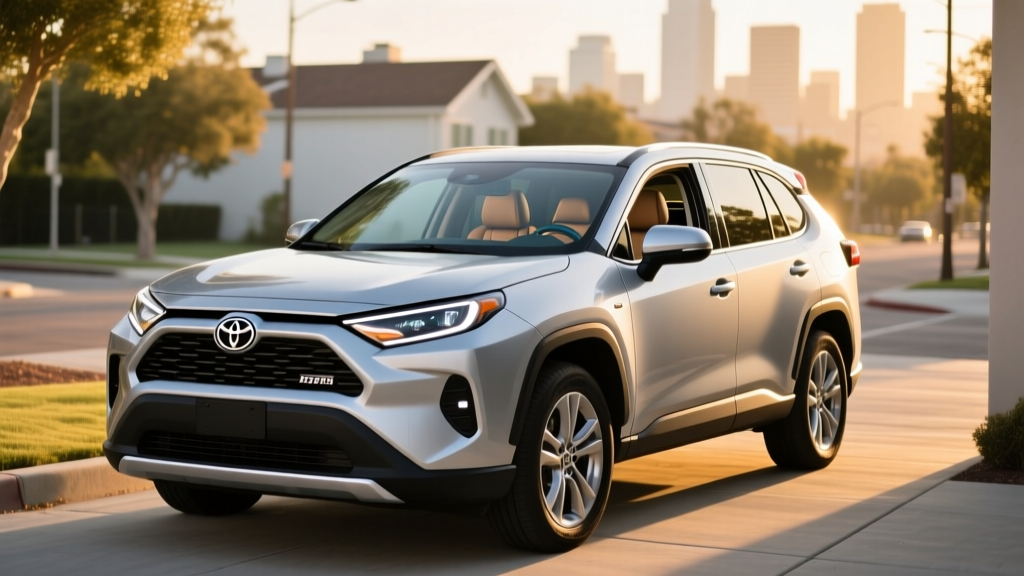
Quick Verdict: The 2020 RAV4 Hybrid Limited Still Punches Above Its Weight
If you're shopping the used hybrid SUV market in 2026, the 2020 Toyota RAV4 Hybrid Limited remains one of the most compelling picks. It delivers an EPA-estimated 41 city / 38 highway / 40 combined MPG, standard all-wheel drive, and a 219-horsepower powertrain — all without ever needing to be plugged in. Now six model years old, the Limited trim holds up thanks to premium features like SofTex upholstery, a heated steering wheel, and Toyota Safety Sense 2.0.
This is a conventional hybrid (HEV), not a plug-in. That distinction matters for buyers cross-shopping the RAV4 Prime (PHEV) or full battery-electric alternatives. Below, we break down the real-world fuel economy, battery longevity, ownership costs, and whether the 2020 RAV4 Hybrid Limited fits your daily driving needs better than a PHEV or BEV.
HEV vs. PHEV: What the 2020 RAV4 Hybrid Actually Is
Conventional Hybrid (HEV) — 2020 RAV4 Hybrid: Charges itself via regenerative braking and the gasoline engine. No plug, no cord, no charging station needed. The small traction battery assists the engine to reduce fuel consumption. You refuel at any gas station.
Plug-In Hybrid (PHEV) — 2020 RAV4 Prime: A larger battery (18.1 kWh) that charges via a plug and delivers ~42 miles of electric-only driving before the gas engine kicks in. Requires home or public charging to maximize benefit.
The 2020 RAV4 Hybrid Limited is firmly in the HEV camp. Its 1.6 kWh nickel-metal hydride (NiMH) traction battery is far too small for meaningful electric-only driving — it exists to buffer energy for acceleration assist and regenerative braking. If you want plug-in capability, you're looking at the RAV4 Prime, which Toyota introduced for the 2021 model year.
Fuel Economy: EPA Ratings and Real-World MPG
| Driving Condition | EPA Estimate | Real-World Expectation |
|---|---|---|
| City | 41 MPG | 40–44 MPG (hybrids often exceed EPA in stop-and-go) |
| Highway | 38 MPG | 34–37 MPG (sustained 70+ mph reduces hybrid advantage) |
| Combined | 40 MPG | 37–41 MPG depending on driving mix |
The RAV4 Hybrid's city-biased fuel economy is a hallmark of Toyota's Hybrid Synergy Drive system. In urban traffic, the electric motor handles low-speed propulsion and the engine shuts off at stops, yielding better city numbers than highway. On a 300-mile highway road trip at 75 mph, expect closer to 34–35 MPG — aerodynamic drag dominates at higher speeds and the hybrid system has less opportunity to recapture energy.
Cold weather also affects fuel economy. In freezing temperatures (below 32°F), expect a 5–10% MPG reduction as the engine runs more frequently to maintain cabin heat and battery temperature. Owners in northern climates typically report winter combined figures around 36–37 MPG.
According to fueleconomy.gov, the 2020 RAV4 Hybrid AWD achieves its 40 MPG combined rating across all trims, including the Limited. Annual fuel cost is estimated at approximately $1,550 based on 15,000 miles and current fuel prices — roughly $600 less per year than the gas-only RAV4 AWD.
Powertrain and Performance Specs
| Specification | 2020 RAV4 Hybrid Limited |
|---|---|
| Engine | 2.5L inline-4 (Dynamic Force) |
| Engine Output | 176 hp / 163 lb-ft torque |
| Front Electric Motor | 118 hp / 149 lb-ft |
| Rear Electric Motor (AWD-i) | 54 hp / 89 lb-ft |
| Net Combined Horsepower | 219 hp |
| Transmission | eCVT (planetary gearset, no fixed gears) |
| Drivetrain | Electronic On-Demand AWD (AWD-i) |
| 0–60 mph | 7.8 seconds (Car and Driver tested) |
| Traction Battery | 1.6 kWh NiMH (sealed, no plug) |
| Towing Capacity | 1,750 lbs |
| Cargo Volume | 37.6 cu ft (rear seats up) / 69.8 cu ft (folded) |
The AWD-i system uses the rear electric motor to power the rear axle when slip is detected or during hard acceleration. There's no mechanical driveshaft connecting the front and rear axles — it's fully electronic. This setup provides competent all-weather traction for snow and rain, though it's not designed for serious off-road use. The 7.8-second 0–60 time is brisk for a compact hybrid SUV, beating the gas-only RAV4 AWD by roughly a full second.
Reliability and Hybrid Battery Longevity
Hybrid Battery Warranty: Toyota covers the hybrid battery and hybrid system components for 10 years / 150,000 miles (whichever comes first) on 2020 models. This warranty is transferable to subsequent owners.
Powertrain Warranty: 5 years / 60,000 miles.
Basic Warranty: 3 years / 36,000 miles.
The 2020 RAV4 Hybrid uses a nickel-metal hydride (NiMH) traction battery, a chemistry Toyota has deployed across millions of hybrids since the original Prius in 1997. NiMH is less energy-dense than the lithium-ion packs in modern EVs and PHEVs, but it has an exceptionally well-documented longevity profile. Failure before 150,000 miles is uncommon.
When replacement is eventually needed, a new OEM hybrid battery from Toyota costs approximately $2,500–$3,500 including labor at a dealership. Refurbished or aftermarket NiMH modules are available for $1,200–$1,800 installed. Independent hybrid-specialty shops can often replace individual battery modules rather than the entire pack, reducing costs further.
Toyota's 10-year/150,000-mile hybrid warranty on the 2020 model year provides coverage through at least 2030 for the original owner. For used buyers, verify remaining warranty coverage by checking the in-service date with a Toyota dealer using the VIN.
2020 RAV4 Hybrid Limited: Pricing and Tax Credits
The 2020 RAV4 Hybrid Limited originally carried an MSRP of approximately $38,170 (including destination). In the 2026 used market, clean-title examples with 50,000–80,000 miles typically sell for $24,000–$29,000 depending on condition, mileage, and region.
Federal tax credit eligibility: The 2020 RAV4 Hybrid does not qualify for the federal §30D clean vehicle credit. That credit applies only to plug-in electric vehicles (BEVs and PHEVs) with sufficient battery capacity. Conventional hybrids like this one are excluded under current IRS rules.
The used EV credit (§25E, up to $4,000) also does not apply, as it requires the vehicle to be a qualified plug-in electric drive vehicle. Your cost savings with the RAV4 Hybrid come entirely from reduced fuel consumption, not tax incentives.
Who Should Choose the RAV4 Hybrid vs. a PHEV or Full EV?
Choose the 2020 RAV4 Hybrid (HEV) if:
- You lack access to home or workplace charging (apartment, street parking, no garage)
- You want maximum simplicity — no plugs, no charging apps, no range planning
- Your budget is under $30,000 and you want a proven, reliable compact SUV
- You drive a mix of city and highway and want consistent MPG without behavior changes
Choose the RAV4 Prime (PHEV) if:
- You can install a Level 2 charger at home and most daily trips are under 42 miles
- You want electric-only commuting with gas-engine flexibility for road trips
- You're willing to pay a used-market premium ($35,000–$42,000 for 2021–2022 models)
Choose a full EV (e.g., Tesla Model Y, Hyundai Ioniq 5) if:
- You have reliable home charging and want to eliminate gasoline entirely
- You want lower per-mile energy costs (~$0.04–$0.06/mile on electricity vs. ~$0.10–$0.12/mile on gas for the hybrid)
- You qualify for the §30D federal tax credit (up to $7,500 for new EVs, income and sourcing rules apply)
Pros and Cons
Pros
- 40 MPG combined with no plug-in requirement — true fill-up-and-go convenience
- 219 hp provides confident highway merging and passing
- Standard AWD-i handles snow and rain without driver intervention
- Limited trim includes premium features: SofTex seats, heated steering wheel, JBL audio, panoramic moonroof
- 10-year/150,000-mile hybrid battery warranty (transferable)
- Strong resale value — Toyota hybrid demand remains high
Cons
- No electric-only driving mode; always burns gasoline
- No federal or state tax credit eligibility for conventional hybrids
- eCVT produces a droning engine note under hard acceleration
- Towing capacity limited to 1,750 lbs (gas RAV4 can tow 1,500 lbs; competitors like the CR-V Hybrid similar)
- Infotainment system feels dated by 2026 standards (no wireless CarPlay on 2020 model)
- Used Limited examples command a premium — harder to find under $25,000 with low miles
Frequently Asked Questions
How many MPG does the 2020 Toyota RAV4 Hybrid Limited get?
The EPA rates it at 41 city / 38 highway / 40 combined MPG. In real-world driving, most owners report 37–41 MPG combined, with city driving often exceeding the EPA estimate and sustained highway driving falling slightly below.
Does the 2020 RAV4 Hybrid need to be plugged in?
No. The 2020 RAV4 Hybrid is a conventional hybrid (HEV). It charges its own battery through regenerative braking and the gasoline engine. You simply fill it with regular unleaded gasoline at any station.
How far can it drive on electric power alone?
Effectively zero miles in any practical sense. The 1.6 kWh NiMH battery assists the engine during acceleration and enables brief engine-off coasting, but it cannot propel the vehicle at meaningful speeds on electricity alone. If electric-only range is a priority, look at the RAV4 Prime PHEV (42 miles electric-only).
Is the hybrid battery reliable, and what does replacement cost?
Toyota's NiMH hybrid batteries have an outstanding reliability record, with many lasting well beyond 150,000 miles. The 2020 model carries a 10-year/150,000-mile hybrid battery warranty. If replacement is needed after warranty, expect $2,500–$3,500 for a new OEM battery or $1,200–$1,800 for a refurbished unit installed at an independent shop.
Does the 2020 RAV4 Hybrid qualify for any tax credit?
No. Federal tax credits under §30D (new clean vehicles) and §25E (used clean vehicles) apply only to plug-in electric vehicles — battery-electric vehicles (BEVs) and plug-in hybrids (PHEVs). Conventional hybrids like the RAV4 Hybrid are not eligible. Check your state's incentive programs, as a few states offer modest rebates for hybrids, though most have shifted incentives toward plug-in vehicles.
How does the 2020 RAV4 Hybrid compare to the gas-only RAV4?
The hybrid gets roughly 10 MPG more combined (40 vs. 30 MPG for the gas AWD model), produces 16 more horsepower (219 vs. 203), and accelerates to 60 mph about a second faster. The trade-off is a higher purchase price — expect to pay $2,000–$4,000 more for a comparable used hybrid vs. gas model, which typically pays back in fuel savings within 3–4 years at 15,000 miles/year.
Is the 2020 RAV4 Hybrid Limited a good buy in 2026?
Yes, if you want a no-compromise hybrid SUV without plug-in requirements. The Limited trim's premium features, combined with Toyota's hybrid reliability and strong resale values, make it one of the safest used-SUV purchases in the $25,000–$30,000 range. The main risk is paying too much for a high-mileage example — prioritize vehicles under 80,000 miles with documented maintenance history and remaining hybrid warranty coverage.