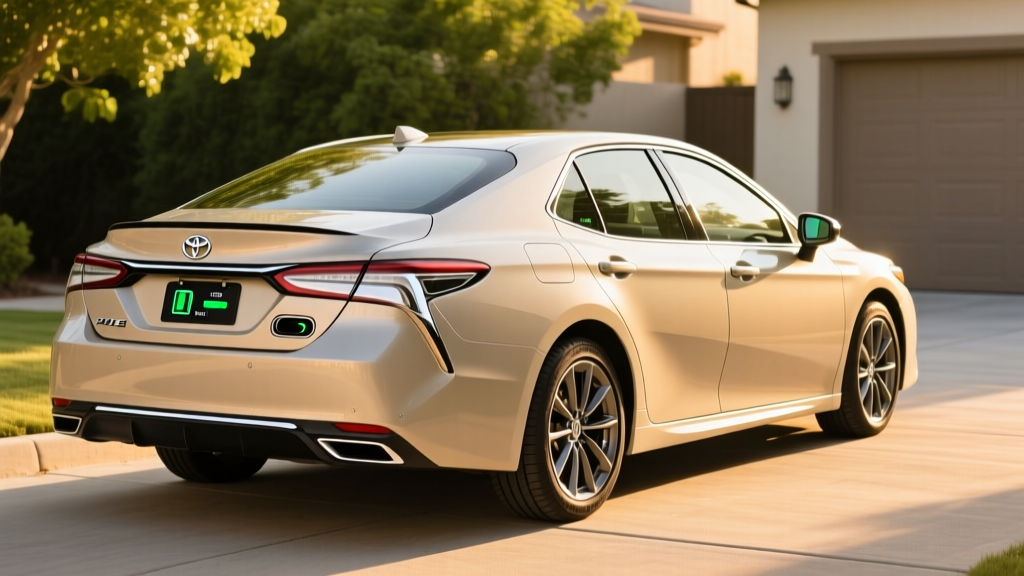
Quick Verdict: The 2020 Camry Hybrid XLE in 2026
The 2020 Toyota Camry Hybrid XLE remains one of the most compelling used midsize sedans for buyers who want hybrid efficiency without plugging in. With an EPA-rated 44 MPG combined, a proven 2.5-liter Dynamic Force engine paired with Toyota's Hybrid Synergy Drive, and a hybrid battery warranty that often outlasts the original ownership period, this HEV (conventional hybrid electric vehicle) is a low-risk, high-reward choice. In 2026, used examples typically list between $18,000 and $24,000 depending on mileage and condition — a significant discount from its original MSRP of roughly $32,000.
This guide covers everything a prospective buyer needs: exact EPA fuel economy, real-world MPG observations, the hybrid battery's expected lifespan and replacement cost, how the XLE trim compares to other Camry Hybrid trims, and whether this HEV fits your needs better than a plug-in hybrid (PHEV) or a full battery-electric vehicle (BEV).
HEV vs. PHEV: What the Camry Hybrid Actually Is
Before diving into specs, it's critical to distinguish the two hybrid architectures on the market, because confusion here leads to buyer regret.
Conventional Hybrid (HEV) — This Car
The 2020 Camry Hybrid XLE is a conventional hybrid. It has a small traction battery (approximately 1.6 kWh usable, nickel-metal hydride) that recharges exclusively through regenerative braking and the gasoline engine. You never plug it in. There is no electric-only driving range beyond brief low-speed assists. The electric motor supplements the gas engine to reduce fuel consumption, but the car cannot operate as a pure EV for any meaningful distance.
Plug-In Hybrid (PHEV) — Not This Car
A PHEV like the Toyota RAV4 Prime or Chrysler Pacifica Hybrid carries a much larger battery (typically 14–20 kWh), charges via a wall outlet or public charger, and delivers 25–42 miles of electric-only range before the gas engine kicks in. Toyota did not offer a Camry PHEV in the U.S. market for the 2020 model year. If you want plug-in capability in a Toyota sedan, you'd need to look at a different model or a later year.
Bottom line: The 2020 Camry Hybrid XLE is an HEV. No charging cable. No electric-only range. Just excellent fuel economy from a self-charging system.
Fuel Economy: EPA Ratings and Real-World MPG
The 2020 Camry Hybrid XLE carries slightly different EPA ratings than the lighter LE and SE trims because the XLE adds weight from its premium interior, larger 18-inch wheels (on some builds), and additional sound insulation.
| Trim | City MPG | Highway MPG | Combined MPG |
|---|---|---|---|
| LE | 51 | 53 | 52 |
| SE | 44 | 47 | 46 |
| XLE | 44 | 47 | 44 |
Source: fueleconomy.gov
The LE's 52 MPG combined is exceptional — among the highest of any non-plug-in midsize sedan. The XLE drops to 44 combined, still outstanding, primarily due to its heavier curb weight and, on certain configurations, larger wheel-and-tire packages that increase rolling resistance.
Real-World MPG vs. EPA Sticker
Hybrids like the Camry often exceed their EPA city rating in stop-and-go traffic because regenerative braking recovers energy that a conventional car wastes as heat. In real-world driving:
- City driving: Expect 44–50 MPG in the XLE — some owners report touching the LE's 51 MPG figure on gentle commutes.
- Highway driving: Expect 40–45 MPG at 70–75 mph. Hybrids lose their advantage at sustained high speed because the electric motor contributes less and aerodynamic drag dominates.
- Cold weather (below 30°F): Expect a 5–12% drop. The engine runs more often to generate cabin heat, reducing the hybrid system's efficiency advantage.
- Combined mixed driving: Most owners land between 42–47 MPG, consistent with the EPA's 44 combined estimate.
With a 13.2-gallon fuel tank, the XLE delivers approximately 540–620 miles of total range per fill-up in mixed conditions — enough for most drivers to visit a gas station once every two weeks.
Powertrain and Performance Specs
The 2020 Camry Hybrid uses Toyota's fourth-generation Hybrid Synergy Drive, pairing a 2.5-liter inline-four (the Dynamic Force A25A-FXS engine) with an electric motor-generator and an electronically controlled continuously variable transmission (eCVT).
| Engine | 2.5L inline-4 (A25A-FXS), Atkinson cycle |
| Engine Horsepower | 176 hp @ 5,700 rpm |
| Engine Torque | 163 lb-ft @ 3,600–5,200 rpm |
| Electric Motor Output | 88 kW (118 hp) |
| Net Combined Horsepower | 208 hp |
| Transmission | eCVT (planetary gearset) |
| Traction Battery | ~1.6 kWh, Nickel-Metal Hydride (NiMH) |
| Drivetrain | Front-wheel drive |
| 0–60 mph | ~7.5 seconds |
| Curb Weight (XLE) | ~3,572 lbs |
| Fuel Tank | 13.2 gallons |
The 208 combined horsepower is competitive with the non-hybrid Camry's 203-hp four-cylinder, but the hybrid delivers torque more smoothly thanks to the electric motor's instant response off the line. The 0–60 time of roughly 7.5 seconds is adequate for merging and passing — this is not a performance sedan, but it never feels underpowered in daily driving.
The eCVT is not a belt-driven CVT like those in some competitors. Toyota's planetary gearset design is mechanically simple, with fewer wear components, contributing to the drivetrain's well-documented longevity.
XLE Trim: What You Get for the Money
The XLE sits near the top of the 2020 Camry Hybrid lineup (above LE and SE), emphasizing comfort and technology. Key XLE-specific features include:
- Leather-trimmed seats with heated front seats
- 9-inch touchscreen with Apple CarPlay, Android Auto, and Amazon Alexa
- JBL premium audio system (9 speakers, available with navigation)
- Blind Spot Monitor with Rear Cross-Traffic Alert
- Smart Key with push-button start and wireless phone charging (available)
- 18-inch alloy wheels (dark gray metallic finish)
- Dual-zone automatic climate control
- Toyota Safety Sense P (TSS-P): pre-collision system, lane departure alert, automatic high beams, full-speed-range dynamic radar cruise control
Notably, the 2020 model year added Apple CarPlay and Android Auto to the Camry lineup, addressing a common complaint from earlier years. However, the 2020 Camry does not include a native Wi-Fi hotspot or the updated Toyota Safety Sense 2.0 (which arrived on the 2021 refresh).
Hybrid Battery: Lifespan, Warranty, and Replacement Cost
For any used hybrid buyer, the traction battery is the single biggest unknown. Here's what the data tells us about the Camry Hybrid's battery.
Toyota Hybrid Battery Warranty
Toyota warrants the hybrid battery in the 2020 Camry Hybrid for 10 years or 150,000 miles (whichever comes first) in most states. In California and states that follow CARB (California Air Resources Board) emissions standards, the warranty extends to 10 years / 150,000 miles as well, with additional emissions component coverage. This warranty transfers to subsequent owners, meaning a 2020 model purchased used in 2026 still has factory hybrid battery coverage through the 2030 model year or 150,000 miles.
Real-World Battery Longevity
Toyota's NiMH hybrid batteries in the Camry and Prius lines have a demonstrated track record of lasting 150,000–200,000+ miles with normal use. The 2020 model uses a relatively small 1.6 kWh pack that operates within a conservative state-of-charge window (roughly 40–80%), which reduces stress on the cells and slows degradation. Unlike a full EV battery that cycles deeply, the Camry's hybrid battery experiences shallow, frequent cycles — a regime that NiMH chemistry handles well.
Failures before 100,000 miles are rare. When they do occur, they're typically covered under warranty. The most common age-related issue is a gradual reduction in electric-motor assist, which manifests as slightly lower MPG rather than a sudden failure.
Replacement Cost
If the hybrid battery does need replacement out of warranty:
- New OEM battery (Toyota dealer): $2,500–$4,000 including labor
- Refurbished/remanufactured battery: $1,500–$2,500 including labor
- Individual module replacement: $500–$1,200 (some independent hybrid specialists can replace only the degraded cells within the pack)
For a 2020 model with typical mileage of 60,000–90,000 miles in 2026, the remaining factory warranty makes an out-of-pocket battery replacement unlikely during your ownership.
Pricing, Tax Credits, and Total Cost of Ownership
Used Market Pricing (2026)
The 2020 Camry Hybrid XLE originally carried an MSRP of approximately $32,330 (before destination). In the 2026 used market, expect to pay:
- 60,000–80,000 miles: $20,000–$24,000
- 80,000–120,000 miles: $17,000–$20,000
- Above 120,000 miles: $14,000–$17,000
Prices vary by region, condition, accident history, and dealer vs. private-party sale.
Tax Credit Eligibility
The 2020 Camry Hybrid XLE is a conventional HEV — it does not qualify for the federal §30D new clean vehicle credit or the §25E used clean vehicle credit. Both credits require the vehicle to have a plug (PHEV or BEV) and meet battery sourcing, MSRP, and buyer income requirements per current IRS guidelines.
Some states previously offered rebates for conventional hybrids, but most have shifted incentive funding to plug-in vehicles. Check your state's energy office or AFDC incentive database for any remaining local programs, but plan your purchase assuming no tax credit or rebate.
Five-Year Ownership Cost Estimate
Assuming a purchase price of $21,000, 15,000 miles/year, and $3.30/gallon regular unleaded:
- Annual fuel cost: ~$1,125 (at 44 MPG combined)
- 5-year fuel cost: ~$5,625
- Comparable gas-only midsize sedan (30 MPG): ~$8,250 over 5 years
- Fuel savings vs. gas car: ~$2,625 over 5 years
Insurance, maintenance (oil changes, tires, brakes), and depreciation are additional. Hybrid brake pads often last 80,000+ miles due to regenerative braking reducing mechanical brake wear — a frequently overlooked savings.
Reliability and Safety
The 2020 Camry Hybrid benefits from Toyota's strong reliability reputation and a mature powertrain that was in its third generation by this model year. The 2.5L Dynamic Force engine and eCVT have been in production since 2018 with minimal design changes, meaning most early-production issues were resolved before the 2020 build year.
Safety ratings are excellent:
- NHTSA: 5-Star Overall Safety Rating — NHTSA 2020 Camry
- IIHS: Top Safety Pick (with specific headlight configurations)
The standard Toyota Safety Sense P suite provides forward collision warning with pedestrian detection, lane departure alert with steering assist, and full-speed adaptive cruise control — features that were optional or unavailable on many competitors at this price point.
Who Should Choose the 2020 Camry Hybrid XLE?
Decision Framework: Is This the Right Electrified Car for You?
Choose the Camry Hybrid XLE (HEV) if:
- You cannot charge at home (apartment, street parking, no garage outlet)
- You want 40+ MPG without changing your refueling habits
- You drive 12,000–20,000 miles/year and want to minimize fuel costs
- You prefer a proven, low-risk powertrain with strong resale value
- Your budget is $18,000–$24,000 for a reliable used sedan
Consider a PHEV instead if:
- You have home charging access (Level 1 or Level 2)
- Your daily commute is under 30 miles round-trip (a PHEV can cover this on electricity alone)
- You want to reduce gasoline use further while keeping road-trip flexibility
- You're eligible for the §25E used clean vehicle credit (up to $4,000 on qualifying used PHEVs/BEVs)
Consider a full EV (BEV) if:
- You have reliable home Level 2 charging
- Your daily driving is under 200 miles and you rarely take road trips over 300 miles
- You want zero tailpipe emissions and minimal maintenance (no oil changes, no exhaust system)
- You're eligible for the §30D or §25E federal tax credit on a new or used EV
Pros and Cons
Pros
- 44 MPG combined EPA — real-world often matches or exceeds in city driving
- 540+ mile total range per tank eliminates range anxiety entirely
- Hybrid battery warranty (10 yr / 150,000 mi) likely still active on 2020 models
- Proven powertrain with excellent reliability track record
- Strong safety ratings (NHTSA 5-star, IIHS Top Safety Pick)
- XLE premium features: leather, JBL audio, heated seats, TSS-P safety suite
- No charging infrastructure needed — refuels at any gas station in 3 minutes
- Regenerative braking extends brake pad life significantly
Cons
- No electric-only driving range — still 100% gasoline-dependent
- No federal or state tax credit eligibility (HEV, not PHEV/BEV)
- XLE MPG (44 combined) trails the LE trim (52 combined) noticeably
- Infotainment system is dated by 2026 standards — no wireless CarPlay, no native Wi-Fi
- eCVT drone under hard acceleration (common to all Toyota hybrids)
- Not eligible for HOV lane stickers in most states (reserved for PHEVs/BEVs)
- Rear seat does not fold flat in Hybrid trims due to battery placement (limited cargo flexibility)
Frequently Asked Questions
How many MPG does the 2020 Toyota Camry Hybrid XLE get?
The EPA rates the XLE trim at 44 city / 47 highway / 44 combined MPG. In real-world driving, most owners achieve 42–47 MPG in mixed conditions, with city driving sometimes exceeding the EPA estimate thanks to regenerative braking. Highway-only driving at 75+ mph typically yields 40–43 MPG.
Does the 2020 Camry Hybrid need to be plugged in?
No. The 2020 Camry Hybrid is a conventional hybrid (HEV), not a plug-in hybrid (PHEV). The battery charges itself through regenerative braking and the gasoline engine. There is no charging port and no electric-only driving range. You refuel it exactly like a standard gasoline car.
How far can the 2020 Camry Hybrid go on a full tank?
With a 13.2-gallon fuel tank and 44 MPG combined, expect approximately 540–580 miles of total range per tank in mixed driving. Gentle city driving at the EPA's 44 city rating could push this toward 600+ miles. This is one of the longest ranges of any midsize sedan, hybrid or otherwise.
Is the 2020 Camry Hybrid reliable, and what does a battery replacement cost?
Yes. Toyota's hybrid powertrain is among the most reliable in the industry, with the 2.5L Dynamic Force engine and eCVT having a proven track record since 2018. The hybrid battery is warrantied for 10 years / 150,000 miles, and real-world data shows these packs routinely lasting 150,000–200,000+ miles. If replacement is ever needed out of warranty, expect $2,500–$4,000 for a new OEM battery or $1,500–$2,500 for a refurbished unit.
Does the 2020 Camry Hybrid qualify for any tax credit?
No. The federal §30D new vehicle credit and §25E used vehicle credit both require a plug-in vehicle (PHEV or BEV). Since the Camry Hybrid is a conventional HEV with no plug, it does not qualify for any federal EV tax credit. Some states previously offered hybrid rebates, but most have ended. Check the AFDC state incentive database for any remaining local programs.
Hybrid vs. PHEV vs. EV — which should I choose?
If you lack home charging access, the Camry Hybrid (HEV) is the right call — you get 44+ MPG with zero behavior change. If you can charge at home and your commute is under 30 miles, a PHEV like the RAV4 Prime lets you drive on electricity daily while keeping a gas engine for road trips. If you have Level 2 home charging, drive under 200 miles daily, and want the lowest operating cost and zero tailpipe emissions, a full BEV like the Hyundai Ioniq 6 or Tesla Model 3 is worth considering — especially with available tax credits.
What's the difference between the Camry Hybrid XLE and LE trims?
The LE is the efficiency leader at 52 MPG combined, with a lighter curb weight, smaller 16-inch wheels, and a cloth interior. The XLE trades 8 MPG combined for a premium experience: leather seats, heated front seats, JBL audio, blind spot monitoring, 18-inch wheels, and a more refined ride. If maximum fuel economy is your priority, the LE is the better choice. If comfort and features matter more, the XLE justifies the MPG trade-off.