Quick Verdict: The Midsize Hybrid Benchmark
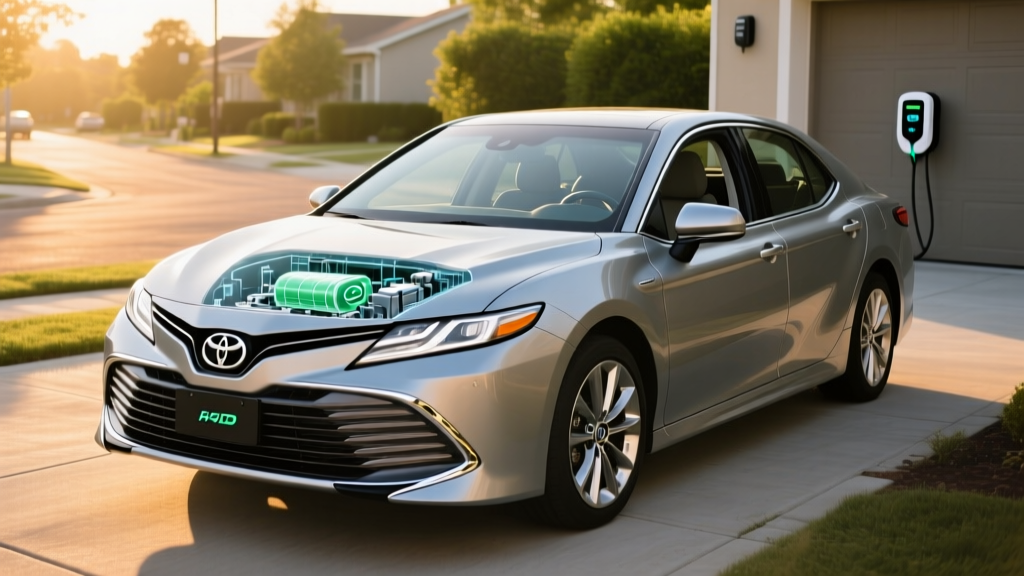
The 2020 Toyota Camry Hybrid remains one of the most efficient midsize sedans ever sold in the United States, with an EPA-estimated 52 MPG combined on the LE trim. Six years after its debut, it continues to be a top pick on the used market for buyers who want EV-like city efficiency without ever plugging in. With 208 combined horsepower, a proven nickel-metal hydride (NiMH) battery pack, and Toyota's 10-year/150,000-mile hybrid battery warranty, the Camry Hybrid delivers a compelling case for conventional hybrid ownership — especially for drivers who lack access to home charging.
This is a conventional hybrid (HEV), not a plug-in hybrid (PHEV). It generates all its electricity through regenerative braking and its gasoline engine. You will never plug it in. If you're looking for electric-only driving, you'd need a PHEV like the Toyota Prius Prime or a full battery-electric vehicle (BEV). We'll cover that decision framework below.
2020 Camry Hybrid Fuel Economy: EPA vs. Real World
| Trim | City MPG | Highway MPG | Combined MPG |
|---|---|---|---|
| LE | 51 | 53 | 52 |
| SE / XLE | 44 | 47 | 46 |
The LE trim's 52 MPG combined is exceptional for a midsize sedan — only the Hyundai Ioniq Hybrid and the Toyota Prius beat it in the non-plug-in segment. The SE and XLE trims drop to 46 combined due to larger 18-inch wheels, a sport-tuned suspension, and additional weight from premium features.
Based on owner-reported data from fueleconomy.gov and long-term fleet testing, expect the LE to deliver 48–54 MPG in mixed driving. Hybrids often exceed their EPA city estimates in stop-and-go traffic because regenerative braking recovers energy that gas cars waste as heat. Highway cruising at 75+ MPH tends to pull figures down to the low-to-mid 40s. In cold weather (below 30°F), expect a 5–10% reduction as the engine runs more frequently to maintain cabin heat and battery temperature.
With a 13.2-gallon fuel tank, the LE trim offers a theoretical range of 686 miles per tank. Real-world drivers regularly report 550–630 miles between fill-ups in mixed driving — enough for most commuters to visit the gas station once every two to three weeks.
Powertrain: How the Hybrid System Works
| Engine | 2.5L 4-cylinder Atkinson-cycle |
| Engine Output | 176 hp / 163 lb-ft torque |
| Electric Motor | Permanent-magnet synchronous (88 kW / 118 hp) |
| Combined Net Horsepower | 208 hp |
| Transmission | Electronic CVT (eCVT) — planetary gearset |
| Drivetrain | Front-wheel drive (AWD-e available on LE/SE) |
| 0–60 mph | ~7.5 seconds (FWD), ~7.1 seconds (AWD-e) |
| Hybrid Battery | 1.6 kWh NiMH (sealed, not plug-in) |
| Towing Capacity | Not rated for towing |
Toyota's Hybrid Synergy Drive pairs the 2.5L Atkinson-cycle engine with an electric motor through a planetary gearset that functions as a continuously variable transmission. Unlike belt-driven CVTs found in some competitors, Toyota's eCVT has no belts or pulleys — it's a gear-based power-split device that's proven extremely durable. There are no traditional friction clutch packs to wear out.
The AWD-e models (available on LE and SE trims for 2020) add a 40 kW (54 hp) rear electric motor that engages automatically during acceleration and low-traction conditions up to 43 MPH. This system has no mechanical driveshaft connecting the front and rear axles — it's purely electric all-wheel drive, and it costs you only 1 MPG combined versus the FWD LE.
HEV vs. PHEV vs. BEV: Which Powertrain Fits You?
| Factor | HEV (Camry Hybrid) | PHEV (e.g., Prius Prime) | BEV (e.g., Tesla Model 3) |
|---|---|---|---|
| Plug-in Required? | No | Yes (for EV range) | Yes (always) |
| Electric-Only Range | None (EV mode ~1 mi at low speed) | 25 mi (2020 Prius Prime) | 250–358 mi |
| Total Range | ~686 mi | ~640 mi | 250–358 mi |
| Home Charging Needed? | No | Recommended | Essential |
| Federal Tax Credit (New) | None | Up to $7,500 (§30D) | Up to $7,500 (§30D) |
| Used EV Credit (§25E) | Not eligible | Up to $4,000 | Up to $4,000 |
| Best For | No home charger, long highway miles | Short commute + home charger | Home charger + daily <250 mi |
- Choose the Camry Hybrid if: You don't have reliable access to a Level 2 home charger, you drive a mix of city and highway miles, you want minimal maintenance, or you regularly take road trips exceeding 300 miles without wanting to plan charging stops.
- Choose a PHEV instead if: Your daily commute is under 25 miles round-trip, you can charge at home overnight, and you want to drive mostly on electricity while keeping a gas engine for longer trips.
- Choose a full BEV instead if: You have home charging, your daily driving is under 250 miles, you want the lowest per-mile fuel cost, and you're ready to plan DC fast-charging stops on road trips.
Battery Longevity, Warranty & Replacement Cost
Toyota covers the 2020 Camry Hybrid's battery with a 10-year / 150,000-mile warranty (whichever comes first) in all 50 states. This was an upgrade from the prior 8-year/100,000-mile coverage that applied to 2019 and earlier models. The warranty covers battery capacity loss below a defined threshold and any manufacturing defects.
The 2020 Camry Hybrid uses a 1.6 kWh nickel-metal hydride (NiMH) battery pack located beneath the rear seat. Unlike the larger lithium-ion packs in PHEVs and BEVs, this small battery is designed for frequent shallow charge-discharge cycles rather than deep cycling. Toyota's hybrid system keeps the battery in a narrow state-of-charge window (roughly 40–80%), which dramatically reduces degradation.
Real-world longevity data: Toyota hybrid batteries have an excellent track record. Fleet data and owner reports show most Camry and Prius hybrid batteries last well beyond 150,000 miles. Failures before 100,000 miles are uncommon. The most common failure mode is gradual capacity loss rather than sudden failure, which manifests as slightly reduced fuel economy over time rather than a non-starting vehicle.
Replacement cost: If the battery fails outside of warranty, a new OEM replacement from a Toyota dealer typically runs $2,500–$4,000 including labor. Refurbished or aftermarket NiMH packs are available for $1,500–$2,500. Individual module replacement (repairing only the failed cells) can cost $500–$1,200 at a hybrid-specialty shop. For context, this is dramatically less than BEV battery replacement, which can exceed $10,000–$20,000.
Pricing & Tax Credit Eligibility
| Trim | Original MSRP (2020) | Typical Used Price (2026)* |
|---|---|---|
| LE | $28,430 | $16,000–$20,000 |
| SE | $29,930 | $17,500–$22,000 |
| XLE | $32,730 | $19,000–$24,000 |
*Used price ranges based on 60,000–90,000 mile examples in good condition, per Kelley Blue Book and CarGurus listings as of early 2026.
Federal tax credits: The 2020 Camry Hybrid is a conventional HEV. It does not qualify for the IRS §30D Clean Vehicle Credit (which applies only to plug-in vehicles — PHEVs and BEVs). It also does not qualify for the §25E Used Clean Vehicle Credit, which similarly requires a plug-in powertrain.
Some states and local utilities offer rebates or incentives for hybrid purchases, but these vary widely by jurisdiction and are more commonly directed at plug-in vehicles. Check your state energy office or utility provider for current programs. Consult a tax professional for personalized guidance on any available incentives.
Reliability, Safety & Ownership Costs
The 2020 Camry Hybrid benefits from Toyota's reputation for long-term reliability, and the hybrid system is one of the most proven in the industry — first introduced in the 1997 Prius and continuously refined since. The eCVT transmission has no belts, friction clutches, or torque converter to fail, and the regenerative braking system reduces wear on the conventional brake pads. Owners commonly report original brake pads lasting 80,000–100,000 miles thanks to regen handling most deceleration.
Safety ratings: The 2020 Camry earned the IIHS Top Safety Pick+ award and a 5-star overall rating from NHTSA (nhtsa.gov). Standard Toyota Safety Sense 2.0 includes pre-collision braking with pedestrian detection, full-speed adaptive cruise control, lane departure alert with steering assist, lane tracing assist, and automatic high beams.
- 52 MPG combined (LE) — best-in-class midsize sedan efficiency
- No plug-in charging required — fill up at any gas station
- 10-year / 150,000-mile hybrid battery warranty
- Proven eCVT powertrain with minimal wear components
- Top Safety Pick+ with standard TSS 2.0 suite
- Strong resale value relative to non-hybrid competitors
- AWD-e option for snow-belt buyers
- No electric-only driving capability (not a PHEV)
- No federal tax credit eligibility (HEV, not plug-in)
- SE/XLE trims drop to 46 MPG combined
- Infotainment system lacks native Apple CarPlay in early 2020 builds (added mid-year)
- Rear battery placement slightly reduces under-floor cargo space vs. gas Camry
- Engine drone under hard acceleration (eCVT characteristic)
Buying a Used 2020 Camry Hybrid in 2026: What to Check
As a six-year-old vehicle, the 2020 Camry Hybrid is entering its best value window. Here's what to verify before purchasing:
- Hybrid battery health: Ask the dealer or seller for a hybrid battery health check report. Toyota dealerships can run a diagnostic that shows battery block voltages and internal resistance. Look for balanced block voltages (within 0.2V of each other).
- Remaining warranty: The 10-year/150,000-mile hybrid battery warranty means a 2020 model is covered until 2030 or 150,000 miles — whichever comes first. Verify the odometer reading and confirm the warranty transfers (it does, automatically, with no paperwork needed).
- Service records: Toyota hybrids don't require special hybrid-system maintenance, but regular oil changes (0W-16 synthetic, every 10,000 miles) and inverter coolant checks matter.
- Brake condition: Regen-heavy driving preserves pads, but the friction brakes can corrode from underuse in warm, humid climates. Check rotors for surface rust or pitting.
- 12V auxiliary battery: Like all modern cars, the Camry Hybrid has a standard 12V battery (located in the trunk) that powers electronics. This is separate from the hybrid traction battery and typically needs replacement every 4–5 years — budget $180–$250 if it's original.
Frequently Asked Questions
How many MPG does the 2020 Toyota Camry Hybrid get?
The LE trim is EPA-rated at 51 city / 53 highway / 52 combined. The SE and XLE trims are rated at 44 city / 47 highway / 46 combined. In real-world driving, city-heavy commutes often return higher-than-EPA numbers thanks to regenerative braking, while sustained highway driving at 75+ MPH may yield the low-to-mid 40s.
Does the 2020 Camry Hybrid need to be plugged in?
No. The Camry Hybrid is a conventional HEV, not a plug-in hybrid. It charges its small 1.6 kWh battery entirely through regenerative braking and the gasoline engine. You will never plug it into a charger. If you want plug-in capability with electric-only range, look at the Toyota Prius Prime (PHEV) or a full BEV.
How long will the hybrid battery last, and what does replacement cost?
Toyota's NiMH hybrid batteries are designed to last the life of the vehicle under normal use. The 2020 model carries a 10-year/150,000-mile hybrid battery warranty (valid through 2030). Real-world data shows most Toyota hybrid batteries exceed 150,000 miles before significant degradation. If replacement is needed out of warranty, expect $2,500–$4,000 for a new OEM pack or $1,500–$2,500 for a refurbished unit.
Does the 2020 Camry Hybrid qualify for any tax credit?
No. As a conventional hybrid (HEV), the Camry Hybrid does not qualify for the federal IRS §30D Clean Vehicle Credit or the §25E Used Clean Vehicle Credit. Both credits require plug-in capability (PHEV or BEV). Some state or utility incentives may apply to hybrids — check your local programs. Consult a tax professional for guidance specific to your situation.
Is the AWD-e system worth it?
If you live in a region with frequent rain or snow, the AWD-e system (available on LE and SE trims) provides meaningful traction benefits. It adds a rear electric motor that engages automatically and only costs 1 MPG combined versus the FWD LE. On dry pavement, you'll never notice it. For buyers in the Sun Belt, FWD is sufficient and slightly more efficient.
How does the Camry Hybrid compare to a full EV for daily commuting?
If you can charge at home and your daily commute is under 50 miles, a BEV will cost significantly less per mile to fuel (roughly $0.04–$0.06/mile on electricity vs. $0.07–$0.09/mile on gasoline at 52 MPG and $3.50/gallon). However, the Camry Hybrid wins on flexibility — no range planning for road trips, no charging infrastructure dependency, and lower upfront cost on the used market. For apartment dwellers or those without home charging access, the Camry Hybrid eliminates the charging-logistics problem entirely.