Quick Verdict: The 2020 Accord Hybrid Touring in Today's Market
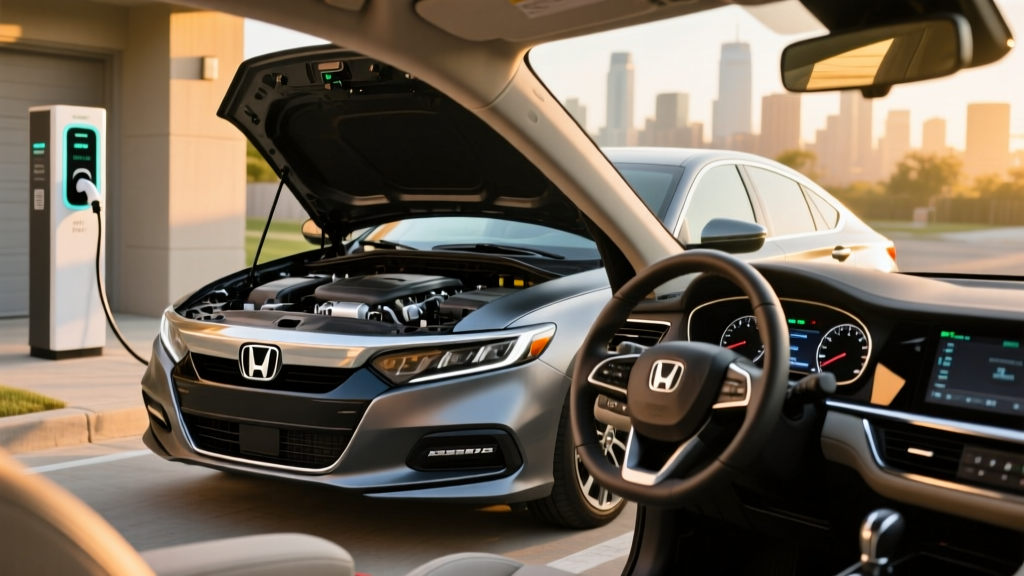
The 2020 Honda Accord Hybrid Touring sits in a rare sweet spot for used-car shoppers in 2026: it's a conventional hybrid (HEV) — not a plug-in — that delivers genuine 40+ MPG in real-world driving without requiring any change to your fueling habits. With the Touring trim, you get Honda's full suite of driver-assistance tech, leather interior, and a premium audio system, all wrapped around a two-motor hybrid powertrain that prioritizes electric-driven acceleration more than most competitors from its era.
As a used purchase in 2026, the Accord Hybrid Touring typically trades between $22,000 and $28,000 depending on mileage and condition. It does not qualify for the federal §30D new-vehicle tax credit (that applies only to new purchases), and as a conventional hybrid, it was never eligible for the plug-in hybrid credit anyway. But its low cost of ownership, strong reliability record, and EPA-rated 48 MPG combined make it a compelling alternative to both used BEVs and newer gas-only sedans.
HEV vs. PHEV vs. EV: Where the Accord Hybrid Fits
Conventional Hybrid (HEV) — like this Accord: No plug. The battery recharges through regenerative braking and the gas engine. You fuel it like a normal car. The electric motor assists acceleration and enables brief low-speed EV driving, but there is no meaningful electric-only range.
Plug-in Hybrid (PHEV): Has a larger battery (typically 10–25 kWh) and a charge port. Offers 25–50 miles of electric-only driving before the gas engine kicks in. Must be plugged in regularly to realize efficiency benefits. May qualify for federal tax credits when purchased new.
Battery Electric Vehicle (BEV): No gas engine. Runs entirely on a large battery pack (60–100+ kWh). Requires home or public charging infrastructure. Zero tailpipe emissions.
The 2020 Accord Hybrid is firmly in the HEV category. Its 1.3 kWh lithium-ion battery pack is far too small to provide plug-in capability or meaningful electric-only range. If you need electric-only commuting, you'd be looking at a PHEV like the Toyota RAV4 Prime or a BEV like the Tesla Model 3. But if you want maximum fuel efficiency with zero lifestyle change — no charging cables, no range planning — the Accord Hybrid is purpose-built for that.
Fuel Economy: EPA Ratings vs. Real-World MPG
| Metric | EPA Rating | Real-World Expectation |
|---|---|---|
| City | 48 MPG | 45–52 MPG (hybrids often beat EPA in city) |
| Highway | 47 MPG | 40–45 MPG (less regen benefit at steady speed) |
| Combined | 48 MPG | 43–49 MPG depending on driving mix |
| Fuel tank | 12.8 gallons | ~540–620 miles per tank |
According to fueleconomy.gov, the 2020 Honda Accord Hybrid (all trims, including Touring) earns an EPA-estimated 48 MPG city / 47 MPG highway / 48 MPG combined. These numbers are among the highest of any midsize sedan from that model year.
How many MPG does this hybrid actually get? Real-world data from owner forums and Fuelly tracking suggests most Accord Hybrid owners report 43–49 MPG combined over thousands of miles. City-heavy commuters sometimes exceed the EPA city rating — Honda's two-motor system is exceptionally efficient in stop-and-go traffic where regenerative braking recaptures energy constantly. Highway-heavy drivers will see numbers closer to 40–43 MPG, especially at speeds above 75 mph where aerodynamic drag dominates.
Cold weather impacts hybrid efficiency less severely than it impacts EVs, but expect a 3–5 MPG drop in winter months due to reduced battery efficiency and increased engine idling for cabin heat. This is far less punishing than the 20–30% range loss a BEV experiences in freezing temperatures.
Powertrain Specs: Two-Motor Hybrid System
| Specification | 2020 Accord Hybrid Touring |
|---|---|
| Engine | 2.0L Atkinson-cycle 4-cylinder |
| Engine HP / Torque | 143 hp / 129 lb-ft |
| Electric Motor HP | 181 hp (drive motor) |
| Combined System Output | 212 hp |
| Transmission | Electronic CVT (e-CVT, no physical gears) |
| Hybrid Battery | 1.3 kWh lithium-ion (NMC chemistry) |
| Drivetrain | Front-wheel drive |
| 0–60 mph | ~6.7 seconds |
| Curb Weight | ~3,399 lbs |
Honda's hybrid system in the 10th-generation Accord operates differently from Toyota's planetary-gear hybrid synergy drive. In most driving conditions, the gas engine acts solely as a generator, producing electricity that feeds the 181-hp drive motor. The engine only mechanically connects to the wheels via a lock-up clutch at sustained highway speeds (roughly 45–80 mph) where direct mechanical drive is more efficient.
The result is a driving feel closer to an EV than a traditional hybrid — the electric motor handles the vast majority of acceleration events, delivering smooth, linear torque from a stop. The 212 combined horsepower and 232 lb-ft of combined torque give the Accord Hybrid Touring respectable passing power, and the 0–60 time of approximately 6.7 seconds is only marginally slower than the 1.5T turbo gas Accord.
Touring Trim: What You Get at the Top
The Touring was the range-topping trim for the 2020 Accord Hybrid, and it came fully loaded with no additional option packages available. Key Touring-exclusive or Touring-standard features include:
- Honda Sensing suite: adaptive cruise control with low-speed follow, lane-keeping assist, road departure mitigation, collision mitigation braking (SAE Level 2 driver-assist — driver must remain engaged)
- Navigation with 8-inch Display Audio touchscreen
- Premium audio: 10-speaker, 452-watt system
- Heated and ventilated front seats, heated rear seats, heated steering wheel
- Wireless phone charging pad
- LED headlights with auto high-beam
- Rain-sensing wipers
- Low Speed Braking Control and front/rear parking sensors
- 19-inch alloy wheels (unique to Touring Hybrid)
The original MSRP for the 2020 Accord Hybrid Touring was $36,240 (including destination). In 2026, used examples with 50,000–80,000 miles typically list between $22,000 and $28,000, representing strong value retention for a six-year-old hybrid sedan.
Battery Warranty, Reliability, and Replacement Cost
Original Hybrid Battery Warranty: 8 years / 80,000 miles (10 years / 150,000 miles in California Air Resources Board [CARB] states including CA, CT, ME, MD, MA, NJ, NY, OR, RI, VT, WA)
Powertrain Warranty: 5 years / 60,000 miles
For a 2020 model in 2026: The 8-year/80k-mile battery warranty has expired for most vehicles (6 years elapsed, likely 60k+ miles). However, in CARB states, the 10-year/150k-mile warranty may still be active through 2030.
Is this hybrid reliable? Honda's two-motor hybrid system has proven highly durable. The 10th-generation Accord Hybrid (2018–2022) has accumulated substantial real-world mileage data, and widespread hybrid battery failures are uncommon. Consumer Reports has generally rated the Accord Hybrid's reliability as average to above-average for its class.
What does battery replacement cost? If the hybrid battery pack does fail outside of warranty, a replacement from Honda typically runs $2,000–$4,000 for the battery module itself, with total installed cost (parts + labor at a dealership) reaching $3,500–$5,500. Independent hybrid specialists and refurbished battery options can reduce this to $1,500–$3,000. For context, the 1.3 kWh pack is far smaller and cheaper to replace than a BEV battery or even a PHEV battery.
The smaller 12V auxiliary battery (standard lead-accent or AGM) will need replacement every 3–5 years at a typical cost of $150–$250 — same as any conventional car.
Tax Credits and Incentives: What Applies in 2026
Does the 2020 Honda Accord Hybrid Touring qualify for any tax credit?
- Federal §30D New Vehicle Credit: No. This credit applies only to new vehicle purchases, and the Accord Hybrid is a conventional HEV — not a plug-in. Even when new, it did not qualify.
- Federal Used EV Credit (§25E): No. This credit (up to $4,000) applies only to used BEVs and PHEVs purchased from a dealer for under $25,000. Conventional hybrids are excluded.
- State incentives: Some states offer hybrid-specific rebates or HOV lane access, but most state incentive programs have shifted focus to plug-in vehicles. Check your state's energy office or AFDC incentive database for current local programs.
The Accord Hybrid's value proposition is purely operational: you save at the pump, not at the tax office. At 48 MPG combined versus a comparable gas Accord 1.5T (33 MPG combined), you'd save approximately $550–$750 per year in fuel costs at 15,000 miles driven annually and $3.50/gallon gasoline, according to fueleconomy.gov's fuel cost calculator.
Who Should Choose the Accord Hybrid vs. an EV or Gas Car?
Choose the 2020 Accord Hybrid Touring if:
- You want 45+ MPG without any charging infrastructure or behavior change
- You drive 12,000–20,000 miles per year and want to minimize fuel spend
- You live in an apartment or lack access to home/workplace charging
- You regularly take long road trips and don't want to plan around charging stops
- You want a loaded midsize sedan with Honda Sensing safety tech for under $28,000
Look at a PHEV instead if:
- You can charge at home and want 25–50 miles of electric-only commuting
- Your daily round-trip commute is under 40 miles (a PHEV could eliminate most gas use)
- You want to qualify for tax credits (when buying new)
Look at a BEV instead if:
- You have reliable home Level 2 charging
- You want zero tailpipe emissions and minimal maintenance
- Your daily driving is under 250 miles and you're comfortable with public DC fast charging for road trips
Pros and Cons
Pros
- 48 MPG combined EPA — among the best of any midsize sedan
- EV-like acceleration feel from the two-motor system
- Touring trim is fully loaded with no add-on packages needed
- Spacious cabin with 16.7 cu ft trunk (hybrid battery doesn't compromise cargo)
- Strong Honda Sensing ADAS suite standard
- Lower battery replacement cost than PHEVs or BEVs
- Excellent real-world reliability track record
Cons
- No electric-only driving range (it's an HEV, not a PHEV)
- No federal or state tax credit eligibility
- e-CVT drone under hard acceleration (engine RPM doesn't match road speed)
- Touring's 19-inch wheels produce a firmer ride than lower trims with 17-inch wheels
- Infotainment system lacks wireless Apple CarPlay/Android Auto (wired only for 2020)
- Original battery warranty likely expired outside CARB states
Frequently Asked Questions
How many MPG does the 2020 Honda Accord Hybrid Touring get?
The EPA rates all 2020 Accord Hybrid trims at 48 city / 47 highway / 48 combined MPG. Real-world owners typically report 43–49 MPG combined, with city-heavy drivers sometimes exceeding the EPA city estimate thanks to aggressive regenerative braking.
Can I plug in the Accord Hybrid to charge it?
No. The 2020 Accord Hybrid is a conventional hybrid (HEV), not a plug-in hybrid (PHEV). It has no charge port. The 1.3 kWh battery recharges exclusively through regenerative braking and the onboard gas engine. You fuel it at a gas station like any other car.
How far can it go on electric only?
The Accord Hybrid can operate in EV mode for very short distances — typically under 1 mile at speeds below 25 mph — but it has no meaningful electric-only range. This is normal for conventional hybrids. If electric-only commuting matters to you, a PHEV like the Toyota Prius Prime (25 miles EV) or Hyundai Tucson PHEV (33 miles EV) would be a better fit.
Is the hybrid battery reliable, and what does replacement cost?
Honda's hybrid battery packs in the 10th-generation Accord have proven durable, with widespread failures being rare at typical mileages. The original warranty was 8 years/80,000 miles (10 years/150,000 in CARB states). If replacement is needed out of warranty, expect $3,500–$5,500 at a dealership or $1,500–$3,000 through an independent hybrid specialist.
Does the 2020 Accord Hybrid qualify for any tax credit?
No. As a conventional hybrid, it was never eligible for the federal plug-in vehicle tax credit. The used EV credit (§25E) also excludes conventional hybrids. Your savings come entirely from reduced fuel consumption — roughly $550–$750/year versus the gas-only Accord at current fuel prices.
How does it compare to the Toyota Camry Hybrid?
The 2020 Camry Hybrid LE is rated at 52 MPG combined (4 MPG better), but the XLE and SE trims drop to 46 MPG. The Accord Hybrid Touring offers more rear legroom (40.4" vs 38.0"), a larger trunk, and a more refined driving experience, while the Camry Hybrid edges it on pure efficiency in the LE trim. Both are strong choices; the Accord wins on space and refinement, the Camry Hybrid LE on peak MPG.
What's the maintenance schedule like?
The Accord Hybrid follows Honda's standard maintenance minder system. Key services include oil changes every 7,500–10,000 miles (the engine runs less frequently than in a gas car, so oil lasts longer), cabin air filter replacement, brake fluid, and transmission fluid. Brake pads often last 80,000+ miles thanks to regenerative braking reducing wear on the friction brakes. There are no hybrid-specific maintenance items beyond periodic system checks.