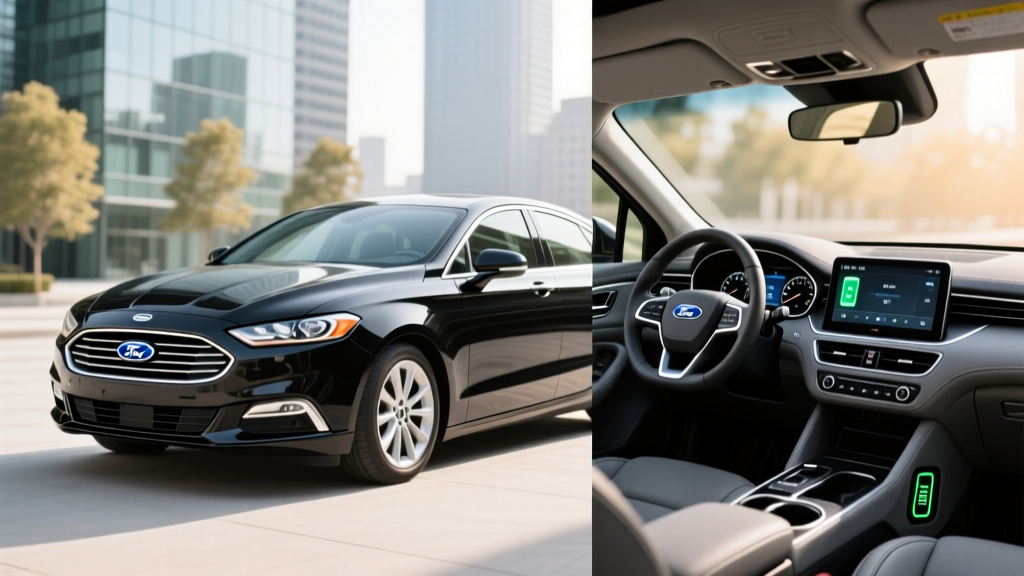
Quick Verdict: A Proven Midsize Hybrid That Punched Above Its Weight
The 2020 Ford Fusion Hybrid SE occupies a specific place in the used-hybrid market: it was the final model year of Ford's midsize sedan before the automaker pivoted entirely to SUVs and trucks. For buyers in 2026 hunting a fuel-efficient daily driver on the used market, the Fusion Hybrid SE remains a compelling option — offering 42 MPG combined, a comfortable cabin, and a hybrid powertrain backed by Ford's long-running hybrid expertise dating back to the 2005 Escape Hybrid.
This guide covers everything you need to evaluate a used 2020 Fusion Hybrid SE: exact EPA fuel economy, real-world MPG expectations, battery longevity, warranty coverage, and how it stacks up against buying a full EV or a conventional gas sedan today.
HEV vs. PHEV: Understanding What the Fusion Hybrid Actually Is
Before diving into specs, it's critical to distinguish between the two electrified Fusion variants Ford sold in 2020:
| Feature | Fusion Hybrid (HEV) | Fusion Energi (PHEV) |
|---|---|---|
| Powertrain type | Conventional hybrid — no plug | Plug-in hybrid — charges from outlet |
| Battery capacity | 1.4 kWh (net usable) | 7.6 kWh usable |
| Electric-only range | Not applicable (EV assist only) | 26 miles EPA |
| Needs to plug in? | No — regenerates via braking & engine | Yes — for EV range benefit |
| EPA combined MPG/MPGe | 42 MPG | 103 MPGe (EV mode) / 42 MPG (hybrid) |
| Federal tax credit (new) | Never eligible | Up to $4,140 (expired for new purchases) |
| DC fast charging | No | No — Level 1/Level 2 only |
This review focuses on the Fusion Hybrid SE (HEV). If you're looking at the Energi plug-in variant, the electric-only range and charging details differ significantly. The conventional Hybrid SE requires no plug, no charging routine, and no behavioral change from a gas car — it simply sips less fuel.
Fuel Economy: EPA Numbers and Real-World MPG
The 2020 Ford Fusion Hybrid SE carries the following official EPA ratings, as confirmed by fueleconomy.gov:
| Driving Cycle | EPA Rating |
|---|---|
| City | 43 MPG |
| Highway | 41 MPG |
| Combined | 42 MPG |
The Fusion Hybrid's 14.1-gallon fuel tank gives it a theoretical range of roughly 590 miles on a fill-up. Real-world mixed driving yields approximately 520–560 miles between stops — still impressive for a midsize sedan.
Powertrain Specs: What's Under the Hood
| Specification | 2020 Ford Fusion Hybrid SE |
|---|---|
| Engine | 2.0L Atkinson-cycle inline-4 |
| Engine output | 141 HP @ 6,000 RPM / 129 lb-ft torque |
| Electric motor | Permanent-magnet AC synchronous, 118 HP / 117 lb-ft |
| Combined system output | 188 HP (net) |
| Transmission | eCVT (electronically controlled continuously variable) |
| Drivetrain | Front-wheel drive |
| 0–60 MPH | ~7.8 seconds (est.) |
| Hybrid battery | 1.4 kWh lithium-ion (net usable capacity) |
| Battery chemistry | NMC (nickel manganese cobalt) |
| Curb weight | ~3,627 lbs |
| Cargo volume | 12.0 cu ft (trunk; battery intrudes slightly vs. gas model) |
The eCVT in the Fusion Hybrid is not a belt-driven CVT like those in some competitors. It uses a planetary gearset to blend engine and motor power — a design Toyota pioneered and Ford licensed, resulting in exceptional durability and smooth power delivery. There are no belts to replace and no traditional transmission fluid changes on the hybrid transaxle at typical intervals.
Battery Warranty, Lifespan, and Replacement Cost
How long does the battery actually last? Ford's hybrid battery packs have a strong track record. The Fusion Hybrid uses a relatively small 1.4 kWh pack that is never deeply cycled — the hybrid system keeps the battery in a narrow state-of-charge window (roughly 30–70%) to minimize stress. This shallow-cycling strategy dramatically extends cell life. Many Ford hybrids from the 2010–2015 era are still running on their original battery packs well past 150,000 miles.
Battery replacement cost: If the battery does fail out of warranty (increasingly rare), a refurbished or new replacement pack for the Fusion Hybrid typically runs between $2,500 and $4,000 including labor at an independent hybrid specialist, or $4,000–$6,000 at a Ford dealer. Given that a 2020 model's hybrid warranty runs through at least 2028, most buyers will enjoy full coverage for several more years.
Pricing and Tax Credit Eligibility in 2026
The 2020 Fusion Hybrid SE originally started at an MSRP of approximately $26,270 (including destination). Well-equipped examples with the optional Driver Assist Package, leather-trimmed seats, and navigation pushed toward $31,000–$33,000.
Used market pricing (2026): Clean-title 2020 Fusion Hybrid SE models with 50,000–80,000 miles typically trade between $14,500 and $19,000 depending on condition, mileage, and region. Low-mileage examples under 30,000 miles may command $20,000+.
Does the 2020 Fusion Hybrid Qualify for Any Tax Credit?
No. Conventional hybrids (HEVs) like the Fusion Hybrid have never qualified for the federal §30D Clean Vehicle Credit. The federal credit applies only to battery electric vehicles (BEVs) and plug-in hybrids (PHEVs) meeting battery-capacity, sourcing, MSRP, and income requirements.
The Fusion Energi (PHEV) did qualify for a partial federal credit when new, but that credit is no longer available for used purchases unless the vehicle meets the separate Used Clean Vehicle Credit (up to $4,000 or 30% of sale price, capped at a $25,000 sale price, subject to income limits and dealer registration requirements). Consult a tax professional to confirm eligibility.
Some states offer their own incentives for hybrid purchases or registrations — check your state's energy or environmental agency for current programs.
Hybrid vs. PHEV vs. Full EV: Which Fits You?
Choose the Fusion Hybrid (HEV) if:
- You lack access to home or workplace charging (apartment, street parking)
- You want maximum fuel efficiency with zero behavioral change
- Your daily commute is under 40 miles of mixed driving
- You want a lower purchase price and proven long-term reliability
Choose a PHEV (like a RAV4 Prime or Prius Prime) if:
- You can charge at home (even a standard 120V outlet works for overnight)
- Your daily driving is under 30–40 miles and you want EV-mode commuting
- You want some electric-only driving but also need road-trip flexibility
Choose a full EV (BEV) if:
- You have reliable Level 2 home charging
- You want to eliminate gasoline entirely and minimize maintenance
- You qualify for federal/state EV tax credits that offset the higher upfront cost
- Your typical trips fit within a 200–300 mile range envelope
Pros and Cons of the 2020 Fusion Hybrid SE
Pros
- 42 MPG combined — excellent for a midsize sedan
- Smooth, quiet hybrid powertrain with no plug-in hassle
- Strong hybrid battery reliability record
- Comfortable ride quality and spacious rear seat
- Ford Co-Pilot360 safety suite (automatic emergency braking, lane keeping, blind-spot monitoring)
- Apple CarPlay and Android Auto standard
- Competitive used-market pricing in 2026
Cons
- Discontinued after 2020 — no new models available; parts availability is fine but will narrow over time
- Trunk space reduced to 12.0 cu ft (battery pack intrusion)
- No all-wheel-drive option
- Modest 188 HP — adequate but not quick for highway merging
- Rear seat does not fold flat (hybrid battery placement)
- Infotainment screen is 8 inches — smaller than current competitors
- No DC fast charging capability (not applicable to HEV, but a limitation vs. PHEV/EV)
Reliability and Safety Ratings
The 2020 Fusion Hybrid benefits from Ford's longest-running hybrid platform, which debuted in the 2013 model year and received continuous refinement through 2020. The 2.0L Atkinson-cycle engine is a naturally aspirated, low-stress design with minimal turbocharger or direct-injection complexity. The eCVT planetary gearset has no wear-prone belts or clutches.
Safety: The 2020 Fusion earned a 5-Star Overall Safety Rating from NHTSA and was an IIHS Top Safety Pick when equipped with specific headlights. Standard Ford Co-Pilot360 includes pre-collision assist with automatic emergency braking, lane-keeping system, auto high-beam headlamps, and a rearview camera. Blind-spot monitoring and rear cross-traffic alert were included on the SE trim.
Common issues to check on a used 2020 model: Some owners have reported minor 12V battery drain if the vehicle sits for extended periods (a common issue across hybrid and non-hybrid vehicles alike). The hybrid system itself has been largely trouble-free across model years. Always verify that the hybrid battery state-of-health (SoH) reads normally via a Ford diagnostic scan during a pre-purchase inspection.
Frequently Asked Questions
How many MPG does the 2020 Ford Fusion Hybrid SE get?
The EPA rates the 2020 Fusion Hybrid SE at 43 MPG city, 41 MPG highway, and 42 MPG combined. In real-world city-heavy driving, many owners report 44–48 MPG thanks to generous regenerative braking. Highway-only driving at higher speeds may yield 37–39 MPG.
Does the Fusion Hybrid need to be plugged in?
No. The Fusion Hybrid is a conventional hybrid (HEV). It charges its small battery entirely through regenerative braking and the gasoline engine. You fuel it like a normal car — just less often.
How long will the hybrid battery last?
Ford's hybrid batteries are designed for shallow cycling and have a strong longevity record. The battery is warranted for 8 years/100,000 miles (10 years/150,000 miles in CARB states). Many Ford hybrids exceed 150,000 miles on the original pack. For a 2020 model, the standard warranty extends through at least 2028 or 100,000 miles.
What does a replacement hybrid battery cost?
Out-of-warranty replacement runs roughly $2,500–$4,000 at an independent hybrid shop or $4,000–$6,000 at a Ford dealer. Refurbished packs are available and are a cost-effective option. However, given the battery's reliability record and remaining warranty coverage on a 2020 model, this is an unlikely expense in the near term.
Does the 2020 Fusion Hybrid qualify for a federal tax credit?
No. The federal §30D Clean Vehicle Credit applies only to plug-in vehicles (BEVs and PHEVs) that meet battery sourcing, MSRP, and buyer income requirements. Conventional hybrids like the Fusion Hybrid are not eligible. Some states may offer separate hybrid incentives — check your local programs.
Is the 2020 Fusion Hybrid SE a good buy in 2026?
Yes, for the right buyer. If you want a proven, no-compromise hybrid sedan with excellent fuel economy, comfortable highway manners, and strong safety ratings — and you don't need plug-in capability — a used Fusion Hybrid SE at $14,500–$19,000 represents solid value. Its main trade-offs are a smaller trunk and the reality that Ford no longer makes the model, which could affect long-term resale value.