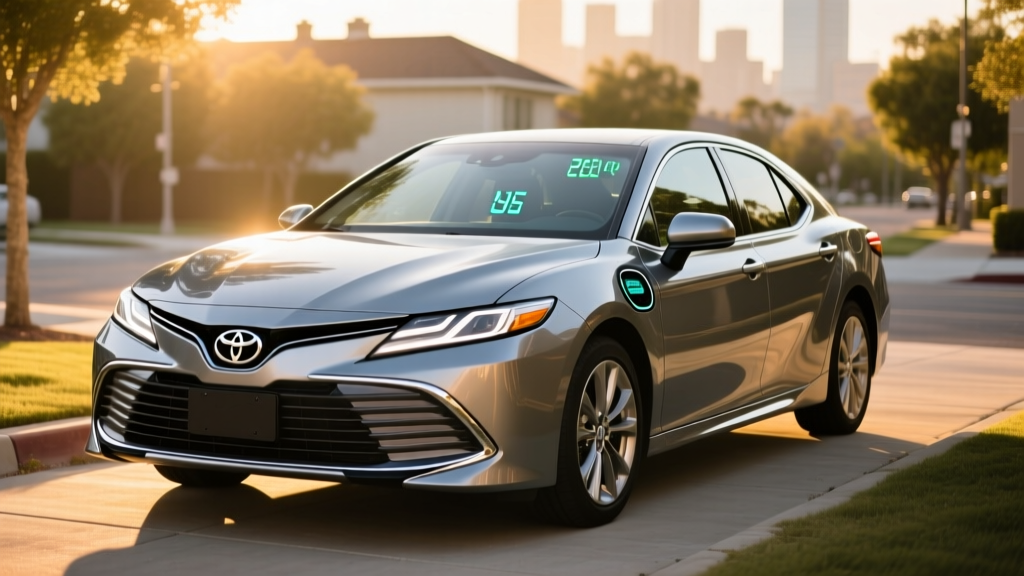
The 2020 Toyota Camry Hybrid remains one of the most efficient midsize sedans ever sold in the United States, and in 2026 it continues to be a strong option on the used-hybrid market. With EPA-estimated fuel economy reaching 52 MPG combined on the LE trim, this conventional hybrid (HEV) delivers exceptional efficiency without requiring a plug, a home charger, or any change in driving habits. Below, we examine the exact EPA numbers, real-world MPG results, battery longevity, ownership costs, and how the 2020 Camry Hybrid stacks up against plug-in hybrids and full EVs.
2020 Camry Hybrid MPG: EPA Ratings by Trim
Not all 2020 Camry Hybrid trims share the same fuel economy. The LE trim achieves the highest EPA numbers thanks to lighter weight and lower-resistance tires, while the SE and XLE trims sacrifice a few MPG for sportier tuning and additional features.
| Trim | City MPG | Highway MPG | Combined MPG | Fuel Tank (gal) | Est. Total Range (mi) |
|---|---|---|---|---|---|
| LE | 51 | 53 | 52 | 13.2 | ~686 |
| SE | 44 | 47 | 46 | 13.2 | ~607 |
| XLE | 44 | 47 | 46 | 13.2 | ~607 |
Source: EPA / fueleconomy.gov
The 7-MPG gap between the LE and the SE/XLE trims is significant. It comes down to wheels (16-inch on the LE vs. 18-inch on the SE/XLE), tire compound, and slight suspension tuning differences. If maximum fuel economy is the priority, the LE is the clear choice.
Real-World MPG: What Owners Actually See
EPA estimates are a useful baseline, but real-world results vary based on driving style, climate, and terrain. The 2020 Camry Hybrid has a well-documented tendency to meet or exceed its EPA city rating in stop-and-go traffic — a characteristic common to Toyota's Hybrid Synergy Drive system, which recovers energy through regenerative braking more effectively at lower speeds.
- City driving (stop-and-go): 48–55 MPG — regenerative braking maximizes efficiency
- Highway (steady 65–70 mph): 45–50 MPG — electric motor assists less at sustained speed
- Cold weather (below 32°F): 40–46 MPG — engine runs more often for cabin heat and battery warming
- Mountainous terrain: 38–44 MPG — elevation changes reduce net efficiency despite regen on descents
Many owners report lifetime averages between 48–54 MPG on the LE trim in mixed driving, consistent with or slightly above the EPA combined estimate.
This cold-weather penalty is worth noting. Unlike a full EV, which can lose 20–30% of range in freezing temperatures, the Camry Hybrid's efficiency drop is more modest — roughly 10–15%. The gasoline engine generates waste heat that warms the cabin without a significant energy penalty, an inherent advantage of hybrids in cold climates.
Powertrain and Performance Specifications
The 2020 Camry Hybrid pairs a 2.5-liter four-cylinder Atkinson-cycle engine with an electric motor and a nickel-metal hydride (NiMH) traction battery. This is a conventional hybrid — it charges its battery through regenerative braking and engine-driven generation. There is no plug, no external charging port, and no electric-only driving mode of any meaningful distance.
| Engine | 2.5L 4-cyl Atkinson-cycle |
| Engine Output | 176 HP / 163 lb-ft torque |
| Electric Motor Output | 118 HP / 149 lb-ft torque |
| Net Combined System HP | 208 HP |
| Traction Battery | 1.6 kWh NiMH (sealed) |
| Transmission | eCVT (planetary gearset) |
| Drivetrain | Front-wheel drive (FWD) |
| 0–60 mph | ~7.5 seconds |
| Curb Weight | ~3,572 lbs (LE) |
The 208 combined horsepower provides confident acceleration for daily driving and highway merging. The eCVT is not a belt-driven CVT — Toyota uses a planetary gearset that seamlessly blends engine and motor power. This design has proven exceptionally durable, with very few reports of transmission-related failures.
HEV vs. PHEV vs. EV: Which Powertrain Fits You?
The 2020 Camry Hybrid is a conventional HEV. Toyota did not offer a Camry plug-in hybrid (PHEV) for the 2020 model year in the United States. If you're cross-shopping, here's how the three electrified powertrain types compare:
| Factor | HEV (e.g., Camry Hybrid) | PHEV (e.g., RAV4 Prime) | BEV (e.g., Tesla Model 3) |
|---|---|---|---|
| Plug-in required? | No | Yes (for EV range) | Yes (always) |
| Electric-only range | ~1 mi at low speed | 25–42 mi typical | 250–350+ mi |
| Home charging needed? | No | Recommended (Level 2) | Essential (Level 2) |
| Fuel cost per mile | ~$0.07 (gas) | ~$0.04 (electric) / ~$0.08 (gas) | ~$0.04 (electric) |
| Maintenance | Oil changes, standard | Oil changes + EV systems | Minimal (no oil, fewer fluids) |
| Federal tax credit (§30D) | No | Yes (if eligible, up to $7,500 on new) | Yes (if eligible, up to $7,500 on new) |
| Best for | No home charging access | Short commute + home charger | Home charger + mostly electric |
- You don't have access to home or workplace charging
- You want maximum simplicity — no plugs, no range planning
- You drive 15,000+ miles/year and want proven reliability
- Your budget is in the $18,000–$26,000 used-car range (2026 market)
- You have a garage or driveway where you can install a Level 2 charger
- Your daily commute is under 30 miles round-trip
- You want to drive mostly on electricity with gas backup for road trips
- You have reliable home Level 2 charging
- You want the lowest per-mile fuel cost and minimal maintenance
- You're buying new and can take advantage of the §30D federal tax credit
Battery Warranty, Lifespan, and Replacement Cost
Battery longevity is the top concern for used-hybrid buyers. The 2020 Camry Hybrid uses a relatively small 1.6 kWh NiMH battery pack — far smaller than an EV's 60–100 kWh pack — and Toyota's hybrid system is engineered to keep the battery within a narrow state-of-charge window (roughly 40–80%), which dramatically reduces degradation stress.
- Coverage: 10 years / 150,000 miles (in states that adopted California's emissions warranty rules, including CA, NY, MA, NJ, CT, RI, VT, ME, MD, OR, WA, CO, and others)
- Federal baseline: 8 years / 100,000 miles (minimum in all states)
- What's covered: Hybrid battery pack, hybrid control module, and related hybrid-system components
- Transferable: Yes — warranty transfers to subsequent owners automatically
Real-world data from fleet operators and high-mileage owners shows that Toyota's NiMH hybrid batteries commonly last 180,000–250,000+ miles before requiring replacement. Many original Prius batteries from the 2004–2009 era are still functional past 200,000 miles.
If replacement is needed out of warranty:
- New OEM battery (Toyota dealer): $3,000–$4,500 installed
- Refurbished/reconditioned battery: $1,500–$2,500 installed
- Aftermarket new battery: $2,000–$3,000 installed
For a 2020 model purchased in 2026 (6 years old), the original hybrid battery warranty is likely still active — either under the 8-year/100,000-mile federal baseline or the 10-year/150,000-mile extended coverage, depending on your state and the vehicle's mileage. Always verify warranty status through a Toyota dealer using the VIN.
Pricing, Tax Credits, and Used Market Value (2026)
The 2020 Camry Hybrid is no longer sold new. On the used market in 2026, pricing varies by trim, mileage, and condition:
| Trim | Original MSRP (2020) | Est. Used Price (2026, ~60K mi) |
|---|---|---|
| LE | $28,430 | $19,000–$22,000 |
| SE | $29,980 | $20,000–$23,500 |
| XLE | $32,730 | $22,000–$26,000 |
Tax Credit Eligibility
Because the 2020 Camry Hybrid is a conventional HEV (not a PHEV or BEV), it does not qualify for the federal §30D Clean Vehicle Credit, which applies only to plug-in electric vehicles. The IRS explicitly excludes conventional hybrids from this credit.
However, if you purchase a used plug-in vehicle (PHEV or BEV) from a dealer, the Used Clean Vehicle Credit (§25E) may provide up to $4,000 or 30% of the sale price (whichever is less), subject to income caps and vehicle price limits. This credit does not apply to the Camry Hybrid either, since it has no plug.
Some states offer separate incentives for hybrids or efficient vehicles, but these vary widely. Check your state's energy office or the Alternative Fuels Data Center for current state-level programs.
Reliability and Safety Ratings
Toyota's hybrid powertrain is among the most proven in the industry. The 2020 Camry Hybrid earned strong marks across the board:
- NHTSA Overall Rating: 5 out of 5 stars (NHTSA)
- IIHS Rating: Top Safety Pick+ (with specific headlight trims)
- J.D. Power Predicted Reliability: Above average for the midsize car segment
Common maintenance items for the 2020 Camry Hybrid at 60,000–100,000 miles include brake fluid flush, coolant replacement, cabin and engine air filters, and tire rotation. The regenerative braking system significantly extends brake pad life — many owners report original brake pads lasting 80,000–120,000 miles.
- Class-leading 52 MPG combined (LE trim)
- No plug-in required — works with any gas station
- Proven reliability with 208 HP system output
- 10-year/150,000-mile hybrid battery warranty (many states)
- Strong safety ratings (NHTSA 5-star, IIHS TSP+)
- ~686 miles of total range per tank (LE)
- Low maintenance costs — brake pads last 80K+ miles
- SE/XLE trims drop to 46 MPG combined
- No plug-in option — cannot drive on electric-only
- FWD only — no AWD available on 2020 Hybrid (AWD Hybrid arrived 2021)
- NiMH battery (not lithium-ion) — slightly heavier
- No federal tax credit eligibility
- Infotainment system feels dated vs. 2025+ competitors
5-Year Ownership Cost Estimate
For buyers evaluating the 2020 Camry Hybrid as a used purchase in 2026, here's a projected 5-year cost assuming 15,000 miles/year and national average fuel prices:
| Category | Annual Cost | 5-Year Total |
|---|---|---|
| Fuel (52 MPG, $3.30/gal avg) | ~$952 | ~$4,760 |
| Insurance (national avg) | ~$1,400 | ~$7,000 |
| Maintenance (oil, filters, tires) | ~$450 | ~$2,250 |
| Repairs (out-of-warranty reserve) | ~$200 | ~$1,000 |
| Depreciation (est. $20K purchase) | ~$1,500 | ~$7,500 |
| Total (excl. financing) | ~$22,510 |
Compared to a similarly aged gas-only midsize sedan averaging 28 MPG combined, the Camry Hybrid saves approximately $1,800–$2,200 in fuel costs over 5 years, depending on local gas prices and driving mix.
Frequently Asked Questions
How many MPG does the 2020 Camry Hybrid get?
The 2020 Camry Hybrid LE achieves an EPA-estimated 51 city / 53 highway / 52 combined MPG. The SE and XLE trims are rated at 44 city / 47 highway / 46 combined. Real-world results for the LE trim typically range from 48–55 MPG in mixed driving.
Does the 2020 Camry Hybrid need to be plugged in?
No. The 2020 Camry Hybrid is a conventional hybrid (HEV). It charges its small 1.6 kWh battery through regenerative braking and the gasoline engine. There is no charging port and no plug-in capability. You fuel it like any other gas car.
Does the 2020 Camry Hybrid qualify for any federal tax credit?
No. The IRS §30D Clean Vehicle Credit applies only to plug-in electric vehicles (PHEVs and BEVs). The Camry Hybrid is a conventional HEV and is not eligible for federal tax credits. Some states may offer separate incentives for fuel-efficient vehicles — check the Alternative Fuels Data Center.
How long will the hybrid battery last, and what does replacement cost?
Toyota's NiMH hybrid batteries commonly last 180,000–250,000+ miles. The 2020 Camry Hybrid carries a hybrid battery warranty of 10 years/150,000 miles in many states (8 years/100,000 miles minimum nationwide). If replacement is needed, expect $1,500–$4,500 depending on whether you choose refurbished, aftermarket, or OEM.
Is the 2020 Camry Hybrid reliable?
Yes. Toyota's Hybrid Synergy Drive is one of the most proven hybrid systems in the world, with over two decades of real-world data. The eCVT planetary gearset has very few failure points. NHTSA gave it 5 stars overall, and IIHS named it a Top Safety Pick+. Common maintenance is limited to standard fluid changes, filters, and tires — with brake pads often lasting over 80,000 miles thanks to regenerative braking.
What's the difference between the 2020 Camry Hybrid and a Camry PHEV?
Toyota did not offer a Camry PHEV in the U.S. for the 2020 model year. A PHEV would offer 25–40 miles of electric-only range and require plug-in charging. The Camry Hybrid is HEV-only — no plug, no electric-only mode, but also no charging infrastructure requirement. If you want a Toyota PHEV, the RAV4 Prime (42 miles EV range) and Prius Prime (25 miles EV range) are the closest alternatives.
Should I buy the 2020 Camry Hybrid or a full EV?
If you lack home charging access or frequently drive long distances in areas with sparse charging infrastructure, the Camry Hybrid is the more practical choice. If you have reliable Level 2 home charging and want the lowest per-mile fuel cost (~$0.04/mile electric vs. ~$0.07/mile gas), a used EV like the Chevrolet Bolt or Tesla Model 3 may save more over time — but at a higher upfront purchase price.