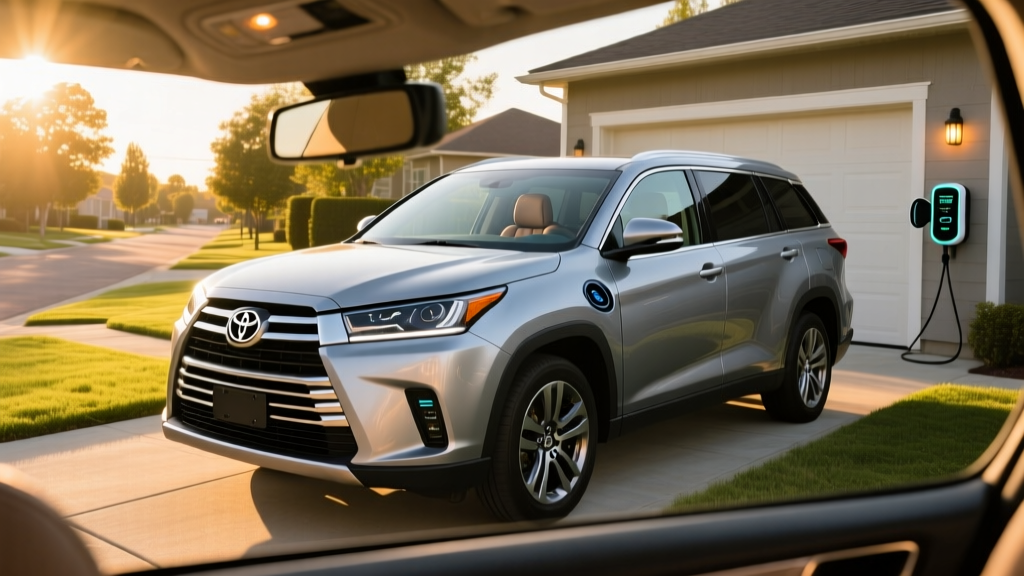
The 2019 Toyota Highlander Hybrid occupies a specific niche: a three-row family hauler that sips fuel without requiring a plug, a charging routine, or any change in driving habits. Toyota sold this generation (2014–2019) with a proven V6 hybrid powertrain that prioritizes reliability and predictable efficiency over flash. In 2026, it remains one of the most common used-hybrid searches — and for good reason. But with newer four-cylinder hybrid Highlanders and a wave of plug-in alternatives now available, does the 2019 model still hold up?
This guide covers the exact EPA figures, real-world MPG you can expect, the hybrid battery's lifespan and replacement cost, and how this conventional HEV stacks up against PHEVs and full EVs for family duty.
HEV vs. PHEV: What the 2019 Highlander Hybrid Actually Is
The 2019 Highlander Hybrid is a conventional hybrid electric vehicle (HEV). It does not plug in. It has no electric-only driving range of any meaningful distance. Its small nickel-metal hydride (NiMH) battery — roughly 1.9 kWh of total capacity — is recharged exclusively through regenerative braking and the gasoline engine.
Conventional Hybrid (HEV) vs. Plug-In Hybrid (PHEV) — Key Differences
| Feature | HEV (2019 Highlander Hybrid) | PHEV (e.g., 2026 RAV4 Prime) |
|---|---|---|
| Plugs in? | No | Yes (Level 1 or Level 2) |
| Battery size | ~1.9 kWh (NiMH) | 18.1 kWh (lithium-ion) |
| Electric-only range | ~0.5 mi at low speed | 42 mi EPA |
| Federal tax credit | None | Up to $7,500 (§30D, if eligible) |
| Fueling | Gasoline only | Gasoline + electricity |
Toyota did not offer a plug-in Highlander in 2019. If you want a Toyota three-row PHEV, you'd need to look at the current-generation Highlander (which still isn't a PHEV as of 2026) or step down to the RAV4 Prime. The 2019 Highlander Hybrid is strictly a gas-and-go proposition.
Fuel Economy: EPA Ratings and Real-World MPG
The 2019 Highlander Hybrid pairs a 3.5-liter V6 engine with front and rear electric motors for a combined system output of 306 horsepower and standard all-wheel drive (AWD-i). Here's what the EPA says, and what you'll actually see:
| Driving Cycle | EPA Rating | Real-World Expectation |
|---|---|---|
| City | 29 MPG | 28–31 MPG (hybrids often exceed EPA in stop-and-go) |
| Highway | 27 MPG | 24–27 MPG (aerodynamic drag and speed hurt hybrid advantage) |
| Combined | 29 MPG | 26–29 MPG |
Source: fueleconomy.gov — 2019 Toyota Highlander Hybrid AWD.
Why real-world can beat EPA in the city: Conventional hybrids recapture energy during braking. Stop-and-go traffic means more regen cycles, which keeps the battery topped up and lets the electric motors shoulder more of the load. On the highway, the V6 runs more often and the hybrid system offers less advantage. Expect roughly 26–27 MPG on a 70-mph road trip, and 30+ MPG in suburban errand-running.
Cold-Weather MPG Note
In sub-freezing temperatures, expect a 5–10% fuel-economy drop (roughly 25–26 MPG combined). The engine runs longer to warm the cabin and catalytic converter, and battery efficiency drops in cold. This is normal for all hybrids and far less severe than the 20–30% range loss EVs experience in winter.
Powertrain and Performance Specs
| Specification | 2019 Highlander Hybrid |
|---|---|
| Engine | 3.5L V6 + 2 electric motors (front/rear) |
| Combined HP | 306 hp |
| Transmission | CVT (eCVT — planetary gearset) |
| Drivetrain | AWD-i (electric rear axle, no mechanical driveshaft) |
| 0–60 mph | ~7.5 seconds |
| Towing capacity | 3,500 lbs |
| Battery type | NiMH (nickel-metal hydride), ~1.9 kWh |
| Seating | 7 or 8 passengers (trim-dependent) |
| Cargo (behind 3rd row) | 13.8 cu ft |
The AWD-i system uses a dedicated rear electric motor rather than a mechanical driveshaft from the engine. This means AWD engagement is instant when traction is needed, but the rear motor's output is modest — this is a confidence-in-rain system, not an off-roader. Towing maxes out at 3,500 lbs, which covers a small boat or utility trailer but not a large camper.
Hybrid Battery Lifespan, Warranty, and Replacement Cost
This is the top concern for any used-hybrid buyer, and it's where the 2019 Highlander Hybrid shines — or at least, where Toyota's track record does.
Factory Hybrid Battery Warranty
Toyota warranted the 2019 Highlander Hybrid battery for 8 years / 100,000 miles (10 years / 150,000 miles in CARB states including California, New York, Massachusetts, and others that follow California emissions standards). As of 2026, a 2019 model is 7 years old — meaning most examples are either still under warranty or just past it, depending on mileage.
Real-world battery longevity: Toyota's NiMH hybrid batteries have a strong track record of lasting 150,000–200,000+ miles before significant degradation. The Highlander Hybrid's battery is relatively small and is never deeply discharged (the system keeps it in a narrow state-of-charge window), which extends cycle life. Failures before 120,000 miles are uncommon.
Replacement cost if it fails:
- New OEM Toyota battery: $3,000–$4,500 installed at a dealership
- Refurbished/remanufactured battery: $1,500–$2,500 installed at an independent hybrid specialist
- Individual module replacement: $500–$1,200 if only a few cells are weak (a hybrid specialist can test and replace individual modules rather than the full pack)
For context, the NiMH pack in the Highlander Hybrid is far cheaper to replace than a full EV lithium-ion battery ($8,000–$20,000+). And because the battery is small, replacement is a 2–3 hour job, not a multi-day lift-out.
Pricing in 2026: Used Market and Tax Credits
The 2019 Highlander Hybrid was offered in LE, XLE, and Limited trims. Original MSRPs ranged from approximately $37,000 (LE) to $48,000 (Limited). In the 2026 used market:
- LE trim (80k–100k miles): $18,000–$22,000
- XLE trim (60k–80k miles): $22,000–$27,000
- Limited trim (50k–70k miles): $25,000–$31,000
Federal tax credit: The 2019 Highlander Hybrid does not qualify for the §30D federal clean vehicle credit. That credit applies only to plug-in vehicles (BEVs and PHEVs) with sufficient battery capacity and compliant sourcing. Conventional HEVs have never been eligible. Some states may offer minor used-vehicle rebates for hybrids, but these are rare and jurisdiction-specific — check your state's energy office or IRS §30D guidelines for current rules.
Who Should Choose the 2019 Highlander Hybrid — and Who Shouldn't
Choose This HEV If…
- You need three rows but can't charge at home (apartment, street parking, no garage)
- You want AWD and 306 hp without a fuel-economy penalty
- You prioritize long-term reliability and low maintenance costs
- Your daily driving is a mix of city and highway (the hybrid system thrives here)
- You tow occasionally (3,500-lb capacity covers light trailers)
Look Elsewhere If…
- You want electric-only driving for school runs and errands (consider a PHEV like the RAV4 Prime or a three-row EV like the Kia EV9)
- You want federal tax-credit savings (only PHEVs and BEVs qualify under §30D)
- You need more than 13.8 cu ft of cargo behind the third row (this generation is tight; the 2020+ redesign added space)
- You drive mostly highway miles (the hybrid advantage shrinks; a diesel or efficient gas SUV may match it)
2019 Highlander Hybrid vs. Newer Alternatives
The 2020 redesign switched the Highlander Hybrid to a 2.5L four-cylinder hybrid system with improved efficiency (35–36 MPG combined) and more cargo room. If budget allows ($30,000+ used), the 2020–2023 models are meaningfully better. But the 2019 V6 model offers more horsepower (306 vs. 243 in the newer four-cylinder) and a smoother, more refined engine note under hard acceleration. It's a trade-off: newer models win on MPG and space; the 2019 wins on power and lower used pricing.
Frequently Asked Questions
How many MPG does the 2019 Toyota Highlander Hybrid get?
The EPA rates it at 29 city / 27 highway / 29 combined. In real-world driving, expect 28–31 MPG in city and suburban use, and 24–27 MPG on sustained highway trips. Cold weather may drop combined MPG to 25–26.
Does the 2019 Highlander Hybrid plug in or have electric-only range?
No. It is a conventional hybrid (HEV), not a plug-in. It cannot be charged from an outlet and has no meaningful electric-only range. It runs primarily on gasoline with electric-motor assist.
Is the hybrid battery reliable, and what does replacement cost?
Toyota's NiMH hybrid batteries commonly last 150,000–200,000+ miles. The factory warranty was 8 years/100,000 miles (10/150,000 in CARB states). If replacement is needed, expect $3,000–$4,500 for a new OEM battery, or $1,500–$2,500 for a refurbished unit from a hybrid specialist.
Does the 2019 Highlander Hybrid qualify for any tax credit?
No. The federal §30D clean vehicle credit applies only to plug-in vehicles (BEVs and PHEVs). Conventional hybrids have never been eligible. Check your state's energy office for any local hybrid incentives, though these are uncommon in 2026.
Hybrid vs. PHEV vs. EV — which is right for a family SUV?
Choose a conventional hybrid (HEV) if you can't charge at home and want maximum simplicity. Choose a PHEV if you can install a Level 2 charger and want 30–40 miles of electric-only driving for daily errands with gas backup for road trips. Choose a full EV if you have reliable home charging, want the lowest per-mile fuel cost, and are comfortable planning longer road trips around DC fast charging. The 2019 Highlander Hybrid is a strong HEV choice; for PHEV or EV three-row options, look at the Toyota RAV4 Prime (two-row) or Kia EV9.
How does the AWD system work on the 2019 Highlander Hybrid?
Toyota's AWD-i uses a separate rear electric motor rather than a mechanical driveshaft. The rear motor engages automatically when the system detects front-wheel slip or during hard acceleration. It's effective for rain, light snow, and gravel, but not designed for serious off-roading.
What's the difference between the 2019 V6 hybrid and the 2020+ four-cylinder hybrid?
The 2019 uses a 3.5L V6 (306 hp combined, 29 MPG). The 2020+ redesign uses a 2.5L four-cylinder (243 hp combined, 35–36 MPG). The newer model is more efficient and roomier; the 2019 is more powerful and less expensive on the used market.