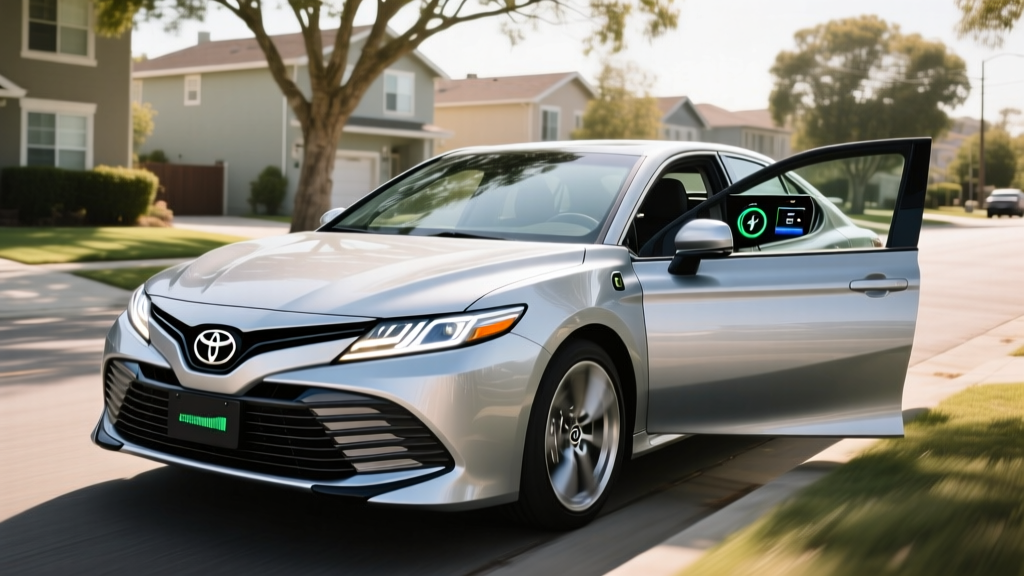
The 2019 Toyota Camry Hybrid sits at a fascinating crossroads in 2026. It's old enough to have depreciated into genuine bargain territory on the used market, yet its fourth-generation hybrid powertrain remains one of the most efficient and reliable systems Toyota has ever built. For buyers weighing a used hybrid against a new EV or a conventional gas sedan, the 2019 Camry Hybrid demands a serious look — not because it's exciting, but because the numbers simply work.
This guide covers everything you need to know: EPA and real-world MPG, the hybrid battery's expected lifespan and replacement cost, what you'll actually pay in 2026, and whether this conventional hybrid (HEV) or a plug-in alternative better fits your driving life.
2019 Toyota Camry Hybrid: Powertrain and Efficiency Specs
Before we get into the driving experience, here are the hard numbers that define this car. The 2019 Camry Hybrid uses Toyota's fourth-generation Hybrid Synergy Drive, pairing a 2.5-liter four-cylinder Atkinson-cycle engine with an electric motor and a compact nickel-metal hydride (NiMH) battery pack.
| Specification | Value |
|---|---|
| Powertrain Type | Conventional Hybrid (HEV) — no plug-in |
| Gas Engine | 2.5L 4-cyl Atkinson-cycle (176 hp / 163 lb-ft) |
| Electric Motor | 88 kW (118 hp) permanent-magnet AC motor |
| Combined Net Horsepower | 208 hp |
| Hybrid Battery | 1.6 kWh NiMH (not plug-in) |
| Transmission | eCVT (planetary gearset, no traditional belts) |
| 0-60 mph | ~7.5 seconds |
| Drivetrain | Front-wheel drive |
| Curb Weight | ~3,472 lbs (LE trim) |
| Trunk Volume | 15.1 cu ft |
Note the distinction: this is a conventional hybrid (HEV), not a plug-in hybrid (PHEV). You never plug it in. The 1.6 kWh battery recharges entirely through regenerative braking and the gas engine. If you're looking for electric-only driving range, you'll need to look at a PHEV like the Toyota Prius Prime or a full BEV.
EPA Fuel Economy and Real-World MPG
The 2019 Camry Hybrid comes in three trims — LE, SE, and XLE — and fuel economy varies slightly by trim due to wheel size and weight differences.
| Trim | City MPG | Highway MPG | Combined MPG |
|---|---|---|---|
| LE | 51 | 53 | 52 |
| SE | 44 | 47 | 46 |
| XLE | 44 | 47 | 46 |
Source: EPA / fueleconomy.gov
The LE trim's 52 MPG combined is one of the highest EPA ratings of any non-plug-in midsize sedan ever sold. In real-world ownership, here's what to expect:
- City driving: Hybrids excel here. Expect 48–55 MPG in stop-and-go traffic, where regenerative braking recovers the most energy and the electric motor handles low-speed propulsion.
- Highway driving: Expect 42–48 MPG at 70–75 mph. The gas engine carries the load at sustained speed, and aerodynamic drag reduces the hybrid advantage.
- Cold weather (below 35°F): Expect a 10–15% drop to roughly 40–46 MPG combined. The engine runs longer to heat the cabin and bring the catalytic converter to operating temperature.
- SE/XLE trims: The larger 18- and 19-inch wheels and stickier tires cost you roughly 6 MPG combined versus the LE. Real-world SE/XLE owners typically report 40–44 MPG combined.
The LE trim's efficiency advantage is substantial. If fuel economy is your primary goal, the LE with its 16-inch wheels and low-rolling-resistance tires is the trim to find.
HEV vs. PHEV vs. Full EV: Which Powertrain Fits You?
A common question from used-car shoppers in 2026: should you buy a conventional hybrid like the 2019 Camry Hybrid, a plug-in hybrid (PHEV), or go fully electric? The answer depends almost entirely on your charging access and daily driving pattern.
| Factor | HEV (Camry Hybrid) | PHEV (e.g., Prius Prime) | BEV (e.g., Tesla Model 3) |
|---|---|---|---|
| Plug-in required? | No | Yes (for EV range) | Yes |
| Electric-only range | None (EV assist only) | 25–44 miles | 250–360 miles |
| Total range | ~600+ miles | ~600+ miles (gas+EV) | 250–360 miles |
| Home charging needed? | No | Recommended (120V or 240V) | Essential (240V Level 2) |
| Fuel cost per mile | ~$0.07–0.09 | ~$0.03–0.08 (varies) | ~$0.03–0.05 |
| Federal tax credit (new) | None | Up to $7,500 (§30D) | Up to $7,500 (§30D) |
| Maintenance | Low (oil changes, no plug) | Low-medium | Minimal |
| Best for | No home charging, long trips | Short commute + home plug | Home L2 charging, daily driving |
- You don't have access to home or workplace charging
- You regularly drive more than 200 miles between fuel stops
- You want EV-like city efficiency without ever thinking about charging
- You're buying used and want to avoid battery degradation concerns tied to larger packs
Look at a PHEV or BEV instead if:
- You can install a Level 2 home charger and your commute is under 40 miles
- You want to minimize or eliminate gasoline use
- You qualify for federal or state EV incentives on a new or used electrified vehicle
Hybrid Battery Lifespan, Warranty, and Replacement Cost
This is the single biggest concern for used hybrid buyers, and it deserves a thorough answer.
Toyota covers the hybrid battery and all hybrid-system components (inverter, control module, electric motor) for 10 years or 150,000 miles from the original date of first use, whichever comes first. In states that adopted California's stricter emissions standards (including CA, NY, MA, and others), hybrid-system coverage may extend to 10 years / 150,000 miles as well, with some components covered to 15 years / 150,000 miles under the emissions warranty.
For a 2019 model in 2026, that means original factory warranty coverage may still be active if the vehicle has fewer than 150,000 miles — check the in-service date on the Carfax.
How long do Camry Hybrid batteries actually last? Toyota's NiMH hybrid batteries have an exceptional track record. Data from fleet operators, taxi services, and high-mileage owners consistently shows these packs lasting 150,000–200,000+ miles before significant capacity loss. The 1.6 kWh pack is small, operates in a narrow state-of-charge window (roughly 40–80% SoC), and is never deep-cycled — all of which dramatically extends cell life. The battery management system also prevents thermal extremes.
Replacement cost if the battery fails out of warranty:
- New OEM battery from Toyota: $2,500–$4,000 (parts + labor at a dealership)
- Refurbished/remanufactured battery: $1,200–$2,200 from aftermarket suppliers
- Individual cell replacement: Some independent hybrid specialists can replace only the failed cells within the pack for $500–$1,000
For context, the hybrid battery in the 2019 Camry Hybrid is far less expensive to replace than a BEV traction battery (which can run $8,000–$20,000+) because it's much smaller and simpler. Most owners will never need a replacement.
2026 Used Pricing and Tax Credit Eligibility
As of early 2026, the 2019 Toyota Camry Hybrid trades on the used market in these approximate ranges:
| Trim | Mileage Range | Approximate Price |
|---|---|---|
| LE | 50,000–70,000 mi | $17,000–$20,500 |
| SE | 50,000–70,000 mi | $18,000–$22,000 |
| XLE | 50,000–70,000 mi | $19,500–$24,000 |
| Any (high mileage) | 90,000–120,000 mi | $13,500–$17,000 |
Does the 2019 Camry Hybrid qualify for any tax credit? No — and this is important to understand.
- Federal §30D New EV Credit: Not applicable. The Camry Hybrid is a conventional HEV with no plug-in capability. It was never eligible for the federal tax credit even when new.
- Used Clean Vehicle Credit (§25E): This credit (up to $4,000 or 30% of sale price) applies only to used plug-in electric vehicles — BEVs and PHEVs with at least 7 kWh of battery capacity. The Camry Hybrid's 1.6 kWh NiMH pack does not qualify.
- State incentives: A small number of states offer modest rebates for used hybrids, but these are rare and vary by jurisdiction. Check your state's energy office or DMV for current programs.
The absence of tax credits is offset by the low purchase price and exceptional fuel economy. At 52 MPG combined (LE), the Camry Hybrid pays for itself through fuel savings alone versus a comparable gas-only midsize sedan.
Driving Experience, Tech, and Daily Practicality
The 2019 Camry Hybrid isn't trying to be a sports sedan, but it's far more composed than the mushy, slow hybrids of the early 2010s. The 208 combined horsepower is adequate for merging and passing, and the eCVT delivers seamless, gear-hunt-free acceleration. Toyota's hybrid system transitions between electric-only, gas, and combined power so smoothly that most passengers won't notice the switches.
Technology and safety:
- Toyota Safety Sense P (TSS-P): Standard on all trims — includes pre-collision braking with pedestrian detection, lane departure alert with steering assist, automatic high beams, and full-speed adaptive cruise control. This is a strong safety suite for a 2019 vehicle.
- Infotainment: A 7-inch or 8-inch touchscreen (depending on trim) with Apple CarPlay standard. No Android Auto — Toyota didn't add it until the 2020 model year. This is a notable gap for Android users.
- Safety ratings: The 2019 Camry earned a 5-star overall rating from NHTSA and a Top Safety Pick+ designation from IIHS when equipped with specific headlights.
Practicality notes:
- Trunk space is 15.1 cu ft — competitive with the gas Camry, as the hybrid battery sits under the rear seat rather than intruding on cargo space.
- Rear seat room is generous, fitting two adults comfortably on long trips.
- The fuel tank holds 13.2 gallons, giving the LE trim a theoretical range of roughly 686 miles per tank — though 580–620 miles is more realistic before the low-fuel warning.
Total Cost of Ownership: 5-Year Estimate
Here's how the 2019 Camry Hybrid stacks up on running costs over five years, assuming 12,000 miles/year and a national average gas price of $3.30/gallon:
| Cost Category | 5-Year Estimate |
|---|---|
| Purchase Price (avg.) | $19,000 |
| Fuel (60,000 mi @ 52 MPG, $3.30/gal) | $3,808 |
| Insurance (avg. national) | $7,500–$9,000 |
| Maintenance (oil, filters, brakes, tires) | $2,200–$3,000 |
| Estimated Repairs | $500–$1,200 |
| Depreciation (5-year hold) | $5,500–$7,000 |
| Total Estimated 5-Year Cost | $38,500–$43,000 |
For comparison, a similar-age gas-only 2019 Camry LE (rated at 29 MPG combined) would cost roughly $7,448 in fuel over the same 60,000 miles — nearly double the hybrid's fuel spend. The hybrid's modest purchase premium pays back within 2–3 years of typical driving.
Pros and Cons
Pros
- Class-leading 52 MPG combined (LE trim) — real-world city MPG often exceeds EPA
- Proven, ultra-reliable Toyota hybrid system with 10yr/150k-mi battery warranty
- No charging infrastructure required — works for apartment dwellers
- Standard Toyota Safety Sense P (adaptive cruise, AEB, lane assist)
- Strong resale value; Camry Hybrids hold value well
- Comfortable ride, spacious rear seat, usable 15.1 cu ft trunk
- Low maintenance costs (regenerative braking extends pad life significantly)
Cons
- No Android Auto (Apple CarPlay only)
- SE and XLE trims sacrifice 6 MPG for larger wheels — LE is the efficiency pick
- No electric-only driving range — this is not a PHEV
- No federal or state tax credits available
- eCVT drone under hard acceleration (common to Toyota hybrids)
- Dated infotainment interface by 2026 standards
- All-wheel drive not available (AWD-e debuted on 2020 model year)
Frequently Asked Questions
How many MPG does the 2019 Toyota Camry Hybrid get?
The LE trim achieves an EPA-rated 51 city / 53 highway / 52 combined MPG. The SE and XLE trims are rated at 44 city / 47 highway / 46 combined. In real-world driving, the LE often exceeds 50 MPG in city traffic and delivers 42–48 MPG on the highway.
Does the 2019 Camry Hybrid need to be plugged in?
No. This is a conventional hybrid (HEV), not a plug-in hybrid. The small 1.6 kWh battery charges through regenerative braking and the gas engine. You fuel it exactly like a regular car — just less often.
How far can it drive on electric power alone?
The 2019 Camry Hybrid can operate on electric-only power for very short distances (roughly 0.5–1 mile) at low speeds (under 25 mph), typically in parking lots or heavy stop-and-go traffic. It is not designed for meaningful electric-only range. If you want 25+ miles of EV driving, look at a PHEV like the Toyota Prius Prime or a full BEV.
Is the 2019 Camry Hybrid reliable? What if the hybrid battery fails?
Yes — Toyota's hybrid systems are among the most reliable powertrains in the automotive industry. The hybrid battery is covered by a 10-year/150,000-mile warranty from the original in-service date. For a 2019 model, that factory coverage may still be active in 2026 depending on mileage. Out-of-warranty replacement costs $1,200–$4,000 depending on whether you choose refurbished or new OEM. Most packs last 150,000–200,000+ miles.
Does the 2019 Camry Hybrid qualify for any tax credit?
No. The federal §30D credit applies only to plug-in electric vehicles (BEVs and PHEVs). The used-vehicle credit (§25E) also requires a plug-in vehicle with at least 7 kWh of battery capacity. The Camry Hybrid's 1.6 kWh NiMH pack makes it ineligible for both. Some states may offer small incentives for hybrids — check your state's energy office.
How does the Camry Hybrid compare to a Prius?
The 2019 Prius achieves 52–56 MPG combined (similar to the Camry Hybrid LE) but offers less power (121 hp combined vs. 208 hp), less interior space, and a hatchback body style. The Camry Hybrid is the better choice if you need a traditional sedan with more passing power and a more comfortable ride. The Prius wins on maximum efficiency and cargo versatility.
Should I buy a 2019 Camry Hybrid or a used EV?
If you have reliable home Level 2 charging and your daily driving is under 200 miles, a used BEV (like a 2019–2021 Tesla Model 3 or Chevrolet Bolt) will cost less per mile to operate and may qualify for the $4,000 used-EV tax credit. If you lack home charging, frequently take long road trips, or want to minimize upfront cost and complexity, the 2019 Camry Hybrid is the more practical choice.