Quick Verdict: Still a Benchmark Midsize Hybrid
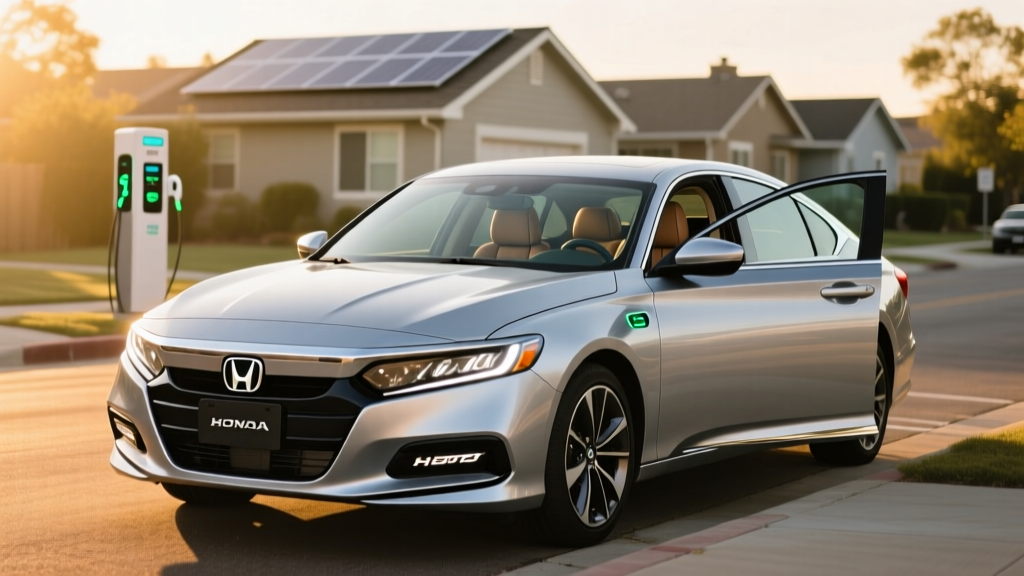
The 2019 Honda Accord Hybrid Touring remains one of the most complete midsize hybrid sedans on the used market in 2026. Honda's two-motor hybrid system delivers an EPA-rated 48 MPG combined, a premium Touring trim loaded with Honda Sensing safety tech and leather, and a powertrain that prioritizes electric-motor drive feel over the rubber-band sensation of older CVTs. For buyers who want near-EV efficiency without plug-in infrastructure or range anxiety, this Accord Hybrid is a compelling used-car target — provided you verify battery health and understand what the Touring trim actually gets you over lower trims.
Powertrain & Driving Character
Honda's Intelligent Multi-Mode Drive (i-MMD) system in the 2019 Accord Hybrid is unlike most competitor hybrid setups. Rather than using a planetary gearset like Toyota's Hybrid Synergy Drive, Honda employs two electric motors and a clutch-based system that operates in three modes:
- EV Drive: The battery powers the propulsion motor directly — used at low speeds and light loads.
- Hybrid Drive: The 2.0L Atkinson-cycle engine generates electricity via a generator motor, which feeds the propulsion motor. The engine is not mechanically connected to the wheels.
- Engine Drive: At steady highway speeds, a lock-up clutch connects the engine directly to the front wheels for maximum efficiency.
| Specification | Value |
|---|---|
| Engine | 2.0L Atkinson-cycle inline-4 |
| Engine Output | 143 hp / 129 lb-ft torque |
| Propulsion Motor | 181 hp / 232 lb-ft torque |
| Combined System Output | 212 hp |
| Transmission | Electronic CVT (e-CVT, no traditional gears) |
| Drivetrain | Front-wheel drive |
| Hybrid Battery | 1.3 kWh lithium-ion (located under rear seats) |
| 0–60 mph | ~6.7 seconds |
| Curb Weight | ~3,300 lbs |
The result on the road is a driving feel closer to an EV than most hybrids. Off the line, the 232 lb-ft of instant electric torque gives the Accord Hybrid confident acceleration, and the engine only audibly engages under hard throttle demands. At highway cruise, the direct-drive clutch mode avoids the efficiency losses of a traditional e-CVT, contributing to strong highway MPG.
Fuel Economy: EPA Ratings vs. Real-World MPG
The EPA rates the 2019 Accord Hybrid (all trims, including Touring) at:
| Cycle | EPA Rating |
|---|---|
| City | 48 MPG |
| Highway | 47 MPG |
| Combined | 48 MPG |
Source: fueleconomy.gov
Compared to the non-hybrid 2019 Accord 1.5T (EPA 30/38/33 MPG), the Hybrid Touring delivers roughly a 45% improvement in combined fuel economy — translating to approximately 200 fewer gallons per year at 15,000 miles, or roughly $600–$800 in annual fuel savings depending on local gas prices.
Touring Trim: What You Get at the Top
The Touring was the most expensive trim in the 2019 Accord Hybrid lineup, carrying an original MSRP of $34,990 (including destination). Here is what the Touring adds over the next-lower EX-L Hybrid:
- Full Honda Sensing suite (standard on all trims, but Touring adds low-speed braking control)
- Adaptive cruise control with low-speed follow
- Lane keeping assist and road departure mitigation
- Navigation system with 8-inch touchscreen
- Wireless phone charging pad
- Heated rear seats (front heated seats standard on EX-L)
- Heated steering wheel
- Rain-sensing wipers
- Front and rear parking sensors
- Auto-dimming side mirrors
- 450-watt premium audio with 10 speakers and subwoofer
In 2026, expect a well-maintained 2019 Accord Hybrid Touring with 60,000–90,000 miles to trade between $18,000 and $23,000 depending on condition, mileage, and regional demand. The Touring commands a $1,500–$2,500 premium over EX-L and Sport trims.
Battery Warranty, Lifespan & Replacement Cost
Hybrid battery longevity is the top concern for used-hybrid buyers, and it is worth examining in detail.
Real-world battery degradation: Honda's lithium-ion hybrid battery in the 10th-gen Accord has proven durable. The battery is relatively small (1.3 kWh) and the i-MMD system manages charge cycles conservatively, keeping the state of charge in a narrow middle band to minimize stress. Owner reports of full hybrid battery failure on 2018–2022 Accord Hybrids are rare. When failures do occur, they typically manifest as reduced fuel economy and a dashboard warning rather than a sudden no-start condition.
Replacement cost: A new OEM hybrid battery from Honda runs approximately $2,000–$3,000 installed at a dealership. Independent hybrid specialists and refurbished battery options can bring the cost down to $1,200–$2,000. This is significantly less than a full EV battery replacement and is comparable to a major service event like a timing chain or transmission rebuild on a conventional car.
Tax Credits & Incentives: What Applies in 2026
Because the 2019 Accord Hybrid is a conventional HEV (not a plug-in), it does not qualify for the federal §30D New Clean Vehicle Credit — that credit applies only to new plug-in vehicles (BEVs and PHEVs) meeting battery sourcing and MSRP requirements. It also does not qualify for the federal Used Clean Vehicle Credit (§25E), which is limited to used BEVs and PHEVs priced under $25,000.
Some states offer modest incentives for conventional hybrids, but these vary widely and change frequently. Check your state's energy office or department of environmental quality for current programs. A few states historically offered hybrid tax credits or HOV lane access, though most have sunset these as EV incentives have taken priority.
Reliability & Safety Ratings
The 2019 Accord Hybrid benefits from the same strong reliability record as the broader 10th-generation Accord platform. Key reliability points:
- Consumer Reports has generally rated the Accord Hybrid as "Better Than Average" to "Much Better Than Average" for predicted reliability across the 2018–2022 model years.
- NHTSA awarded the 2019 Accord a 5-Star Overall Safety Rating across frontal, side, and rollover crash tests (nhtsa.gov).
- IIHS named the 2019 Accord a Top Safety Pick+ when equipped with LED headlights (standard on Touring trim), earning "Good" ratings across all crashworthiness tests and a "Superior" rating for front crash prevention.
Common issues reported by owners at higher mileages include:
- Infotainment system lag and occasional Apple CarPlay disconnection (software-related, sometimes resolved with firmware updates)
- Road noise at highway speeds (a known Accord trait, not hybrid-specific)
- 12V battery drain if the car sits for extended periods (common in all modern vehicles with parasitic draw)
Accord Hybrid vs. PHEV vs. Full EV: Which Fits You?
| Factor | HEV (This Accord) | PHEV (e.g., Toyota RAV4 Prime) | BEV (e.g., Tesla Model 3) |
|---|---|---|---|
| Plug Required? | No | Yes (optional but recommended) | Yes (mandatory) |
| Electric-Only Range | 0 miles (EV mode at low speed only) | 25–42 miles typical | 250–350+ miles |
| Fuel/Charging Cost | Gas only (~$0.10–0.14/mi) | Gas + electricity (~$0.04–0.08/mi on electric) | Electricity only (~$0.03–0.06/mi) |
| Home Charging Needed? | No | Recommended for full benefit | Yes — Level 2 strongly recommended |
| Maintenance | Standard ICE maintenance | Standard ICE maintenance | Minimal (no oil, fewer fluids) |
| Upfront Cost (Used) | Lowest | Moderate | Highest |
| Federal Tax Credit | None | None (used HEV/PHEV) | Up to $4,000 used EV credit (§25E) |
| Best For | No home charging, high-mileage commuters | Home charging + short daily commutes | Home charging + willingness to plan road trips |
- You lack reliable access to home or workplace charging
- You drive 15,000+ miles per year and want to minimize fuel costs without behavioral change
- You want a proven, low-risk powertrain with widely available service
- You value a loaded premium trim (Touring features) at a sub-$25K used price
- You have Level 2 charging at home and a commute under 35 miles (PHEV could eliminate most gas use)
- You want to qualify for the federal used EV tax credit (up to $4,000 under §25E for qualifying used BEVs/PHEVs)
- You want to eliminate tailpipe emissions entirely and your daily driving fits within BEV range
Pros & Cons
- 48 MPG combined — real-world often matches or exceeds
- EV-like acceleration feel from 232 lb-ft electric torque
- Touring trim is genuinely loaded (heated rear seats, nav, premium audio)
- Top Safety Pick+ with excellent crash ratings
- Spacious cabin with 16.7 cu-ft trunk (hybrid battery doesn't eat cargo space)
- Proven reliability with affordable battery replacement if needed
- No electric-only driving range — it's a gas car with excellent efficiency
- No federal or most state tax credits for used HEV purchase
- Infotainment system feels dated by 2026 standards (no wireless CarPlay)
- Noticeable road noise on coarse pavement
- Hybrid battery warranty has mostly expired on 2019 models
- CVT drone under hard acceleration (though less than older hybrids)
Frequently Asked Questions
How many MPG does the 2019 Honda Accord Hybrid Touring get?
The EPA rates it at 48 city / 47 highway / 48 combined MPG. Real-world reports cluster around 44–50 MPG combined, with city-heavy drivers often exceeding the EPA rating and highway-only drivers at 75+ mph seeing 40–44 MPG. Cold weather can reduce economy by 3–5 MPG.
Does the 2019 Accord Hybrid need to be plugged in?
No. The Accord Hybrid is a conventional hybrid (HEV), not a plug-in hybrid (PHEV). It charges its 1.3 kWh battery through regenerative braking and the gasoline engine. You never plug it in — you simply refuel with gasoline like any other car.
What is the hybrid battery replacement cost?
A new OEM hybrid battery from Honda costs approximately $2,000–$3,000 installed. Refurbished or aftermarket options range from $1,200–$2,000. Full battery failure is uncommon on this generation; most units last well beyond 150,000 miles with normal use.
Is the 2019 Accord Hybrid reliable?
Yes. The 10th-generation Accord Hybrid has earned above-average reliability scores from Consumer Reports and holds a strong reputation among hybrid owners. The i-MMD system has fewer wear components than a traditional automatic transmission (no torque converter, no gear shifts), and Honda's 2.0L Atkinson-cycle engine is lightly stressed.
Does the 2019 Accord Hybrid qualify for any tax credit?
No federal tax credit applies. The §30D New Clean Vehicle Credit and §25E Used Clean Vehicle Credit both require plug-in vehicles (BEVs or PHEVs). As a conventional HEV, the Accord Hybrid is ineligible for federal EV incentives. Some states may offer minor hybrid incentives, but these vary by jurisdiction and change frequently — check your state's energy office for current programs.
How does the Accord Hybrid compare to the Toyota Camry Hybrid?
The 2019 Camry Hybrid XLE is rated at 46 combined MPG (EPA), slightly below the Accord's 48. The Accord Hybrid delivers more power (212 hp vs. 208 hp), a larger trunk, and a more EV-like driving feel due to Honda's series-hybrid-dominant architecture. The Camry Hybrid offers available all-wheel drive (introduced for 2020), which the Accord lacks. Both are excellent choices; the Accord edges ahead on driving dynamics and interior space, while the Camry offers AWD availability.
What should I check before buying a used 2019 Accord Hybrid?
Request a pre-purchase inspection that specifically includes hybrid battery state-of-health (SoH) diagnostics via Honda's HDS scan tool. Check for any open recalls (particularly fuel pump and software-related recalls that affected 2018–2020 Accords). Verify maintenance records, especially for the cabin air filter and engine air filter, which affect hybrid system cooling. Confirm whether the vehicle was registered in a CARB state, as this may extend hybrid battery warranty coverage to 10 years / 150,000 miles.