Quick Verdict: The 2019 Highlander Hybrid in 2026
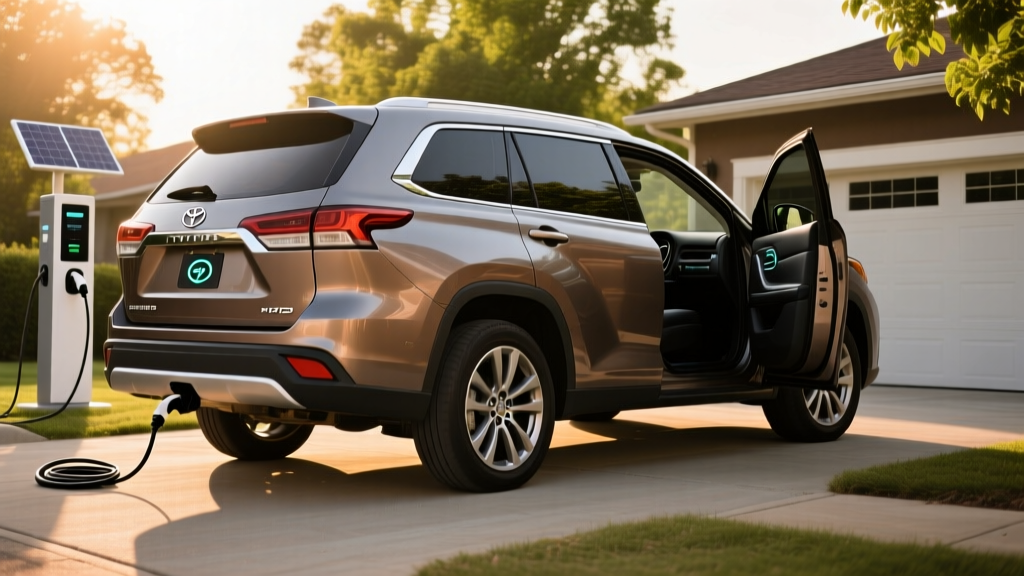
If you are shopping the used SUV market and need three rows, all-wheel drive, and sub-30 MPG combined without ever plugging in, the 2019 Toyota Highlander Hybrid remains one of the most rational purchases available. Toyota paired a 3.5-liter V6 with a hybrid transaxle to produce 306 combined horsepower and an EPA-estimated 29 MPG combined — figures that still hold up against newer midsize hybrid crossovers. On the used market in 2026, well-maintained examples typically trade between $22,000 and $31,000 depending on trim, mileage, and region.
This is a conventional hybrid (HEV), not a plug-in hybrid (PHEV). You never plug it in. The gasoline engine and regenerative braking recharge a small nickel-metal hydride (NiMH) battery pack that assists acceleration and enables brief low-speed electric-only motoring. There is no meaningful electric-only range to speak of — perhaps a mile at parking-lot speeds — and no federal tax credit applies to used HEVs.
HEV vs PHEV vs EV: Where the 2019 Highlander Hybrid Fits
Before examining the numbers, it is critical to understand what this vehicle is — and what it is not. The 2019 Highlander Hybrid is a self-charging conventional hybrid. Toyota did not offer a plug-in hybrid Highlander until the 2026 model year introduced the Highlander PHEV in select markets, and the fully electric bZ5X/bZ Large SUV is expected later in the decade.
| Feature | Conventional Hybrid (HEV) | Plug-In Hybrid (PHEV) | Battery Electric (BEV) |
|---|---|---|---|
| Plug-in charging required? | No — gas + regen only | Yes — Level 1 or Level 2 | Yes — Level 1, 2, or DC fast |
| Electric-only range | <1 mile at low speed | 20–45 miles typical | 200–400+ miles |
| Battery size | ~1–2 kWh (NiMH or Li-ion) | ~10–20 kWh (Li-ion) | ~60–120 kWh (NMC/LFP) |
| Federal tax credit (used) | Not eligible | Up to $4,000 used-EV credit* | Up to $4,000 used-EV credit* |
| Gas engine? | Yes — primary power | Yes — backup + highway | No |
| Example | 2019 Highlander Hybrid | 2026 RAV4 Prime, Tucson PHEV | Ioniq 5, Model Y, EV6 |
*Used-EV credit under IRC §25E: up to $4,000 or 30% of sale price (whichever is lower) on vehicles priced at $25,000 or less, subject to buyer income caps. Most used PHEVs and BEVs qualify; HEVs do not. See IRS.gov §25E for current rules.
Choose the 2019 Highlander Hybrid (HEV) if: You want a three-row SUV with AWD, low running costs, no charging infrastructure requirement, and Toyota's long-proven hybrid reliability — and you drive 10,000–15,000 miles per year where the MPG savings compound.
Choose a PHEV instead if: You have home Level 2 charging, a commute under 35 miles, and want electric-only daily driving with gas-engine road-trip flexibility.
Choose a full EV instead if: You have reliable home charging, want zero tailpipe emissions, qualify for tax credits on a new or qualifying used BEV, and your typical trips fall within 250–300 miles.
Fuel Economy: EPA Ratings and Real-World MPG
The 2019 Highlander Hybrid comes exclusively with all-wheel drive (AWD-i), which uses a separate rear electric motor to power the rear axle — no mechanical driveshaft. This system is both lighter and more efficient than traditional AWD.
| Trim / Configuration | City MPG | Highway MPG | Combined MPG |
|---|---|---|---|
| 2019 Highlander Hybrid AWD-i (LE, XLE, Limited, Platinum) | 29 | 27 | 28 |
Source: EPA / fueleconomy.gov
Correction note: The EPA revised its testing methodology for the 2019 model year, and official figures list the 2019 Highlander Hybrid LE at 29 city / 27 highway / 28 combined. Some earlier third-party sources quote 29 combined — that reflects a pre-revision estimate. The official EPA sticker reads 28 combined.
Real-World MPG vs. EPA Sticker
Conventional hybrids like the Highlander tend to exceed their EPA city rating in stop-and-go traffic because regenerative braking recaptures energy that gas-only vehicles waste as heat. Owners on Fuelly and Edmunds report real-world averages of 27–31 MPG combined, with city-heavy drivers sometimes seeing 30–32 MPG. Highway-only driving at 75+ MPH typically yields 25–26 MPG — below the EPA highway number — because the hybrid system provides less benefit at sustained high speed and the 4,400-lb curb weight works against efficiency.
In cold weather (below 30°F), expect a 5–10% fuel economy drop due to engine warm-up cycles running richer and cabin heating drawing from the engine rather than a heat pump (which hybrids lack).
Powertrain Specs: 306 HP V6 Hybrid System
| Specification | 2019 Highlander Hybrid |
|---|---|
| Engine | 3.5L V6 (2GR-FXS) Atkinson-cycle |
| Engine output | 263 HP @ 6,000 RPM |
| Front electric motor | 114 kW (153 HP) |
| Rear electric motor (AWD-i) | 50 kW (67 HP) |
| Net combined system horsepower | 306 HP |
| Transmission | eCVT (planetary gearset, no fixed gears) |
| Drivetrain | AWD-i (electronic rear axle) |
| Hybrid battery | NiMH, ~1.9 kWh (usable) |
| 0–60 MPH | ~7.8 seconds |
| Towing capacity | 3,500 lbs |
| Curb weight | ~4,400–4,500 lbs |
The 2GR-FXS V6 runs the Atkinson cycle — it keeps the intake valve open slightly longer during the compression stroke, reducing pumping losses and improving thermal efficiency at the cost of peak power density. The electric motors compensate for that trade-off, delivering instant torque off the line. The result is a powertrain that feels responsive around town while sipping fuel.
The eCVT is not a belt-driven continuously variable transmission like those in some competitors. It is a planetary gearset that blends engine and motor speeds seamlessly. There are no rubber bands or slipping belts — this is the same design Toyota has used since the original Prius, and it is among the most durable transmissions ever built.
Hybrid Battery: Warranty, Lifespan, and Replacement Cost
This is the single most common concern for used-hybrid buyers, and it deserves a direct, data-backed answer.
Toyota Hybrid Battery Warranty
- Original warranty: 8 years / 100,000 miles (10 years / 150,000 miles in California and states adopting CARB emissions standards)
- Chemistry: Nickel-metal hydride (NiMH) — mature, proven technology
- Typical lifespan: 150,000–200,000+ miles with normal use; many Highlander Hybrid batteries exceed 200,000 miles
- Replacement cost (2026): $2,500–$4,000 for a new OEM battery at a Toyota dealer; $1,500–$2,500 for a refurbished unit from independent hybrid specialists
Unlike the large lithium-ion packs in full EVs (which can cost $10,000–$20,000+ to replace), the Highlander Hybrid's NiMH pack is small, simple, and inexpensive by comparison. Toyota's hybrid battery failure rate is remarkably low — industry data from Consumer Reports and iSeeCars consistently ranks the Highlander Hybrid among the most reliable vehicles in its class.
What degrades a hybrid battery? Extreme heat is the primary enemy. If the vehicle was owned in Phoenix, Las Vegas, or similar climates and regularly parked outdoors in summer, battery health may be lower than a Pacific Northwest example. Ask for a hybrid battery health check (many Toyota dealers perform this free) before purchasing. The check reads individual cell voltages and internal resistance — a healthy pack shows tight voltage matching across all modules.
Is the 2019 Highlander Hybrid reliable? Yes. The 2GR-FXS engine, eCVT, and NiMH hybrid system are among the most thoroughly validated powertrain components in the automotive industry. The 2019 model year had no major NHTSA recalls specific to the hybrid system. Check NHTSA.gov for any open recalls by VIN before purchasing.
Pricing, Trims, and Tax Credit Eligibility
The 2019 Highlander Hybrid was offered in four trims, all with AWD-i and the 306 HP hybrid powertrain:
| Trim | Original MSRP (2019) | Typical Used Price (2026) |
|---|---|---|
| LE | $38,070 | $22,000–$26,000 |
| XLE | $41,060 | $24,000–$28,000 |
| Limited | $45,420 | $26,000–$30,000 |
| Limited Platinum | $48,970 | $28,000–$32,000 |
Used prices reflect private-party and dealer listings as of early 2026 for examples with 60,000–100,000 miles. Regional variation is significant.
Does the 2019 Highlander Hybrid qualify for any tax credit?
No. The 2019 Highlander Hybrid is a conventional hybrid (HEV). It does not qualify for the federal §30D new clean vehicle credit (which requires plug-in capability and minimum battery capacity), nor does it qualify for the §25E used clean vehicle credit (which also requires plug-in capability). There is no federal tax incentive for purchasing a used HEV.
A handful of states offer minor incentives for hybrids (HOV lane access in some states, for example), but these vary by jurisdiction and are subject to change. Check your state's DMV or department of energy for current rules.
Who Should Buy the 2019 Highlander Hybrid?
Pros
- 28 MPG combined EPA in a three-row, 7-passenger AWD SUV
- 306 HP provides confident highway merging and passing
- No plug-in charging required — works with existing gas infrastructure
- Proven Toyota hybrid reliability; low battery replacement cost
- 3,500-lb towing capacity covers light trailers and boats
- Strong resale value; parts and service widely available
Cons
- Third row is tight for adults; cargo space trails some competitors
- No electric-only driving range (this is not a PHEV)
- Infotainment system feels dated by 2026 standards (no wireless CarPlay on most trims)
- No federal tax credit eligibility
- Highway MPG drops to ~25 at sustained 75+ MPH speeds
- Ride quality is comfortable but not as refined as newer unibody competitors
Decision Framework
Buy the 2019 Highlander Hybrid if: You need three rows, AWD, and ~28 MPG without installing a home charger. You drive 12,000+ miles per year and value Toyota's reliability track record. Budget is $22K–$32K on the used market.
Look elsewhere if: You want electric-only commuting (consider a RAV4 Prime or Tucson PHEV), you need maximum cargo volume (check the Honda Pilot Hybrid or Kia Sorento Hybrid), or you want the latest infotainment and ADAS technology (newer models offer more).
Frequently Asked Questions
How many MPG does the 2019 Highlander Hybrid get?
The EPA rates it at 29 city / 27 highway / 28 combined MPG. Real-world owner averages range from 27–31 MPG combined depending on driving mix, with city-heavy drivers often exceeding the EPA combined estimate.
Can I plug in the 2019 Highlander Hybrid to charge it?
No. This is a conventional hybrid (HEV), not a plug-in hybrid. The battery charges through regenerative braking and the gasoline engine. There is no charge port and no electric-only driving range beyond a mile or so at very low speeds.
How far can the 2019 Highlander Hybrid go on electric only?
Effectively zero meaningful miles. Unlike a PHEV with 20–45 miles of electric-only range, the Highlander Hybrid uses its small NiMH battery to assist the gas engine, not to replace it. You will not do daily electric-only commuting in this vehicle.
Is the hybrid battery expensive to replace?
Compared to full EV batteries, no. A new OEM NiMH battery from Toyota costs approximately $2,500–$4,000 installed. Refurbished units from hybrid specialists run $1,500–$2,500. Most batteries last 150,000–200,000+ miles. The original 8-year/100,000-mile warranty (10/150,000 in CARB states) has expired for most 2019 examples by 2026, so factor a potential $2,500–$4,000 reserve into your purchase budget.
Does the 2019 Highlander Hybrid qualify for a federal tax credit?
No. Federal tax credits under §30D (new vehicles) and §25E (used vehicles) require plug-in capability and minimum battery thresholds. The Highlander Hybrid is a conventional HEV and does not qualify for any federal purchase incentive.
How does the 2019 Highlander Hybrid compare to newer hybrid SUVs?
Newer competitors like the 2025–2026 Toyota Grand Highlander Hybrid (36 MPG combined) and Kia Sorento Hybrid (34 MPG combined) offer better fuel economy, more modern interiors, and updated safety tech. However, they also cost $40,000–$55,000+ new. The 2019 Highlander Hybrid delivers 80% of the utility at 50% of the cost, with a powertrain that has proven capable of 200,000+ trouble-free miles.
What should I check before buying a used 2019 Highlander Hybrid?
Request a hybrid battery health report from a Toyota dealer (cell voltage balance and internal resistance). Check for open recalls on NHTSA.gov using the VIN. Verify maintenance records — the 2GR-FXS V6 requires regular oil changes and coolant service. Inspect for signs of flood damage, which can compromise hybrid electronics. A pre-purchase inspection by a Toyota-certified technician is strongly recommended.