Quick Verdict: The 2019 Fusion Titanium Hybrid in 2026
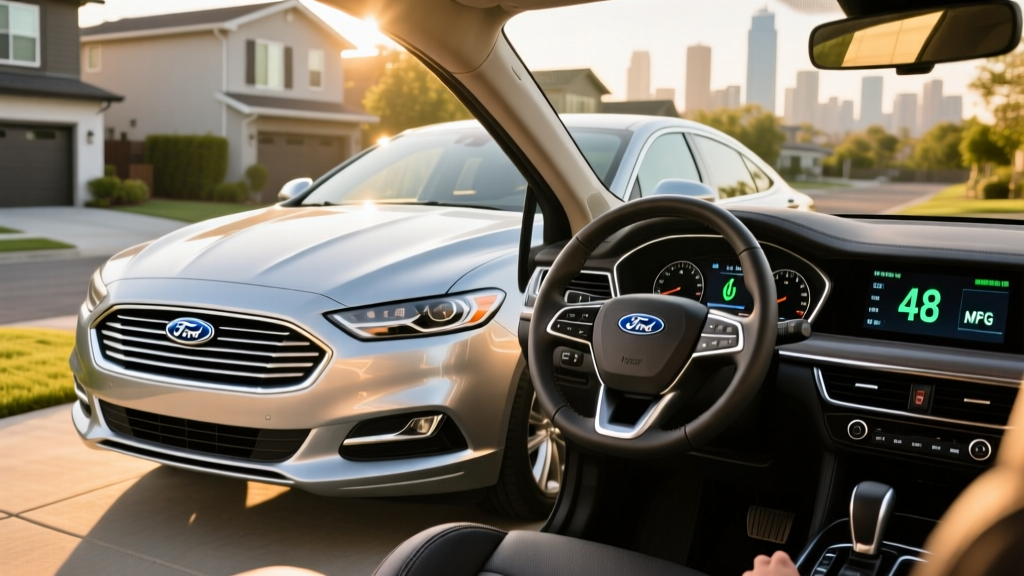
The 2019 Ford Fusion Titanium Hybrid occupies a specific niche in today's used-car market: a midsize conventional hybrid (HEV) that requires no plug, delivers strong city fuel economy, and undercuts newer electrified sedans on price. With the Fusion discontinued after the 2020 model year, the 2019 Titanium represents the final full production year of Ford's hybrid sedan, making it a known quantity with established reliability data.
If you're shopping the used market in 2026 and want hybrid efficiency without the complexity or cost of a plug-in hybrid or full EV, the Fusion Titanium Hybrid remains a rational choice — provided you understand what it does well (city MPG, comfort) and where it falls short (highway efficiency, aging infotainment, no DC fast charging because it's not a PHEV).
2019 Ford Fusion Titanium Hybrid — Key Specifications
| Attribute | Specification |
|---|---|
| Powertrain | 2.0L Atkinson-cycle I-4 + electric motor (HEV) |
| Combined Horsepower | 188 hp (net system) |
| EPA MPG (City / Hwy / Combined) | 43 / 41 / 42 MPG |
| Fuel Tank | 13.5 gallons |
| Total Range (est.) | ~567 miles |
| 0-60 mph | ~7.8 seconds |
| Drivetrain | Front-wheel drive, eCVT |
| Hybrid Battery | 1.4 kWh (usable), Lithium-ion |
| Plug-In Required? | No — conventional HEV |
| Original MSRP (Titanium trim) | ~$34,595 (2019) |
| Typical Used Price (2026) | $14,000 – $19,500 |
| Federal Tax Credit | Not eligible (used HEV) |
HEV vs. PHEV: What the Fusion Hybrid Actually Is
Before diving into fuel economy, it's critical to distinguish what you're buying. Ford sold the Fusion in two electrified variants for 2019:
- Fusion Hybrid (HEV): A conventional, self-charging hybrid. The 1.4 kWh battery is recharged exclusively by the gasoline engine and regenerative braking. You never plug it in. It cannot drive on electric power alone for meaningful distances. This is the model reviewed here.
- Fusion Energi (PHEV): A plug-in hybrid with a larger 9.0 kWh battery that can travel approximately 26 miles on electricity alone before the gas engine engages. Requires plugging in (Level 1 or Level 2 AC charging; no DC fast charge). This is a different vehicle with different economics.
If you see "Fusion Hybrid" on a listing, confirm whether it's the standard HEV or the Energi PHEV — the badging and charge-port presence are the quickest tells. The Titanium trim was available on both, so trim alone does not distinguish them.
Fuel Economy: EPA Ratings vs. Real-World MPG
The EPA rates the 2019 Ford Fusion Hybrid at 43 MPG city, 41 MPG highway, and 42 MPG combined, per fueleconomy.gov. That city-heavy advantage is characteristic of conventional hybrids: regenerative braking recaptures energy in stop-and-go traffic, and the electric motor handles low-speed launches where gasoline engines are least efficient.
| Driving Scenario | Expected MPG |
|---|---|
| EPA City | 43 MPG |
| EPA Highway | 41 MPG |
| EPA Combined | 42 MPG |
| Real-World City (mixed traffic) | 40 – 46 MPG |
| Real-World Highway (70-75 mph) | 36 – 40 MPG |
| Real-World Combined (owner-reported) | 38 – 43 MPG |
| Cold Weather (below 30°F) | 34 – 38 MPG |
Why real-world MPG varies: Hybrids routinely exceed their EPA city rating in warm, moderate-speed urban driving because the electric motor does more work. Highway driving at sustained 70+ MPH favors the gasoline engine, reducing the hybrid advantage. Cold weather hits hybrids harder than gas-only cars because the engine must run more frequently to generate cabin heat, reducing electric-motor utilization. Expect a 10-15% MPG drop in winter months in northern climates.
For comparison, the non-hybrid 2019 Fusion with the 1.5L EcoBoost achieves 23/34/27 MPG (city/highway/combined). The hybrid's 42 MPG combined represents a roughly 55% improvement in fuel economy — substantial for drivers covering 15,000+ miles annually.
Powertrain and Driving Dynamics
The 2019 Fusion Hybrid pairs a 2.0-liter Atkinson-cycle four-cylinder engine (141 hp, 129 lb-ft) with a 120-hp electric motor integrated into an electronically controlled continuously variable transmission (eCVT). Net system output is 188 horsepower. The Atkinson cycle sacrifices some low-end torque for greater thermal efficiency — a tradeoff that works well in hybrid applications where the electric motor fills the torque gap.
The eCVT is not a belt-driven CVT like those in some competitors; it uses a planetary gearset (Toyota's Hybrid Synergy Drive architecture, licensed by Ford) that provides seamless power blending without the rubber-band feel. Acceleration is adequate rather than quick — 0-60 MPH in approximately 7.8 seconds — but throttle response from a stop is immediate thanks to electric motor torque.
The Titanium trim adds features that affect the driving experience: standard 18-inch wheels (slightly firmer ride than the SE's 17-inch options), upgraded sound insulation, and a sport-tuned suspension. It's a comfortable cruiser, not a sport sedan, but body control is competent and steering is well-weighted for a hybrid midsize.
Battery Warranty, Lifespan, and Replacement Cost
Hybrid Battery Coverage
- Original Warranty: 8 years / 100,000 miles (whichever comes first) for the hybrid battery pack, per Ford's powertrain coverage.
- CARB States: In California Air Resources Board states, hybrid battery warranty extends to 10 years / 150,000 miles.
- 2026 Status: A 2019 model's standard 8-year/100k warranty has expired as of the 2027 model year (or upon reaching 100k miles). CARB-state 10-year coverage may still apply through 2029.
- Battery Chemistry: Lithium-ion (not LFP). The 1.4 kWh pack is small by modern standards and operates in a narrow state-of-charge window, which reduces degradation stress.
- Replacement Cost: A new OEM hybrid battery pack for the Fusion Hybrid runs approximately $2,000 – $3,500 (parts + labor at a Ford dealer). Independent hybrid shops may offer refurbished packs for $1,200 – $2,000.
Because the Fusion Hybrid's battery is small and the system keeps it within a conservative charge window (typically 40-80% SoC), degradation is slow. Many Fusion Hybrids have surpassed 150,000 miles on the original pack. That said, a 2019 model with 80,000+ miles in 2026 is approaching the window where battery replacement becomes a realistic consideration within the next 2-4 years of ownership.
Titanium Trim: What You Get for the Money
The Titanium was the top non-Energi trim for the 2019 Fusion Hybrid. Standard equipment includes:
- Leather-trimmed heated and cooled front seats
- SYNC 3 infotainment with 8-inch touchscreen, Apple CarPlay, and Android Auto
- Sony 12-speaker audio system
- Ambient interior lighting
- 18-inch machined aluminum wheels
- Adaptive cruise control with stop-and-go
- Lane-keeping system and BLIS (Blind Spot Information System)
- Auto high-beam headlamps
- Rearview camera
Notable omissions by 2026 standards: no wireless CarPlay/Android Auto, no digital instrument cluster (the Fusion uses a hybrid-specific analog/LCD combo), and the adaptive cruise does not support full stop-and-hold in all conditions. The driver-assist suite is competent for its era but does not approach the capabilities of current Level 2 systems like Ford's own BlueCruise on newer models.
Pricing, Tax Credits, and Ownership Economics
The 2019 Ford Fusion Titanium Hybrid originally carried an MSRP of approximately $34,595 (before options). In the 2026 used market, expect to pay between $14,000 and $19,500 depending on mileage, condition, and region, per aggregated listing data.
Federal Tax Credit Eligibility
The 2019 Fusion Hybrid does not qualify for any current federal tax credit:
- New EV/PHEV Credit (§30D): Only applies to new plug-in vehicles. The Fusion Hybrid is a conventional HEV and was never eligible even when new.
- Used EV Credit (§25E): Up to $4,000 for used plug-in electric vehicles priced under $25,000. The Fusion Hybrid does not qualify because it is not a plug-in vehicle. (The Fusion Energi PHEV may qualify under this credit if other income and price requirements are met — consult IRS guidelines.)
Annual Fuel Cost Estimate
At 42 MPG combined and 15,000 miles per year, with gas at $3.40/gallon (2026 national average estimate):
- Annual fuel cost: ~$1,214
- Monthly fuel cost: ~$101
- Compare to the gas-only Fusion 1.5L EcoBoost (27 MPG combined): ~$1,889/year — a savings of approximately $675/year with the hybrid.
Fusion Hybrid vs. PHEV vs. Full EV: Which Fits You?
Choose the 2019 Fusion Hybrid (HEV) if:
- You cannot charge at home (apartment, street parking, no garage)
- Your budget is under $20,000 and you want proven hybrid reliability
- You drive mostly city and suburban miles where hybrid efficiency shines
- You want zero behavior change — no plugging in, no range planning
Choose a Used PHEV (e.g., Fusion Energi, Prius Prime) if:
- You have home Level 2 charging and a commute under 30 miles
- You want electric-only daily driving with gas-engine backup for road trips
- You want to qualify for the up-to-$4,000 used clean vehicle credit (§25E)
Choose a Full EV (BEV) if:
- You have reliable home or workplace charging
- You want the lowest per-mile energy cost (electricity vs. gasoline)
- You're willing to accept a higher purchase price for lower running costs
- You want access to HOV lanes (state-dependent) and the full §30D or §25E credit
Pros
- Strong city MPG (43 EPA, often exceeded in real-world traffic)
- No plug-in required — zero infrastructure dependency
- Comfortable ride, well-insulated cabin in Titanium trim
- Proven Toyota-derived hybrid powertrain architecture
- Low used price relative to newer electrified vehicles
- Good cargo space for a hybrid sedan (12.0 cu ft trunk)
Cons
- Discontinued model — no new parts pipeline from Ford long-term
- Highway MPG drops noticeably above 70 MPH
- Dated infotainment vs. 2024+ competitors
- No federal tax credit eligibility (HEV)
- Hybrid battery out of standard warranty on most 2019 examples
- Modest acceleration (7.8s 0-60) compared to turbocharged rivals
Reliability and Known Issues
The 2019 Fusion Hybrid benefits from Ford's long-running partnership with Toyota's hybrid system architecture, which has proven durable across millions of vehicles (Toyota Prius, Camry Hybrid, and Ford's own Escape Hybrid and Fusion Hybrid). The planetary eCVT has no belts, clutches, or torque converters to wear, and the gasoline engine operates under lighter load than in a conventional car.
Common issues reported by owners and tracked by NHTSA include:
- 12V battery drain: Like many hybrids, the Fusion can experience 12V auxiliary battery issues if left sitting for extended periods. Not related to the hybrid traction battery.
- Infotainment glitches: SYNC 3 can freeze or reboot; typically resolved with software updates or a module reset.
- Brake feel: The transition between regenerative and friction braking can feel non-linear, especially when the battery is fully charged. This is normal hybrid behavior, not a defect.
Overall, the Fusion Hybrid ranks as an average-to-above-average reliability pick in the used hybrid sedan segment. The powertrain itself is one of the more robust in the industry.
Frequently Asked Questions
How many MPG does the 2019 Ford Fusion Titanium Hybrid get?
The EPA rates it at 43 city / 41 highway / 42 combined MPG. Real-world owners typically report 38-43 MPG combined, with city driving often exceeding the EPA estimate and sustained highway driving falling a few MPG below.
Does the Fusion Hybrid need to be plugged in?
No. The Fusion Hybrid is a conventional HEV. The battery charges through the gasoline engine and regenerative braking. If you want a plug-in Fusion, you need the Fusion Energi (PHEV), which is a separate model.
How far can the Fusion Hybrid drive on electric only?
Not meaningfully. As a conventional HEV, the Fusion Hybrid can creep at very low speeds (under ~25 MPH) on electric power for short distances (typically under 1 mile), but the gasoline engine engages frequently. It is not designed for electric-only commuting. For that, you need a PHEV or BEV.
Is the hybrid battery expensive to replace?
A new OEM replacement pack runs $2,000-$3,500 installed at a Ford dealer. Refurbished packs are available for $1,200-$2,000 from independent hybrid specialists. Given the small 1.4 kWh pack size and conservative charge management, many original batteries last 150,000+ miles.
Does the 2019 Fusion Hybrid qualify for any tax credit in 2026?
No. As a conventional hybrid (HEV), it does not qualify for the federal §30D new vehicle credit or the §25E used clean vehicle credit. Those credits require plug-in capability (PHEV or BEV). Some states may offer minor hybrid incentives — check your state's energy office for current programs.
How does the Fusion Hybrid compare to a Toyota Camry Hybrid?
The 2019 Camry Hybrid LE achieves 51/53/52 MPG (EPA), significantly outperforming the Fusion's 43/41/42. The Camry also benefits from a more current platform and broader parts availability. The Fusion's advantages are its lower used pricing and the Titanium trim's premium features. If fuel economy is the top priority, the Camry Hybrid wins on paper and in practice.
Is the Fusion Hybrid a good buy in 2026?
For buyers who need hybrid efficiency without plug-in infrastructure, have a budget under $20,000, and accept that Ford has discontinued the model, the Fusion Hybrid offers strong value. The powertrain is proven, the Titanium trim is well-equipped, and real-world fuel savings are meaningful. The main risks are long-term parts availability for a discontinued nameplate and hybrid battery replacement cost as these vehicles age past 100,000 miles.