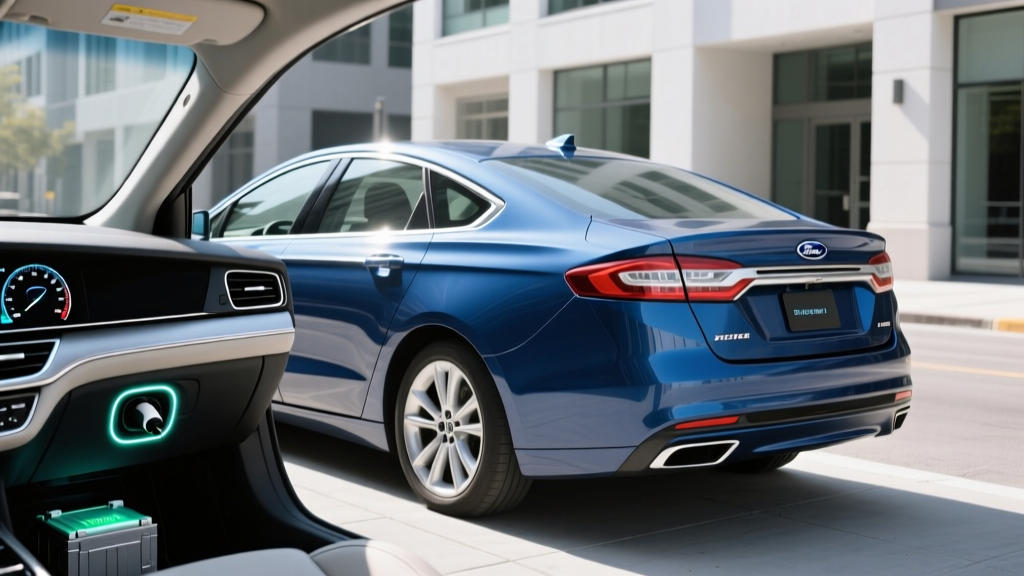
The Ford Fusion Hybrid was discontinued after the 2020 model year, but the 2019 edition remains one of the most popular midsize hybrid sedans on the used market. With over 100,000 units sold across its production run, buyers in 2026 are asking a practical question: how does the 2019 Ford Fusion Hybrid hold up after six or seven years of daily driving?
This guide examines the 2019 Fusion Hybrid's reliability record, battery longevity, real-world fuel economy, and total cost of ownership — with hard data from owner surveys, EPA testing, and repair-cost databases. We also compare it against the plug-in hybrid (PHEV) variant, the Fusion Energi, so you know exactly which version fits your commute.
2019 Ford Fusion Hybrid: Powertrain and Key Specs
Before diving into reliability, let's establish what's under the hood. The 2019 Fusion Hybrid pairs a 2.0-liter Atkinson-cycle four-cylinder engine with an electric motor and a 1.4 kWh lithium-ion battery pack. Combined output is 188 horsepower, routed through an electronically controlled continuously variable transmission (eCVT).
| Spec | Value |
|---|---|
| Engine | 2.0L Atkinson-cycle I4 |
| Electric Motor | 88 kW permanent-magnet AC |
| Combined Horsepower | 188 hp |
| Battery Capacity (usable) | 1.4 kWh (lithium-ion) |
| Transmission | eCVT |
| Drivetrain | Front-wheel drive |
| 0–60 mph | ~8.1 seconds |
| Curb Weight | ~3,640 lbs |
| EPA Fuel Economy | 43 city / 41 highway / 42 combined MPG |
| Fuel Tank | 13.5 gallons |
| Total Range | ~567 miles |
Note: The Fusion Hybrid is a conventional hybrid (HEV). It does not plug in. The battery recharges through regenerative braking and the gasoline engine. If you're looking for a plug-in variant, that's the Fusion Energi — covered in detail below.
Fuel Economy: EPA Ratings vs. Real-World MPG
The EPA rates the 2019 Fusion Hybrid at 43 MPG city, 41 MPG highway, and 42 MPG combined for the SE and Titanium trims. The base S trim carries identical ratings. These figures come from fueleconomy.gov.
| Driving Condition | EPA MPG | Real-World Expectation |
|---|---|---|
| City | 43 MPG | 44–48 MPG (hybrids excel in stop-and-go) |
| Highway | 41 MPG | 37–40 MPG (aerodynamic drag, less regen benefit) |
| Combined | 42 MPG | 39–45 MPG depending on driving mix |
| Cold Weather (below 32°F) | — | 35–38 MPG (engine runs more for cabin heat) |
Why real-world city MPG often beats the EPA sticker: Conventional hybrids recapture kinetic energy during braking and low-speed driving. In heavy traffic, the electric motor handles more of the load, and the gas engine shuts off at stops. Owners who drive predominantly in urban environments regularly report 45+ MPG on forums and fuel-tracking apps like Fuelly.
Highway caveat: At sustained 70–80 mph speeds, the gasoline engine does most of the work. Expect highway-only road trips to yield 37–40 MPG — still excellent for a midsize sedan, but noticeably lower than the city figure.
HEV vs. PHEV: Fusion Hybrid vs. Fusion Energi
Ford offered two electrified Fusions in 2019. Understanding the difference is critical before you buy.
| Attribute | Fusion Hybrid (HEV) | Fusion Energi (PHEV) |
|---|---|---|
| Type | Conventional Hybrid | Plug-in Hybrid |
| Plugs In? | No | Yes (Level 1 / Level 2) |
| Battery Capacity | 1.4 kWh | 7.6 kWh (usable) |
| Electric-Only Range | N/A (EV assist only) | 26 miles (EPA) |
| Total Range | ~567 miles | ~410 miles (gas + electric) |
| Combined HP | 188 hp | 188 hp |
| EPA MPG (gas) | 42 combined | 42 combined (charge-sustaining) |
| MPGe (electric + gas) | N/A | 103 MPGe |
| Level 2 Charge Time (0–100%) | N/A | ~2.5 hours at 3.6 kW |
| DC Fast Charging | N/A | Not supported |
| Trunk Space | 12.0 cu ft | 8.2 cu ft (battery intrudes) |
| 2019 Base MSRP | $28,000 | $35,495 |
Choose the Fusion Hybrid (HEV) if: You want maximum simplicity, no charging routine, and the best trunk space. It's ideal for drivers without access to home or workplace charging.
Choose the Fusion Energi (PHEV) if: Your daily commute is under 26 miles round-trip, you can charge at home overnight, and you want to drive mostly on electricity during the week while keeping gas-engine range for road trips. The trade-off is reduced trunk space due to the larger battery.
2019 Ford Fusion Hybrid Reliability: What the Data Shows
The 2019 Fusion Hybrid benefits from Ford's third-generation hybrid powertrain, which debuted in the 2013 model year and received incremental refinements through 2019. By this model year, most early-generation issues (inverter coolant leaks, battery module failures) had been addressed through engineering revisions.
Reliability Ratings and Owner Reports
J.D. Power rated the 2019 Fusion Hybrid at 82 out of 100 for overall quality and dependability in its initial quality study. Consumer Reports gave the 2019 Fusion Hybrid an above-average reliability rating, noting that the hybrid powertrain has fewer moving parts than a conventional automatic transmission — no torque converter, no traditional gear shifts, and reduced brake wear thanks to regenerative braking.
Key reliability strengths reported by owners and mechanics:
- eCVT durability: Ford's planetary-gear eCVT has no friction bands or clutch packs to wear out. Failures before 150,000 miles are rare.
- Brake longevity: Regenerative braking handles most deceleration, allowing original brake pads to last 80,000–100,000+ miles in mixed driving.
- Engine simplicity: The Atkinson-cycle 2.0L lacks a turbocharger, reducing complexity and thermal stress compared to Ford's EcoBoost engines.
- Electrical system: The 2019 model year resolved most SYNC 3 infotainment glitches that plagued 2017–2018 models.
Known Issues to Watch
No used car is without risk. Here are the most commonly reported problems for the 2019 Fusion Hybrid at higher mileages:
- 12V auxiliary battery drain: Like many hybrids, the Fusion relies on a conventional 12V battery for accessories and ECU wake-up. If the car sits unused for weeks, the 12V can die — preventing the hybrid system from starting. Replacement cost: ~$200–$300.
- Hybrid battery coolant pump: Some owners report coolant pump failures between 80,000–120,000 miles. If the pump fails, the inverter can overheat. Replacement: ~$400–$600.
- EVAP system codes: Loose or deteriorating gas caps and purge valve issues can trigger check-engine lights. Inexpensive fix (~$50–$150).
- Suspension wear: Front struts and sway-bar links may need replacement around 90,000–110,000 miles — typical for any midsize sedan, not hybrid-specific.
Hybrid Battery Longevity and Replacement Cost
How Long Do Fusion Hybrid Batteries Last?
Ford's 1.4 kWh lithium-ion pack in the Fusion Hybrid is modest in size and operates within a conservative state-of-charge (SoC) window — typically between 40% and 80%. This shallow cycling dramatically reduces degradation compared to a full EV battery that regularly cycles from 10% to 90%.
Based on fleet data and owner reports aggregated by hybrid specialist forums, the Fusion Hybrid battery commonly reaches 150,000–200,000 miles before capacity loss becomes noticeable (defined as a measurable drop in electric-assist availability or a 1–3 MPG decline). Some taxi fleets using Fusion Hybrids have reported original batteries exceeding 250,000 miles.
Battery Replacement Cost in 2026
If the high-voltage battery does require replacement outside of warranty:
- New OEM battery pack (Ford): $2,500–$3,500 for the part, plus $500–$800 labor. Total: $3,000–$4,300.
- Refurbished/remanufactured pack: $1,500–$2,200 including installation from independent hybrid shops.
- Individual module replacement: Some specialists can replace only the degraded modules within the pack for $800–$1,500, though this is less common for the Fusion's smaller battery.
Compared to full EV battery replacements ($8,000–$20,000+), the Fusion Hybrid's small battery is relatively affordable to replace — and the likelihood of needing one before 200,000 miles is low.
Used Pricing and Tax Credit Eligibility in 2026
The 2019 Ford Fusion Hybrid was offered in three trims: S, SE, and Titanium. Original MSRPs ranged from $28,000 to $33,875.
| Trim | Original MSRP | 2026 Used Price (60K–90K mi) |
|---|---|---|
| S | $28,000 | $12,500–$15,000 |
| SE | $29,600 | $14,000–$17,500 |
| Titanium | $33,875 | $16,500–$20,000 |
Does the 2019 Fusion Hybrid Qualify for Any Tax Credit?
No. The federal §30D new clean vehicle credit does not apply to used hybrid vehicles. The used clean vehicle credit (§25E) provides up to $4,000, but it is restricted to used battery-electric vehicles (BEVs) and fuel-cell vehicles — not conventional hybrids. The Fusion Hybrid (HEV) does not qualify.
The Fusion Energi (PHEV) originally qualified for a federal tax credit of up to $4,609 when purchased new, but that credit is no longer available for used purchases. Neither the Hybrid nor the Energi qualifies for any current federal incentive on the used market.
Some states and local utilities offer rebates for used hybrid purchases — check your state's energy office or utility provider for current programs.
Fusion Hybrid vs. Full EV vs. Gas Car: Which Fits You?
Choose the 2019 Ford Fusion Hybrid if:
- You want 40+ MPG without changing your fueling habits
- You lack reliable access to home or workplace EV charging
- Your budget is $12,000–$20,000 for a used sedan
- You drive a mix of city and highway miles
- You want low maintenance costs and proven reliability
Choose a full EV (e.g., used Chevrolet Bolt, Nissan LEAF, Tesla Model 3) if:
- You can install a Level 2 home charger
- Your daily driving is under 200 miles
- You want to eliminate gasoline costs entirely
- You want the lowest per-mile fuel cost (~$0.04–$0.06/mile on electricity vs. ~$0.10/mile for the Fusion Hybrid at 42 MPG and $3.50/gal)
Choose a conventional gas sedan (e.g., 2019 Toyota Camry LE) if:
- You drive primarily long highway routes where the hybrid's city advantage is minimal
- You want the lowest possible purchase price (used Camry LE: ~$11,000–$14,000)
- You prefer widely available non-hybrid service options in rural areas
Ownership Costs: 5-Year Projection
Here's what owning a 2019 Fusion Hybrid actually costs compared to a comparable gas-only midsize sedan, assuming 15,000 miles/year, $3.50/gallon gas, and national-average insurance rates.
| Cost Category | Fusion Hybrid (42 MPG) | Gas Sedan (28 MPG) |
|---|---|---|
| Fuel | $6,250 | $9,375 |
| Maintenance (oil, brakes, tires) | $2,800 | $3,500 |
| Insurance (avg) | $6,500 | $6,000 |
| Estimated Repairs (out of warranty) | $1,500 | $1,800 |
| Total | $17,050 | $20,675 |
The Fusion Hybrid saves approximately $3,625 over five years in operating costs compared to a 28 MPG gas sedan. That's roughly $725 per year — meaningful savings that offset the slightly higher used purchase price of the hybrid.
Frequently Asked Questions
How many MPG does the 2019 Ford Fusion Hybrid get?
The EPA rates it at 43 MPG city, 41 MPG highway, and 42 MPG combined. In real-world city driving, many owners report 44–48 MPG. Highway-only trips typically yield 37–40 MPG.
Is the 2019 Ford Fusion Hybrid reliable after 100,000 miles?
Yes. The third-generation hybrid powertrain has a strong track record. The eCVT has no traditional wear components, regenerative braking extends brake life, and the Atkinson-cycle engine runs under less stress than a turbocharged alternative. The main high-mileage risk is the hybrid battery, which typically lasts 150,000–200,000 miles. Replacement costs $3,000–$4,300 if needed.
Does the 2019 Fusion Hybrid need to be plugged in?
No. The Fusion Hybrid is a conventional hybrid (HEV). It charges its small 1.4 kWh battery through regenerative braking and the gasoline engine. You fuel it like any other car at a gas station. Only the Fusion Energi (PHEV) plugs in.
What is the hybrid battery warranty on a 2019 Fusion Hybrid?
Ford originally warranted the hybrid battery for 8 years/100,000 miles federally, and 10 years/150,000 miles in CARB states (California, New York, Massachusetts, and others). As of 2026, most 2019 models are at or past the 8-year federal threshold. Check remaining warranty status with a Ford dealer using the VIN.
How much does it cost to replace the hybrid battery?
A new OEM replacement runs $3,000–$4,300 installed. Refurbished packs are available for $1,500–$2,200 installed. Given the battery's typical 150,000–200,000-mile lifespan, most owners will never need a replacement.
Does the 2019 Fusion Hybrid qualify for a tax credit?
No federal tax credit is available for purchasing a used 2019 Fusion Hybrid. The §25E used clean vehicle credit applies only to battery-electric and fuel-cell vehicles, not conventional hybrids. Check your state and local utility for possible rebates.
Fusion Hybrid or Fusion Energi — which should I buy used?
Buy the Hybrid if you want simplicity, no plug-in routine, and maximum trunk space (12.0 cu ft). Buy the Energi if your commute is under 26 miles, you can charge at home, and you want to drive on electricity most weekdays. The Energi sacrifices trunk space (8.2 cu ft) for its larger 7.6 kWh battery and plug-in capability.
Is the 2019 Fusion Hybrid a good buy in 2026?
For budget-conscious buyers seeking a reliable, fuel-efficient midsize sedan without the charging requirements of a full EV, the 2019 Fusion Hybrid is a strong used-car choice. With 42 MPG combined, low projected maintenance costs, and used prices starting around $12,500, it offers a compelling total-cost-of-ownership story. The main consideration is the aging-out of the hybrid battery warranty — factor in potential battery replacement cost when negotiating price on higher-mileage examples.