Quick Verdict: The 2018 Highlander Hybrid in 2026
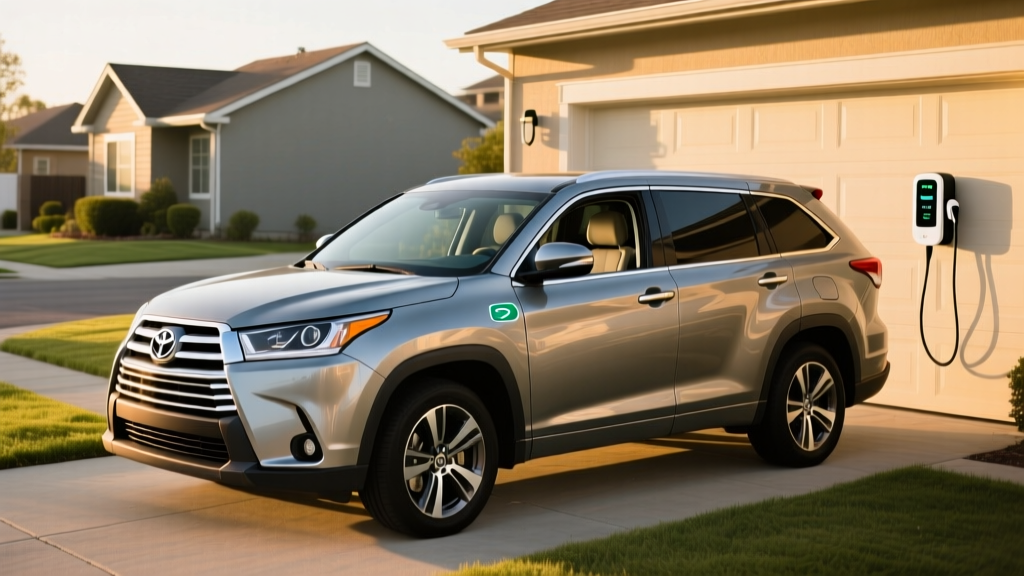
The 2018 Toyota Highlander Hybrid remains one of the most dependable three-row family haulers on the used market. With an EPA-rated 29 MPG combined and Toyota's proven hybrid synergy drive, it delivers meaningful fuel savings over its gas-only sibling without requiring any change in driving habits — no plugs, no charging anxiety, no range limitations. Eight years into its lifecycle, the 2018 model is now firmly in value territory, with well-maintained examples trading between $18,000 and $26,000 depending on mileage and trim.
But is it the right electrified choice for your family in 2026, or should you look at a newer PHEV or full EV? This guide covers every number that matters.
HEV vs PHEV: What the 2018 Highlander Hybrid Actually Is
| Factor | HEV (This Vehicle) | PHEV (e.g., Chrysler Pacifica Hybrid) | Full EV (e.g., Kia EV9) |
|---|---|---|---|
| Plugs in? | No | Yes (optional) | Yes (required) |
| Electric-only range | None | ~32 mi (Pacifica) | 230-300+ mi |
| Home charging needed? | No | Recommended | Essential |
| Federal tax credit | None | Up to $7,500 (new) | Up to $7,500 (new) |
| Best for | No home charging access; simplicity | Short commutes + road trips | Home charging + lower running cost |
Fuel Economy: EPA Ratings vs Real-World MPG
The 2018 Highlander Hybrid carries EPA ratings that remain competitive even against 2026 hybrid SUVs. According to fueleconomy.gov, the official numbers are:
| Metric | AWD-i (All Trims) |
|---|---|
| City MPG | 29 |
| Highway MPG | 27 |
| Combined MPG | 29 |
| Fuel tank capacity | 17.2 gal |
| Total range | ~499 miles |
For comparison, the 2018 gas-only Highlander V6 AWD earns an EPA 22 MPG combined — a 7 MPG gap that translates to roughly $400-$550 in annual fuel savings for the hybrid at 15,000 miles/year and $3.40/gallon regular unleaded.
Powertrain Specs: What's Under the Hood
The 2018 Highlander Hybrid pairs a 3.5-liter V6 Atkinson-cycle gasoline engine with Toyota's Hybrid Synergy Drive system and an electronically controlled continuously variable transmission (eCVT). The AWD-i system uses a separate rear electric motor to power the rear axle — there is no mechanical driveshaft connecting front to rear.
| Spec | Value |
|---|---|
| Engine | 3.5L V6 Atkinson-cycle |
| Gas engine power | 295 hp (combined system net) |
| Front electric motor | 167 hp / 247 lb-ft |
| Rear electric motor (AWD-i) | 67 hp / 103 lb-ft |
| Combined system horsepower | 295 hp |
| Transmission | eCVT |
| 0-60 mph | ~7.8 seconds |
| Drivetrain | AWD-i (electronic AWD) |
| Towing capacity | 3,500 lbs |
| Hybrid battery | ~1.9 kWh NiMH (sealed) |
That 295 combined horsepower makes the Highlander Hybrid one of the more powerful vehicles in its class — it outmuscles the 2018 Honda Pilot Hybrid (which wasn't offered) and delivers confident highway merging. The eCVT eliminates shift shock, and the transition between electric and gas power is nearly imperceptible in normal driving.
Hybrid Battery: Lifespan, Warranty & Replacement Cost
This is the single biggest concern for used-hybrid buyers, and it's where Toyota's track record provides genuine reassurance.
Real-World Battery Longevity: Toyota's NiMH hybrid batteries have demonstrated exceptional durability. Data from owner communities and repair databases show that Highlander Hybrid batteries commonly reach 180,000-250,000 miles before requiring replacement. The NiMH chemistry used in the 2018 model is less energy-dense than modern lithium-ion but is extremely tolerant of the shallow charge-discharge cycles that characterize hybrid operation — the battery typically operates between 40% and 80% state of charge, which dramatically extends cycle life.
Replacement Cost in 2026:
- New OEM battery (Toyota dealer): $3,500 - $4,500 installed
- Remanufactured battery (specialist shop): $2,000 - $2,800 installed
- Used/salvage battery: $800 - $1,500 (variable remaining life)
Before purchasing any used 2018 Highlander Hybrid, have a qualified technician perform a hybrid battery health check. Toyota's Techstream diagnostic software can read individual module voltages and internal resistance — large variance between modules signals impending failure. A healthy battery should show module voltage variance of less than 0.2V under load.
2026 Used Market Pricing & Tax Credit Reality
As of early 2026, the 2018 Toyota Highlander Hybrid trades in the following ranges on the used market:
| Trim | Original MSRP | 2026 Used Range (60k-100k mi) |
|---|---|---|
| LE | $37,030 | $18,000 - $21,000 |
| XLE | $40,500 | $20,000 - $24,000 |
| Limited | $45,950 | $22,000 - $26,000 |
| Limited Platinum | $48,950 | $24,000 - $28,000 |
Federal Tax Credit: The 2018 Highlander Hybrid does not qualify for the federal §30D new clean vehicle credit — that credit applies only to new plug-in vehicles (PHEVs and BEVs) with sufficient battery capacity. However, if you purchase this vehicle from a dealer for under $25,000, it may qualify for the Used Clean Vehicle Credit (IRC §25E) — but only if it is a plug-in vehicle. Since the 2018 Highlander Hybrid is a conventional HEV with no plug, it does not qualify for any federal tax credit, new or used. Some states offer their own incentives for hybrid purchases; check your state's energy office or department of revenue for current programs.
Reliability, Safety & Ownership Costs
Toyota's hybrid powertrains are among the most proven in the industry. The 2018 Highlander Hybrid benefits from:
- No traditional starter motor — the hybrid motor-generator starts the engine, eliminating a common failure point
- No alternator — the hybrid system handles all 12V charging duties
- Regenerative braking — significantly reduces wear on friction brake pads; many owners report 80,000+ miles on original brake pads
- eCVT transmission — uses a planetary gearset with no belts, chains, or clutch packs to wear out; far more reliable than conventional automatic or CVT transmissions
The 2018 Highlander earned a Top Safety Pick designation from IIHS with Good ratings across all crashworthiness tests. Toyota Safety Sense P (TSS-P) was standard on all trims, including pre-collision system with pedestrian detection, lane departure alert with steering assist, automatic high beams, and full-speed-range dynamic radar cruise control.
Estimated Annual Ownership Costs (2026):
- Fuel (15,000 mi/yr at 29 MPG, $3.40/gal): ~$1,760
- Insurance (national avg, good driver): ~$1,400 - $1,900
- Maintenance (oil changes, filters, tires): ~$500 - $700
- Total annual running cost: ~$3,660 - $4,360
Compare this to the gas-only 2018 Highlander V6 AWD at 22 MPG combined: fuel alone would cost ~$2,318/year — a $558 annual premium over the hybrid.
Pros, Cons & Who Should Buy
- 29 MPG combined — excellent for a 3-row AWD SUV
- 295 hp provides confident acceleration
- Proven Toyota hybrid reliability; minimal powertrain failure points
- No plug required — works with any lifestyle
- Standard AWD-i across all trims
- Toyota Safety Sense P standard
- Strong resale value retention
- Small 1.9 kWh battery — no electric-only driving
- No federal tax credit eligibility (HEV)
- Dated infotainment by 2026 standards (no wireless CarPlay on most trims)
- Third row is tight for adults on long trips
- Battery warranty likely expired on most examples
- CVT drone under hard acceleration
- Choose this HEV if: You want three rows, AWD, and lower fuel costs without installing a home charger or changing your routine. You drive 12,000-20,000 miles/year and want a proven, low-risk ownership experience.
- Choose a PHEV instead if: You have home charging, a short daily commute (under 30 miles), and want some electric-only driving to cut fuel use further. Look at the Chrysler Pacifica Hybrid or a newer Toyota RAV4 Prime.
- Choose a full EV instead if: You have reliable home Level 2 charging, drive under 300 miles/day, and want the lowest per-mile energy cost and zero tailpipe emissions. The Kia EV9 or Tesla Model X offer three-row EV options.
Frequently Asked Questions
How many MPG does the 2018 Toyota Highlander Hybrid get?
The EPA rates the 2018 Highlander Hybrid at 29 city / 27 highway / 29 combined MPG. In real-world driving, city-heavy commuters often see 30-32 MPG, while sustained highway driving at 75+ MPH typically returns 25-27 MPG. Cold weather reduces efficiency by roughly 2-4 MPG.
Does the 2018 Highlander Hybrid need to be plugged in?
No. This is a conventional hybrid (HEV), not a plug-in hybrid (PHEV). The battery charges through regenerative braking and the gasoline engine. You fuel it like any other vehicle — just fill the 17.2-gallon tank with regular 87-octane gasoline.
Is the 2018 Highlander Hybrid reliable, and what does a battery replacement cost?
Yes — Toyota's hybrid system is among the most reliable powertrains in the automotive industry. The NiMH hybrid battery typically lasts 180,000-250,000 miles. If replacement is needed, expect $3,500-$4,500 for a new OEM battery or $2,000-$2,800 for a remanufactured unit at a specialist shop.
Does the 2018 Highlander Hybrid qualify for any tax credit?
No. Federal tax credits under IRC §30D (new vehicles) and §25E (used vehicles) require plug-in capability with a minimum battery capacity. Since the 2018 Highlander Hybrid is a conventional HEV with no plug, it does not qualify for any federal purchase credit. Check your state's energy office for any local hybrid incentives.
How does the 2018 Highlander Hybrid compare to the current-generation model?
The current 2026 Highlander Hybrid uses a newer 2.5L 4-cylinder hybrid system rated at 243 hp combined and achieves an EPA 35-36 MPG combined — a meaningful efficiency improvement. However, it sacrifices ~50 horsepower and has a lower 3,500-lb towing capacity. If maximum fuel economy is your priority, the newer model wins. If you want more power and a lower purchase price, the 2018 remains compelling on the used market.
What should I check before buying a used 2018 Highlander Hybrid?
Prioritize a hybrid battery health scan using Toyota Techstream diagnostics to check module voltage balance. Also verify that the inverter cooling system has been serviced (coolant flush), inspect the brake actuator assembly (a known wear item on Toyota hybrids around 100,000-150,000 miles), and confirm all recall campaigns have been completed via NHTSA's recall lookup.