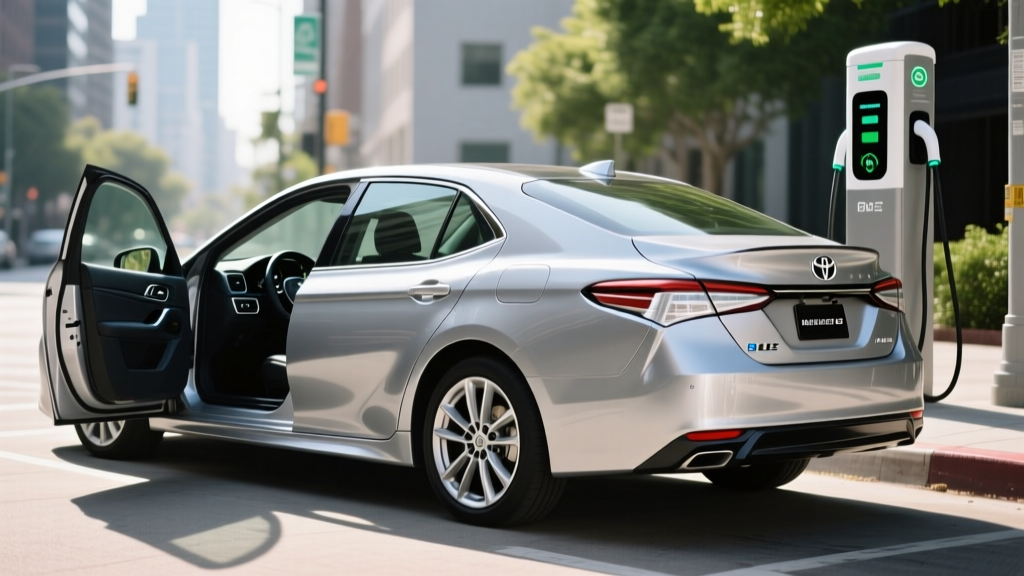
The 2018 Toyota Camry Hybrid XLE sits at a crossroads for used-car shoppers in 2026: it's a midsize sedan that delivers genuine 40+ MPG without a plug, carries Toyota's long-standing hybrid reliability reputation, and can be found on the used market for roughly $16,000–$22,000 depending on mileage and condition. But is an eight-year-old hybrid still a smart buy, and what should you know about its battery before signing the paperwork?
This guide covers the 2018 Camry Hybrid XLE's real-world fuel economy, powertrain specs, battery longevity data, and how it stacks up against modern PHEVs and full EVs for today's buyers.
Fuel Economy: EPA Ratings vs. Real-World MPG
The 2018 Camry Hybrid XLE carries an EPA-estimated 44 MPG city / 47 MPG highway / 46 MPG combined. That's not a typo — unlike many vehicles, this hybrid actually returns slightly better numbers on the highway than in the city, though the spread is narrow. The LE trim edges slightly higher at 51/53/52 MPG combined due to lighter wheels and lower rolling-resistance tires, but the XLE's 18-inch alloys and additional equipment cost you roughly 5–6 MPG.
| Trim | City MPG | Highway MPG | Combined MPG |
|---|---|---|---|
| Camry Hybrid LE | 51 | 53 | 52 |
| Camry Hybrid SE | 44 | 47 | 46 |
| Camry Hybrid XLE | 44 | 47 | 46 |
Source: fueleconomy.gov
Real-World Expectations
In mixed driving, owners and testers consistently report 42–48 MPG combined with the XLE. City-heavy commutes with frequent stops play to the hybrid system's strengths — regenerative braking recaptures energy at every light, and the engine shuts off at idle. Highway cruising above 70 MPH sees efficiency dip to roughly 39–42 MPG as aerodynamic drag dominates and the electric motor contributes less. In cold weather (below 35°F), expect a 5–10% drop as the engine runs more frequently to heat the cabin and bring the catalytic converter to operating temperature.
With a 13.2-gallon fuel tank, real-world range lands between 550 and 630 miles per fill-up — a genuine road-trip advantage over most EVs and PHEVs.
Powertrain and Performance Specs
The 2018 Camry Hybrid uses Toyota's fourth-generation Hybrid Synergy Drive, pairing a 2.5-liter four-cylinder engine with an electric motor through an electronically controlled continuously variable transmission (eCVT).
| Specification | 2018 Camry Hybrid XLE |
|---|---|
| Engine | 2.5L inline-4 (Atkinson cycle) |
| Engine Output | 176 HP / 163 lb-ft torque |
| Electric Motor Output | 118 HP / 149 lb-ft torque |
| Net Combined Horsepower | 208 HP |
| Transmission | eCVT (planetary gearset) |
| Hybrid Battery | 1.6 kWh nickel-metal hydride (NiMH), sealed |
| 0–60 MPH | ~7.8 seconds |
| Drivetrain | Front-wheel drive |
| Curb Weight | ~3,572 lbs |
The 208 combined horsepower figure represents peak system output — the engine and motor don't hit their individual peaks simultaneously. What matters in daily driving is the strong low-end torque from the electric motor, which gives the Camry Hybrid confident off-the-line acceleration and seamless stop-start transitions. The eCVT avoids the rubber-band feel of belt-driven CVTs; Toyota's planetary gearset design splits power mechanically and electrically, delivering smooth, direct acceleration.
HEV vs. PHEV: Where the Camry Hybrid Fits
The 2018 Camry Hybrid is a conventional hybrid (HEV) — it has no plug, no electric-only driving range to speak of, and you never need to charge it. The small 1.6 kWh NiMH battery recharges through regenerative braking and the gasoline engine. Toyota did not offer a Camry PHEV in the US market for the 2018 model year.
HEV vs. PHEV vs. EV — Quick Comparison
| Feature | HEV (Camry Hybrid) | PHEV (e.g., Prius Prime) | BEV (e.g., Tesla Model 3) |
|---|---|---|---|
| Plug Required? | No | Yes (optional) | Yes (mandatory) |
| Electric-Only Range | ~1 mile at low speed | 25–44 miles (model dependent) | 250–360+ miles |
| Total Range | 550–630 miles | 400–600+ miles | 250–360+ miles |
| Home Charging Needed? | No | Recommended for full benefit | Yes, essential |
| Federal Tax Credit (New) | None | Up to $7,500 (§30D, if eligible) | Up to $7,500 (§30D, if eligible) |
| Fuel Cost per Mile | ~$0.08 (gas at $3.50/gal) | ~$0.04 electric / ~$0.08 gas | ~$0.04 (home charging) |
The Camry Hybrid XLE makes sense if you lack reliable home charging access, drive long or unpredictable routes, or simply want maximum efficiency with zero lifestyle change. A PHEV rewards drivers who can plug in nightly and commute under 30 miles. A full BEV delivers the lowest per-mile cost but demands charging infrastructure and route planning for road trips.
Battery Longevity, Warranty, and Replacement Cost
Hybrid battery anxiety is the top concern for used-hybrid buyers, and it deserves a direct answer.
Original Battery Warranty
Toyota covered the 2018 Camry Hybrid battery for 8 years / 100,000 miles (10 years / 150,000 miles in California and states that follow CARB emissions rules). For a 2018 model, original factory coverage has expired in most states as of 2026.
Real-World Battery Lifespan
Toyota's NiMH hybrid batteries have a well-documented track record. Data from fleet operators, taxi services, and long-term owners shows these packs commonly last 150,000–200,000+ miles before meaningful capacity loss. Unlike the lithium-ion packs in EVs and PHEVs, the Camry's small NiMH battery is never deeply cycled — the hybrid system keeps the state of charge in a narrow 40–80% window, which dramatically extends cell life.
That said, age matters alongside mileage. An eight-year-old battery that sat in a hot climate (Arizona, Texas, Florida) may show more degradation than one in a temperate region. Heat accelerates NiMH cell deterioration.
Replacement Cost
If the hybrid battery does fail outside warranty:
- New OEM battery from Toyota: $2,500–$4,000 (parts and labor at a dealership)
- Refurbished/remanufactured battery: $1,200–$2,000 installed
- Individual cell replacement (specialist shops): $500–$1,000 if only a few cells are weak
Before buying a used 2018 Camry Hybrid, ask for a hybrid battery health check. Many Toyota dealers can pull the battery's internal resistance readings and state-of-health data through the OBD-II port. A pre-purchase inspection by a hybrid-experienced mechanic is worth the $100–$150 fee.
Pricing and Tax Credit Eligibility in 2026
The 2018 Camry Hybrid XLE originally carried an MSRP of approximately $32,685 (including destination). In the 2026 used market, expect to pay:
- $16,000–$18,000 for examples with 90,000–120,000 miles
- $18,000–$22,000 for examples with 50,000–80,000 miles in clean condition
- $22,000+ for low-mileage, single-owner, certified pre-owned units
Federal Tax Credits
The 2018 Camry Hybrid does not qualify for the federal §30D new clean vehicle credit — it is a conventional HEV, not a plug-in vehicle. The IRS restricts §30D credits to PHEVs and BEVs meeting battery capacity, critical mineral sourcing, and MSRP thresholds.
However, if you purchase this vehicle from a dealer as a used car, you may be eligible for the Used Clean Vehicle Credit (§25E), which offers up to $4,000 or 30% of the sale price (whichever is less). But — and this is critical — §25E also requires the vehicle to be a plug-in electric vehicle (PHEV or BEV) with a minimum 7 kWh battery. Since the Camry Hybrid is a conventional HEV with a 1.6 kWh pack, it does not qualify for any federal tax credit.
Some states and utilities offer rebates for used hybrid purchases. Check your state energy office or local utility for current programs, as these vary widely by jurisdiction.
Who Should Buy the 2018 Camry Hybrid XLE?
Pros
- 46 MPG combined (EPA) with no plug required
- 550–630 mile real-world range per tank
- Proven Toyota hybrid reliability; NiMH battery longevity well documented
- Comfortable XLE interior with leatherette, dual-zone climate, 8-inch touchscreen
- Strong safety scores: IIHS Top Safety Pick, 5-star NHTSA overall
- Low cost per mile: ~$0.08/mi fuel cost at $3.50/gallon
Cons
- No electric-only driving; not eligible for federal tax credits
- XLE's 18-inch wheels reduce MPG vs. LE trim by ~6 MPG combined
- Original hybrid battery warranty expired for most 2018 models
- eCVT drone under hard acceleration (common to Toyota hybrids of this era)
- Infotainment lacks Apple CarPlay/Android Auto (added in 2019 refresh)
Decision Framework
Choose the 2018 Camry Hybrid XLE if:
- You can't install a home charger and want maximum MPG without a plug
- Your commute is 20–60 miles round-trip with mixed city/highway driving
- You want a proven, low-risk used sedan with minimal maintenance surprises
- You regularly take road trips where charging infrastructure is sparse
Look at a PHEV (e.g., 2020+ Prius Prime) if:
- You have Level 2 home charging and a commute under 25 miles each way
- You want electric-only daily driving with gas backup for longer trips
Look at a full EV (e.g., 2022+ Tesla Model 3, Hyundai Ioniq 5) if:
- You have reliable home charging and want the lowest per-mile fuel cost
- You qualify for the §30D credit on a new or used EV purchase
Frequently Asked Questions
How many MPG does the 2018 Camry Hybrid XLE actually get?
The EPA rates it at 44 city / 47 highway / 46 combined. Real-world owners report 42–48 MPG combined in temperate conditions, with city-heavy driving often exceeding the EPA estimate and sustained 75+ MPH highway driving dropping to 39–42 MPG.
Does the 2018 Camry Hybrid need to be plugged in?
No. This is a conventional hybrid (HEV), not a plug-in hybrid (PHEV). The battery charges through regenerative braking and the gasoline engine. You simply fill it with gas and drive.
How long will the hybrid battery last?
Toyota's NiMH hybrid batteries commonly last 150,000–200,000+ miles. Age and heat exposure are the main factors in degradation. For a 2018 model in 2026, a pre-purchase hybrid battery health check is strongly recommended.
What does it cost to replace the hybrid battery?
A new OEM battery runs $2,500–$4,000 installed at a dealer. Refurbished packs cost $1,200–$2,000 installed, and individual cell repairs at specialist shops can be as low as $500–$1,000.
Does the 2018 Camry Hybrid qualify for any tax credit?
No federal tax credits apply. The §30D new-vehicle credit and §25E used-vehicle credit both require plug-in vehicles (PHEV or BEV). The Camry Hybrid is a conventional HEV and is ineligible. Check your state and utility for possible local hybrid incentives.
Is the XLE worth the MPG penalty over the LE trim?
If you value leatherette seats, a power-adjustable front passenger seat, blind-spot monitoring, ambient lighting, and 18-inch alloy wheels, yes — the 6 MPG combined difference (52 vs. 46) costs roughly $100–$130 per year in additional fuel at 12,000 miles/year and $3.50/gallon. For most buyers, that's a reasonable trade for the added comfort and features.
How does the 2018 Camry Hybrid compare to a modern 2026 hybrid?
Today's Camry Hybrid (2025–2026) uses a fifth-generation system with a lithium-ion battery and achieves up to 52 MPG combined on XLE trims. The gains are real but modest — roughly 6 MPG combined. If budget is the priority, the 2018 model delivers 90% of the efficiency at half the price of a new one.