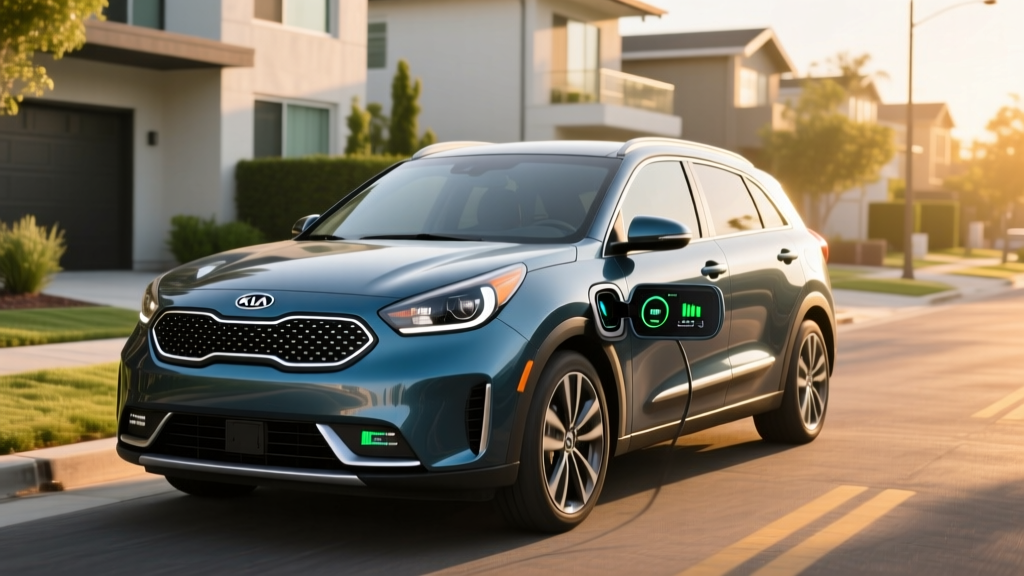
The 2018 Kia Niro Hybrid occupies a specific niche that still resonates in 2026: a practical, no-nonsense compact crossover that sips fuel without demanding you change how you drive. Unlike a plug-in hybrid or full EV, this conventional hybrid (HEV) requires zero lifestyle adjustment — no charging cables, no range planning, no outlet hunting. You fill it with gas and go, while its parallel-hybrid system quietly slashes fuel consumption, especially in city driving.
With used 2018 Niro Hybrid examples now trading well below $15,000, it has become one of the most accessible fuel-efficient crossovers on the market. But does its efficiency hold up in real-world conditions? How reliable is its lithium-ion hybrid battery eight years later? And how does it compare to newer hybrids, PHEVs, and EVs available today? This review covers the exact numbers you need to decide.
2018 Kia Niro Hybrid: Powertrain and Efficiency Specs
The 2018 Niro pairs a 1.6-liter Atkinson-cycle four-cylinder engine with a permanent-magnet synchronous electric motor and a 1.56 kWh lithium-ion polymer battery pack. Power flows through a 6-speed dual-clutch automatic transmission (DCT) — a deliberate choice by Kia that gives the Niro a more natural driving feel compared to the rubber-band sensation of the CVTs found in the Toyota Prius and Honda Insight of the same era.
| Specification | Value |
|---|---|
| Engine | 1.6L Atkinson-cycle I4 |
| Engine Output | 104 hp / 109 lb-ft torque |
| Electric Motor | 32 kW (43 hp) permanent-magnet synchronous |
| Combined System Output | 139 hp / 195 lb-ft torque |
| Hybrid Battery | 1.56 kWh lithium-ion polymer |
| Transmission | 6-speed dual-clutch automatic (DCT) |
| Drivetrain | Front-wheel drive |
| 0–60 mph | ~9.7 seconds |
| Curb Weight | 3,139–3,274 lbs (varies by trim) |
| Cargo Volume | 22.7 cu ft (rear seats up) / 54.5 cu ft (folded) |
| Towing Capacity | Not rated for towing |
The 1.56 kWh battery is small by PHEV or EV standards, but it is precisely sized for its role: capturing regenerative braking energy and providing short bursts of electric-only assist at low speeds. It charges exclusively through regenerative braking and the gasoline engine — you never plug it in. This is a conventional hybrid, not a plug-in.
Fuel Economy: EPA Ratings vs. Real-World MPG
Fuel economy varies by trim level because wheel size and equipment weight affect efficiency. The base FE (Fuel Economy) trim rides on 16-inch wheels with low-rolling-resistance tires and achieves the highest ratings, while higher trims with 18-inch wheels see a modest drop.
| Trim | City | Highway | Combined |
|---|---|---|---|
| FE (LX base) | 52 MPG | 49 MPG | 50 MPG |
| LX / EX | 51 MPG | 46 MPG | 49 MPG |
| Touring / Touring Launch Edition | 46 MPG | 40 MPG | 43 MPG |
Source: EPA Fuel Economy — 2018 Kia Niro
Like most hybrids, the Niro tends to exceed its EPA city rating in stop-and-go driving where regenerative braking recovers the most energy. Owners consistently report 50–55 MPG in urban commuting on the FE and LX trims. Highway driving is a different story: at sustained 70–80 mph speeds, the electric motor contributes less and the 1.6L engine does most of the work. Expect 40–44 MPG on the highway for LX/EX trims and 36–40 MPG for the Touring. Cold weather (below 35°F) reduces fuel economy by roughly 5–10% due to increased engine warm-up time and cabin heating demand.
With a 11.9-gallon fuel tank, the FE trim delivers a real-world driving range of approximately 520–580 miles per tank in mixed driving. That translates to roughly 10+ gallons saved per year compared to a similarly sized gasoline-only crossover averaging 28 MPG combined, based on 15,000 annual miles.
HEV vs. PHEV vs. EV: Which Powertrain Fits You?
The 2018 Niro was sold in three distinct powertrain variants. Understanding the differences is critical before shopping the used market, because pricing, capability, and ownership experience diverge significantly.
| Attribute | Niro HEV (Hybrid) | Niro PHEV (Plug-In) | Niro EV (Full Electric) |
|---|---|---|---|
| Powertrain Type | Conventional Hybrid | Plug-In Hybrid | Battery Electric |
| Plug-In Required? | No — self-charging | Yes — 120V or 240V | Yes — 240V recommended |
| Electric-Only Range | ~0.5 mi at low speed | 26 mi (EPA) | 239 mi (EPA) |
| Total Range | ~550 mi | ~560 mi (gas + electric) | 239 mi |
| Hybrid/Traction Battery | 1.56 kWh Li-ion | 8.9 kWh Li-ion polymer | 64 kWh Li-ion polymer |
| Combined System HP | 139 hp | 139 hp | 201 hp |
| EPA Efficiency | 43–50 MPG | 105 MPGe (elec) / 46 MPG (gas) | 112 MPGe |
| DC Fast Charge? | N/A | No (Level 2 AC only) | Yes — CCS, ~64 kW peak |
| Used Price Range (2026) | $9,000–$15,000 | $12,000–$18,000 | $12,000–$19,000 |
- Choose the HEV if: You have no access to home or workplace charging, drive mostly city miles, want the lowest purchase price, and need maximum total range without thinking about it.
- Choose the PHEV if: You can install a Level 2 charger at home, your daily commute is under 26 miles round-trip (covering most errands on electricity), but you still want gas-engine flexibility for road trips.
- Choose the EV if: You have reliable home charging, your daily driving stays under ~200 miles, you want zero tailpipe emissions and the lowest per-mile fuel cost, and you value the EV's instant torque and quietness.
Driving Impressions and Practical Usability
The 2018 Niro Hybrid was never designed to thrill — its 9.7-second 0–60 mph time confirms that. What it delivers instead is competence. The 6-speed DCT shifts crisply in normal driving, avoiding the drone of a CVT under hard acceleration. Steering is light and precise, body roll is well-controlled, and the ride quality over rough pavement is surprisingly compliant for a vehicle with a relatively short 106.3-inch wheelbase.
Where the DCT occasionally stumbles is in low-speed stop-and-go traffic. Some drivers report a slight hesitation or shudder when transitioning from electric-only mode to engine engagement at 15–25 mph. This is a known characteristic of early Hyundai/Kia hybrid DCT programming and is generally not indicative of a mechanical fault, but it is worth experiencing on a test drive.
Practicality is a strong suit. The 22.7 cu ft cargo area behind the rear seats outpaces the 2018 Toyota Prius (24.6 cu ft with seats up, but a liftback rather than a crossover hatch). Rear seat legroom of 37.4 inches is generous for the class, and the relatively flat load floor makes the Niro usable for family duty, pet transport, or weekend gear hauling.
Reliability, Battery Longevity, and Warranty
The 2018 Niro Hybrid uses a lithium-ion polymer battery manufactured by LG Chem (now LG Energy Solution). Unlike the nickel-metal hydride (NiMH) batteries in older Toyota hybrids, lithium-ion chemistry offers better energy density and lighter weight, but buyers of used examples naturally ask: how long will it last, and what does replacement cost?
Kia's original hybrid battery warranty for the 2018 Niro covers 10 years or 100,000 miles (whichever comes first) for the original owner in most states. In California Air Resources Board (CARB) states — including California, New York, Massachusetts, and several others — the warranty extends to 10 years / 150,000 miles. However, because the 2018 model year is now past the 10-year mark as of 2028 (and approaching it in 2026 for high-mileage examples), most used 2018 Niros will have partially or fully expired factory battery warranties unless the vehicle has unusually low mileage and was purchased late in the model year. Always verify warranty status with a Kia dealer using the VIN.
In practice, the Niro's 1.56 kWh hybrid battery has proven durable. Unlike EV batteries that undergo deep charge-discharge cycles daily, the Niro's hybrid battery operates in a narrow state-of-charge window — typically between 40% and 80% — which dramatically reduces degradation stress. Industry data and owner forums suggest that Hyundai/Kia hybrid batteries from this generation commonly reach 150,000–200,000+ miles before significant capacity loss is observed.
If replacement becomes necessary, a new OEM hybrid battery pack for the 2018 Niro currently runs approximately $2,500–$3,500 including labor at a dealership. Independent hybrid-specialty shops may offer refurbished packs for $1,500–$2,500. This is a fraction of EV battery replacement costs (typically $5,000–$20,000) because the pack is small.
Beyond the battery, the 2018 Niro's overall reliability record is solid. The 1.6L GDI engine is well-proven, and the DCT, while occasionally jerky at low speed, has not shown widespread failure patterns. Common wear items reported by owners include 12V auxiliary battery replacement (typical for any vehicle at 4–5 years), brake actuator noise (regenerative braking reduces pad wear significantly — many owners report 80,000+ miles on original pads), and occasional infotainment screen freezes resolved by software updates.
Tax Credits, Incentives, and Used Purchase Economics
When new, the 2018 Niro Hybrid did not qualify for the federal §30D EV tax credit because it is a conventional hybrid without plug-in capability. This remains true on the used market: the Niro HEV does not qualify for any federal tax credit, whether new or used. The IRS used-EV credit (up to $4,000 under §25E) applies only to qualified plug-in electric vehicles and fuel-cell vehicles — conventional hybrids are excluded.
| Model | Federal Credit (Original Purchase) | Used EV Credit §25E (2026) |
|---|---|---|
| Niro HEV (Hybrid) | Not eligible — no plug-in | Not eligible — not a qualified EV |
| Niro PHEV (Plug-In) | Up to $4,543 (original, now expired) | Potentially up to $4,000 (income & price caps apply) |
| Niro EV (Electric) | $7,500 (original, now expired) | Potentially up to $4,000 (income & price caps apply) |
For context on the used EV credit, the IRS §25E rules require the buyer's modified adjusted gross income to fall below $75,000 (single) / $150,000 (joint), the sale price must not exceed $25,000, and the vehicle must be at least two model years old. See IRS Used Clean Vehicle Credit for full eligibility details.
The real economic story of the 2018 Niro Hybrid is fuel savings. At a used purchase price of $10,000–$14,000 and 50 MPG combined, a driver covering 15,000 miles annually at $3.40/gallon spends roughly $1,020/year on fuel. A comparable gasoline crossover at 28 MPG combined would cost about $1,821/year — an annual savings of approximately $800, or $4,000 over five years of ownership.
Trims, Features, and What to Look For
The 2018 Niro Hybrid was offered in five trims: FE, LX, EX, Touring, and Touring Launch Edition. Here is what differentiates them:
- FE: Maximum efficiency (50 MPG combined). 16-inch alloy wheels, 7-inch touchscreen, Apple CarPlay/Android Auto, rearview camera, basic cloth seats. The lightest and most efficient trim.
- LX: Adds roof rails, upgraded interior trim, and optional cargo cover. Nearly identical efficiency to FE (49 MPG combined).
- EX: 18-inch wheels (reduces MPG to 49 combined), leather-wrapped steering wheel, push-button start, Smart Cruise Control, blind-spot detection, rear cross-traffic alert.
- Touring: Leather seats, heated/ventilated front seats, 8-inch navigation screen, Harman Kardon premium audio, LED headlights. Efficiency drops to 43 MPG combined due to weight and 18-inch wheels.
- Touring Launch Edition: Same as Touring with exclusive exterior color and badging. Limited production.
Used-buying checklist for the 2018 Niro Hybrid:
- Verify hybrid battery health via OBD-II scan tool (check state-of-health percentage — aim for 85%+ at this age).
- Confirm whether the original hybrid battery warranty is still active by VIN through a Kia dealer.
- Check for DCT software update recalls — Kia issued a TSB for low-speed shudder on some 2017–2019 Niros.
- Inspect for uneven tire wear, which can indicate alignment issues that reduce fuel economy.
- Review maintenance records — the 1.6L GDI engine benefits from regular oil changes with the correct 0W-20 synthetic.
2018 Kia Niro Hybrid: Pros and Cons
- 50 MPG combined on FE trim — among the most efficient crossovers ever sold
- No plug-in required — zero lifestyle change from a gas car
- Generous cargo space (22.7 cu ft) for a compact hybrid
- 6-speed DCT avoids CVT drone — more natural driving feel
- Strong safety ratings: IIHS Top Safety Pick, NHTSA 5-star overall
- Low used-market price ($9K–$15K) with strong fuel payback
- Apple CarPlay and Android Auto standard on all trims
- Modest 139 hp — 0–60 in 9.7 seconds; highway merging requires planning
- Touring trim drops to 43 MPG — significant penalty for luxury features
- DCT can hesitate in low-speed stop-and-go traffic
- No all-wheel-drive option (FWD only)
- Original hybrid battery warranty expiring on most examples by 2028
- Not eligible for any federal tax credit (new or used)
- Rear visibility somewhat limited by thick C-pillars
Frequently Asked Questions
How many MPG does the 2018 Kia Niro Hybrid get?
The EPA rates the 2018 Niro Hybrid FE at 52 city / 49 highway / 50 combined MPG. The LX and EX trims achieve 51/46/49 MPG, while the heavier Touring trim drops to 46/40/43 MPG. In real-world city driving, many owners report exceeding their EPA city rating by 2–5 MPG thanks to aggressive regenerative braking.
Does the 2018 Niro Hybrid need to be plugged in?
No. The Niro Hybrid is a conventional hybrid (HEV). Its small 1.56 kWh battery charges exclusively through regenerative braking and the gasoline engine. You never plug it in. If you want plug-in capability, look at the Niro PHEV (26 miles electric-only range) or the Niro EV (239 miles EPA range).
Is the 2018 Kia Niro Hybrid reliable?
Yes. The Niro Hybrid has a strong reliability record. The 1.6L engine and hybrid system have proven durable, with the lithium-ion hybrid battery commonly lasting 150,000+ miles without significant degradation. The most common complaints involve minor infotainment glitches and low-speed DCT hesitation, neither of which are typically expensive to address. The Niro earned a Top Safety Pick rating from the IIHS and a 5-star overall rating from NHTSA.
What does it cost to replace the hybrid battery?
A new OEM hybrid battery for the 2018 Niro costs approximately $2,500–$3,500 installed at a Kia dealership. Refurbished or aftermarket packs are available from independent hybrid specialists for $1,500–$2,500. Because the battery is only 1.56 kWh, replacement costs are far lower than EV battery replacements. Most owners will never need to replace it within typical ownership periods.
Does the 2018 Niro Hybrid qualify for any tax credit?
No. The conventional Niro Hybrid does not qualify for the federal §30D new EV credit or the §25E used EV credit, as both require plug-in electric capability. The Niro PHEV and Niro EV may qualify for the used EV credit (up to $4,000) if buyer income and vehicle price requirements are met. Consult a tax professional and review IRS guidelines for your specific situation.
How does the 2018 Niro Hybrid compare to a Toyota Prius?
The 2018 Prius achieves 54 MPG combined (Two trim) versus the Niro FE's 50 MPG — a slight efficiency edge for the Prius. However, the Niro offers a crossover-style seating position, more upright cargo area (22.7 cu ft vs. 24.6 cu ft but with a lower, less usable shape in the Prius), and a conventional 6-speed transmission feel versus the Prius's CVT. If maximum MPG is your only priority, the Prius wins. If you prefer crossover ergonomics and a more natural driving feel, the Niro is the stronger choice.
Should I buy a used 2018 Niro Hybrid in 2026?
If you need an affordable, ultra-efficient daily driver and cannot charge at home, the used 2018 Niro Hybrid is one of the best values in the segment. At $10,000–$14,000 with 50 MPG, it offers a compelling total cost of ownership. The key risk is hybrid battery warranty expiration — prioritize low-mileage examples and have the battery health checked before purchase. If you have home charging access, also cross-shop the Niro PHEV and Niro EV on the used market, as both may qualify for the $4,000 used EV credit, further reducing effective cost.