Quick Verdict: A Performance Hybrid Out of Time
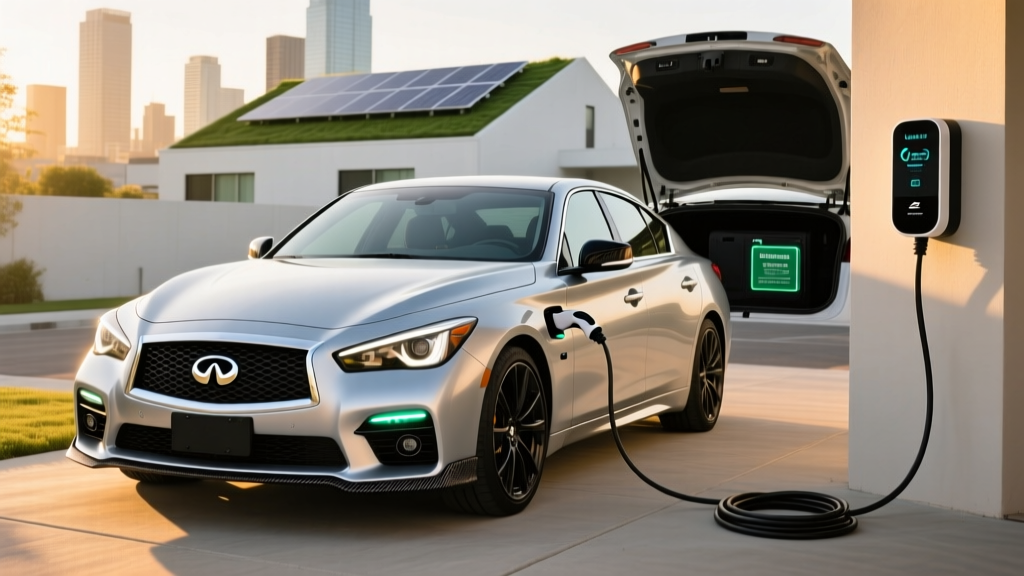
The 2018 Infiniti Q50 Hybrid occupies an unusual space in the used-car market: a luxury sport sedan that pairs a twin-turbo V6 with an electric motor for 360 combined horsepower, yet achieves an EPA-rated 29 MPG combined. For 2026 buyers shopping the used luxury-hybrid segment, the Q50 Hybrid (officially badged as the Q50 Sport Hybrid) offers genuine performance credentials alongside meaningful fuel savings over its gas-only siblings — but it comes with important caveats around battery age, parts availability, and the reality that Infiniti discontinued this powertrain after 2018.
This was the final model year for Infiniti's Direct Response Hybrid system in the Q50. If you're evaluating one on the used market today, the hybrid battery is at minimum eight years old, which makes warranty status and replacement cost the single most important factor in your purchase decision.
HEV vs PHEV: What the Q50 Hybrid Actually Is
Conventional Hybrid (HEV): The 2018 Q50 Hybrid is a conventional self-charging hybrid. It does not plug in. The small lithium-ion battery recharges through regenerative braking and the gasoline engine. You fuel it exclusively at a gas station — there is no electric-only driving range to speak of beyond brief low-speed assist.
Plug-in Hybrid (PHEV): A PHEV like the Toyota RAV4 Prime or BMW 330e has a larger battery (typically 10-20 kWh) that you charge via a plug, delivering 20-40 miles of pure electric range before the gas engine engages. The Q50 Hybrid is not a PHEV.
Why it matters: If you want electric-only commuting, the Q50 Hybrid will not deliver that. It's designed to reduce fuel consumption and boost acceleration simultaneously — a performance hybrid, not an efficiency-first commuter.
EPA Fuel Economy and Real-World MPG
| Configuration | City | Highway | Combined |
|---|---|---|---|
| Q50 Sport Hybrid (RWD) | 27 MPG | 32 MPG | 29 MPG |
| Q50 Sport Hybrid (AWD) | 26 MPG | 30 MPG | 27 MPG |
| Q50 3.0t (gas-only RWD, baseline) | 20 MPG | 29 MPG | 23 MPG |
Source: EPA / fueleconomy.gov
Real-world MPG expectations: Conventional hybrids tend to meet or exceed their EPA city rating because regenerative braking recaptures more energy in stop-and-go traffic. On the highway, where the electric motor contributes less, expect the Q50 Hybrid RWD to return roughly 28-30 MPG at 70 mph. In city-heavy commuting (60%+ city driving), owners commonly report 28-31 MPG. AWD models lose approximately 2 MPG across the board due to drivetrain losses and added weight.
Cold-weather impact: Expect a 5-10% reduction in fuel economy during winter months. The gasoline engine runs more frequently to maintain cabin heat, reducing the hybrid system's ability to shut it off at stops.
The hybrid's advantage over the gas-only Q50 3.0t is most pronounced in city driving: 27 MPG versus 20 MPG is a 35% improvement where it matters most for daily commuting. On the highway, the gap narrows to just 3 MPG.
Powertrain Specs: 360 HP From Two Sources
| Specification | Detail |
|---|---|
| Engine | 3.5L V6 (naturally aspirated) |
| Engine output | 302 HP / 258 lb-ft torque |
| Electric motor | 67 HP / 214 lb-ft torque |
| Combined system output | 360 HP |
| Transmission | 7-speed automatic (no torque converter — uses motor as clutch) |
| Drivetrain | RWD standard; AWD available |
| Hybrid battery | ~1.4 kWh lithium-ion (not user-serviceable, not plug-in) |
| 0-60 mph | ~5.1 seconds (RWD) |
| Curb weight | ~4,032 lbs (RWD Hybrid) |
Infiniti's Direct Response Hybrid system is unusual. Rather than using a conventional torque converter, the electric motor sits between the engine and transmission and acts as both a drive motor and a clutch. This gives the Q50 Hybrid sharper throttle response than most hybrids of its era — it feels more like a performance sedan that happens to be efficient, rather than an efficiency sedan that happens to be quick.
The 1.4 kWh battery pack is small by any standard. It exists to buffer energy from regenerative braking and provide short bursts of electric assist — typically under 1 mile of electric-only creep at parking-lot speeds. Do not expect meaningful electric-only driving.
Used Pricing in 2026 and Tax Credit Reality
The 2018 Q50 Hybrid was originally priced from approximately $51,800 (RWD) to $54,000+ (AWD) before options. In the 2026 used market, examples typically trade between $16,000 and $24,000 depending on mileage, condition, trim level, and whether the hybrid battery has been replaced.
Federal tax credit for used hybrids (2026 rules):
- The IRS Used Clean Vehicle Credit (§25E) offers up to $4,000 or 30% of the sale price (whichever is less) for qualifying used EVs and PHEVs.
- Conventional hybrids like the Q50 Sport Hybrid do not qualify for this credit. The vehicle must be a plug-in EV or PHEV to be eligible.
- Income caps apply: $75,000 single / $150,000 joint filers.
- The vehicle must be purchased from a licensed dealer, priced at or below $25,000, and be at least two model years old.
- Even if the Q50 Hybrid were eligible (it is not), many examples now exceed the $25,000 price cap.
Bottom line: No federal tax credit applies to the 2018 Q50 Hybrid. Check your state's incentives — some states offer modest rebates for used hybrids, but most have shifted focus to plug-in vehicles.
Battery Health, Warranty, and Replacement Cost
Original hybrid battery warranty: Infiniti covered the Q50 Hybrid's lithium-ion battery pack for 8 years / 100,000 miles (96 months), whichever came first. In states that adopted California's stricter emissions warranty rules (CA, CT, MA, ME, NJ, NY, OR, RI, VT, WA), coverage extended to 10 years / 150,000 miles.
2026 warranty reality: A 2018 model year vehicle is now eight years old. Most Q50 Hybrids on the used market have either just exited their original battery warranty window or are within months of doing so. If you're buying in a CARB state and the vehicle has under 150,000 miles, you may still have limited coverage — but verify with an Infiniti dealer using the VIN before purchase.
Battery replacement cost: A new OEM hybrid battery pack for the 2018 Q50 Hybrid runs approximately $3,500 to $5,000 including labor at a dealership. Third-party reconditioned or refurbished packs are available for $2,000-$3,500, though availability varies and quality is inconsistent. As Infiniti discontinued this hybrid system, parts supply may tighten further in coming years.
What does a failing hybrid battery look like in practice? Expect a gradual decline in fuel economy — perhaps 2-4 MPG below original spec — rather than a sudden failure. The dashboard will eventually trigger a hybrid system warning light. Unlike a full EV battery, the Q50 Hybrid's 1.4 kWh pack is small enough that replacement, while expensive, doesn't approach the $10,000-$20,000+ figures associated with EV battery swaps.
Reliability Track Record
The 2018 Q50 Hybrid's powertrain is generally considered reliable. The 3.5L V6 (VQ35HR family) is a proven engine with a long production history, and the hybrid system uses a relatively simple parallel configuration. The most commonly reported issues on owner forums and reliability databases include:
- Hybrid battery cooling fan: The fan that manages battery temperature can fail, typically between 60,000-90,000 miles. Replacement runs $400-$700.
- 12V auxiliary battery: Like all hybrids and EVs, the Q50 has a conventional 12V battery that powers electronics. These typically last 3-5 years and are inexpensive to replace (~$200).
- Transmission behavior: The unique motor-as-clutch 7-speed can feel slightly jerky at low-speed transitions when new; this doesn't typically worsen with age but is worth noting in a test drive.
- Brake actuator: The regenerative braking system uses a specialized brake actuator. Failures are uncommon but expensive ($1,500-$2,500) when they occur, typically above 100,000 miles.
For a vehicle of this age, a pre-purchase inspection by a technician familiar with Infiniti hybrid systems is strongly recommended. Ask specifically for a hybrid battery state-of-health (SoH) reading — this diagnostic can reveal whether the pack is operating within normal parameters or approaching end of life.
Who Should Buy the 2018 Q50 Hybrid vs Alternatives
Pros
- 360 HP makes it genuinely quick (5.1s to 60 mph)
- 27-29 MPG combined is strong for a luxury sport sedan
- 27 MPG city beats the gas-only Q50 by 35%
- No plug-in requirement — fuel and go
- Luxury interior with premium materials
- Used prices ($16K-$24K) represent significant depreciation discount
Cons
- Hybrid battery likely out of warranty in 2026
- Discontinued powertrain — parts supply risk increases over time
- No electric-only range (not a PHEV)
- Infotainment system dated by 2026 standards (dual-screen, no wireless CarPlay)
- No federal tax credit eligibility
- AWD hybrid is rare on the used market
Choose the 2018 Q50 Hybrid if:
- You want a sporty luxury sedan with sub-$25K pricing and strong city MPG
- You cannot install a home charger (apartment/condo living) and need a no-plug solution
- You drive 12,000+ miles/year and want fuel savings without going full EV
- You value acceleration as much as efficiency
Look at a full EV or newer PHEV instead if:
- You want electric-only commuting (consider a used BMW 330e, Toyota RAV4 Prime, or new PHEV)
- You want current warranty coverage on the battery system
- You want modern infotainment, wireless CarPlay/Android Auto, or advanced ADAS
- You qualify for the $7,500 federal EV credit on a new purchase (IRS §30D rules)
Consider the gas-only Q50 3.0t if:
- Your driving is mostly highway (the hybrid advantage shrinks to ~3 MPG)
- You want simpler maintenance with no hybrid-specific components
- You can find a well-maintained example at a lower price
Frequently Asked Questions
How many MPG does the 2018 Infiniti Q50 Hybrid get?
The EPA rates the RWD model at 27 city / 32 highway / 29 combined MPG. The AWD version drops to 26/30/27. In real-world city-heavy driving, owners commonly see 28-31 MPG with the RWD model.
Can the 2018 Q50 Hybrid drive on electric power only?
Only marginally. The hybrid system can propel the car at very low speeds (parking lots, brief stop-and-go) for roughly under one mile. It is not a plug-in hybrid and has no meaningful electric-only range. Think of the motor as a performance and efficiency assist, not a primary drive source.
Is the 2018 Q50 Hybrid reliable?
The powertrain is generally reliable. The V6 engine is proven, and the hybrid system is relatively simple. Key concerns at this vehicle age are hybrid battery health, brake actuator condition, and battery cooling fan operation. A pre-purchase inspection with a hybrid SoH check is essential.
What does it cost to replace the hybrid battery?
Expect $3,500-$5,000 for a new OEM pack at a dealership, or $2,000-$3,500 for a refurbished unit from a third party. Given the vehicle's age and the discontinued powertrain, factor this potential cost into your purchase budget.
Does the 2018 Q50 Hybrid qualify for any tax credit?
No. The federal Used Clean Vehicle Credit (§25E) applies only to plug-in electric vehicles and PHEVs. Conventional hybrids like the Q50 Sport Hybrid are not eligible. No current federal incentive applies to this vehicle. Some states may offer minor incentives — check your state's energy office for details.
Hybrid vs PHEV vs EV — which should I choose?
A conventional hybrid (like the Q50) is best if you cannot charge at home and want better MPG with zero behavior change. A PHEV is ideal if you can charge at home and want 20-40 miles of electric commuting with a gas engine for longer trips. A full EV makes sense if you have reliable home charging, want the lowest operating cost, and your daily driving fits within the vehicle's range. For 2026 buyers with home charging access, a PHEV or EV will typically offer lower total operating costs than a conventional hybrid.
Is the hybrid system covered under any remaining warranty?
The original warranty was 8 years/100,000 miles (10 years/150,000 in CARB states). As of 2026, most 2018 Q50 Hybrids are at or past the 8-year mark. Check with an Infiniti dealer using the specific VIN to confirm whether any coverage remains.