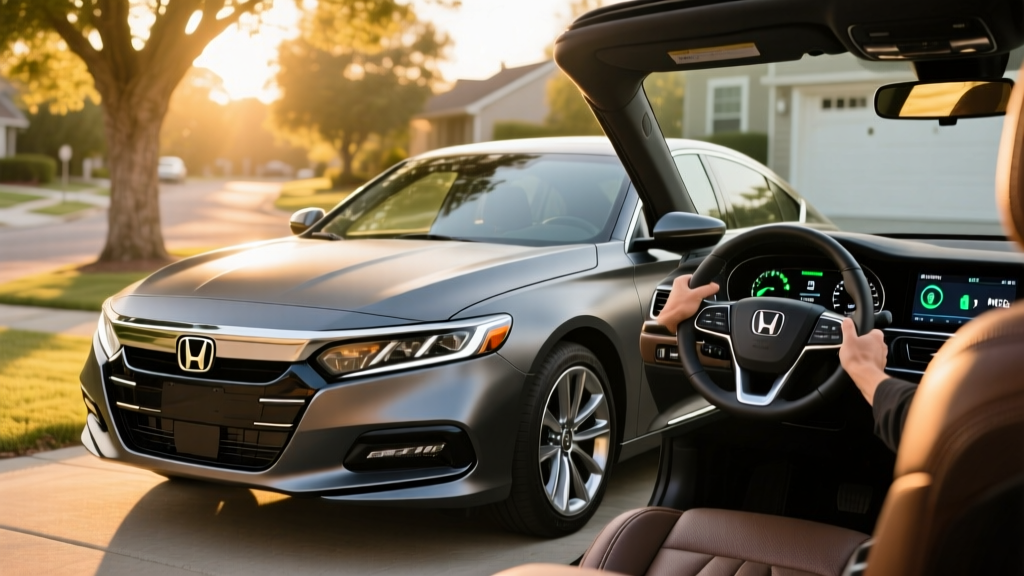
The 2018 Honda Accord Touring Hybrid sits at the top of Honda's electrified sedan lineup from a pivotal model year. As a conventional hybrid (HEV), it requires no plug, no charging infrastructure, and no behavior change from its driver — just fill up with gas and let the two-motor system optimize efficiency. In 2026, with used-car prices still elevated and EV charging infrastructure uneven, this sedan remains a compelling option for buyers who want electrified efficiency without range anxiety or home-charging logistics.
Below, we break down the exact EPA numbers, real-world fuel economy expectations, powertrain details, battery longevity, and what it costs to own one today.
2018 Honda Accord Touring Hybrid MPG: EPA vs. Real World
The EPA rates the 2018 Accord Hybrid (all trims including Touring) at 47 MPG city / 47 MPG highway / 47 MPG combined. That parity between city and highway is unusual and worth explaining: Honda's two-motor hybrid system runs primarily in electric-drive mode at low and moderate speeds, using the gasoline engine as a generator rather than a direct drive source. This makes city driving exceptionally efficient.
| Driving Condition | EPA MPG | Real-World Expectation |
|---|---|---|
| City | 47 MPG | 44–50 MPG (hybrids often exceed EPA in stop-and-go) |
| Highway | 47 MPG | 42–46 MPG (sustained 75+ mph reduces regen benefit) |
| Combined | 47 MPG | 43–48 MPG depending on driving mix |
Source: fueleconomy.gov — 2018 Honda Accord Hybrid
In real-world ownership, many Accord Hybrid drivers report averaging 44–48 MPG in mixed driving. City-heavy commuters who do lots of stop-and-go driving often see higher numbers than the EPA sticker — a characteristic unique to hybrids, where regenerative braking recaptures energy that a gas car would waste as heat. Highway-only road trips at 75–80 MPH tend to drop efficiency to 40–43 MPG because the system relies more on the gasoline engine at sustained high speeds.
With a 12.8-gallon fuel tank, expect a real-world range of roughly 550–610 miles per tank under normal conditions.
HEV vs. PHEV vs. EV: Where the Accord Hybrid Fits
Before going further, it is critical to distinguish between the three main types of electrified vehicles, because the 2018 Accord Hybrid is a conventional hybrid (HEV), not a plug-in.
HEV vs. PHEV vs. BEV — Quick Reference
| Feature | HEV (Accord Hybrid) | PHEV (e.g., Toyota RAV4 Prime) | BEV (e.g., Tesla Model 3) |
|---|---|---|---|
| Plug-in charging required? | No | Yes (optional but recommended) | Yes (mandatory) |
| Electric-only range | ~1 mile at low speed | 25–45 miles typical | 250–350+ miles |
| Battery size | 1.3 kWh (small buffer) | 13–20 kWh | 60–100 kWh |
| Fuel/energy source | Gasoline only | Gasoline + electricity | Electricity only |
| Federal tax credit (new, §30D) | $0 | Up to $7,500 (if eligible) | Up to $7,500 (if eligible) |
| Home charging needed? | No | Recommended for full benefit | Essential |
The Accord Hybrid captures energy through regenerative braking and engine-driven generation. It cannot be plugged in, and its small 1.3 kWh lithium-ion battery serves as a buffer — not a primary energy store. This makes it ideal for drivers who lack access to home or workplace charging but still want the fuel savings of electrification.
Powertrain: Two-Motor Hybrid System Specs
The 2018 Accord Touring Hybrid uses Honda's third-generation two-motor hybrid system, paired with a 2.0-liter Atkinson-cycle four-cylinder engine. Unlike a traditional hybrid with a planetary gearset (like Toyota's), Honda's system operates primarily as a series hybrid at low and moderate speeds — the engine drives a generator, which powers the electric drive motor. At highway speeds, a lockup clutch connects the engine directly to the wheels for efficiency.
| Specification | Value |
|---|---|
| Engine | 2.0L Atkinson-cycle I-4 |
| Engine horsepower | 146 hp @ 6,200 rpm |
| Drive motor output | 181 hp / 232 lb-ft torque |
| Total system horsepower | 212 hp |
| Transmission | Electronic CVT (e-CVT, no traditional gears) |
| Drivetrain | Front-wheel drive |
| 0–60 mph (est.) | ~7.5 seconds |
| Hybrid battery | 1.3 kWh lithium-ion |
The 212 combined horsepower gives the Accord Hybrid Touring confident passing power. The electric drive motor's instant 232 lb-ft of torque means off-the-line acceleration feels punchier than the numbers suggest — a characteristic advantage of hybrid and electric drivetrains over conventional gas engines that need to build revs.
Touring Trim: What You Get at the Top
The Touring was the most expensive trim in the 2018 Accord Hybrid lineup, and it came loaded. Key standard equipment includes:
- Honda Sensing suite (adaptive cruise control, lane-keeping assist, forward collision warning, road departure mitigation)
- 8-inch touchscreen with Apple CarPlay and Android Auto
- Navigation system
- Heated and ventilated front seats, heated rear seats
- Leather-trimmed interior
- Wireless phone charging
- Head-up display
- Rain-sensing wipers
- LED headlights with auto high beam
- 19-inch alloy wheels
The Touring trim originally carried an MSRP of approximately $34,990 (including destination). In the 2026 used market, expect to pay between $18,000 and $24,000 depending on mileage, condition, and region, based on current pricing from major used-car platforms.
Battery Longevity, Warranty, and Replacement Cost
Hybrid Battery Warranty
Honda covers the 2018 Accord Hybrid's lithium-ion battery pack for 8 years / 100,000 miles (10 years / 150,000 miles in CARB states including California, New York, Massachusetts, and others that follow California emissions standards).
This warranty covers defects and capacity loss below a functional threshold. If buying used in 2026, a 2018 model is now at the tail end of the standard 8-year window — verify remaining coverage with a Honda dealer using the VIN.
Hybrid battery degradation in the Accord is generally mild. The 1.3 kWh pack is small and Honda's battery management system keeps it within a conservative state-of-charge window (typically 20–80%), which dramatically reduces wear. Unlike a full EV battery that cycles through large energy swings daily, the Accord Hybrid's battery handles small, frequent micro-cycles — a less stressful pattern for lithium-ion chemistry.
Replacement cost: If the hybrid battery does need replacement out of warranty, expect to pay between $2,000 and $4,000 for a refurbished or new unit plus labor at a Honda dealership. Independent hybrid specialists can sometimes source refurbished packs for $1,500–$2,500. This is significantly less than a full EV battery replacement, which can exceed $10,000–$15,000.
In practice, Honda's hybrid batteries from this generation have proven durable. Many 2018 Accord Hybrids used in rideshare service have surpassed 150,000 miles on the original battery pack with minimal efficiency loss.
Tax Credits and Incentives for the 2018 Accord Hybrid
Because the 2018 Honda Accord Hybrid is a conventional HEV (not a plug-in), it does not qualify for the federal §30D clean vehicle tax credit. That credit — worth up to $7,500 — applies only to plug-in electric vehicles (BEVs and PHEVs) that meet battery sourcing, MSRP cap, and buyer income requirements as defined by the IRS.
When purchased new, the Accord Hybrid also did not qualify for the federal plug-in credit, because it has no plug. Some states and utilities offer modest rebates or HOV lane access for hybrids, but these programs vary by jurisdiction and many have expired or been redirected toward plug-in vehicles. Check with your state energy office or local utility for any current hybrid incentives.
For buyers specifically seeking a tax credit, a used PHEV or BEV may be a better financial play. The used clean vehicle credit (up to $4,000 or 30% of the sale price, whichever is less) applies to qualifying used plug-in vehicles priced under $25,000 — subject to income caps and dealer reporting requirements.
Who Should Choose the Accord Hybrid vs. a PHEV or Full EV?
Choose the Accord Hybrid If…
- You don't have access to home or workplace charging
- You want maximum simplicity — no plug, no apps, no charging planning
- Your commute is city-heavy with lots of stop-and-go traffic
- You want a proven, low-risk ownership experience
- You regularly take long road trips and don't want to plan charging stops
Consider a PHEV or EV Instead If…
- You have reliable Level 2 home charging (240V outlet or hardwired)
- Your daily commute is under 30–40 miles (a PHEV covers this on electricity alone)
- You want to eliminate or drastically reduce gasoline purchases
- You qualify for the §30D tax credit and want the financial offset
- You want to future-proof against rising gas prices
The Accord Hybrid occupies a specific niche: it is the best option for drivers who want electrified fuel savings but cannot or will not plug in. If you live in an apartment without charging access, park on the street, or simply want zero lifestyle change, the HEV path delivers 47 MPG without a single behavioral adjustment.
Pros and Cons of the 2018 Accord Touring Hybrid in 2026
Pros
- 47 MPG combined — exceptional for a midsize sedan
- No plug-in charging required — zero infrastructure dependency
- Touring trim is fully loaded with premium features
- Honda Sensing ADAS standard (adaptive cruise, lane-keep)
- Spacious interior with 16.7 cu ft trunk (battery under rear seats)
- Smooth, quiet hybrid powertrain with 212 hp
- Proven reliability with strong hybrid battery track record
Cons
- No federal tax credit eligibility (HEV, not PHEV/BEV)
- 8-year battery warranty may be expiring for 2018 models in 2026
- FWD only — no AWD option for snow-belt buyers
- 19-inch wheels on Touring can produce a firmer ride
- Infotainment system is dated compared to 2024+ models
- No electric-only driving beyond very low-speed creep
- Used prices still elevated relative to gas-only Accord trims
Frequently Asked Questions
How many MPG does the 2018 Honda Accord Touring Hybrid get?
The EPA rates it at 47 MPG city, 47 MPG highway, and 47 MPG combined. Real-world results typically fall between 43–50 MPG depending on driving conditions. City-heavy commuters often exceed the EPA number thanks to regenerative braking, while sustained highway driving at 75+ MPH can drop efficiency to 40–43 MPG.
Can I plug in the 2018 Accord Hybrid to charge?
No. The 2018 Accord Hybrid is a conventional hybrid (HEV), not a plug-in hybrid (PHEV). It charges its small battery exclusively through regenerative braking and the gasoline engine. There is no charging port and no electric-only driving mode beyond low-speed maneuvering.
Is the 2018 Accord Hybrid reliable?
Yes. Honda's third-generation two-motor hybrid system has proven durable, and the Accord Hybrid consistently earns strong reliability ratings. The hybrid battery is designed for a conservative state-of-charge window that minimizes degradation. Many examples have exceeded 150,000 miles on the original battery. The IIHS named the 2018 Accord a Top Safety Pick+ when equipped with specific headlights.
What does it cost to replace the hybrid battery?
Out-of-warranty replacement runs approximately $2,000–$4,000 at a Honda dealer, or $1,500–$2,500 through an independent hybrid specialist using a refurbished pack. Honda's hybrid battery warranty covers 8 years/100,000 miles (10 years/150,000 miles in CARB states). For a 2018 model in 2026, check remaining warranty coverage by VIN before purchase.
Does the 2018 Accord Hybrid qualify for any tax credit?
No. As a conventional hybrid without plug-in capability, the Accord Hybrid does not qualify for the federal §30D clean vehicle credit. That credit is reserved for plug-in electric vehicles (BEVs and PHEVs). Some state or utility programs may offer small incentives for hybrids, but these vary widely — check local programs for current availability.
How does the Accord Hybrid compare to a PHEV like the Toyota RAV4 Prime?
A PHEV like the RAV4 Prime offers 42 miles of electric-only range and can be plugged in to charge, potentially eliminating gasoline use for short commutes. The Accord Hybrid offers no electric-only range but requires no charging infrastructure. If you can charge at home and commute under 40 miles, a PHEV will save more on fuel. If you cannot charge at home, the Accord Hybrid's 47 MPG combined is the better practical choice.
Is the 2018 Accord Hybrid a good buy in 2026?
For the right buyer, yes. At $18,000–$24,000 on the used market, it offers premium features, excellent fuel economy, and proven reliability without the charging-dependency of an EV. The main risk is battery warranty expiration — verify remaining coverage before purchasing. If you need AWD, want electric-only commuting, or are chasing a tax credit, look at PHEVs or BEVs instead.